
Uniforms and symbols of the participants in the Yaroslavl Uprising,
6-21 July 1918
Material and reconstructions by A. Karevskiy
Excerpts from the Military Regulations of the Northern Volunteer Army
Disciplinary Regulations:
... Distinctive signs for the units of the "Union for the Defence of the Fatherland and Freedom" – stripes on the left sleeve in the form of a chevron of a narrow St. George ribbon.
Flags and banners must be of the same colours but of the appropriate size. Icons of the saint chosen for a given unit may be sewn onto the banners.
Shoulder-boards are worn only in khaki and only after special permission from headquarters.
Chief of Staff of the Northern Volunteer Army, Colonel A. Perkhur
Authorised representative of HQ with the Eastern Detachment, temporarily acting as government representative, N. Grigoriev
Commander of the Eastern Detachment, N. Sakharov
"Red Book of the Cheka, Vol. 1", Moscow, 1989, p.86.
Yaroslavl Detachment of the Northern Volunteer Army
The soldiers knew each other and did not need special insignia. Officers wore St. George ribbons in their buttonholes and on their caps, St. George chevrons on their left sleeves, and some wore shoulder-boards. White or tricolour arm-bands on the left sleeve became a distinctive sign for the volunteers.
According to unconfirmed reports, the rebels fought under the St. George banner and the tricolour Russian flag.
Tsvetkov, V. Zh. in "The Uprising in the Yaroslavl Region // The Yaroslavl Uprising, July 1918", Moscow, 1998, p.7.
Vspol'ye, End of June
Considering that in 1918 there were frequent cases of Red Army soldiers going out into the field and starting to shoot aimlessly, I accepted this shooting as aimless and lay down again. But less than five minutes later, a Red Army soldier came to me and reported that some people, apparently officers but without shoulder-boards, had arrived at the military warehouse and began to remove the guards, who resisted. Firing started and the entire guard was arrested. The new arrivals came in a truck with machine guns and took several machine guns and one cannon from the warehouses.
After riding two blocks, I was stopped by four young soldiers in the form of cadets, holding rifles at the ready, with St. George ribbons and bows on their chests. I asked them, "What's going on?" They replied, "Get off your horse and you'll find out what's going on". They took me off my horse and led me to the guardhouse, where one of my escorts turned to a soldier who also had a St. George ribbon and bow on his cap and said, "Captain, they've brought in some commander who is leading an attack on us".
Polyakov, A. P. in "Memoirs of the head of the Novgorod Detachment", 1928, from FGA YaO – TsDNI F.394 Op.1 D.64 L.6-10 ob, at www.alexanderyakovlev.org/fond/issues-doc/64356
Yaroslavl
Prisoners with St. George ribbons on their chests began to arrive more frequently.
Gromov, A. in "Memoirs of the Yaroslavl Mutiny // History of the Yaroslavl White Guard mutiny (6-22 July 1918), Collection 2", Yaroslavl, 1922, pp.26-35, at www.alexanderyakovlev.org/fond/issues-doc/64357
Not far from the People's House, two corpses in grey greatcoats with St. George ribbons in their buttonholes lay under the trees on the embankment.
Petrovichev, G. I. in "On the Yaroslavl Mutiny", 1924, from FGA YaO – TsDNI F.394 Op.1 D.64 L.88, 107-156, at www.alexanderyakovlev.org/fond/issues-doc/64359
Throughout the uprising, the mood among the residents was one of waiting; no one knew who was opposing the Soviet government (one or two words are missing in the typescript), but the uprising was led by the intelligentsia, officers, students, and even high school students, and the practice of saluting according to rank was resumed, with everyone wearing shoulder-boards and insignia.
The Semenov staircase to the Volga presented an interesting picture. Under the arch lay several officers in full uniform, with St. George crosses, dead. The next morning the officers were stripped by looters.
Losinov, E. in "Notes on the White Guard uprising in Yaroslavl in 1918" 1920 from GARF F.9431 Op.1 D.100 L.1, at www.alexanderyakovlev.org/fond/issues-doc/64364
On 6 July 1918, i.e. on Saturday morning, I went to work as usual, but when I stepped outside, I saw a scene: a chain of soldiers with St. George ribbons stretched along the bank of the Kotorosl River, heading towards the Moscow railway station.
Kostylev, I. in "Memoirs", 17 July 1924, from FGA YaO – TsDNI F.394 Op.1 D.63 L.43-44, at www.alexanderyakovlev.org/fond/issues-doc/64364
6 July
By noon, the shooting was getting more and more intense, and there were very few people on the streets; most were staying at home. White Guard patrols with St. George ribbons on their chests (a sign of distinction from the Reds) appeared in the city centre, running around and asking everyone they met whether the Reds had passed through there.
A. B. in "Memories of the White Guard uprising in Yaroslavl from 6 July to 21 July 1918", 14 July 1924 from FGA YaO – TsDNI F.394 Op.1 D.63 L.117-122, at alexanderyakovlev.org/fond/issues-doc/64364
The uprising in Murom, 1918
The rebels also introduced external distinctions. "All White Guards wore white arm-bands". White flags were also used as identifying marks on the cars that either arrived with the rebels on a steamboat from Nizhny Novgorod or were captured in the city.
Kapustin, L. in "The Last Commander of the Kappelevtsy: Forgotten Pages from the Biography of General N. P. Sakharov // Siberian Historical Almanac, Volume 1: The Civil War in Siberia", Krasnoyarsk, 2010, p.95
After the defeat of the Murom uprising:
For the second day now, we had been retreating from the city of Murom. We were walking through forests. Past villages and hamlets. South. Somewhere far away, the Czechs were fighting. We were surrounded by enemies. The Red Army was looking for us. There were many of them. And we were 500 people. Would we make it? Would everyone come out of this march unscathed?
The water in the bucket began to boil. The fat captain brought tea. They took out sugar. Horses snorted in the darkness. Carts were vaguely visible. Rifles were all around. Bayonets glinted dimly. Looking to the side, you saw a band of robbers. Greatcoats without shoulder-boards. Crumpled field caps. Some were dressed in civilian clothes. But they all had weapons. Rifles. Revolvers.
Oksanin, N. in "In the Forest // Military Gazette (Novonikolaevsk), No. 2", 22 November 1918.
St. George ribbon
If we talk about the St. George ribbon as a distinctive sign of the Yaroslavl rebels, it is found almost everywhere. "Then an officer came up from the armoured car and tied St. George ribbons around our arms so that they wouldn't shoot us". "Was your distinctive sign a St. George ribbon? – Yes". "St. George ribbons were given as passes through the cordons. This St. George ribbon was given to everyone. Volunteers were already being registered. It was a pass through the barricade." "I was stopped by four young soldiers in the form of cadets, holding rifles at the ready, with St. George ribbons and bows on their chests." "Prisoners with St. George ribbons on their chests began to arrive more frequently." "Not far from the House of the People, on the embankment under the trees, lay two corpses in grey greatcoats with St. George ribbons in their buttonholes." "In the morning, I went to work as usual, but as soon as I stepped outside, I saw a scene: a chain of soldiers with St. George ribbons stretched along the bank of the Kotorosl River, heading towards the Moscow railway station. One of the soldiers asked me rudely, 'Where are you going? Don't go, there's going to be shooting soon'." "When I went out into the courtyard, I saw a different picture: the soldiers with St. George ribbons were gone, and there were 8-9 soldiers standing in the courtyard with a red flag." "By 12 noon, the shooting was getting more and more intense, and there were very few people on the streets: more and more people were staying at home. White Guard patrols with St. George ribbons on their chests (to distinguish them from the Reds) appeared in the city centre, running around and asking everyone they met whether the Reds had passed through there." "Everyone is gathering and asking each other, but no one knows anything for sure yet." "The British are advancing from the north, they are defeating the Bolsheviks and promising us a good life," said a man passing by with a colourful White Guard ribbon on his jacket." Some eyewitnesses pointed out that many of the townspeople who had joined the White Guards wore a badge with St. George the Victorious on top of their St. George ribbon bow. The presence of special badges might seem strange, were it not for the fact that these were badges of the Union of the Russian People, which featured St. George in the crown. Even Finance Commissar Petrovichev reported on the use of pre-revolutionary symbols: "Some comrades said that there were a lot of officers on the boulevard and that they were beginning to behave provocatively, even wearing badges from the former Tsarist era."
Vasilchenko, A. V. in "The Yaroslavl Mutiny", Moscow, 2018, pp.109-110.
From the memoirs of actress V. Barkovskaya
On the night of the uprising, returning from the theatre, Ermakov warned me not to be alarmed if I heard gunshots, and when I asked him to explain what was going on, he said that it was not a woman's business. I did not see him again until Ermakov's wife arrived with a request to go to Theatre Square to help a seriously wounded man. When Ermakov's wife arrived, my husband and I were asleep, and she woke us up. While we were bandaging the wounded man, a horseman rode up to us and said, "Sisters, bring us something to drink, and if possible, some cigarettes." Then an officer from an armoured car approached and tied our arms with St. George ribbons so that we would not be shot.
Vasilchenko, A. V. in "The Yaroslavl Mutiny", Moscow, 2018, p.217.
Modern finds
According to the recollections of former drivers of motorcade No. 1138 (located to the right of the bridge at Vspol'ye), Tsarist medals, officer's cockades and coins were found while digging the ground with an excavator.
Vasilchenko, A. V. in "The Yaroslavl Mutiny", Moscow, 2018, p.311
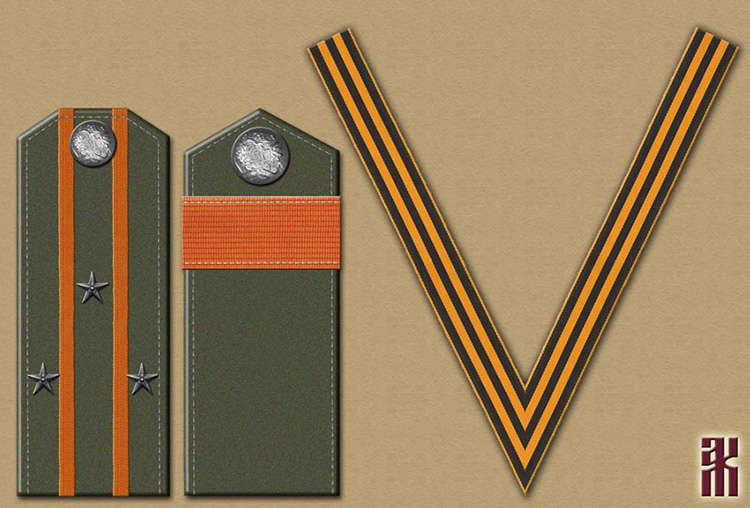
Insignia in accordance with the Military Regulations of the Northern Volunteer Army:
1 and 2 – khaki shoulder-boards; 3 – sleeve chevrons made of narrow St. George ribbon
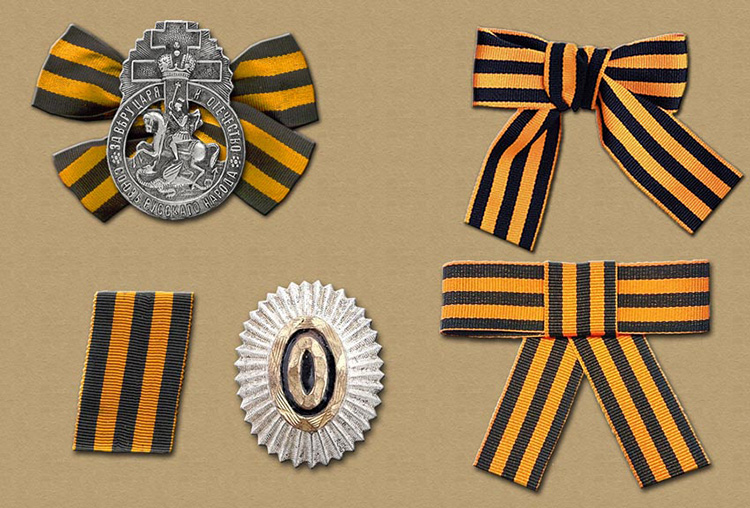
Distinctive symbols of the participants in the uprising:
1 – St. George ribbon with the badge of the Union of the Russian People;
2 and 5 – St. George ribbons bows on the chest; 3 – St. George ribbon cockade;
4 – officer's cockade of the old model
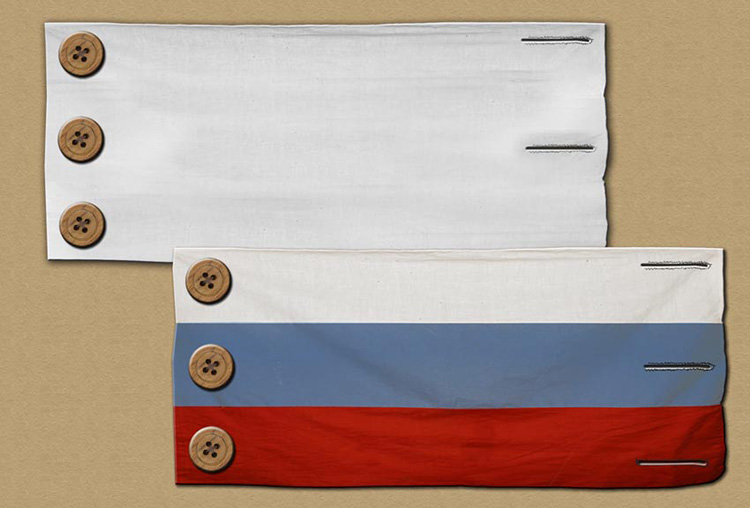
Distinctive symbols of the uprising participants
The white arm-bands are based on the model of the Volga People's Army, and the tricolour arm-bands are for those preserved by former active members of the Yaroslavl branch of the Union of the Russian People.
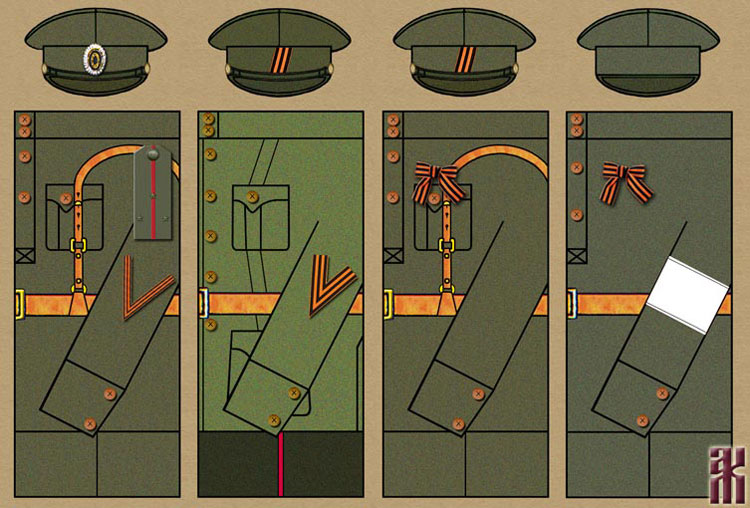
Appearance of military personnel in the uprising:
1 – "regulation" uniform, with khaki shoulder-boards and St. George chevron on the arm;
2 – St. George ribbon instead of the cockade and sleeve chevron;
3 – with an old-style cockade and a St. George bow on the chest;
4 – no cockade, St. George ribbon bow on the chest and a white arm-band
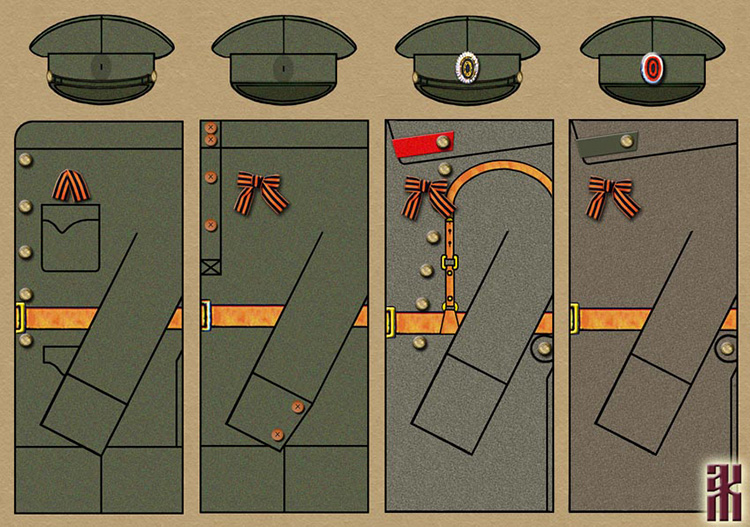
Appearance of military personnel in the uprising:
1 – former officer, no cockade, ; 2 – former lower ranks, no cockade;
3 – former officer, old style cockade; 4 – former lower ranks, old style cockade
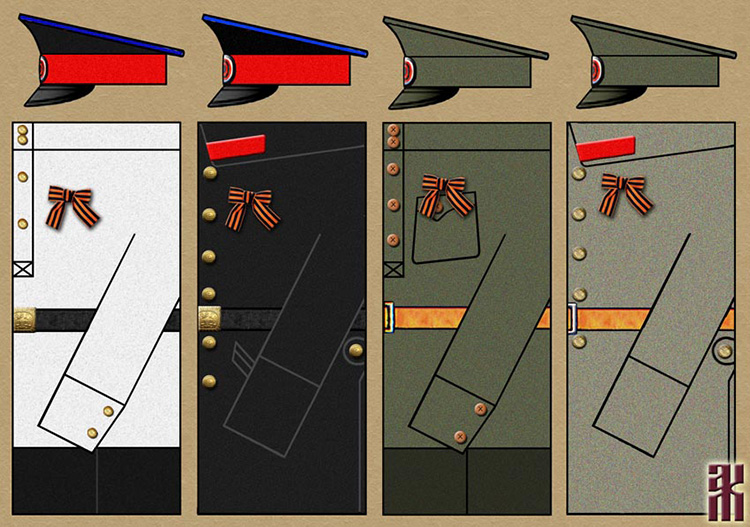
Appearance students at military educational institutions in the uprising:
1 – Yaroslavl Cadet Corps shown here is a summer linen blouse;
2 – Yaroslavl Cadet Corps parade uniforms (largely fallen out of use by this time);
3 and 4 – cadets from infantry schools or ensign schools
There were no infantry or ensign schools in Yaroslavl itself, but a certain number of cadets had returned home to their native city after the collapse of the old army.
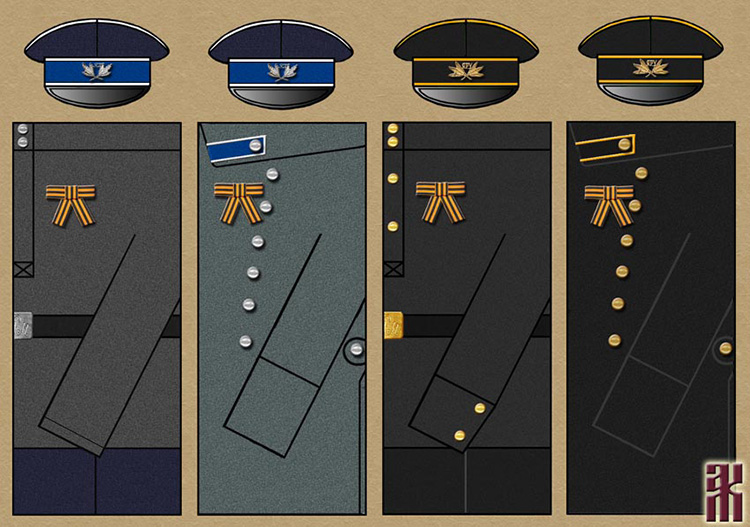
Appearance of student participants in the uprising:
1 and 2 – Yaroslavl City Gymnasium; 3 and 4 – Yaroslavl Real School
According to the rules in force at the time, students' uniform greatcoats were worn without a belt.
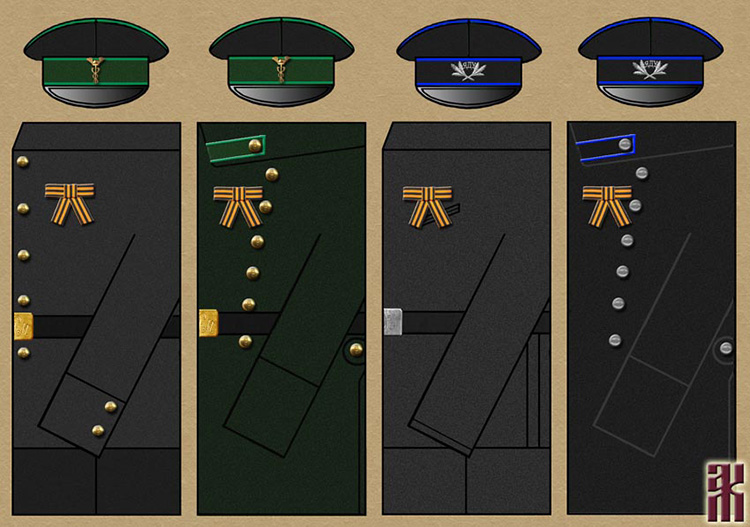
Appearance of student participants in the uprising:
1 and 2 – Yaroslavl Commercial School; 3 and 4 – Yaroslavl Theological School
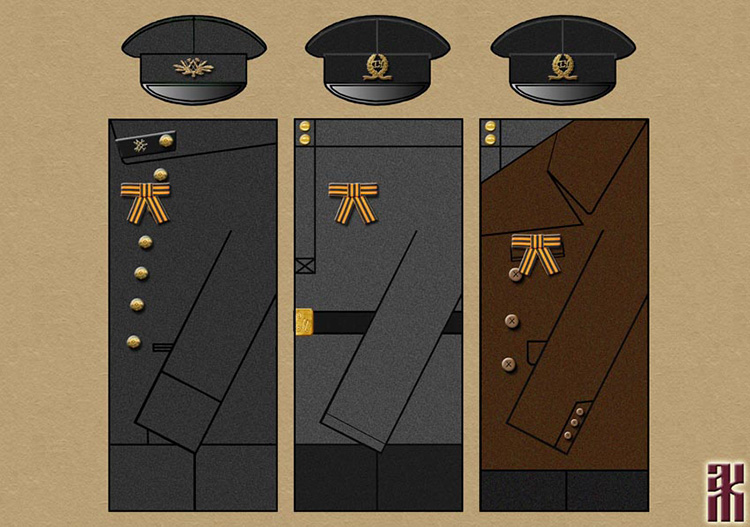
Appearance of student participants in the uprising:
1 – Yaroslavl Lower Mechanical and Technical School;
2 and 3 – Yaroslavl City (Higher Primary) School
Warm outer clothing was not provided for public schools – clothing of any style was used.
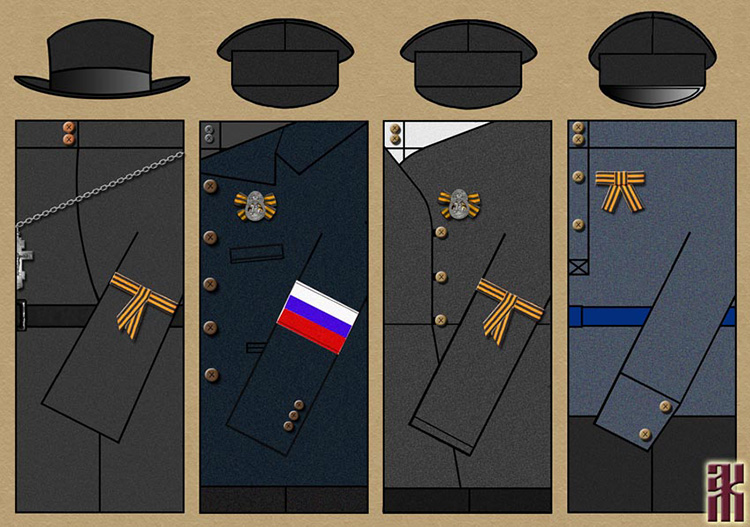
Appearance of townspeople and peasants from surrounding villages in the uprising:
1 – priest with a St. George ribbon on his sleeve and priest's pectoral cross on his chest;
2 – townsperson with insignia of the Yaroslavl branch of the Union of the Russian People;
3 and 4 – peasants, one with the insignia of the Union of the Russian People
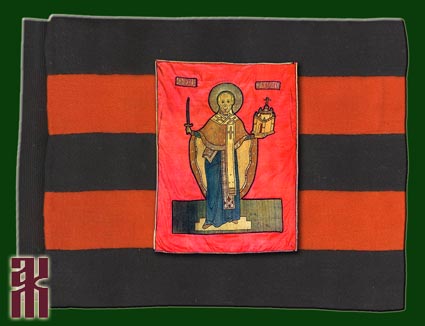
Reconstruction of the appearance of a banner of the Northern Volunteer Army
(according to the Military Regulations of the Northern Volunteer Army)
Home — State Symbols — Flags — Uniforms — Badges & Medals — Money — Other
Pygmy Wars Notes
The original for this page is at kolchakiya.ru/uniformology/yaroslavl_rebels.htm.
Discussion on the translation choices I have made can be found here.