
Uniforms of the 11th Yaitsk Army Corps of the Southern Army Group
Material and reconstructions by A. Karevskiy
April 1919
By that time four regiments and one battalion of jaegers had finally been formed, and the formation of two other regiments and a second battalion of jaegers had begun. ... The men were still wearing the blue Chinese uniforms which had initially been purchased. Rifles had just been issued to the regiments and there was not a single machine gun. The crews for two batteries had been formed, but there were no guns yet, because they were just being shipped to Petropavlovsk. The two cavalry squadrons formed had only half the necessary horses. We had just started to create a wagon train and a divisional hospital.
Gopper, K. I. in "Four catastrophes // The Civil War in Russia: The catastrophe of the White Movement in Siberia", St. Petersburg, 2004, p.153.
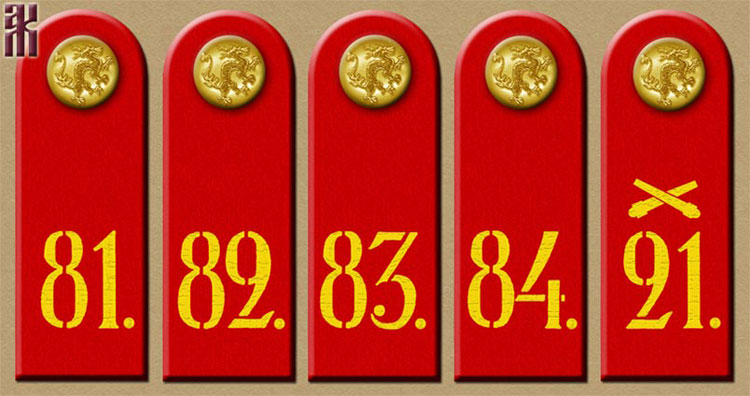
Possible shoulder-boards of the other ranks of the 21st Infantry Division
of the 11th Yaitsk Army Corps
The shoulder-straps of the other ranks winter tunic for the 1910 Imperial Chinese Army uniforms are shown here. The lower end of the shoulder strap was sewn into the shoulder, so it would seem logical to assume that the corps command, which was working in conditions of extreme scarcity of material resources, was physically unable to provide everyone with Russian-style shoulder-boards, and was temporarily forced to use the existing Chinese ones with the appropriate ciphers.
The 21st Division was the only one which was at least roughly completed in the 11th Yaitsk Corps.
.jpg)
Uniforms of the 11th Yaitsk Army Corps
This European-style was introduced into the Imperial Chinese Army in 1910. The dark blue was the winter colour. This colour was not used in the republican armies, completely giving way to various shades of khaki. It is assumed that the command of the 11th Yaitsk Army Corps purchased these outdated uniforms, which were still available in warehouses in China.
Home — State Symbols — Flags — Uniforms — Badges & Medals — Money — Other
Pygmy Wars Notes
The original for this page is at kolchakiya.ru/uniformology/yaic_army_corp.htm.
Imperial practice was that the first two regiments of an infantry division had red shoulder-boards and the second two had blue. Rifle regiments, by contrast, had raspberry (although red was often used when it was not available).
Petropavlovsk is modern Petropavl, Kazakhstan.
The following illustration by A. Lebedeva was on the original page but later taken out:
.jpg)
Discussion on the translation choices I have made can be found here.
History of the 11th Yaitsk Army Corps
Taken from gorod.ru and siberia.forum.ru:
The 11th Yaitsk Army Corps started forming in February in Troitsk, mainly from Red Army prisoners held in camps in Ekaterinburg and Chelyabinsk. It was intended to serve as a link between the armies of Admiral Kolchak and General Denikin (which would place it in the Ural Host region, hence the name Yaitsk, which is an old name for the Ural River).
The corps was never fully formed. In early May it was included in Belov's Southern Army Group and moved to the area of the Bolshoy Ik River (60 km NE of Orenburg). Initially it did well, moving to near Sterlitamak. When the front collapsed it retreated towards Atbasar, now Kazakhstan. In September the corps was disbanded and the units were sent to form two independent rifle brigades.
It was never a proper corps. It included the 21st Yaitsk Rifle Division (81st Yaitsk, 82nd Uralsk, 83rd Guryev, 84th Aleksandr-Gai Rifle Regiments), two jaeger battalions, the 21st Artillery Divizion, the 21st Engineer Divizion and some cavalry (possibly the 21st Cuirassier Horse Divizion and a Hussar Horse Divizion). From 4 to 27 July 1919 the 1st Independent Orenburg Cossack Brigade was temporarily attached. In mid-April four companies of a Latvian detachment of the corps suppressed an uprising in the Kustanai district, but it is unclear if they remained an independent battalion.