
Uniforms of White Russians Units during the Xinjiang Uprising, 1931-33
All material and reconstructions are by A. Karevskiy unless noted otherwise.
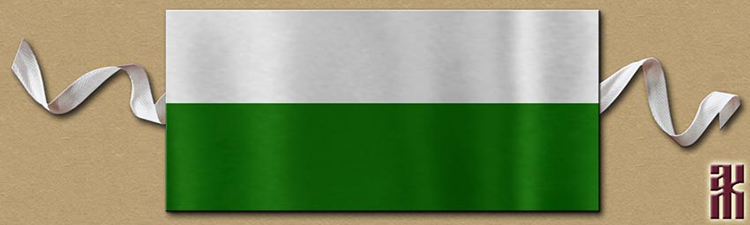
Arm band of the White Russian Units in Xinjiang
Judging by the well-known group photograph in Norin's article, traditional white and green "Siberian colours" were used, and the arm-band itself was made with two ribbon ties (whereas during the Russian Civil War similar arm-bands were usually fastened with buttons).
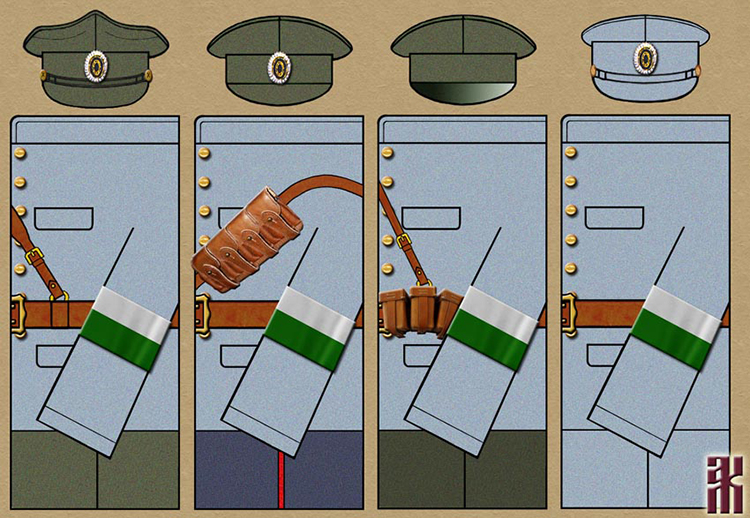
Uniforms of the White Russian Units in Xinjiang:
1 – a former infantry officer, with a sword belt and a cap with a crumpled crown;
2 – a former cavalry officer, with a random cartridge belt;
3 – a former lower rank soldier in the infantry, with cartridge pouches for a Mauser rifle;
4 – a former infantry officer in Chinese uniform.
Based on the photograph mentioned above, the White Army units used a mixture of Russian and Chinese uniforms. In particular, all servicemen are dressed in Chinese short jackets with low stand-up collars and use Chinese leather equipment. Some works mention emigrés wearing shoulder-boards, but it is unknown whether they were used in armed formations: only arm-bands can be seen in the photographs.
The "Altai Volunteer Army"
In the autumn of 1933 a strange formation entered Xinjiang. They were dressed in Imperial Russian Army uniforms and were armed with the latest technology of the time, BT-5 tanks and light bombers (R-5 biplanes). This formation was called the Altai Volunteer Army.
These "Altai volunteers" were in fact clearly Soviet troops. The 7,000-strong contingent included two regiments of the Red Army and two regiments of the OGPU. To disguise the USSR's intervention in the conflict, they were given an exotic name and dressed in old uniforms with shoulder-boards. Not only that, but to ensure that no one would guess, the Altai volunteers used the pre-revolutionary system of ranks. Gospodin Staff-Captain of the OGPU and Tovarishch Lieutenant of the Red Army -– it sounds like a joke, but it was reality.
Norin, E. in "The tale of how the Whites and the Reds fought in the same ranks" cited at ru-history.livejournal.com/4107032.html
So the Altai soldiers appeared in Xinjiang armed with R-5 aircraft, BA-27 armoured vehicles, three-inch mountain guns and 37-mm Hotchkiss cannons, Maxim and Degtyaryov machine guns, and Dyakonov mortars. They even had portable shortwave radio stations. Judging by the weapons they had, it was not difficult to guess that the Altaitsy were actually Soviets. Of course it was impossible to hide the distinctive appearance of the soldiers and commanders, but since Russian emigrants lived in Xinjiang, the Altaitsy affiliation with the USSR was not publicised – all interested parties pretended that only local personnel were fighting. For example, Pavel Semenovich Rybalko, future Marshal of Armoured Forces and twice Hero of the Soviet Union, was referred to as a Russian general in Chinese service, assistant commander of the Southern Front. Interestingly, former White Guards who served under Rybalko knew him by his real surname.
In December 1933 the R-5 unit was transported in disassembled form to the small Kazakh station of Ayaguz, reassembled, and the machines flew to Xinjiang. Mountain ranges up to four kilometres high were crossed without radio stations or oxygen equipment, in thick clouds. Upon arrival at their destination, the Soviet pilots were met by émigres in the uniforms of the Tsarist army.
Belash, E. in "Polite People for Xinjiang" at vpk-news.ru/articles/29222
Home — State Symbols — Flags — Uniforms — Badges & Medals — Money — Other
Pygmy Wars Notes
The original for this page is at kolchakiya.ru/uniformology/Xinjiang_rebels.htm.
Discussion on the translation choices I have made can be found here.