
Uniforms of the US Expeditionary Forces in the East of Russia
August 1918-February 1920
All material and reconstructions are by A. Karevskiy unless noted otherwise.
The sources used for the American Expeditionary Forces uniforms in Siberia were:
North, D. "Soldiers of World War I, 1914-1918: Uniforms, insignia, equipment and weapons", Moscow, 2015, p.82-119.
Funken, F. and Funken, L. "The First World War, 1914-1918, Part 1: Infantry – Armoured Vehicles – Aviation", Moscow, 2002.
Funken, F. and Funken, L. "The First World War 1914-1918, Part 2: Cavalry – Artillery – Engineers – Navy", Moscow, 2002.
Katcher, P. "The U.S. Army 1890-1920 // Men-at-Arms, No. 230", Oxford, 1991.
Henry, M. "The U.S. Army of World War I // Men-at-Arms, No. 386", Oxford, 2003.
Rottman, G. "Army Combat Equipment 1910-1988 // Men-at-Arms, No. 205", Oxford, 1989.
Deryabin, A. A. "Interventionist Forces", Moscow, 1999
"The American Expeditionary Force in Siberia" at en.wikipedia.org/wiki/American_Expeditionary_Force,_Siberia
The American Expeditionary Forces in Siberia, stationed in Vladivostok from August 1918, initially consisted of the 27th and 31st Infantry Regiments (the latter only formed in 1916). Volunteers from the 8th Infantry Division (specifically the 12th, 13th, and 62nd Infantry Regiments) were assigned to relieve the personnel of both regiments. In addition to Vladivostok, there were American garrisons in Khabarovsk, Verkhneudinsk and Nikolsk-Ussuriysk.
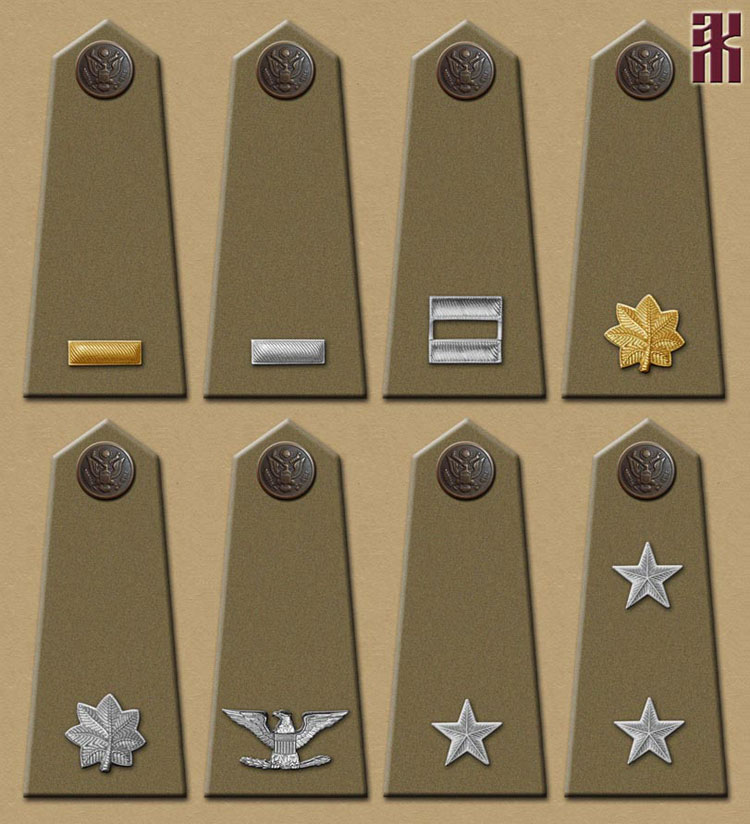
Shoulder straps of officers of the United States Army:
1 – second lieutenant; 2 – lieutenant; 3 – captain; 4 – major;
5 – lieutenant-colonel; 6 – colonel; 7 – brigadier-general; 8 – major-general
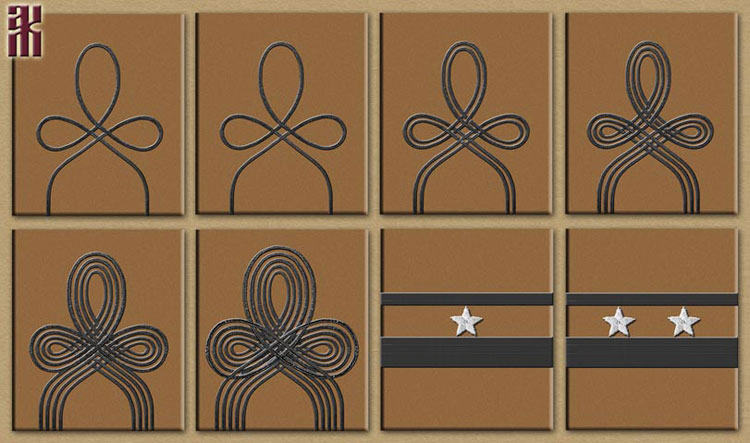
Greatcoat cuff insignia of officers of the United States Army:
1 – second lieutenant; 2 – lieutenant; 3 – captain; 4 – major;
5 – lieutenant-colonel; 6 – colonel; 7 – brigadier-general; 8 – major-general
The stitching was made of black cord for the officers, and black wool braid for generals.
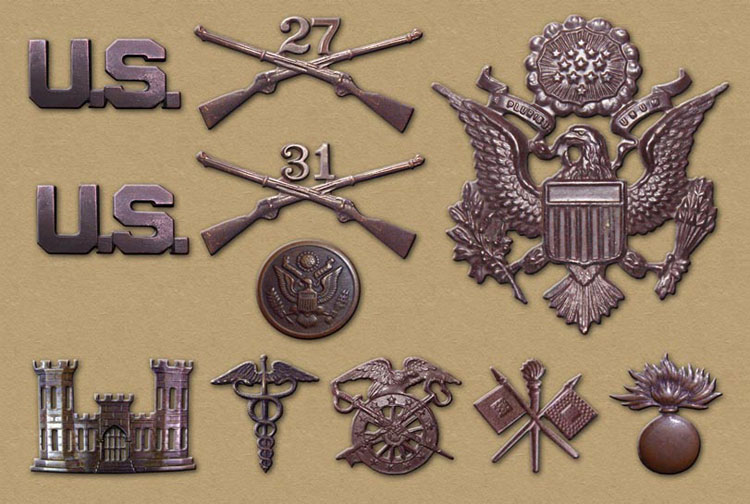
Specialist insignia of the United States Army (of units stationed in Siberia):
upper left – infantry officer collar badges; upper right – cockade;
centre – uniform button (standard for all military personnel);
bottom row – collar badges of Engineers, Medical Corps, Quartermasters,
Signals, and Ordnance, respectively
The number above the crossed rifles was the regiment's number (it was absent on the first model)
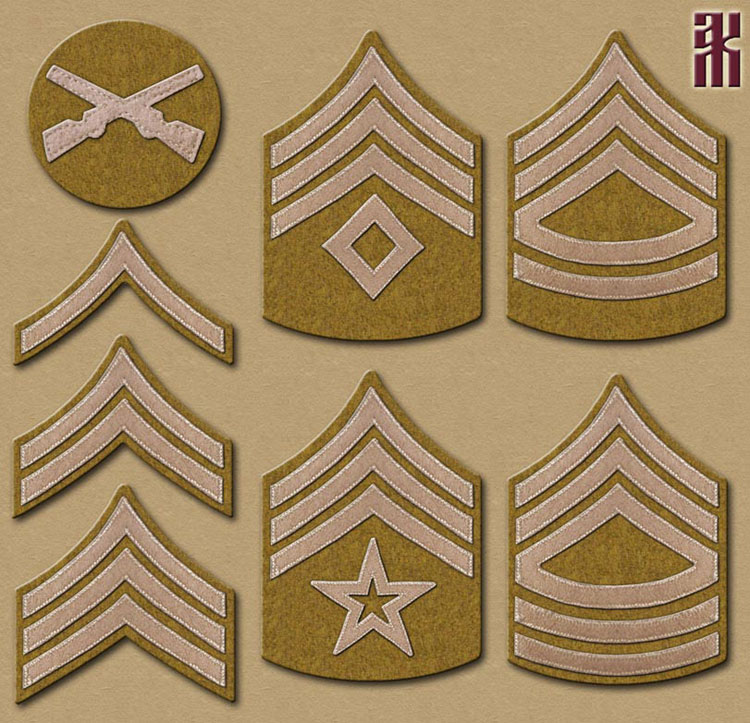
Sleeve insignia of other ranks in the United States Army: (down, from left)
1 – private first class; 2 – lance-corporal; 3 – corporal; 4 – sergeant;5 – first sergeant;
6 – colour sergeant; 7 – battalion sergeant-major; 8 – regimental sergeant major
The chevrons were made of olive brown wool fabric; initially they were worn on both sleeves, but from 1916 onwards they were worn only on the right.
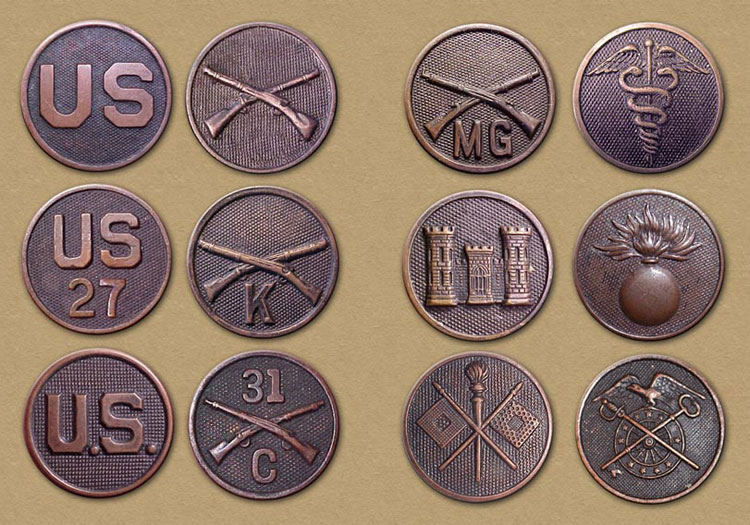
Other ranks collar devices of the United States Army:
Infantry on left: 1 & 2 – first variant; 5 and 6 – second variant; 9 and 10 – third variant;
specialists on right: 3 – MG company; 4 – medical corps; 7 – engineers;
8 – artillery and technical services; 11 – signals; 12 – quartermasters
All three variants of collar discs (which were issued 1916-1918) coexisted in the infantry units at the time. The second variant adds the regiment number to the US and the company number under the crossed rifles. The third variant moved the regiment number to the right disc.
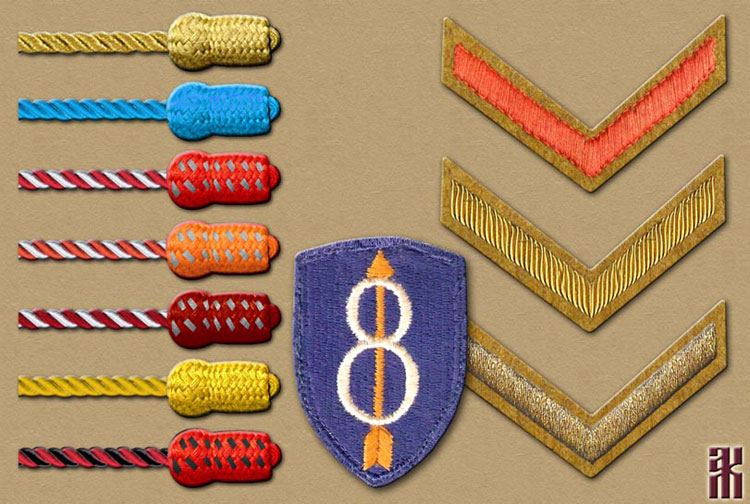
Insignia of the United States Army:
On the left, hat cords: 1 – officers; 2 – infantry; 3 – engineers; 4 – signals;
5 – medical corps; 6 – quartermasters; 7 – combat support;
8 – sleeve insignia of the 8th Infantry Division (known as the "Pathfinders");
9 – honourable discharge chevron for other ranks;
10 – wound chevron; 11 – foreign service chevron
Hat cords were gold with black for officers of all branches of the armed forces. The sleeve chevrons were introduced in 1916. The discharge chevron was worn on the left sleeve above the elbow. The wound chevron was worn on the right sleeve above the cuff. The chevrons for service outside the country were worn on the left sleeve above the cuff, with one for each 6 months of service.
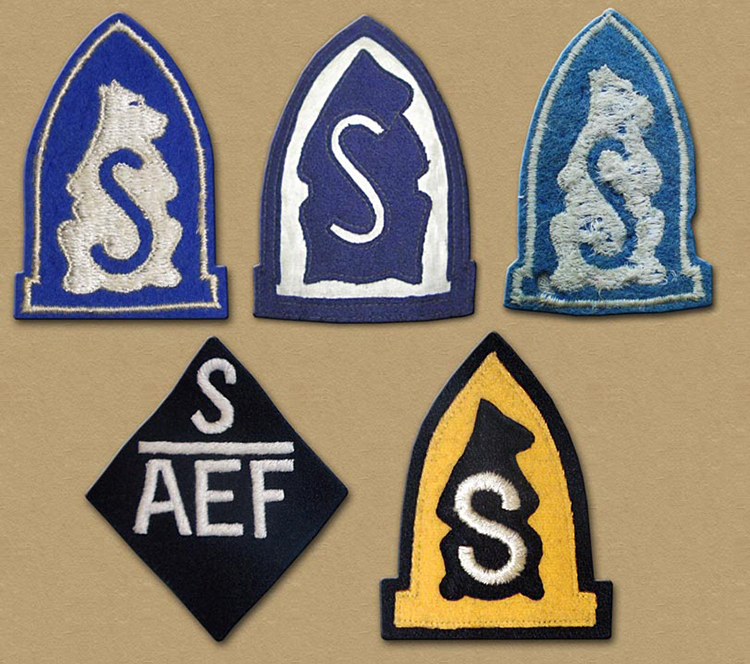
Shoulder patches for Siberia
Four are a stylised taiga wolf with the letter S. These were worn on the left sleeve below the shoulder seam.
The image in the upper right corner was kindly provided by Novosibirsk researcher I. Ladygin
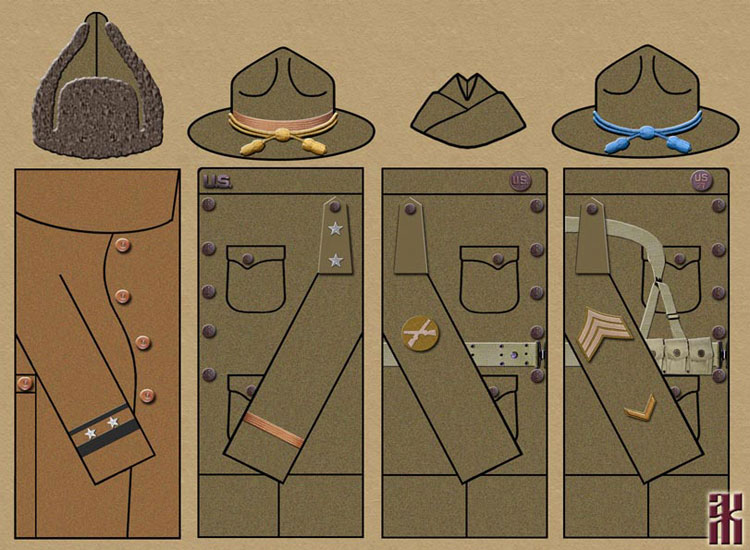
Uniforms of the United States Army:
1 and 2 – Major-General W. Graves; 3 – private; 4 – sergeant
Graves, commander of the American Expeditionary Force in Siberia, is shown in the winter and summer versions of the khaki uniform introduced in 1912. Figures 3 and 4 show infantry of the expeditionary force, with sidecap and hat, in 1910-model equipment. The 1912-model uniform did not differ in any way between officers and other ranks except for the quality of the material and tailoring. From 1918 models with hidden pockets began to appear, but photographs do not show those in Russia. The sergeant's sleeve bears a wound chevron.
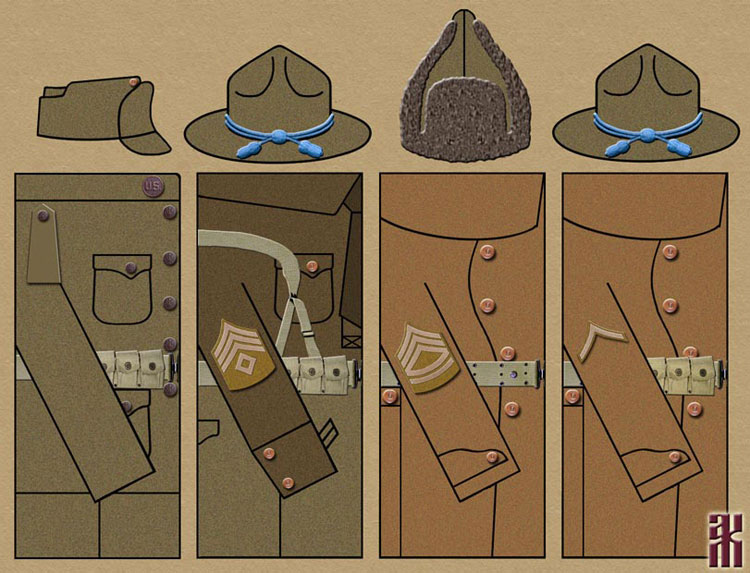
Variants of uniforms of the United States Army, other ranks:
1 – tunic; 2 – shirt and tie; 3 and 4 – greatcoat
Figure 1 has a cap based on the British "homburg" model, which appeared in 1917. The shirt and tie of Figure 2 was introduced in 1917 and "Montana" hat: those for other ranks had coloured cords but no hatband.. Figure 3 has a British-model winter hat (with the light grey cloth replaced by olive brown). The greatcoats of other ranks differed from those of officers in that they had flaps on the cuffs and were made of coarser fabric.
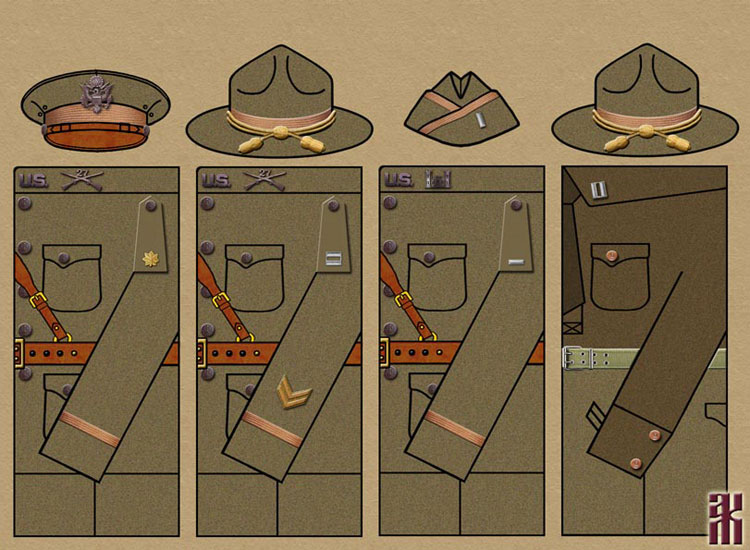
Variants of uniforms of the United States Army, officers:
1, 2 and 3 – tunic; 4 – shirt and tie
Figure 1 has a cap. Figure 2 has a Montana hat and service chevrons. Figure wears the sidecap. Insignia was worn on the collar of the shirt, with rank markings always on the left, while the right sometimes bore the abbreviation "US". Officers' service tunics differed from those of sergeants and privates in the quality of the material and the presence of orange-brown mohair braid on the sleeves. Officers had the same braid as trim on the sidecap, the hatband of the cap, and the hatband for the Montana. Headgear (hats and caps) were completely identical for all officers and generals, except for the insignia worn on the left of the sidecap.
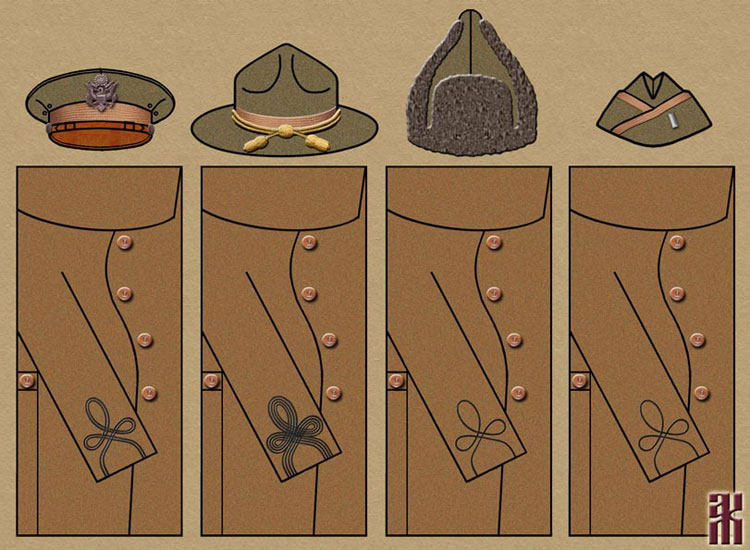
Variants of uniforms of the United States Army, officers in greatcoat
The officer's greatcoat did not have markings on the collars: instead, it had black cord (for officers) or black braid with white embroidered stars (for generals).
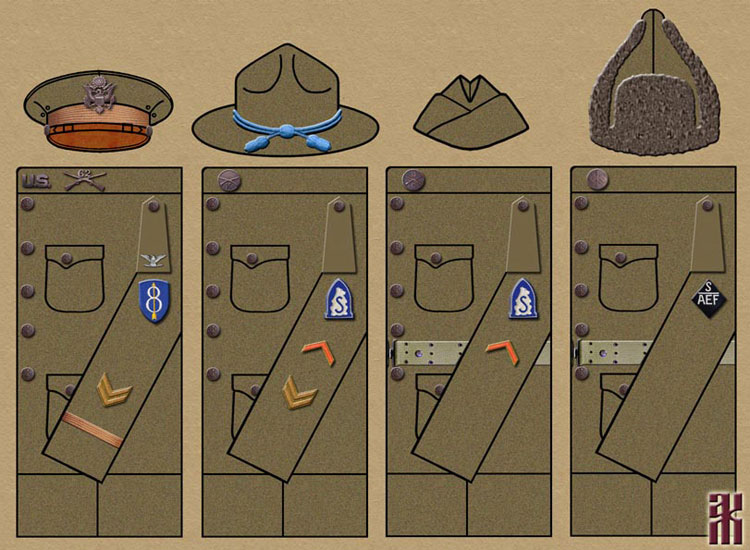
Examples of sleeve insignia on uniforms of the United States Army:
1 – colonel of the 62nd Infantry Regiment, 8th Infantry Division; 2 – private
Judging by photographs, the American Expeditionary Forces in Siberia rarely wore unit patches, especially the officers. Figures 1 and 2 had service chevrons. Figures 2 and 3 show honourable discharge chevrons.
Home — State Symbols — Flags — Uniforms — Badges & Medals — Money — Other
Pygmy Wars Notes
The original for this page is at kolchakiya.ru/uniformology/US_expeditionary_force.htm.
The original page has a short section on medals issued for service in WWI and Siberia. I am not doing the medals sections at this time.
Discussion on the translation choices I have made can be found here.