
Uniform portrait of Lieutenant General Baron R.F. von Ungern-Shternberg
All material and reconstructions are by A. Karevskiy unless noted otherwise.
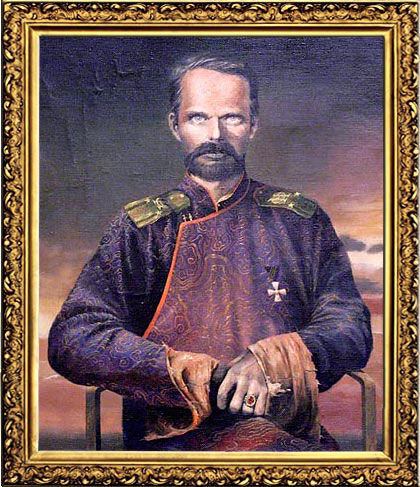
Modern portrait of Lieutenant General Baron R.F. von Ungern-Shternberg, commander of the Asiatic Horse Division
The evolution of Ungern's own costume deserves special consideration. Throughout 1918 and most of 1919, the Semenovtsy commander continued to wear a Cossack officer uniform. According to eyewitnesses, the baron made every effort to provide uniforms and equipment for the units entrusted to him, while he himself, according to the commander of the Composite Manchurian Division, Lieutenant-General V. A. Kislitsyn, "wore torn, patched trousers and an old greatcoat". {1}
On 16 August 1919 Ungern married a Chinese princess from the Zhangku family (Qing dynasty) in Harbin, who was christened Elena Pavlovna. The wedding was conducted according to the Orthodox rite, although Ungern himself formally remained a Lutheran. The marriage was purely political: among other things, it brought the Estonian baron the title of "wan" (prince of the second degree), presented by the Dauriya "All-Mongolian" government of Prince Neise-Gegen, {2} as well as the external distinction of that rank – a cherry red robe. Ungern turned it into a kind of "Russian-Eastern uniform" and wore it with general's shoulder-boards (he had been awarded the rank of major-general by Ataman G. M. Semenov in November 1918), a red kushak waist sash and the Order of St. George on his chest. A correspondent for an American newspaper, A. Gayner, who visited Dauriya around September 1919, described his meeting with Ungern as follows:
A strange picture appeared before me. Sitting at the desk was a man with a long reddish moustache and a small pointed beard, wearing a silk Mongolian cap on his head and a traditional Mongolian dress. On his shoulders were the gold shoulder-boards of a Russian general with the letters "A.C.", which stood for "Ataman Semenov". The baron's unusual appearance puzzled me, which did not escape his attention. He turned to me and said with a laugh, "Do you find my costume unusual? There is nothing surprising about it. Most of my horsemen are Buryats and Mongols, and they like that I wear their clothes." {3}
On 22 September 1919 Ungern was promoted to lieutenant-general, and his units were reorganised into the Asiatic Horse Division. The baron apparently never wore his new shoulder-boards – in all the available photographs he is pictured wearing his previous ones, those of a major-general.
The campaign into Mongolia, which began on 2 October 1920, marked the beginning of the last "transformation" of the commander of the Asiatic Division. According to Golubev's memoirs, an officer in his detachment, at the camp on the Kerulen River (from where the first two assaults on Urga began and where the division's units retreated after their failures):
Ungern himself was not much better dressed than his horsemen. He wore a grey officer's greatcoat with fur trim halfway down, with burnt hems, a dirty, previously white, papakha on his head, and boots, sometimes fur one. On campaigns, he was also frozen to the bone, and at encampments he could often be seen huddled by the fire, without a tent, warming his frozen limbs. In general, he did not take care of himself at all. It is safe to say that ... he only changed his underwear when it was already in tatters. He never gave his underwear to be washed. {4}
A similar account by Orenburg officer S. E. Khitun refers to the moment of the capture of Maimachen, a suburb of Urga:
A horseman in a white papakha and on a white horse rode up to the fire, dismounted and approached us. He was a tall, thin, but broad-shouldered man in a dirty sheepskin coat without shoulder-boards, but with an officer's St. George Cross on his chest. ... He was unarmed. By his arm hung a tashur, a bamboo stick used by Mongol camel drivers. Two grenades hung from his belt. {5}
The following completes the picture:
Ungern wore a white papakha in cold weather and a khaki officer cap with a soft crown in warm weather. He wore cavalry boots. {6}

Mongolian tashur
The above evidence is partly contradicted by the recollections of D. P. Pershin, a resident of Urga, who met Ungern on 8 February 1921 – five days after the liberation of the capital of Khalkha from the Chinese, in Maimachen:
Before us stood a rather tall, thin figure in a short Mongolian-style jacket, rather grubby, cherry-red in colour. With a St. George cross in his buttonhole and white general's shoulder-boards on his shoulders. The attire was strange, to say the least. {7} (Note the discrepancy on the shoulder-boards, which are noted above as gold – A.K.)
Incidentally, according to the same Pershin, it was in this very attire that the baron demonstratively rode into the streets of besieged Urga after the second unsuccessful assault on the city in January 1921. Alyoshin, who was conscripted into the division after the successful assault on Urga, saw the baron in the same way:
He was wearing a dirty papakha, a short, silk, cherry-red Chinese jacket, blue military trousers and high Buryat riding boots. In his right hand he held his famous bamboo whip: he had no other weapons. {8}
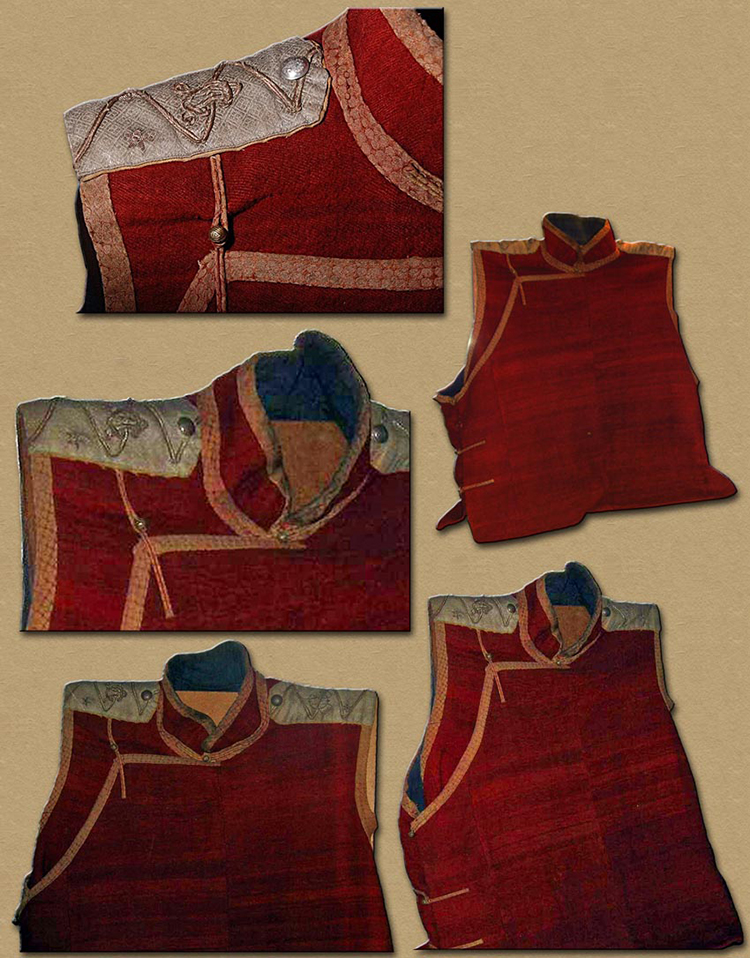
Ungern-Shternberg's cherry-red kurma held by the Minusinsk Local History Museum
Photo by A. Mukhranov at www.muhranoff.ru/2009/1.htm.
Unlike the princely robe, the kurma is made of wool and trimmed with gold brocade around the collar, sides, and armholes. The major-general's shoulder-boards are particularly noteworthy: they are made of silver Mongolian brocade with a fine geometric pattern; the zigzags and monogram of Ataman Semenov are made of silver braid, and the stars are embroidered with silver thread.
The liberation of Urga on 3 February 1921 and the subsequent restoration of the former Khalkhan theocracy on 26 February placed Ungern and his comrades on a par with the greatest national heroes of Mongolia. A decree was signed and announced by the 8th Bogd Khan at the Uzun Khuree Monastery. It read:
I, Jebtsun Damba Khutukhtu, Lama of Outer Mongolia, was enthroned, and by the will of heaven and by the tripartite agreement of Mongolia, China and Russia, our country was ruled independently. Unexpectedly, as a result of violence and inappropriate actions on the part of revolutionary Chinese officials, soldiers and officers, our country was subjected to various restrictions. But thanks to the prayers of the lama, who possessed three treasures, famous generals appeared who destroyed the treacherous enemy, took Urga under their protection and restored the former power, for which they deserve great respect and high rewards. {9}
Ungern was elevated to the rank of hereditary prince of Darkhan-Khoshoi Tshing-wan, the highest khan title available only to those of Chinggisid blood, with the title "Great Bator, General who revived the state". In accordance with his new rank, he received four supreme privileges: to have a green palanquin, to wear yellow clothes and shoes, to have yellow reins on his horse, and to insert a three-pointed peacock feather otgo into his headdress. {10} Despite its exoticism, in the eyes of the initiated, the costume was imbued with deep meaning, symbolising the three degrees of earthly power. In that system, the colour yellow represented the sun and its life force, while green represented the earth and the steppe awakening in spring. The three dots on the iridescent feathers signified the third degree of earthly power – the power to see into the souls of men with a third eye.
For the first time in his new attire – with a pointed Mongolian khan's hat with the ruby globe of the Tsing-Wan and peacock feather, yellow gutul boots and a crimson and gold brocade deel robe – Ungern appeared at the coronation of Bogd Khan, which took place on 26 February 1921 in Urga. Moreover, his subordinates left some different descriptions of their commander's "transformation". Thus, the commandant of the Asiatic Division, N. N. Knyazev, recalled that Ungern
... became a first-level khan of the country and was awarded honours (a scarlet and gold khan's terlig, a yellow kurma, reins, and so on).
Ungern's adjutant, Captain A. S. Makeev, conveyed the general mood of surprise at the first such appearance of the division commander:
His appearance was unusual. The baron was dressed in a Mongolian princely robe, wearing a cap with a feather, and sitting on a beautiful steppe horse with yellow reins – a sign of the highest princely rank of a horseman. Ungern, a figure so familiar to everyone, who had always dressed in simple uniform, now resembled a colourful parrot and it made everyone smile despite themselves. The baron himself was embarrassed by his unusual attire, but tried not to show it. {12}
The same feeling of bewilderment is evident in the simple Dauriyan officer K. I. Lavrentiev:
His attire was truly unusual: something golden-scarlet, with a cap decorated with ribbons, with some kind of robes and capes, one lower than the other. {13}
Finally, M. G. Tornovskiy adds a curious detail:
General Ungern left the monastery on a new white horse, wearing a bright yellow fur terlig, a Mongolian sable hat crowned with a blood-red globe – a sign of the highest princely dignity. From that day until his death, Ungern never parted with his terlig." {14}
General Rezukhin was also awarded the rank of tsing-wan (prince of the 1st degree) and the corresponding honours (yellow terlig, but with a green kurma and reins). During the coronation, he was:
Dressed in a bright yellow terlig and two honorary kurmas worn one on top of the other, with a khan's cap on his head. The horse's reins and saddlecloth were of a type and colour strictly prescribed for a person of such high rank. {11}
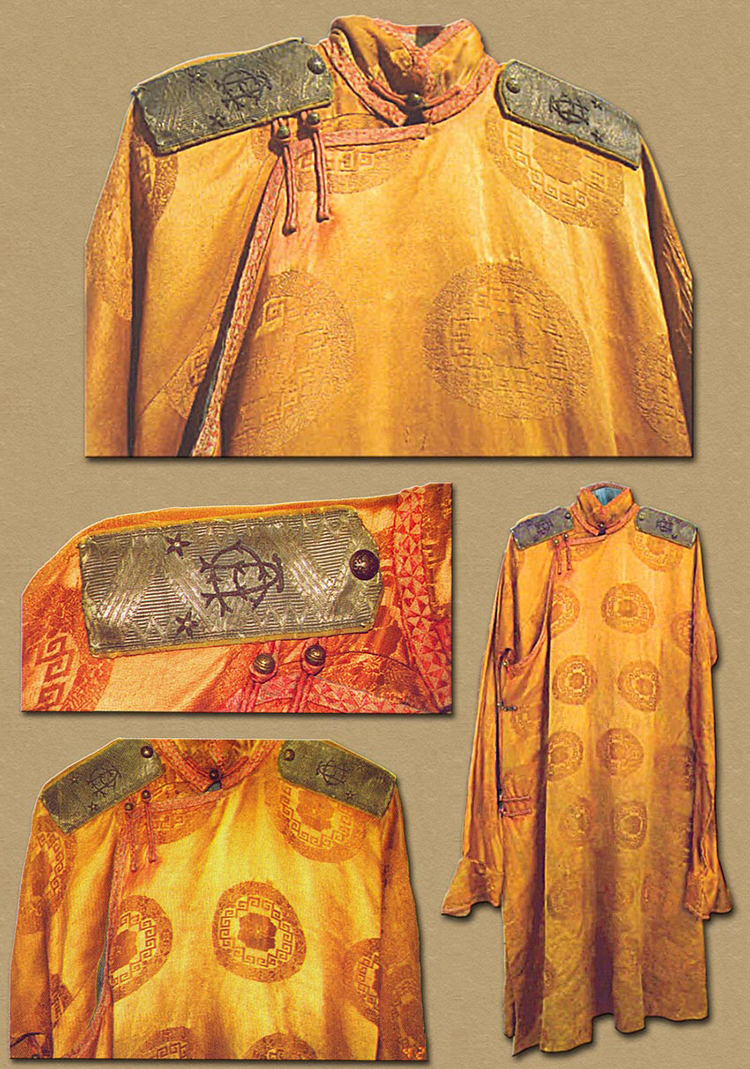
Princely robe belonging to Ungern-Shternberg at the Central Museum of the Armed Forces
From "Baron Ungern in Documents and Memoirs" and also forum.faleristika.info.
The robe is made of golden Mongolian brocade with a typical religious pattern. It bears the shoulder-boards of a major-general of the Transbaikal Cossack Host, embroidered with silver thread with Ataman Semenov's monogram.
As with the previous one, Ungern continued to wear the new robe with a general's shoulder-boards and the Order of St. George. Later, during his interrogation on 27 August 1921 at the headquarters of the Expeditionary Corps, the baron, without going into details inaccessible to the uninitiated, explained that:
He wore the costume of a Mongolian prince – a silk robe – so that he could be seen from a distance by the army. He had no intention of using this costume to win the sympathy of the Mongolian population. {15}
This is how one of the Red commanders, V. Ya. Zazubrin, remembered him:
The white officer's St. George Cross and general's shoulder-boards were striking. The robe was bright, golden, with a purple sash made of fabric. Soft Mongolian boots bent into sharp points. {16}
F. Ossendowski also mentions this same detail – a blue Mongolian belt. {17}
On the march, Ungern continued to wear his old officer's cap. According to legend it had with a silver image of the Russian double-headed eagle and Chinese dragon joined together, although in the last photographs taken in captivity, no cockade is visible at all on his cap with a broken visor. The reason for the unpresentable appearance of the headgear is explained by Knyazev: after the mutiny of the Asiatic Division became an obvious fact, the baron made his way to the Mongolian Division, where, "jumping off his foaming horse, he growled, tore off his cap and began to trample it with his feet." {18}
In all the photographs taken while he was a prisoner, he is seen wearing a single robe, without a belt, a khaki cap and soft Mongolian ichig boots.
After Ungern was executed by the Extraordinary Revolutionary Tribunal on 15 September 1921 in Novonikolaevsk, his robe made its way to the Central Museum of the Armed Forces. However, there is some interesting information about another "uniform" kept in the Minusinsk Local History Museum. It was transferred to the museum on 30 September 1921 by the prominent partisan leader P. E. Shchetinkin through the Minusinsk District Executive Committee, as evidenced by the relevant documents. In the description by journalist N. Kaleneva, it is:
A kind of strange vest, fastened like a Mongolian robe – from left to right. It has a small stand-up collar and very deep armholes. On the left and right sides, there are hanging loops made of yellow cord, fastened with convex round buttons. The shoulder-boards are decorated with a zigzag pattern made of the same cord and several metal stars are sewn on. ... I remembered a photograph of the baron. ... In it, he is pictured wearing this strange waistcoat over either a blouse or a tunic. Apparently he wore it in combination with the traditional military uniform of the Russian army. {19}
The compilers of the unique collection "Baron Ungern in Documents and Memoirs" refer to that item of the baron's wardrobe as a "summer uniform". That is partly confirmed by Knyazev's testimony of 17 August 1921, regarding Modonkul Pass:
I can still clearly see the baron as he sat then, on a hillock, by the fire, from where he could easily observe the entire camp. I remember the white cross on his greasy blouse and the green shoulder-boards with the monogram "A.C." {20}
Notes:
1. Kislitsyn, V. A. in "In the Fire of Civil War", Harbin, 1936, p.101.
2. Neise-Gegen was elected head of the government of Greater Mongolia at a congress held from 25 February to 6 March 1919 by delegates from all the Mongolian-populated regions, with the exception of Khalkha.
3. Cited from: Yuzefovich, L. A. in "The Autocrat of the Desert (The Phenomenon of Baron R.F. Ungern-Shternberg)", Moscow, 1993, p.48.
4. Golubev in "Memoirs // Baron Ungern in Documents and Memoirs", Moscow, 2004, p.532.
5. Khitun, S. E. in "Noble Piglets // Baron Ungern in Documents and Memoirs", Moscow, 2004, p.589.
6. Pershin, D. P. in "Baron Ungern, Urga and Altan-Bulak. (Notes of an eyewitness about the turbulent times in Outer (Khalka) Mongolia in the first third of the 20th century). Samara, 1999. pp.100, 126.
Korolkov, Yu. M. in "Long, Long Ago // Korolkov Yu. M. Kio ku mitsu!", Minsk, 1986, at militera.lib.ru/prose/russian/korolkov/index.html.
7. Pershin, D.P. Op. cit, p.124.
8. Alyoshin, D. D. in "Asian Odyssey // Baron Ungern in Documents and Memoirs", Moscow, 2004, p.417.
9. Cited in: Korolkov, Yu. M. Op. cit. Electronic publication.
10. Yuzefovich, L. A. Op. cit, p.121.
Lomakina, I. I. in "The Formidable Makhakals of the East", Moscow, 2003, p.237.
11. Knyazev, N. N. in "The Legendary Baron // The Legendary Baron: Unknown Pages of the Civil War", Moscow, 2004, pp.68, 69.
12. Makeev, A. S. in "The God of War – Baron Ungern: Memoirs of the Former Adjutant to the Commander of the Asiatic Horse Division // Baron Ungern in Documents and Memoirs", Moscow, 2004, p.447.
13. Lavrentiev, K. I. in "The Capture of Urga by Baron Ungern // Baron Ungern in Documents and Memoirs", Moscow, 2004, p.328.
14. Tornovskiy, M. G. in "Events in Mongolia-Khalka in 1920-1921: Military-historical essay (memoirs) // The Legendary Baron: Unknown Pages of the Civil War.", Moscow, 2004, p.232
15. Cited in: Yuzefovich, L. A. Op. cit, p.238.
16. Zazubrin, V. Ya. in "About the one who is no longer with us (Ungern) // Baron Ungern in Documents and Memoirs", Moscow, 2004, p.557.
17. Ossendovsky, F. in "Men, Beasts and Gods", Moscow, 1994, p.251.
18. Knyazev, N. N. Op. cit, p.163.
19. Kaleneva, N. in "He was considered to be Genghis Khan reborn", Electronic publication at www.aifne.ru.
20. Knyazev, N. N. Op. cit, p.157.
Home — State Symbols — Flags — Uniforms — Badges & Medals — Money — Other
Pygmy Wars Notes
The original for this page is at kolchakiya.ru/uniformology/Ungern.htm.
Discussion on the translation choices I have made can be found here.