
Uniforms of the 4th Ufa "General Kornilov" Rifle Division
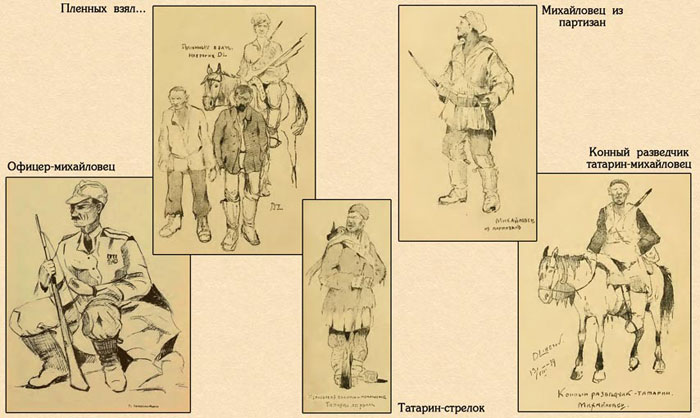
Drawings of the 15th Mikhailov Rifle Regiment by a contemporary
(from Sakharov's book "White Siberia")
1 – officer; 2 – prisoners; 3 – Tatar rifleman; 4 – partisan; 5 – Tatar horse scout
Essay by Ufa Historian and Regional Expert S. G. Shushpanov
In 1918 the division's officers wore what remained of the former Russian army's supplies and might even wear the regimental insignia of the 190th Ochakov Infantry Regiment, whose successor the 4th Ufa Division could well consider itself to be (the first division commander and the first regimental commanders were from the Ochakovtsy). Subordinate to the Samara Military Commissariat, the Ufimtsy certainly wore arm-bands and St. George ribbons on the brims of their caps, as prescribed for units of the People's Army. The Ufa newspapers conscientiously informed their readers about all the changes taking place in the People's Army.
In October 1918 sleeve insignia were replaced with khaki shoulder-boards. By this time there was disappointment among the soldiers of the Ufa garrison with the policies of the KOMUCH and the Ufa Directory, which manifested itself in them leaning towards the Provisional Siberian Government. According to General Boldyrev's memoirs:
The Ufa garrison, especially the officers, openly leaned towards Siberia and even changed the KOMUCH St. George ribbon to the white-green colours of Siberia. {1}
In one of the archives of the Central State Historical Archive of Bashkortostan, there is information about a request by the commander of the 16th Tatar Rifle Regiment, Biglov, for green and raspberry cloth from the Ufa warehouses, which suggests that the command staff of the 4th Ufa Division tried to equip their personnel with camouflage blouses with raspberry shoulder-boards. As is well known, raspberry shoulder-boards were worn by the rifle units of the old Russian army. {2}
Currently, there is a reconstruction of the appearance of the officers of the 13th Ufa Rifle Regiment, made by K. Novikov, based on photographs at his disposal. The uniforms vary in both colour and cut – there are blouses of various cuts and "French" tunics. An interesting detail is that most of the officers' shoulder-boards are khaki, without any ciphers, and only one of them has shoulder-boards with the cipher "13". {3}
In the spring of 1919, on the eve of the March offensive of the Eastern Front, the 4th Ufa Division most likely continued to wear the same uniforms. This conclusion can be drawn based on the fact that one of the Ufa newspapers wrote enthusiastically at that time about the arrival of the 1st Volga Corps in the city: the author of the article described in detail their English uniforms (greatcoats, caps, black wool gloves etc, right down to their rucksacks, how spacious they were and how many compartments they had). If the Ufimtsy, who had been in the city before the Volga Corps, had had similar equipment, such an article would have appeared about them. Incidentally, in the April 1919 issue of the newspaper Velikaya Rossiya, an order from the Ufa commandant was published, according to which all military personnel were obliged to once more wear khaki shoulder-boards.
By the time of the Ufa Operation, the division's uniforms had certainly become completely unusable after three months (March to May) of continuous service at the front. General K. V. Sakharov, who always paid close attention to the appearance of his troops, described the units of the 2nd Ufa Corps:
It was as if they were ... thousands of beggars gathered from church porches. Their clothes were very diverse, mostly their own peasant clothes, such as they wore at home; but everything was worn out, worn out during continuous fighting and looked like rags. Almost all of them had torn boots, sometimes completely without soles; some still wore felt boots, while others had their feet wrapped in rags and tied with string; most of the Tatars wore bast shoes. Almost all of them had trousers with holes through which their bare bodies could be seen. On top, they were dressed in whatever they had: caftans, Tatar coats, [peasant] blouses, and only occasionally a soldier's tunic or blouse. The officers did not differ in appearance from the soldiers. They stood in formation, hung with bags and knapsacks full of cartridges. {4}
Finally, about the "battle drum and black uniforms". After all, any legend, even the most mythical, usually has a basis in reality. In this case, the only version that explains the origin of the legend of the "psychological attack" may be the presence of the 5th Company of the 13th Ufa Regiment, which was made up of students from educational institutions in Ufa. A peculiarity of that company was that it was sent to the front only in emergencies – the rest of the time the volunteers lived with families and continued their education. Most importantly, its soldiers wore the black caps, blouses and trousers of high school students. This is why Chapaev's troops did not encounter the "black-uniformed Kappelevtsy" in the White ranks prior to the Ufa operation – it seems it was the Ufa high school students, who only went to the front when it approached their hometown and who advanced in the regiment's front ranks. This regiment of the Ufa Division was a volunteer regiment and included less combat-ready units in its attacks. Of course, in purely military terms the teenage students of the 5th Company did not pose a great danger to Chapaev's men, their height often not exceeding the length of their rifles, and they went into battle without flinching from the bullets only because they simply did not have the relevant combat experience. {5}
The Ufa Regional Museum has a photograph said to be a parade of White troops in Ufa. Unfortunately, it is difficult to tell that these are indeed White troops, as the soldiers are not wearing shoulder-boards. However, the fact that they are standing in a straight double row, dressed uniformly and wearing large white fur hats, speaks in favour of the Whites. It is not possible to see the details, as the photograph is panoramic and the figures in it are very small. It was taken in either late autumn or early spring, as the Whites were in Ufa in the autumn of 1918 (before leaving) and in the spring of 1919 (after reoccupying the city), so it is difficult to pinpoint its date.
After leaving Ufa, the Reds did not rush to pursue the retreating Ufa Group of the Western Army, as their right flank was successfully held back by the Volga Group. So the Ufimtsy had a respite before the Zlatoust Operation and were able to obtain new uniforms before the resumption of hostilities. The 4th Ufa Division was held in reserve northwest of Suleya Station, at the exit from the Ural Mountains to the Ufa Plateau, and defended the approaches to the railway. Taking advantage of the short pause, the division was replenished, received weapons and long-awaited uniforms. Considering that the best units of Kolchak's army received British uniforms, it can be assumed that it was at this moment that the soldiers of the 5th Company of the 13th Ufa Regiment changed their black high school uniforms for khaki tunics. In any case, there are no further mentions of "psychological attacks" by Kolchak's men in black uniforms. {6}
They might have received them before the Chelyabinsk Operation, in which reserve Siberian divisions equipped with British uniforms took part. However, generally the 4th Ufa Division, despite the high-profile patronage of General Kornilov, was always unlucky with its uniforms, as was the entire Western (3rd) Army.
After retreating to Transbaikalia during the Great Siberian Campaign, the 4th Ufa "General Kornilov" Rifle Regiment continued to use mainly Russian-style uniforms, as evidenced by the photographs in Filimonov's book. Filimonov himself noted that once in Primor'e, "as rifle units, the Ufimtsy ... had raspberry shoulder-boards, piping and tabs." They also wore the intertwined monogram "УГКп" on their shoulder-boards, which stood for "4th Ufa General Kornilov Regiment". {7}
Notes.
1. Boldyrev, V. G. in "The Directory, Kolchak, the Interventionists: Memoirs", Novonikolaevsk, 1925, p.45.
2. Shushpanov, S. G. in "The Forgotten Division: Ufa", 2011, p.34.
3. Novikov, K. at www.bergenschild.narod.ru [link dead]
4. Sakharov, K. V. in "White Siberia (The Civil War of 1918-1920)", Munich, 1923, p.102.
5. Shushpanov, S. G. p.128
6. Shushpanov, S. G. pp.133-134.
7. Filimonov, B. B. in "White Rebels: The Khabarovsk Campaign, Winter 1921-1922, Book 1", Shanghai, 1932, p.34.
Uniforms
Material and reconstructions by A. Karevskiy
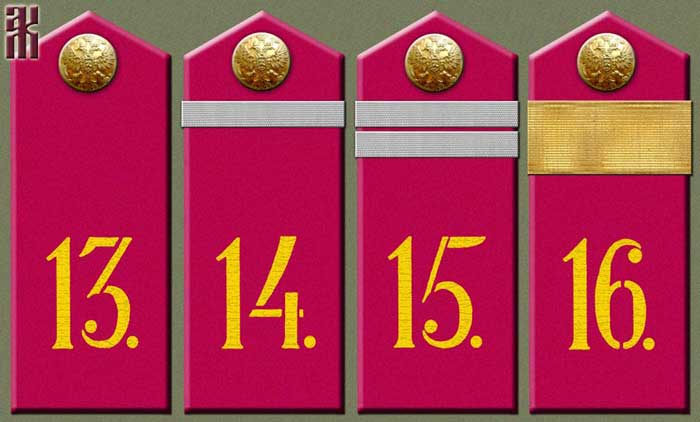
Shoulder-boards of the other ranks of the 4th Ufa General Kornilov Rifle Division:
13th Ufa, 14th Ufa, 15th Mikhailov and 16th Tatar Rifle Regiments
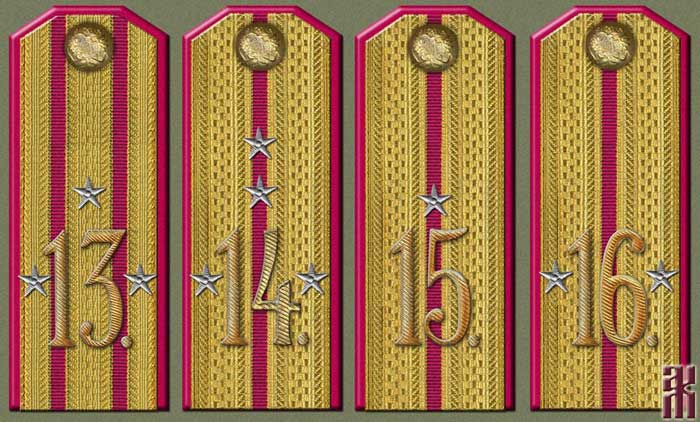
Shoulder-boards of officers of the 4th Ufa General Kornilov Rifle Division:
13th Ufa, 14th Ufa, 15th Mikhailov and 16th Tatar Rifle Regiments
The shoulder-board reconstructions are based on materials dedicated to the 13th Ufa Rifle Regiment and published by K. Novikov at www.bergenschild.narod.ru [link dead].
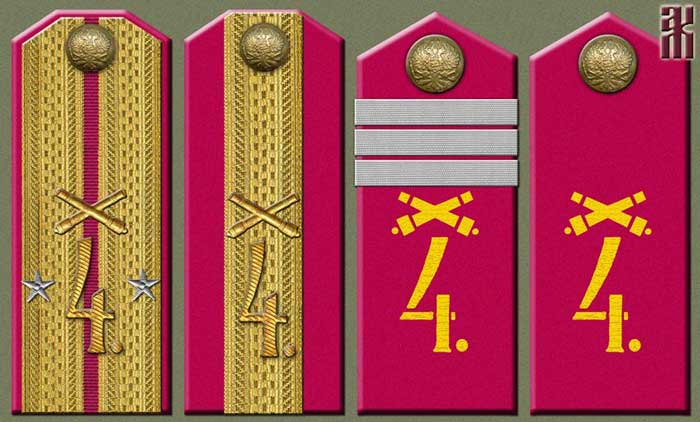
Shoulder-boards of the 4th Ufa Rifle Artillery Divizion
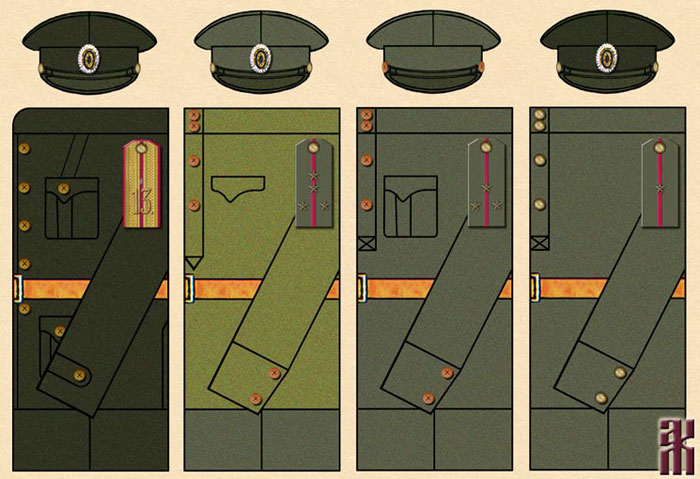
Uniforms of officers of the 13th Ufa Rifle Regiment
The uniform reconstructions are based on materials dedicated to the 13th Ufa Rifle Regiment and published by K. Novikov at www.bergenschild.narod.ru [link dead].
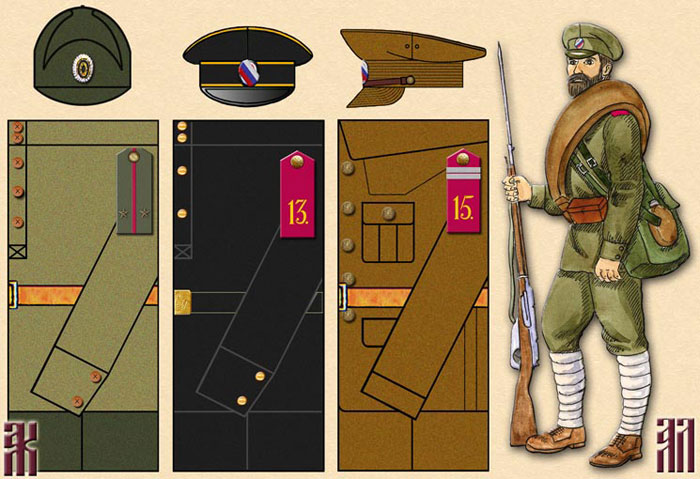
Uniforms of the 4th Ufa Rifle Division:
1 – second lieutenant of the 15th Mikhailov Rifle Regiment;
2 – rifleman of the 5th Company of the 13th Ufa Rifle Regiment (high school uniform);
3 – corporal of the 15th Mikhailov Rifle Regiment (with British uniform); 4 – soldier
Figure 1 is based on a drawing by a contemporary published in Sakharov's "White Siberia".
Home — State Symbols — Flags — Uniforms — Badges & Medals — Money — Other
Pygmy Wars Notes
The original for this page is at kolchakiya.ru/uniformology/Ufim_shooter_div.htm.
The reference to "battle drum and black uniforms" is to the famous attack scene in the film "Chapaev" (seen here). A "psychological attack", sometimes seen in the Civil War, was advancing in formation without shooting, with the intention of intimidating opponents by resolve alone.
"УГКп" is "4 UGKp", with the p for polk, regiment.
While bergenschild.narod.ru is no longer active, I have saved the cited schemes here and here in pdf form.
Figure 4 in the final scheme is an illustration by A. Lebedeva, no longer on the current kolchakiya.ru page.
The originals of the drawings on this page can be seen at the Wiki Commons copy of his book.
Discussion on the translation choices I have made can be found here.
History of the 4th Ufa "General Kornilov" Rifle Division
Originally formed in Ufa in the summer of 1918. Its core was peasant rebel detachments which, in June and July 1918, had liberated almost the entire Ufa Province from the Bolsheviks, with the conjunction with the Czechs. Three of the division's regiments were exclusively of volunteer insurgents; the fourth was formed in the autumn of 1918, but was also largely volunteers. It grew to be of the largest divisions on the Eastern Front in terms of strength (between 16,000 and 20,000 men) and one of the most renowned. Its later expansion was of Russians and Tatars of the Belaya River basin and the left bank of the lower Kama, both officers and men. It contained the 13th Ufa, 14th Ufa, 15th Mikhailovsk, and 16th Tatar Rifle Regiments, and the 4th Ufa Artillery Divizion..
From October 1918 it was part of the 2nd Ufa Army Corps, and from August 1919 the Ufa Group of the 3rd Army. On 20 May 1919 it was named for General Kornilov. From July 1919 it also had the 3rd Orenburg Cossack Brigade attached. It played a leading role in the offensive of March 1919, and during the retreat to the Ural Mountains and on to Chelyabinsk it bore the brunt of the Red Army's attacks.
History of the 4th Ufa Rifle Regiment
After the Great Ice Campaign, in the spring of 1920 the remnants formed the 4th Ufa Rifle Regiment in the Far Eastern Army in Chita (the core being the 13th Regiment). It was part of the Volga Brigade and the second-largest regiment in the army in Transbaikalia. By this time the ranks consisted almost entirely of Tatars and Bashkirs, who demonstrated high combat qualities.
After leaving Transbaikalia, it proceeded in an orderly manner (for which it owed much to the regimental mullah) through the Chinese Eastern Railway exclusion zone to Primor'e. In March 1921, together with the remnants of the 8th Kamsk Regiment, it numbered 121 officers and 653 soldiers. At the front during the Khabarovsk campaign in early January 1922 it fielded around 450 men (three battalions, eight rifle companies and a scout detachment, which effectively served as the ninth company). In August 1922 it was incorporated into the Ufa Battalion (company) as part of the Volga Regiment of the Volga Group or Army. In September 1922 it numbered 300 men and 7 sabres.