
Actual Uniforms of the Provisional All-Russian Government of 1918
according to memoirs and historiography
All reconstructions are by A. Karevskiy unless noted otherwise.
Terms of the Provisional Siberian Government at the Ufa State Conference
11. Establishing the unity of the entire Russian army, subordinate in all operational and organisational matters to a single Supreme Command, the Provisional All-Russian Government will retain the territorial method of recruiting units, will allow territorial name, and, while it recognises the national colours, will also allow distinctive regional territorial colours (for example, white and green for Siberians).
Gins, G. K. in "Siberia, the Allies and Kolchak", p.271.
Ufa, September 1918
The Ufa garrison, especially the officers, openly leaned towards Siberia and even changed the KOMUCH's St. George ribbon to the white and green colours of Siberia.
Boldyrev, V. G. in "The Directory, Kolchak, the Interventionists: Memoirs", Novonikolaevsk, 1925, p.45.
KOMUCH military minister Galkin recounted the following incident. On the eve of the arrival of KOMUCH representatives for the Ufa conference in September, officers removed their People's Army uniforms and donned Siberian Army uniforms, greeting their "Samara government" in this manner.
Spirin, L. M. in "Classes and Parties in the Civil War in Russia (1917-1920)", Moscow, 1968, p.259.
It was not for nothing that Colonel Kappel' lamented when Admiral Kolchak's government reinstated shoulder-boards in the army, rightly believing and anticipating that the introduction of external distinctions between officers and soldiers would bring internal disunity and alienation between the officers and soldiers. All the combat officers of the People's Army were aware of this danger, and, wishing to avoid the harmful consequences of wearing shoulder-boards, they often preferred not to wear them, despite the inevitable punishment for doing so.
Nikolaev, S. N. in "KOMUCH Policy (Experience and Characteristics // The Civil War on the Volga in 1918", Prague, 1928, p.137.
Units of the former People's Army, Samara Army Group
They wore a tricolour stripe, flew the Russian national flag and, it seems, at that time they did not even have shoulder-boards.
"Minutes of the meetings of the Extraordinary Investigative Commission on the Kolchak case // Prisoner of the Fifth Chamber", Moscow, 1990, p.401.
After the official introduction of shoulder-boards, many units continued to wear the cancelled sleeve insignia (for example, the Irkutsk Reserve Rifle Brigade, the Special Purpose Reserve Regiment and the Irkutsk Cossack Divizion at the end of September and beginning of October). ... In some front line units, sleeve insignia were worn until December 1918-January 1919 and later.
Deryabin, A. I. in "The Siberian Army, 1918 // Tseykhgauz, No. 2", Moscow, 1993, p.29.
Samara area, October 1918
The next morning, the "Constituent Assembly" battalion arrived. A thousand fresh fighters, well-equipped and well-clad, replaced General Sakharov's Volga Division. ... We did not like this battalion with its red flags, which we hated, and all their revolutionary slogans. None of them had shoulder-boards, and the soldiers and officers behaved in a disorderly manner. Everywhere we heard the word "comrade", which we hated.
Meybom, F. F. in "The Thorny Path // Pervopokhodnik, No. 27", Los Angeles, 1975, p.9.
Omsk, 22 October 1918
The Siberians are asking to keep the name "Siberian" for their troops, as well as to keep the white and green cockade and flag. I agreed to a double cockade and ribbons of their colours on the Russian national flag.
Boldyrev, V. G. in "The Directory, Kolchak, the Interventionists: Memoirs", Novonikolaevsk, 1925, p.81.
The People's Army did not send reinforcements, supplies, or even money to the unit, despite the fact that there were warehouses of property and food in Ufa, brought by the People's Army from Kazan, Samara, and Simbirsk. The KOMUCH and the Directory disputed each other's right to dispose of those supplies, and as a result, those at the front, behind whom KOMUCH felt safe, remained undressed.
... In any case, during General Boldyrev's tenure as head of the People's Army's, we received neither reinforcements, nor clothing, nor equipment. We had to obtain all of that ourselves, taking more people out of the ranks for economic needs than the situation allowed.
Perkhurov, A. P. in "Confession of a Condemned Man", Rybinsk, 1990, pp.33,34.
Lightweight, wind-torn greatcoats, torn boots, no underwear. On the front line, General Golitsyn introduced Knox to a young captain who had distinguished himself and been wounded twice. And yet he did not have a second blouse to change into. ... It was necessary to clothe the half-naked army. "Our quartermasters are Reds", said Generals Golitsyn and Verzhbitskiy. "All we have is what we take from the enemy in battle: we have not yet received anything from the rear."
Sakharov, K. V. in "White Siberia (The Civil War of 1918-1920)", Munich, 1923, p.27.
Omsk, 17 October 1918
I visited the 2nd Battalion of the 8th Cadre Regiment. The picture was shocking: men were barefoot, ragged, sleeping on bare bunks, some even without hot food, as without boots they cannot go to the kitchens, and there is no way to transport them. The soldiers themselves are excellent, well trained, and if they do not rebel, it is a miracle. Half of those I saw in the barracks lined up barefoot, wearing only their underwear, and there was not a trace of malice on their faces. In the evening, those who managed to find footwear marched in the square: I heard the lively songs of the Siberian riflemen from the train carriage.
Boldyrev, V. G. in "The Directory, Kolchak, the Interventionists: Memoirs", Novonikolaevsk, 1925, p.74.
Chelyabinsk, end of October 1918
The young Siberian troops were dressed in greatcoats made of canvas. ...
In Chelyabinsk, I saw a review and parade of the 41st Ural Mountain Rifle Regiment. After a month of work, the regiment presented itself as a real military unit, but its appearance was very pitiful: more than half of the men had no greatcoats, and their boots were one solid patch. The commander, a young colonel named Kruglevskiy, did everything he could to obtain equipment from the quartermaster's office and from the wealthy part of the population. He said: "I have to beg for it. ... Half of my men are still in the barracks with nothing to wear. There is only one pair of boots for several people.
Sakharov, K. V. in "White Siberia (The Internal War of 1918-1920)", Munich, 1923, pp.21-22.
Direct telephone conversation between Ufa (Vedenyapin) speaking to Omsk (Zenzinov), 5 November 1918
I would very much like to acquaint you at least a little with the situation after the fall of Samara. The army has completely collapsed; it is almost non-existent, it has fallen apart. This forced the Central Committee to call all party members to arms, and here we did so and, together with the Czech command, contrary to Boldyrev's orders, created volunteer units that are holding the front. In our units, the officers are signing a pledge not to wear shoulder-boards and cockades; only with such measures can anything be done.
Deputy S. N. Nikolaev
...under the pretext that the units in the rear did not need proper weapons, they were left with only Berdan rifles, and even those in insufficient numbers, and a few rickety machine guns.
Ganin, A. V. in "Admiral A. V. Kolchak and the Socialist-Revolutionary Party: Military-Political Conflict in November-December 1918 // Military Commentator. Military-Historical Almanac (Ekaterinburg) No. 1 (8)", 2009, pp.23,29 at orenbkazak.narod.ru/esery.pdf
November 1918
I ... met with soldiers and officers in various conditions at the front lines, and I must say that this question never arose for me at the front. I saw the same indifferent attitude – sometimes it was impossible to get shoulder-boards, but what shoulder-boards were there to get, and anyway you can do without them. I could not make demands because they could not be met. ... I met soldiers and officers on the front lines dressed in completely fantastical attire – where one could only talk about shoulder-boards: it at least would be something to wear.
"Minutes of the Meetings of the Extraordinary Investigative Commission on the Kolchak case // Prisoner of the Fifth Chamber", Moscow, 1990. pp.401-402.
Perm, 24 December
The supplies taken in Perm from the warehouses and military factories provided. ... an opportunity to fill many gaps in the supply of our troops. That aspect, despite all the energy and work that had been put into it, left much to be desired. Not to mention the fact that our army was dressed as diversely as the great militia of 1613, there was a major shortage in many things which are required for life and service: there were few short sheepskin coats, felt boots and we even lacked greatcoats.
Sakharov, K. V. in "White Siberia (The Civil War of 1918-1920)", Munich, 1923, p.51.
Minutes No. 26 of the meeting of the Provisional All-Russian Government, 22/9 October
P. V. Vologodskiy reported on the decisions taken by the Siberian Provisional Government on the organisation of power in Russia in general and in Siberia in particular.
[...] In addition, in the interests of Siberian autonomy, Siberian army units should retain their insignia (cockades) and white-green banners.
[...] N. D. Avksentyev, summarising the report of the representatives of the [Provisional] Siberian Government, repeated it point by point:
[...] 5. The Siberian Army shall be retained as part of the All-Russian Army, and the white-green flag shall be retained.
Does this mean that the Siberian army will have a special administration like how they do it in Germany, for example, or does it only mean that the Siberian units of the Russian army will retain their distinctive white and green insignia (cockades) and two-coloured flag?
The Siberian representatives agreed with the latter interpretation to that question.
V. G. Boldyrev pointed out that, as Supreme Commander-in-Chief, he had no objection to these wishes of the [Provisional] Siberian Government, but in the interests of army unity, he believed it would be better if the Siberian units did not have a different flag, but only white and green ribbons on the all-Russian flag.
Representatives of the [Provisional] Siberian Government agreed with this.
Shishkin, V. I. (Ed) in "Provisional All-Russian Government (23 September-18 November 1918). Collection of documents and materials", Novosibirsk, 2010, pp.179-180.
Minutes of the Meeting of the Provisional All-Russian Government, 6 November 1918.
IV. A report was heard from government member V. A. Vinogradov on the transfer by the Department of State Movable Property to the [Provisional] All-Russian Government of part of the manufactured goods and other items removed from the city of Samara after its evacuation.
It was decided: to sell the manufactured goods and other items at cost price to government administrative officials, with the exception of khaki cloth, which was to be transferred to the military department through the government commandant, and to transfer the unsold manufactured goods to the All-Russian Union of Zemstvos and Cities for the provision of assistance to refugees.
Shishkin, V. I. (Ed) in "Provisional All-Russian Government (23 September-18 November 1918). Collection of documents and materials", Novosibirsk, 2010, p.249.
Izmailovo near Belebey, 3 December 1918
A modest, cramped two-room house belonging to a rural resident. This is the apartment of General Kappel' and his staff. It is 7 o'clock in the morning, and the general is already up. The door opens every minute. Officers and soldiers enter. Some are looking for orders, others for information. The general himself will satisfy everyone. A priest enters with his son, a volunteer. He blesses them. He seats them and offers them tea. It is bitterly cold outside. The general needs to go to his position. He gets dressed. But what kind of clothes are these? A light sheepskin coat, a cap on his head, leather boots on his feet. "Your Excellency, how can you go in such clothes, you will freeze. It is terribly cold outside," says the priest. "It's all right," replies the general, "I'll get cold, but I'll warm up later. The soldiers are in greatcoats at their positions, and they don't feel cold or complain."
Near Khlobodarovka, 17 December 1918
It is incredibly cold. I am shivering in my fur coat, felt boots and scarf. A group of horsemen is approaching, their horses are covered with frost. At the front is the general in his usual attire: a light fur coat, a cap, leather boots. However, there is now something different – a bashlyk.
Rozhdestvenskiy, P. P. in "The Russian Cause // The Loyal Guard: The Russian turmoil through the eyes of Monarchist Officers", Moscow, 2008, pp.729-730.
However, for various reasons, not all officers were eager to wear shoulder-boards. This was mentioned, for example, in an order for the Irkutsk Military District, signed on 7 November 1918 by Colonel E. G. Sychev:
Order No. 64 – to wear shoulder-boards – was issued by the Ministry of War on 6 September 1918. There are still great numbers of military personnel wandering around Irkutsk without shoulder-boards. No government removed shoulder-boards before the October coup. The shoulder-boards were removed by the Bolsheviks, who disgraced themselves with crimes against divine and human rights. Anyone who does not want to wear shoulder-boards does not want to belong to the reborn young Russian Army and, therefore, should not wear military uniform. It is extremely surprising to see people with officer's cockades without shoulder-boards. I order the city commandant, two days after the publication of this order, to take the most decisive measures to implement Military Order No. 64. Pay special attention to people with officer's cockades wearing officer's uniforms and arrest them, paying no attention to excuses, even if they are generals. Retired officers who have the honour of wearing military uniforms must also be dressed strictly according to the regulations.
In an order dated 26 November 1918, Colonel Sushko, acting head of the Novonikolaevsk Military District, noted that officers without shoulder-boards and dressed carelessly continued to appear on the streets and in public places. The deadline for acquiring shoulder-boards was set for 1 December.
Similar violations of dress code by officers also took place in Biysk. In an order dated 29 November 1918, signed by Colonel V. I. Polyakov, it was noted that:
Despite repeated orders regarding uniforms, many officers, especially from the People's Army, continue to walk around without shoulder-boards, but for some reason consider it mandatory to wear spurs, even though they are not permitted them.
Some officers, having put on shoulder-boards, considered it unnecessary to place stars on them to indicate rank. In this regard, on 27 February 1919, the commander of the II Separate Steppe Siberian Corps, General V. V. Brzhezovski, wrote in an order:
There are too many captains in the city [Semipalatinsk]. If this is due to the lack of stars on sale, I remind you that they can be easily replaced with thread. I order unit commanders to pay attention to this and to impose penalties on all those who do not have their assigned rank.
Simonov, D. G. in "The White Siberian Army in 1918", Novosibirsk, 2010, p.180.
It happened that the supply authorities delivered products of unsatisfactory quality to the active army. In confirmation, we quote a letter published in the newspaper by an artilleryman who wished to remain anonymous:
The battery is freezing. A 30-degree frost – in [leather] boots! It is still possible to walk, but riding is unthinkable. Every five minutes, completely blue from the cold, the riders fall helplessly from their saddles, jump around frantically, trying to warm up, and freeze again. Do you know what kind of felt boots we received just two weeks ago? No? Alas! Two weeks ago, we were all wearing felt boots and mittens – we could walk without freezing, we could lie in the snow for hours and get up and joke around. We didn't have long to enjoy it. The felt boots began to swell, tufts sticking out in different directions, and their shape became unusually bizarre: a cheeky, insolent finger appeared from inside, sticking out into the light of day and pulling the other fingers with it. Those felt boots ended their earthly journey a week after they were issued, and we were left with boots and low boots again. And the one who brought rotten goods into the army was happily rubbing his hands somewhere in the warmth, in the rear.
Simonov, D. G. in "The White Siberian Army in 1918", Novosibirsk, 2010, p.159 (quoting the "Siberian Herald" of 21 August 1919.
On 17 December 1918 Major-General L. N. Skipedov, inspector of the infantry for the Independent East Siberian Army, inspected the 29th and 30th Regiments of the 8th Chita Rifle Division, stationed in Berezovka. The personnel were housed in unrenovated and poorly heated premises. Due to the lack of mattresses, the soldiers slept on bare bunks. They had almost no uniforms and only one pair of underwear per person. The regiments' supply of weapons also left much to be desired. On average, each company had only 3-4 three-line rifles and 20 Berdan rifles. There were no machine guns or mortars at all.
Simonov, D. G. in "The White Siberian Army in 1918", Novosibirsk, 2010, p.167.
On 22 November 1918 the commander of the 5th Ural Reserve Regiment, Colonel P. P. Rautsen, informed the chief of staff of the 2nd Ural Regular Division about the lack of combat-ready soldiers in the regiment, and on 25 November he told the division commander that the regiment would not be ready to march by 1 December. According to his reports, there were no fully equipped soldiers in the regiment: some of the men had greatcoats but no blouses or trousers, while others had blouses or trousers but no greatcoats. None of the soldiers had underwear or footcloths. Only one-third of the soldiers had "some" footwear, while the rest had either completely unusable footwear (including bast shoes) or went barefoot. Two-thirds of the soldiers did not undergo drill and field training "due to a lack of footwear". Due to a shortage of rifles and a lack of training and combat ammunition, the regiment did not undergo fire training either. The regiment had no field kitchens or supply wagons, except for 22 sleds for servicing the unit's domestic needs. Instead of the 513 horses required by the regulations, the regiment had only 38, and even those were exhausted from overwork.
Simonov, D. G. in "The White Siberian Army in 1918", Novosibirsk, 2010, p.167.
Until early October 1918, Corps Commander General Khanzhin was denied the right to procure uniforms on his own. At the same time, despite repeated requests from Khanzhin himself and the corps quartermaster, the Ural Corps did not receive any boots, greatcoats, fur hats, etc. from the central supply authorities, with the exception of some underwear and quilted jackets. In the end, the quartermaster's office of the West Siberian Military District totally refused to supply the corps (206).
The hopeless situation forced General Khanzhin to resort to an undesirable measure – organising uniform supplies directly to the units. In an order to the corps, dated 5 October 1918, he wrote:
The units of the Ural Corps with conscripts need uniforms. The workshops are unable to produce the enormous quantity of uniforms required for the corps at once. In villages, stations, and towns, especially in cities, people who are not in the army wear soldiers' uniforms that have been sold off and stolen by the Bolsheviks. The approaching cold weather forces me to take extreme measures and clothe the men. In view of the above, I order my representatives and garrison commanders to requisition soldiers' clothing within five days of receiving this order, at the following prices: greatcoats from 20 to 75 rubles, woollen blouses from 10 to 27 rubles, cloth trousers from 8 to 21 rubles, cotton trousers from 3 to 6 rubles, field caps from 4 to 8 rubles, cotton blouses from 4 to 8 rubles.
The money for the purchase of uniforms was to be issued by the corps quartermaster upon presentation of estimates. The corps commander ordered that the accepted items be used to outfit units belonging to the 6th and 7th Ural Mountain Rifle Divisions and the Ural Regular Brigade. People not in the army who wore military uniforms, concealed the mentioned items, or purchased or sold them were subject to a fine of up to 3,000 rubles or imprisonment for up to three months and the requisition of all concealed items.
Simonov, D. G. in "The White Siberian Army in 1918", Novosibirsk, 2010, p.168, citing RGVA F.39617 Op.1. D.151 L.134 and TsDOOSO F.41 Op.1 D.125 L.26.
General M. V. Khanzhin's initiative to requisition items of military clothing was supported by the commander of the Siberian Army, General P. P. Ivanov-Rinov. On 10 October 1918 he ordered the formation of a commission chaired by Major-General M. K. Mende, commander-in-chief of the West Siberian Military District, to study the possibility of requisitioning government-issued clothing from the civilian population. The commission included V. F. Rybakov from the Ministry of Supply, I. F. Dolgopolov from the Ministry of Internal Affairs, M. Kuchin from the Ministry of Labour, D. S. Kovler, Engineer M. Zhernakov from the Omsk Military-Industrial Committee, A. Kanorskiy from the Food Commissioner of the Akmolinsk Region, S. M. Kupchiy, as well as the duty general of the Siberian Army General Staff, Major-General M. N. Fukin, the head of the Omsk garrison, Major-General S. I. Lyashchik, and the representative of the headquarters of the II Steppe Siberian Corps, Lieutenant Glazunov.
The commission meeting took place on 12 October. After a comprehensive discussion of the possibility of requisitioning government-issued clothing from people not in the army, the commission found it necessary, on behalf of the War Department and the Ministry of Supply, to appeal to the population to voluntarily surrender within seven days the items of clothing necessary for the army: greatcoats, woollen blouses and trousers, as well as khaki quilted jackets. When accepting items, the commission found it possible to pay 60 to 80 rubles for a greatcoat, 40 to 60 rubles for a woollen blouse, 30 to 50 rubles for woollen trousers, and 30 to 40 rubles for a quilted jacket. If this measure proved unsuccessful, it was planned to announce a ban on wearing government-issued clothing and to begin requisitioning it. It was assumed that the payment for an greatcoat would be 28 rubles 25 kopecks, for a blouse 27 rubles 50 kopecks, for trousers 21 rubles 25 kopecks, and for a jacket 20 rubles.
The commission decided to "ask the Ministry of Supply to take on the organisation, with the assistance of city and district self-government bodies and the military department through its authorised representatives, of the collection of items voluntarily surrendered by the population within a set period of seven days, and subsequently, if necessary, to carry out the requisition of items necessary for the army." On 13 October, the commander of the Siberian Army added a resolution to the minutes of the commission meeting: "I fully agree, in view of the approaching cold weather, and I request the head of the Ministry of War to implement this as soon as possible."
Simonov, D. G. in "The White Siberian Army in 1918", Novosibirsk, 2010, pp.169-170, citing GARF F.182 Op.1 D.5 L.36-37.
On 19 October 1918 the commander of the 6th Ural Division, Colonel V. M. Neyland, announced in Zlatoust and the Zlatoust district a paid requisition from the civilian population of artillery, cavalry and Cossack saddles, which were to be delivered to the division headquarters within five days. Those who failed to comply with this order faced a fine of up to 3,000 rubles or imprisonment for a term of three months, with free requisitioning of hidden items.
By Order No. 36 of 30 October 1918, the acting commander of the III Ural Corps for the protection of public order and peace in the Ekaterinburg, Kamyshlov, Shadrinsk, Krasno-Ufa, Irbit, and Verkhotur'e districts, Colonel M. N. Nekrasov obliged all tailors in the city of Irbit and a 10 km strip of its surrounding area to work two days a week for the defence forces and sew at least four greatcoats or 10 blouses, or 12 trousers for the corresponding payment. Within three days of the order being announced, representatives of tailoring workshops and all individual tailors were asked to report to the headquarters of the 8th Ural Reserve Regiment for registration. On the same day, Colonel Nekrasov ordered the head of the Shadrinsk district police to register all shoemakers living in the city and district within three days. Each shoemaker was asked to make two pairs of army boots within two weeks from materials provided by the Shadrinsk Leather Committee.
Through the requisitioning of goods, the organisation of sewing and shoemaking workshops, and the recruitment of craftsmen from among the recruits and prisoners of war, much was achieved, but the measures taken were still far from sufficient to provide uniforms for 60,000 people. "The onset of cold weather found the corps without footwear, without clothes, without warm things," wrote General M. V. Khanzhin to the commander of the Siberian Army on 26 October 1918. The commander of the Ural Corps warned that:
General Golitsyn, in order to send half of his division to the front at the urgent request of General Gaida, was forced to almost strip the other half. The lack of uniforms, footwear, and warm clothing is delaying training; it is impossible to immediately remove all the men from the barracks. ... The lack of uniforms, and especially the contrast with the neighbouring Czechoslovaks and Siberians, could have serious consequences. ...
Simonov, D. G. in "The White Siberian Army in 1918", Novosibirsk, 2010, pp.168-169 , citing "Morning in the Urals [newspaper} of 22 October 1918 and TsDOOSO. F.41 Op.1 D.125 L.33,34.
We do not have comprehensive data on the results of purchases of uniforms from the civilian population. However, this campaign was probably justified. For example, in the Biysk district, by 23 November, three parishes had handed over military uniforms in exchange for appropriate compensation, including the Khairuzovsk parish with 194 greatcoats, 37 quilted jackets, 23 woollen blouses and 23 pairs of trousers; The Biysk parish surrendered 284 greatcoats, 27 quilted jackets, 27 woollen blouses and 3 pairs of trousers; The Shubinsk parish surrendered 18 greatcoats and one quilted jacket, for a total of 498 greatcoats, 65 quilted jackets, 50 blouses and 26 pairs of trousers. The total amount of monetary compensation was 40,610 rubles.
Simonov, D. G. in "The White Siberian Army in 1918", Novosibirsk, 2010, pp.170-171 citing "Duma" of 27 November 1918.
Omsk, 18 October 1918.
An offensive and unpleasant story. ... As we were crossing the bridge on Otomanskaya Street, suddenly the car of the commander of the troops, General Matkovskiy, appeared. I saluted. Matkovskiy did not bother to respond, and his car began to brake at full speed. An adjutant jumped out and came straight up to me:
"The commander of the troops wants to see you."
I handed the package to my wife and went to the car. I stood at attention, raised my cap, and reported:
"I am Captain Ilyin, staff officer for assignments under the chief of staff of the Supreme Commander-in-Chief."
Instead of answering, Matkovskiy began to shout:
"Where are your shoulder-boards? Why are you wearing an arm-band? This isn't the Socialist Revolutionary Party or Samara!"
"Allow me to report, Your Excellency, that I have been in Omsk for three days and have ordered shoulder-boards, but have not yet received them."
He interrupted me:
"You are not following orders. I will not tolerate SR behaviour here. You are to be arrested immediately!"
"Yes, sir," I said, and turning to the left, I told my wife that I was to be taken to the guardhouse and asked her to telegraph Rozanov immediately.
I was so choked with anger that tears were ready to burst forth. First of all, I was not guilty of anything; Rozanov himself had seen me and said nothing. Half of the Headquarters was still without shoulder-boards, and most importantly, Matkovskiy had no right under the regulations to arrest me.
At ten o'clock, I suddenly heard a commotion, cries of "guard out" and the noise of a car. People ran around, and the magnificent Matkovskiy himself appeared in the corridor in brand new shiny shoulder-boards.
"You are free, please follow me."
I followed Matkovskiy, and he offered me a seat in his car. When I got in, he began to say that my arrest was indeed a misunderstanding, but that he was outraged that no one was following orders and that discipline was suffering as a result.
Ilyin, I. S. "The Wanderings of a Russian Officer: Diary of Joseph Ilyin, 1914-1920", Moscow, 2016, pp.333-335.
Ufa, 4 October 1918:
In Ufa, I formed a cell. ... I remember one incident when officers and Czechs surrounded us, but we were resourceful and managed to escape. I called myself a colonel and Petrov a lieutenant. No one wore shoulder-boards at that time. It was 4 October in a large restaurant opposite the Circus. Out of nowhere, Petrov ran up and shouted: "Colonel, you are urgently requested to report to the direct line." The officers moved away from me.
"Serbian detachment of Voivode Vladislav Oskar" at TsDOOSO F.41 Op.2 D.196 L.80. Material kindly provided by Ekaterinburg researcher D. V. Kadochnikov.
Home — State Symbols — Flags — Uniforms — Badges & Medals — Money — Other
Pygmy Wars Notes
The original for this page is at kolchakiya.ru/uniformology/ufim_direct_memoirs.htm.
The following illustration by A. Lebedeva was originally on this page but later removed.
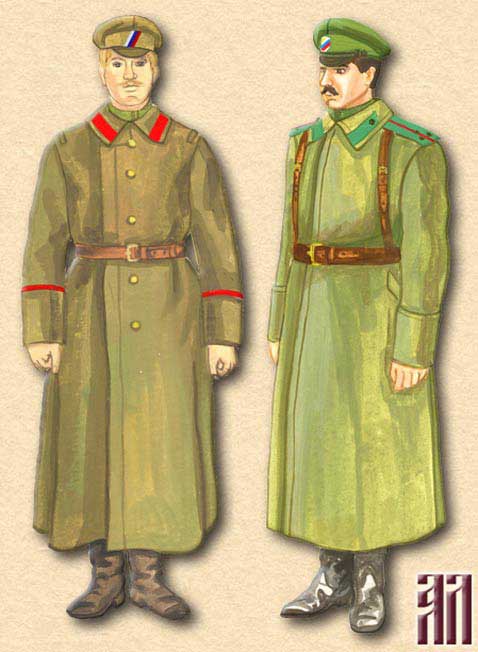
Rifleman of the Samara Army Group and officer of the Kama Army Group
Discussion on the translation choices I have made can be found here.