
Temporary Uniforms of Police in the Tomsk, Enisei and Irkutsk Provinces, 1918-early 1919
All material and reconstructions are by A. Karevskiy unless noted otherwise.
1. Irkutsk City Police
In Irkutsk, with the consent of the chief of the Irkutsk Military District and the approval of the Irkutsk Provincial Commissioner, distinctive sleeve insignia and headdress marks were installed for the chief of police, his assistants, district chiefs and their assistants, as well as for police officers, as follows:
An equilateral chevron of white and green ribbon is to be sewn onto the left sleeve. In the space formed inside the white-green chevron, stripes of golden braid are sewn horizontally, with two for the chief of police and one for his assistants, or in white braid, with two for district heads and one for their assistants.
Police officers on external service will have a military-style cap with the provincial coat of arms on the crown and a vertical white and green ribbon from the upper edge of the crown to the band. Policemen will have a military-style cap, with a green ribbon along the upper edge of the hat-band. Their left sleeve will have a green arm-band with a white border.
This uniform will be introduced on September 20.
"People's Siberia", 20 November 1918, kindly provided by site visitor "Rotmistr Ivanov"
Irsoyuz and the Police
Irsoyuz released 150 pairs of felt boots worth 8,528 rubles from its pitch rolling factory for the police. The felt boots were sold at cost, which resulted in savings of more than 4,000 rubles. against the prices of procurement for the army and private sale.
"Voice of Siberia, No. 23", 4 February 1919, kindly provided by Voronezh researcher N. Zayats
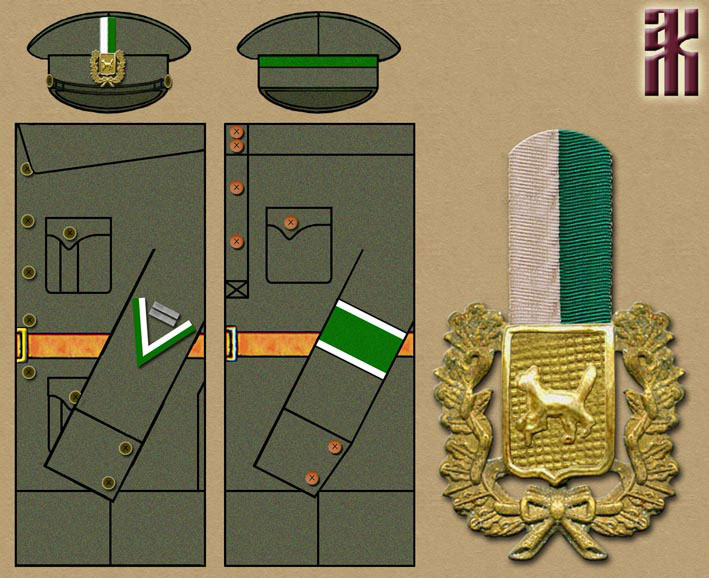
Uniform of the Irkutsk city police: 1 – officer; 2 – policeman; 3 – cockade of the Irkutsk province police of the previous type but with the Imperial crown removed
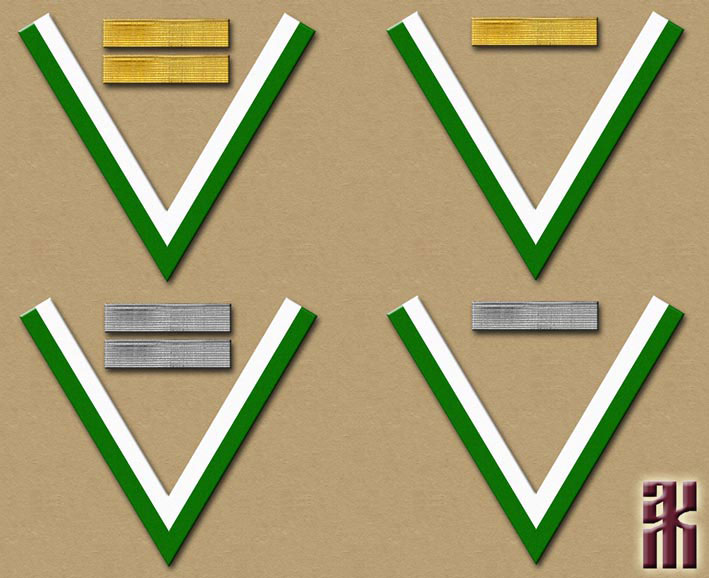
Insignia of the commanders of the Irkutsk city police: 1 – head of the city police;
2 – assistant head of city police; 3 – district commander; 4 – assistant district commander
2. Krasnoyarsk and Enisei Province Police
Emerging law enforcement agencies faced many problems. For a long time they did not have their own uniforms or insignia. Many used army sleeve badges and shoulder-boards. After a short period of time, Omsk demanded " ... that the police not wear sleeve insignia in the form of military ones". On 12 December 1918, a special order temporarily removed this problem.
Until the rules establish uniforms, the police shall wear military uniforms and shoulder-boards with green stripes. Civil officials will have stars running along their shoulder-boards. Ordinary police officers should have two green and white striped shoulder-boards.
In addition, to make them more regular, police were required to wear white and green arm-bands on their left sleeves with the letters "ГМ" (provincial police) and "УМ" (district police) embroidered on them.
Marmyshev, A. V. and Eliseenko, A. G. in "Civil war in the Enisei province", Krasnoyarsk, 2008, p.80, citing AAAK F.1800 Op.1 D.2 L.5 and L.66; AAAK F.1800 Op.2 D.47 L.9934
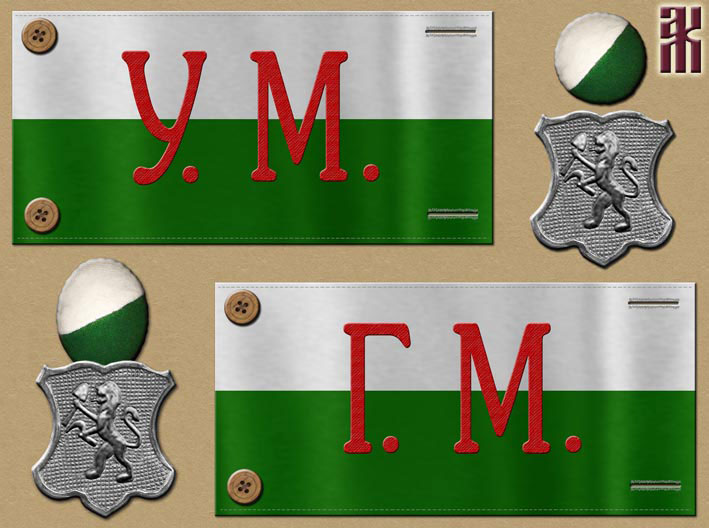
Arm bands and cockades of police of the Krasnoyarsk and Enisei provinces
in accordance with the 12 December 1918 order
In the upper right corner are the cockades of police officers, and in the lower left for ordinary policemen.
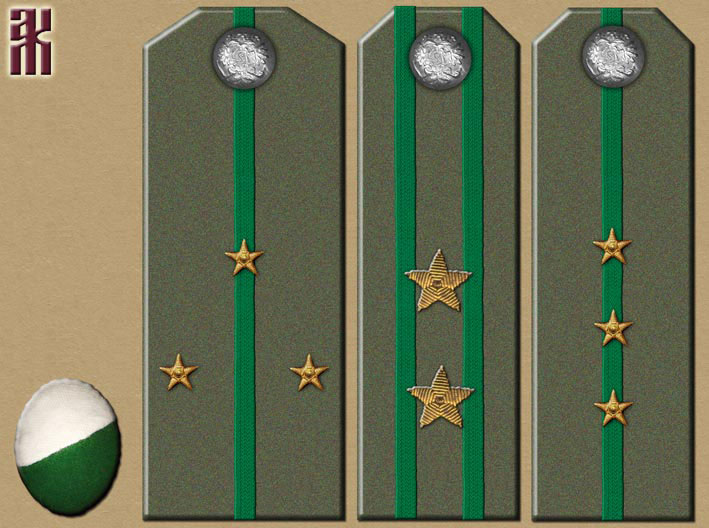
Shoulder-boards of police of the Krasnoyarsk and Enisei provinces in accordance with the 12 December 1918 order: 1 – army lieutenant holding a police position; 2 and 3 – police officers (here, collegiate assessor and collegiate secretary)
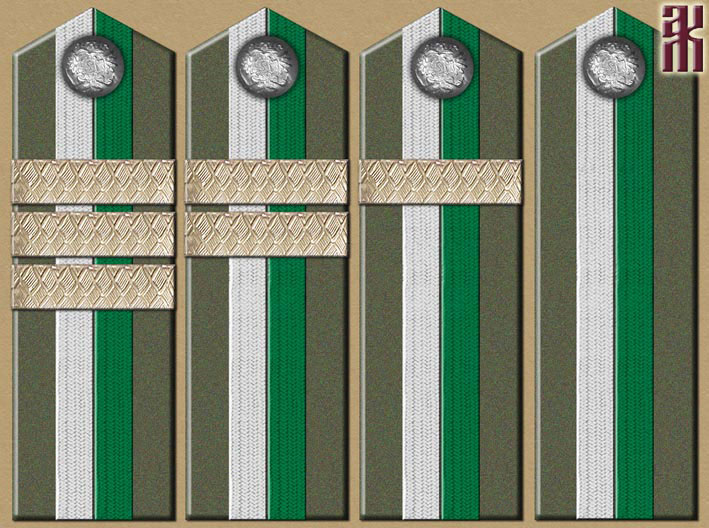
Shoulder-boards of police of the Krasnoyarsk and Enisei provinces in accordance with the 12 December 1918 order: 1 – policeman of the highest salary; 2 – policeman of average salary; 3 – policeman of the lowest salary; 4 – ordinary policeman
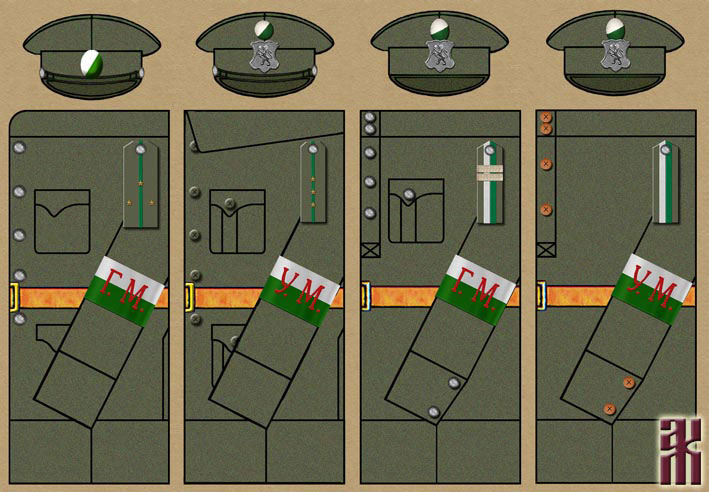
Uniforms of police of the Krasnoyarsk and Enisei provinces in accordance with the 12 December 1918 order: 1 – army officer in police service (city police);
2 – police officer (district police); 3 and 4 – ordinary policemen (city and district police)
3. Changes of 8 April 1919
Circular No. 1516 of the Police Department of the Ministry of Internal Affairs, 8 April 1919
At the same time, the Ministry of Internal Affairs forwards to you a description of the uniform of police officers and special purpose detachments, approved by the Supreme Ruler, and photographs of them.
The Ministry is looking for a way to get the fastest and best uniforms, in the approved pattern, but at present has no confidence it can guarantee that this issue will be resolved by them quickly and in full.
Therefore the Ministry considers it necessary to express the wish that you, for your part, take all possible measures in the near future to have uniforms that are as close as possible to the approved version.
If making such uniforms turns out to be completely impossible, the Ministry believes it is necessary to recommend the following solution:
When Comrade Minister Pepelyaev toured the Tomsk, Enisei and Irkutsk provinces in March of this year, he saw police in those provinces dressed in normal military uniforms, with distinctive insignia in the form of longitudinal shoulder-boards for officers of silver braid based on the previous police model, and for men made of green and white material.
Recognising the establishment of such simplified differences as extremely desirable, the Ministry believes it is necessary to recommend them as a temporary measure if they have already been introduced in the province entrusted to you. If you have not yet introduced such insignia, then the Ministry asks you to take measures to supply police officers with normal military clothing with transverse shoulder-boards for officers, of silver braid with black stripes, and for the police men made of green material.
You must inform the Ministry of Internal Affairs about the adoption of such measures to establish a regular uniform for the police.
Signed: For the manager of the Ministry of Internal Affairs, Comrade Minister Pepelyaev
Acting Director of the Police Department Agarev
Head of the department Khrashchevskiy
Published by Perm researchers D. Lobanov and K. Novikov at bergenschild.com [link dead]
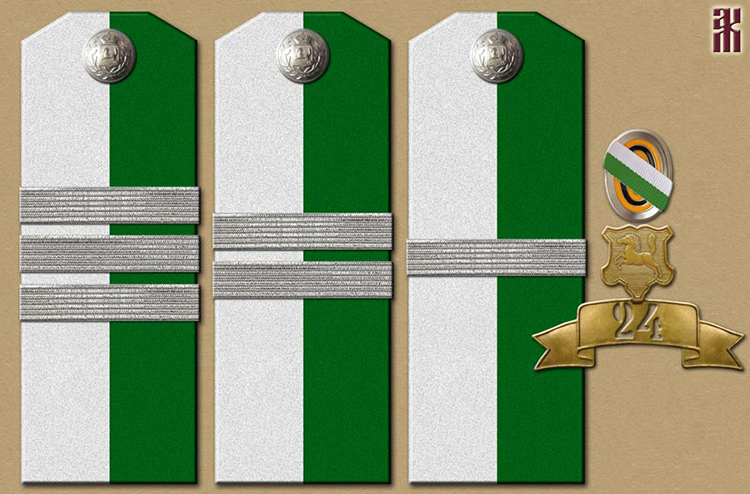
Shoulder-boards and cockade of the lower ranks of the provincial police of the Tomsk, Enisei and Irkutsk provinces: 1 – policeman of the highest salary; 2 – policeman of the average salary; 3 – policeman of the lowest salary; 4 – cockade for the Tomsk province, with the imperial crown cut from the coat of arms and the policeman's number on a metal strip
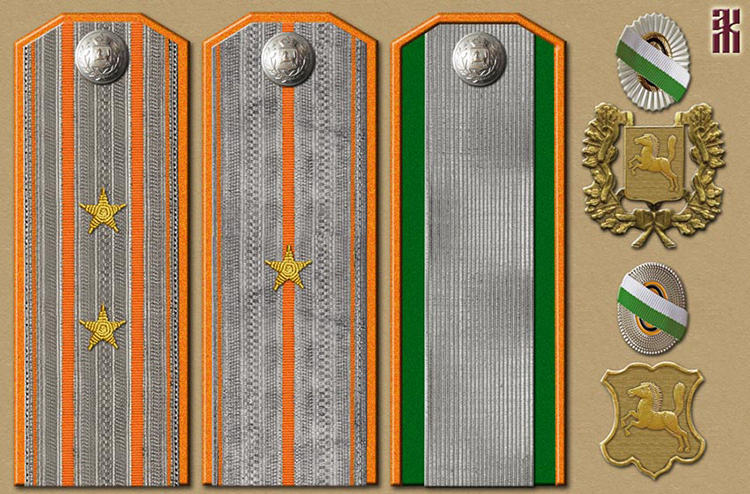
Shoulder-boards and cockades of officers of the provincial police of the Tomsk, Enisei and Irkutsk provinces: 1 – collegiate assessor; 2 – collegiate registrar; 3 – official with no rank;
4 and 5 – officer cockades of Tomsk province; 6 and 7 – no rank and heads of city districts
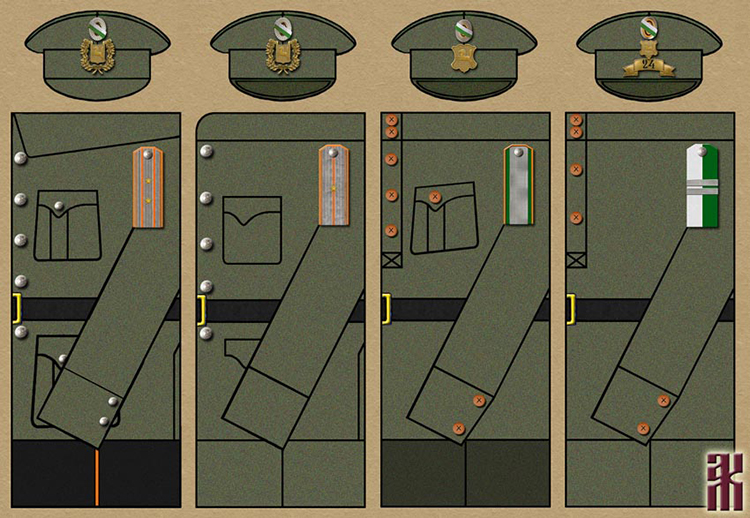
Temporary uniforms of the provincial police of the Tomsk, Enisei and Irkutsk provinces
4. Tomsk Province Police
Kansk City and District Police, April 1919
To the Head of Kansk District
In agreement with the Head of Tomsk province, I introduce the following uniform temporarily for all police: (1) For police chiefs, their assistants, and for station chiefs: white braid shoulder-boards with one red stripe. (2) For assistant district chiefs: green shoulder-boards with one white stripe. (3) For police officers: the shoulder-board is green with a white transverse stripe one and a half fingers wide. 4) For junior policemen: plain green shoulder-boards. All shoulder-boards are to be two fingers wide. Order them to be put on immediately. Remove all sleeve insignia.
Signed: Major-General Samaryaninov
Adjutant, Second-Lieutenant Azarevich
Counter-signed: Secretary Sachkov.
siberia.forum24.ru/?1-8-0-00000031-000-0-0
Tomsk city police
In March 1919 a Tomsk police squad came to the house of merchant Vtorov to arrest a certain N. T. Bayborodin. However, the latter, putting a green and white policeman's arm-band on his left sleeve, managed to escape.
Zvyagin, S. P. in "The Law Enforcement Policy of A.V. Kolchak //siberia.forum24.ru/?1-8-0-00000031-000-0-1-1329046824
Kamen' city and district police
Kamen' was then declared under martial law. More than 2,000 soldiers garrisoned the city, including a legion of White Poles. There are no more than 123 people in our partisan detachment. In order to take possession of the city and seize weapons depots, we needed serious help. ... Kolchak's white arm-bands and knowledge of the password helped our groups bypass all patrols without interference.
Korobchenko, M. S. in "There were Partisans", Barnaul, 1979, p.154.
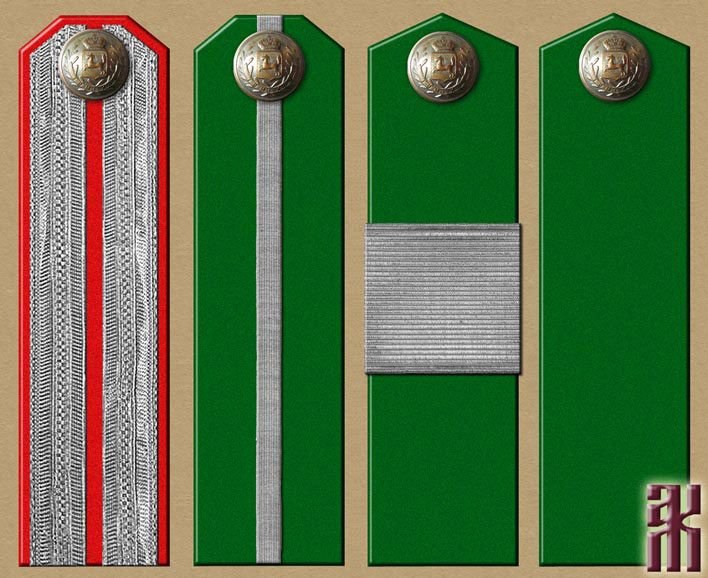
Shoulder-boards of the Kansk city and district police:
1 – chiefs of police, assistant chiefs of police and heads of stations;
2 – assistant chiefs of stations; 3 – senior policemen; 4 – junior policemen
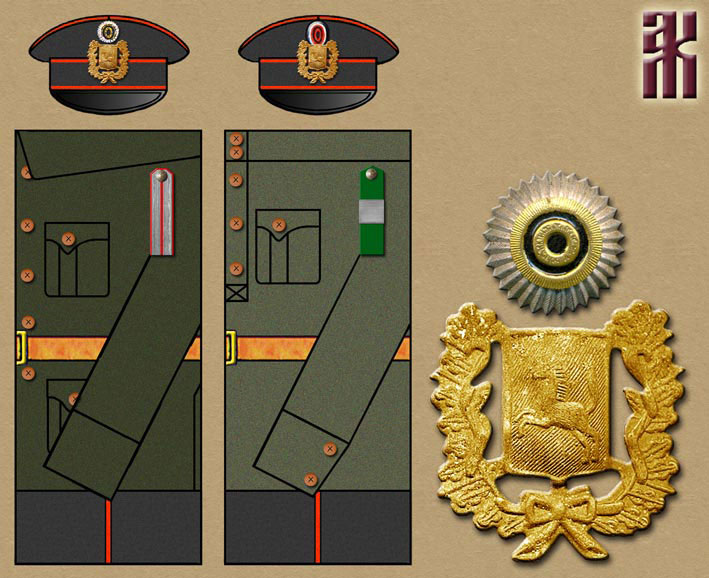
Uniform of the ranks of the Kansk city and district police: 1 – officer; 2 – senior policeman;
3 – cockade of civil officials and cockade of police of the Tomsk province
The reconstructions are based on the report of the manager of the Kansk district, General Samaryaninov. The cockade is the old model but with the Imperial crown taken off.
Home — State Symbols — Flags — Uniforms — Badges & Medals — Money — Other
Pygmy Wars Notes
The original for this page is at kolchakiya.ru/uniformology/Tomsk_Yenisei_Irkut_militia.htm.
Irsoyuz was the short form of the Irkutsk Union of Cooperatives.
Discussion on the translation choices I have made can be found here.