
Uniforms of Aviation, Automotive, and Armoured Units in Eastern Russia
All material and reconstructions are by A. Karevskiy unless noted otherwise.
As in other White armies, the officers of the motorised and armoured units in the East preferred to wear the uniforms that had been established for automobile units in the Imperial Russian Army – "Swedish" leather jackets, leather helmets, and goggles, if they could be obtained.
Automobile Units of the Supreme Ruler's Army
The shoulder-boards were of the Russian Army engineering corps design, red with silver braid and specialist insignia. Often, due to the impossibility of obtaining braid, strips of white fabric and other materials imitating silver were sewn onto the red shoulder-boards. The specialist insignia were also often made in artisanal conditions or were absent altogether.
It should be noted that the Whites in the East had few drivers, cars and armoured vehicles. Automobiles were mainly at the disposal of rear units and headquarters. However, automobiles were actively used by Czechoslovak, Polish and other interventionist units.
Ladygin, I. V. in "Distinguishing marks of Automobile Units in the Armies of the White Movement" at army.armor.kiev.ua/forma-2/belavto.shtml [link dead]
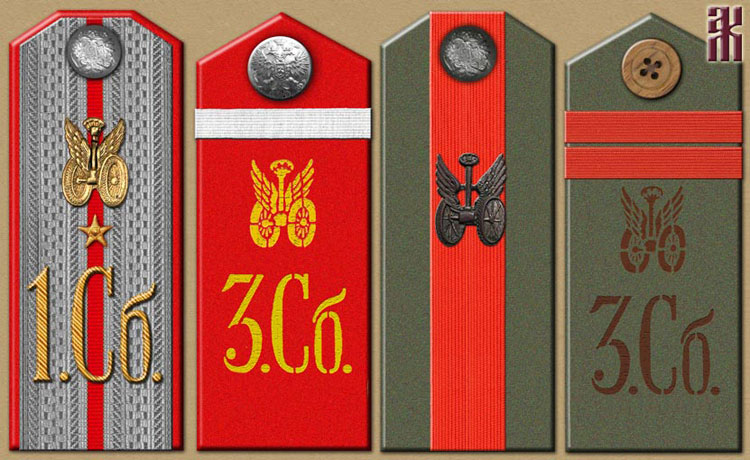
Shoulder-boards of motorised units in Eastern Russia
The ciphers refer to the number of the automobile companies with the addition of the "Сб" for "Siberian". There is a photo with such a code on the side of a vehicle.
voenforum.ru/index.php?showtopic=1335&st=0 [link dead].
Armoured Cars and Trains of the Supreme Ruler's Army
Announcement in the local Ufa press, Summer 1919
The commander of an armoured train divizion asked the young ladies of Ufa to donate two or three black skirts for the shoulder-boards of the armoured divizion he commanded.
Private communication from Ufa local historian S. G. Shushpanov.
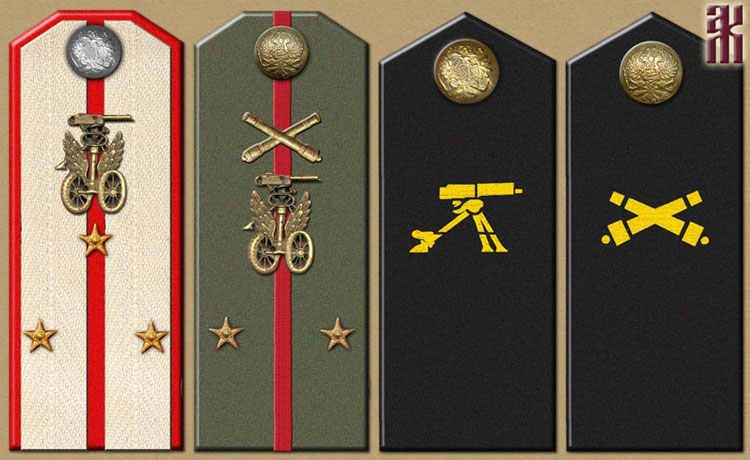
Shoulder-boards of armoured units in Eastern Russia:
1 – armoured unit (cloth tape replacing silver braid); 2 – armoured artillery unit;
3 and 4 – armoured train crew (machine gun and artillery crews, respectively).
An interesting feature is that some Russian Army armoured vehicles were marked with the specialist insignia (without the machine gun). An example of that can be seen here (from ru.wikipedia.org)
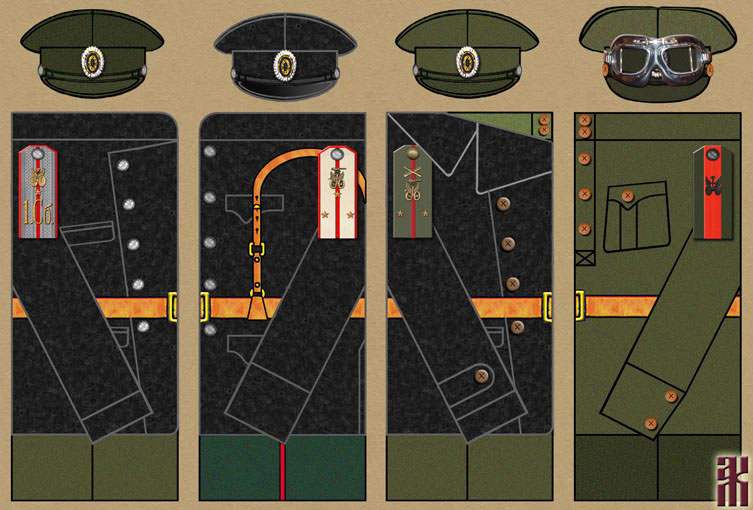
Variants of uniforms of motorised and armoured units in Eastern Russia:
2 – a leather jacket modelled on an officer's tunic; 3 – a jacket of arbitrary design
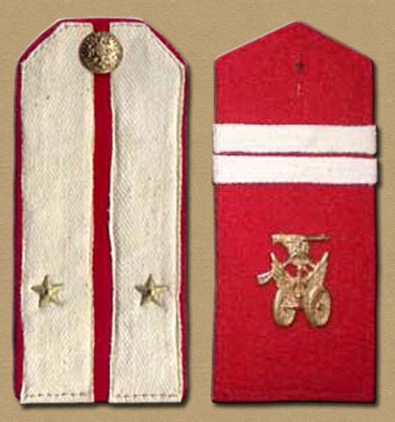
Shoulder-boards of motorised units in Eastern Russia
photos by I. V. Ladygin
www.novonikolaevsk.com/index.php?p=6 [link dead]
Aviation in the Supreme Ruler's Army
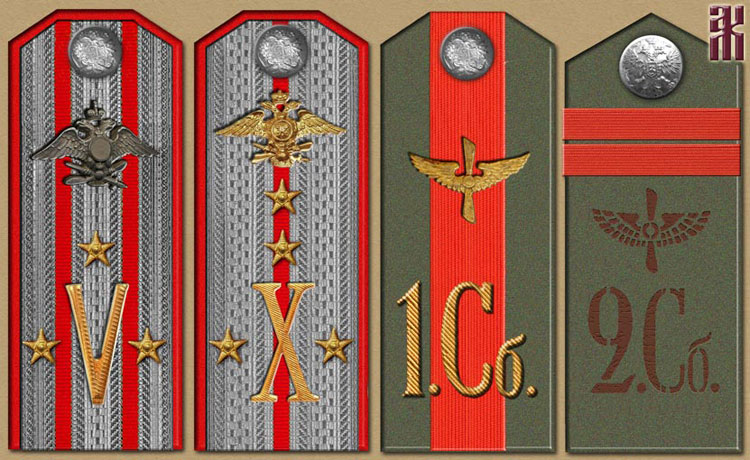
Shoulder-boards of aviation units in Eastern Russia:
1 – military pilot ("voenlet"); 2 – observer pilot ("letnab"); 3 and 4 – technical personnel
The ciphers show the aviation detachment number. It is not known whether Roman numerals were used, following the example of the aviation detachments of the former army, or Arabic numerals with the addition of the letters for "Siberia".
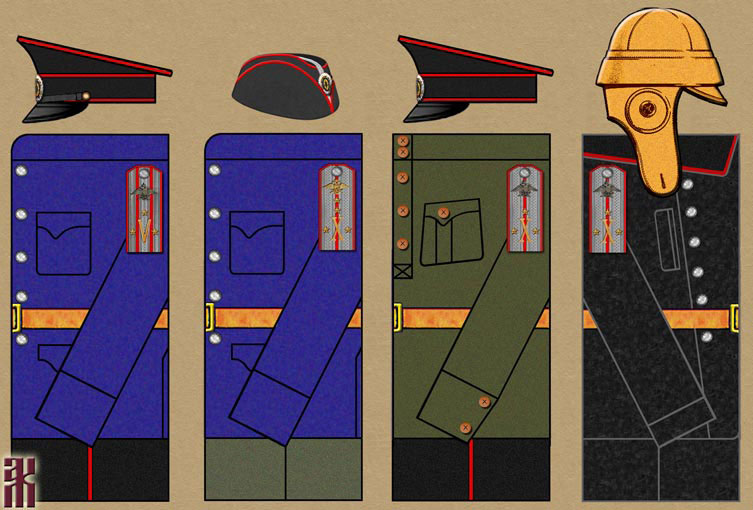
Variants of uniforms worn by aviation units in Eastern Russia.
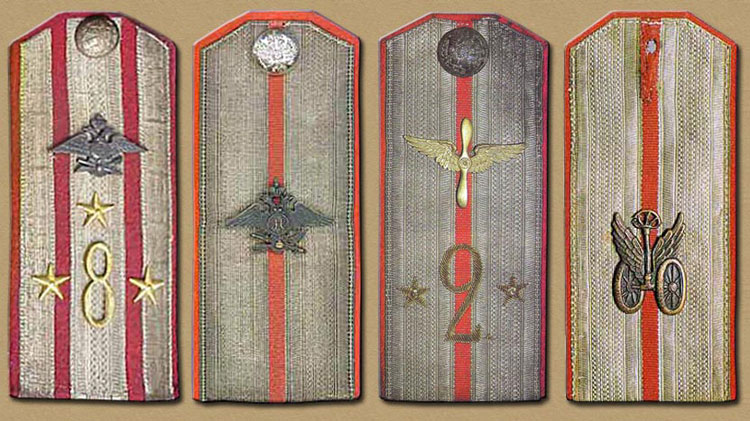
Shoulder-boards of officers of aviation and motor transport units
army.armor.kiev.ua/forma-2/belavto.shtml [link dead]
Home — State Symbols — Flags — Uniforms — Badges & Medals — Money — Other
Pygmy Wars Notes
The original for this page is at kolchakiya.ru/uniformology/technical_units.htm.
Discussion on the translation choices I have made can be found here.
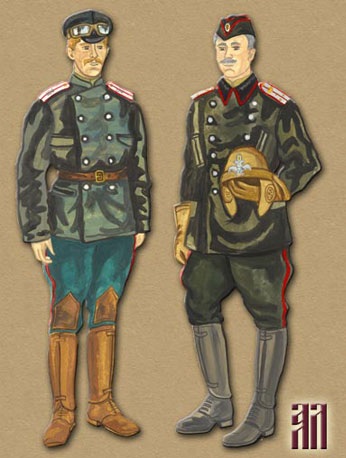
Officers of technical units in the East of Russia
The following illustration, by A. Lebedeva, was originally on the page but later removed.