
Uniforms of the Special State Security Division,
Police Department of the Ministry of Internal Affairs
in the Russian Government, February 1919-January 1920
All reconstructions are by A. Karevskiy. The main source used was the monograph by Kirmel, N. S. and Khandorin, V. G. "Kolchak's Punishing Sword", Moscow, 2015, pp.64-71, 109.
The head of the division initially had the rank of 5th Class, then 4th Class, and the position of deputy director of the Police Department of the Ministry of Internal Affairs. The heads of provincial state security administration were 5th Class rank; of district and city state security administrations were 6th Class, and the heads of an independent state security posts had 7th Class rank.
Personnel were recruited mainly from among former officials of the former Okhrana (Department for the Protection of Public Safety and Order of the Russian Empire), the Independent Gendarme Corps and the Police Department. In April 1919 all restrictions imposed in 1917 by the Provisional Government on those who had served in the gendarmerie and police were lifted.
State security officers up to and including the 9th Class were appointed by the head of the Provincial State Security Administrations, those of the 7th and 8th Classes by the provincial governors, and those of the 5th and 6th Classes by the Minister of Internal Affairs.
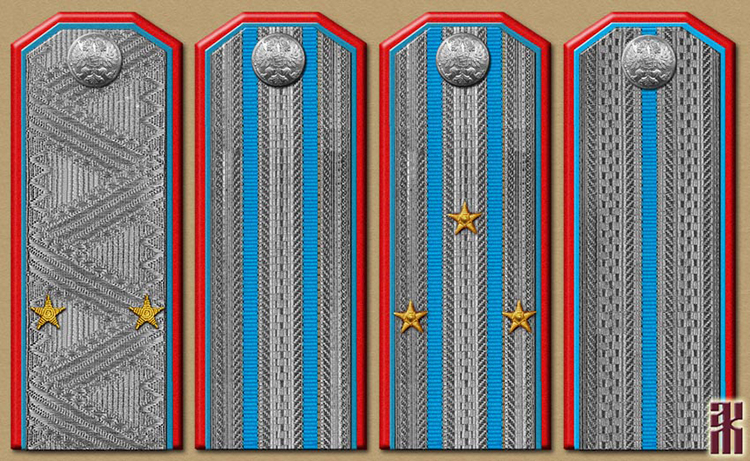
Shoulder-boards of the Independent Gendarme Corps:
1 – Major-General (4th Class); 2 – Colonel (6th Class); 3 – Lieutenant Colonel (7th Class);
4 – Captain
The head of the Special State Security Division, V. A. Babushkin, was the only major-general .
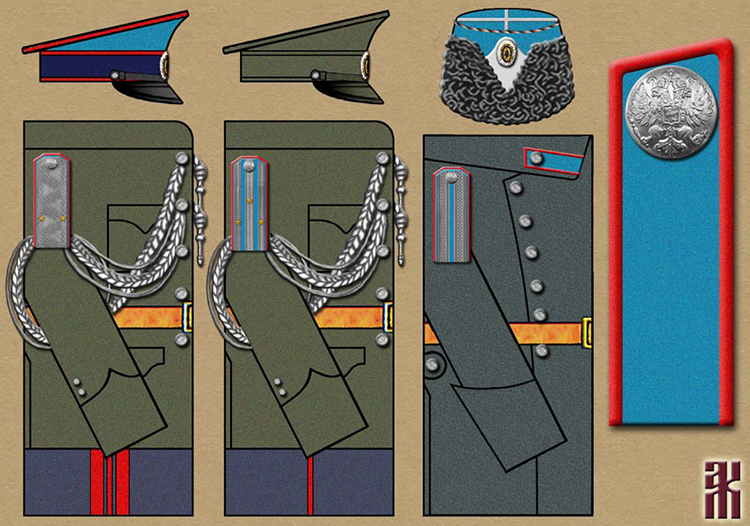
Uniforms of the Independent Gendarme Corps:
1 – coloured cap; 2 – field cap; 3 – greatcoat and dragoon cap; 4 – buttonhole tab
The colour of the Independent Corps of Gendarmes was light blue with a hint of turquoise, so-called "gendarme blue". Former officers of the corps, after its abolition by the Provisional Government, were allowed to keep their former uniforms and, after the abolition of all restrictions in 1919, to wear them again. However, the field cap was customarily worn in wartime. On the white flap in the fur trim below the cockade on the dragoon cap, there was supposed to be a metal image of the state coat of arms, but here it is shown removed, as is the white plume.
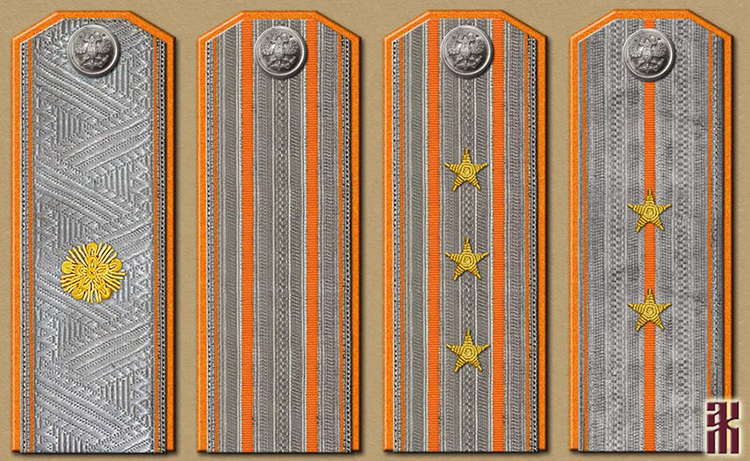
Insignia of police officers and the former Okhrana :
1 – State Councillor (5th Class); 2 – Collegiate Councillor (6th Class);
3 – Court Councillor (7th Class); 4 – Provincial Secretary
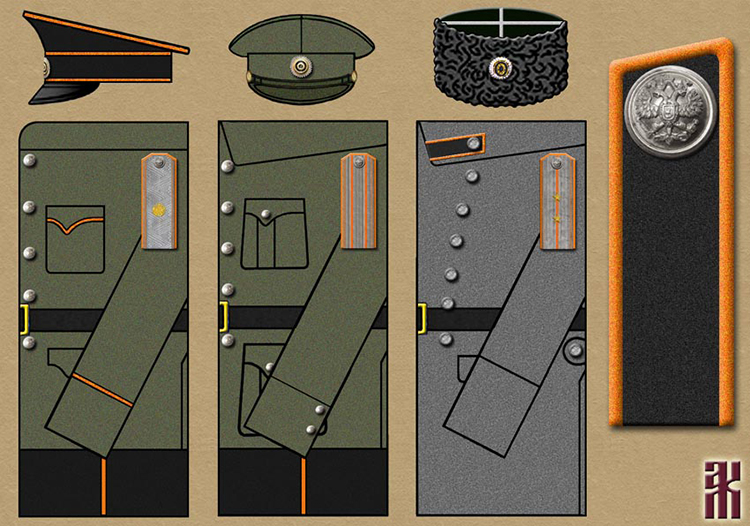
Uniforms of police officers and the former Okhrana and buttonhole tab in the police colours
Figure 1 has a cap and trousers of the previous model, established for police ranks, and a military-style field jacket with piping. Figure 2 is a military-style field cap, a khaki tunic of arbitrary cut and coloured trousers of the old police style. Figure 3 is in a greatcoat and fur hat of the old police style. During the First World War it was common for police to wear khaki uniforms with the appropriate insignia. When the police force was re-established during the Civil War this became widespread.
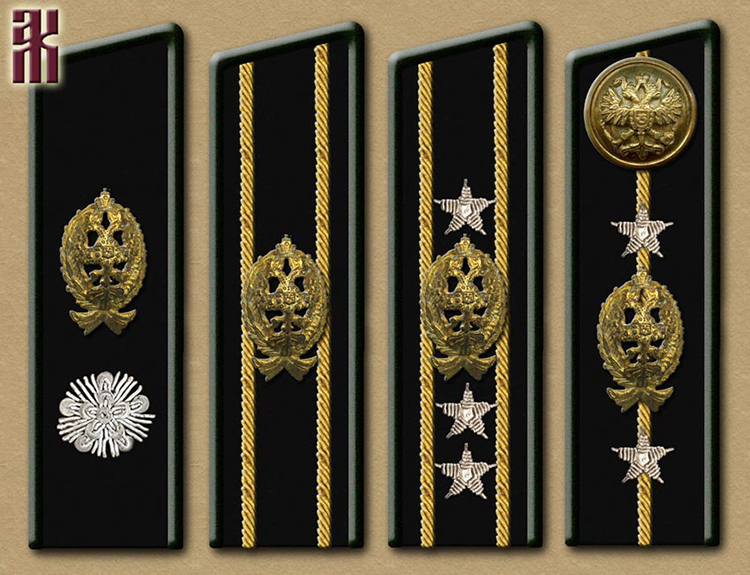
Shoulder-boards of the Ministry of Internal Affairs:
1 – State Councillor (5th Class); 2 – Collegiate Councillor (6th Class);
3 – Court Councillor (7th Class); 4 – provincial secretary
Shoulder-boards made of black velvet with dark green cloth piping were established for officials of the Ministry of Internal Affairs, to match the colour of the uniform. The shoulder-board emblems were the same as the cockade (below), but smaller. The button on Figure 4 is for greatcoats and short coats.
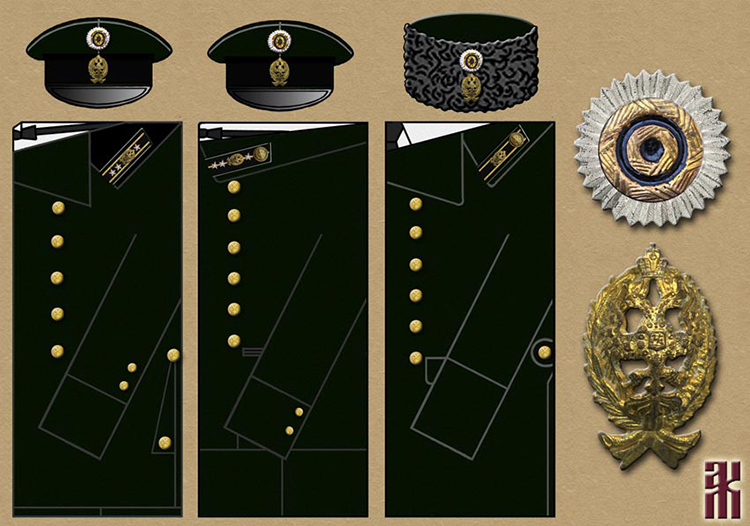
Uniforms of the Ministry of Internal Affairs:
1 – frock coat; 2 – short coat; 3 – greatcoat with fur hat
4 – civilian round cockade; 5 – Ministry of Internal Affairs cockade
The coats were made of dark green fabric with a black velvet collar. The collar could be attached to the greatcoat along with a warm lining.
A total of 17 provincial administrations were established, with 43 district offices and 54 independent offices (including four in provincial centres where no administration had been formed). Akmolinsk province had a provincial office, two district offices (Akmolinsk and Petropavlovsk) and three independent offices (Omsk, Atbasar and Kokchetav). Altai province had a provincial office, four district offices (Biysk, Zmeinogorsk, Kamenskoe and Slavgorodskoe) and two independent offices (Barnaul and Karakorum-Altai). Amur province had a provincial office only. Enisei province had a provincial office, four district offices (Achinsk, Enisei, Kansk and Minusinsk) and one independent office (Krasnoyarsk). Transbaikalia had a provincial office, three district offices (Verkhneudinsk, Nerchinsk and Troitskosavsk) and five independent offices (Akshinsk, Barguzinsk, Selenginsk, Chitinsk and Nerchinsk). Irkutsk province had a provincial office, four district offices (Bodaybinsk, Verkholensk, Nizhneudinsk and Cheremkhovo) and six independent offices (Angarsk, Balagansk, Irkutsk, Kirensk, Tunkinsk and Ekhirk-Bulagatsk). Kamchatka only had one office in Petropavlovsk-Kamchatsk, subordinate to the Primorsk Provincial Administration. Orenburg province had a provincial office, 4four district offices (Verkhneuralsk, Orsky Troitske and Chelyabinsk) and one independent office (Orenburg). Perm province had a provincial office, five district offices (Ekaterinburg, Kamyshlov, Krasno-Ufimsk, Kungur and Irbit) and four independent offices (Verkhoture, Solikamsk, Perm and Cherdyn). Primorsky province had a provincial office, three district offices (Nikolaevsk-on-Amur, Nikolsk-Ussuriysk and Khabarovsk) and two independent offices (Imansk and Olginsk). Sakhalin province had an independent office in Aleksandrovsk, subordinate to the Nikolayevsk-on-Amur district administration of the Primorsk Regional Administration). Semipalatinsk province had one provincial office, two district offices (Pavlodar and Ust-Kamenogorsk) and three independent offices (Zaisan, Karkalinsk and Semipalatinsk). Semirechensk province had a provincial office, one district office (Vernensk) and six independent offices (Dzharkent, Kopal, Lepsinsk, Pishpek, Przhevalsk and Sergiopol). Tobolsk province had a provincial office, four district offices (Kurgan, Tyukalinsk, Tyumen and Yalutorov) and five independent offices (Berezovsk, Ishim, Surgut, Tarsk and Tobolsk). Tomsk province had a provincial office, four district offices (Kainsk, Kuznetsk, Mariinsk and Novonikolaev) and five independent offices (Anzhersk, Tatarsk, Togurt, Tomsk and Shcheglov). Turgai province had a provincial office and four independent offices (Aktyubinsk, Irshesk, Kustanaisk and Turgai). Ufa province had a provincial office, three district offices (Birsk, Zlatoust and Sterlitamak) and three independent offices (Belebeev, Menzelinsk and Ufa). Ural province only had a provincial administration. Uryankhai province (Tuva) had a district branch in Belotsarsk Yakut province had a branch in Yakutsk. In addition, the Harbin State Security Administration (with provincial rights) was established in the CER exclusion zone.
Home — State Symbols — Flags — Uniforms — Badges & Medals — Money — Other
Pygmy Wars Notes
The original for this page is at kolchakiya.ru/uniformology/state_protection.htm.
The Okhrana was the Tsarist secret police force.
Russia had a complex system of upper level territorial division into oblast, guberniya and krai. I have simply called them all "provinces", as the fine distinctions do not really matter. Discussion on other translation choices I have made can be found here.