
Uniforms of the Mountain Horse Partisan Detachment
of Ataman I. N. Solov'ev, 1920-1924
named after Grand Duke Mikhail Alexandrovich
All material and reconstructions are by A. Karevskiy.
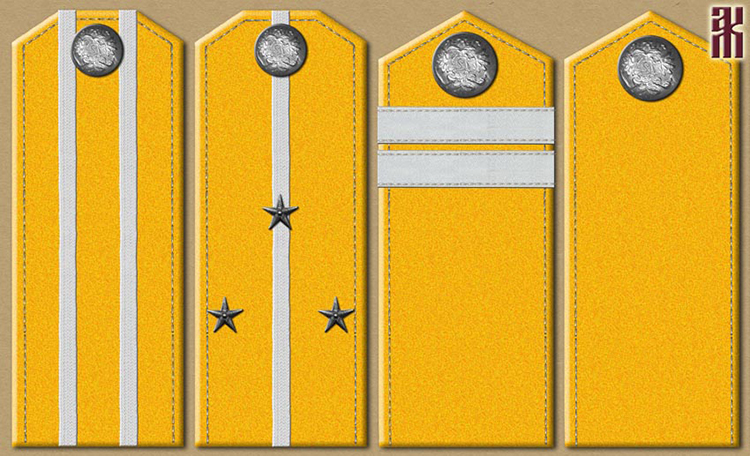
Shoulder-boards of the Mountain Horse Partisan Detachment
According to descriptions, they were all handmade from yellow material (the colour of the Enisei Cossack Host) with white cloth stripes (for officers) or braid (for NCOs) sewn on.
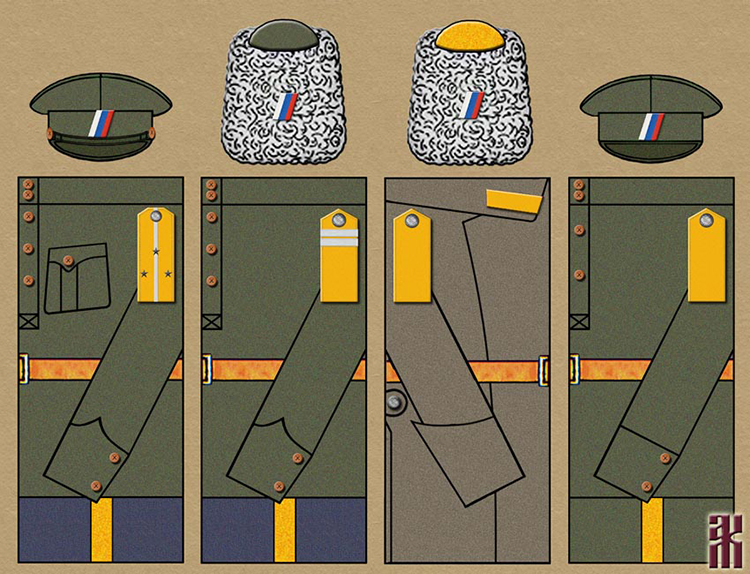
Uniforms of the Mountain Horse Partisan Detachment
All enemy documents note the high quality and uniformity of the detachment's clothing, which followed the Cossack model. The yellow colour of the uniform details (including the stripes on the trousers) was inherited by the detachment from the Enisei Cossack Host. Figure 4 shows an infantry uniform, but with yellow stripes sewn onto khaki trousers (partisans from the former Army of the Supreme Ruler). The cockade in the form of a ribbon in the national colours is extrapolated from the detachment's tricolour banner.
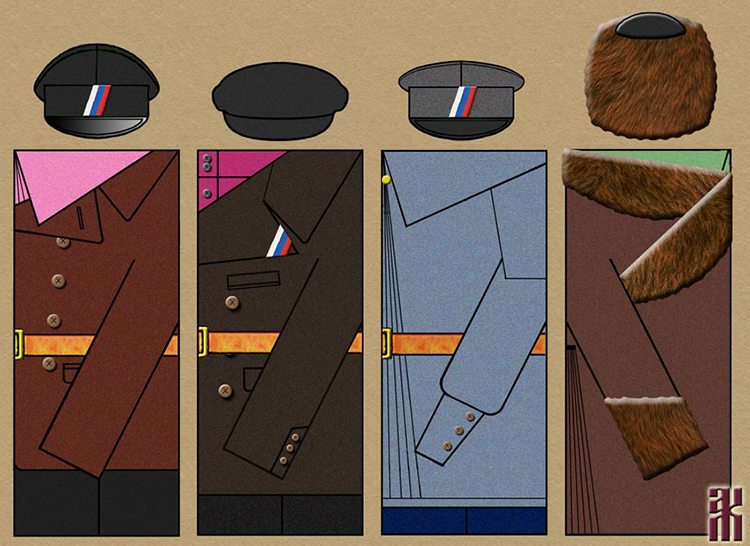
Clothing of volunteer partisans from among the indigenous Khakass population
Figure 1 shows a traditional blouse, a kochenek, worn under a jacket. Figure 3 shows the same blouse without outer clothing. Figure 2 shows a Russian kosovorotka, peasant smock, heavily adopted by the Khakass from Russian settlers. Figure 4 shows winter clothing – a fur hat and a ton coat.
The actions of the rebel detachment were facilitated by the taiga, the mountains, the remoteness of the Minusinsk Basin from large cities (and even more so from the centre of the country), the sympathy of the local population (indigenous and Khakass) for the rebels, but also, of course, the personal qualities of the man who led the detachment. He named the detachment after the Grand Duke, the brother of Tsar Mikhail Alexandrovich. He wrote "For Faith, Tsar and Fatherland" on the banner, introduced shoulder-boards, and established discipline.
In Memoirs and Historiography
Solov'ev, Ivan Nikolaevich. 32 years old, married. Has two children and father in the gang. Born approximately 1894. Father 60 years old, gang quartermaster.
Chief of Staff – Makarov, Alexei Kuzmich. Ex-colonel in the Tsarist army.
Adjutant – Korolev, Vladimir Ivanovich. 28 years old, ensign, educated as an agronomist. Wears a uniform with ensign's shoulder-boards, yellow shoulder-boards.
Head of Intelligence – Astanaev, Sil'verst Yakovlevich. He is 26 years old and comes from the Charkov ulus, Sinyavinsk district. Illiterate. (Obviously, this is mistaken. According to other information obtained, in particular, a personal conversation with his great-grandson, Vasily Sergeevich Astanaev, Sil'verst Yakovlevich studied at Tomsk University.)
Captain-at-Arms – Talkin Prokopiy. Indigenous non-Russian, 40 years old, from the Sarala ulus, Kizyl district.
Platoon commander 1. Kulbesteev, Konstantin Grigorievich. 28 years old, from the Sarala ulus, indigenous non-Russian.
Commander 2. Kulakov, Dmitry. 27 years old, indigenous non-Russian.
Shepachev, Pavel – senior machine gunner, Cossack, 30 years old, from the Teplaya Rechka ulus, Kizyl district.
A court of honour has been established. There is a prayer: "Save your people, Lord, and preserve your possessions..." There is a daily evening roll call to gather the gang. The gang is called "The Grand Duke Mikhail Alexandrovich Mountain and Horse Partisan Detachment".
All are armed with rifles, sabres, revolvers, and there is artillery. The uniforms are identical, of good quality, and in good condition. Everyone in the gang is highly conscious, and on the basis of that they carry out their duties unquestioningly and conscientiously. ... The gang has a set of orders. ...
From the ChON archive, Achinsk branch of GAKK F.1697 Op.3 D.18 L.193.
Achinsk-Minusinsk combat zone, Uzhur, 16 July 1923.
Intelligence reports indicate that the gangs of Solov'ev and Kulakov have joined forces and are operating together. They have four machine guns, are armed with three-line rifles and have a large supply of ammunition. They are well equipped. According to the population, the gang carries a banner reading: "For Faith, Tsar and Fatherland" and calls itself the detachment named after Grand Duke Mikhail Alexandrovich. The gang leader wears colonel's shoulder-boards. They address each other as "Mr. So-and-so".
Direct telephone conversation between Ust'-Abakan (Chebaki, Urevkom member) and Almakaev (Itygin, pre-Urevkom).
G. I. Itygin:
On 31 March I personally negotiated with the bandit Solov'ev. He surrendered some of his weapons, signed a pledge to disband the gang and stated his desire to return to peaceful labour. He was accompanied by four bandits, all of whom declared their allegiance to the Soviet authorities. ... Solov'ev (unclear) ... the rest of the bandits and, with their arrival, promised to surrender their weapons, and renounce his title of commander of the partisan detachment. We cut off the bandits' shoulder-boards, insignia, and headgear. We parted as friends.
Solov'ev fought against the Bolsheviks in Kolchak's army. After the Reds won, he returned to his native places, to the Beliy Iyus River, to the floodplain of that river, to the hills decorated with sub-taiga birch, shining brightly, especially in autumn. Ivan Nikolaevich loved his homeland dearly. And no matter how much they tried to persuade him later, when he already had a family, to go to Mongolia and then on to China, where the remnants of Kolchak's army had gone, he did not want to leave his native land.
In Kolchak's army, he was either a sergeant or a lieutenant (I am not very familiar with Cossack ranks, especially when relating them into normal army ranks), but he signed his proclamations and orders as Captain Solov'ev. I do not think this was impersonation. Nor should he be condemned for allowing himself, as commander of a combat unit, to wear the shoulder-boards of a Russian army colonel. After all, the chief of staff in his unit was the uniformed and legitimate Tsarist colonel Alexei Kuzmich Makarov. It would have been unseemly for a colonel to serve under a captain.
Soloukhin, V. A. in "Salt Lake" at www.rus-sky.com/gosudarstvo/solouhin/slt_lake.htm
Solov'ev and his followers were apparently no strangers to monarchist views. He is referred to as an "old partisan with staunch monarchist views" in the minutes of a meeting of rebel commanders. Zinov'ev also recalled that Solov'ev was a "pure monarchist".' Yu. P. Alekhin testifies that Solov'ev's followers acted under the slogans "For a united and indivisible Russian Empire!" The existence of their slogan "For faith, Tsar and fatherland" is confirmed by Chonovskiy and court documents. However, the monarchist orientation, its attributes and the ranks of the old army were used by rebel leaders both before and after Solov'ev. In Bazarkin's detachment in 1921, most of which consisted of former NCOs of the old armies, the Imperial anthem was performed at roll call, and the officers wore shoulder-boards. Lieutenant Erofeev, the deceased chief of staff of the Oliferov detachment, who allegedly sought to restore the monarchy, was found to be in possession of the seal of a military unit named for Mikhail Alexandrovich. When Kulakov's "gang" was liquidated, an identity card stamped with the seal "First Partisan Regiment named after Mikhail Alexandrovich" was seized as a trophy. Finally, in April 1922 "Captain" Rodionov's detachment, which Zinov'ev recalled had no ordinary soldier left as a result of the promotion of "officers" and "NCOs", there was a flag with the inscription "For faith, Tsar and fatherland!"
Some peasants may have perceived autocracy as a form of government that maintained relative order and stability in their lives during turbulent times. These external and insignificant signs of the rebels' commitment to the monarchist idea, while not reflecting the essence of their movement, increased its authority among participants and the population. They were designed to attract supporters and increase their own combat effectiveness. "Constitutional monarchism" was introduced into Solov'ev's detachment by "Lieutenant" Zinov'ev and "Ensign" Kovalev, who defected to him from Rodionov's "gang" only in June 1922. Solov'ev himself, according to the observations of his contemporaries, had no political convictions and put forward monarchist slogans under the influence of other rebels and because of his ignorance of other forms of government.
Sheksheev, A. P. in "We are in our Native Taiga, Solov'ev, with you... // White Guard Almanac No. 8", Moscow, 2005, pp. 256-263.
The detachment had a tricolour banner with the inscription "For Faith, Tsar and Fatherland".
Annenko, A. in "Triumph and Tragedy of the Emperor of the Taiga", Abakan, 2012 at www.proza.ru/2014/06/26/909
Historians write: "Solov'ev's detachment was organised along the lines of a regular military unit and consisted at various times of 6-15 to 200-500 horsemen, dressed either in Cossack uniforms with shoulder-boards and trouser stripes or in Red Army uniforms. Armed not only with three-line rifles, revolvers and grenades, but also three or four machine guns of various types (there is also information about four guns) ... There were also smaller groups in the Minusinsk district, led by S. Astanaev, M. Mainagashov, M. Shadrin, and N. Kulakov. G. Rodionov, A. Kiykov, and others. The bandit groups were either part of Solov'ev's detachment or, having split off from it, were located in different districts and acted independently."
Sheksheev, A. P. in "The Bandit Movement and the Fight Against It in the Achinsk-Minusinsk Region // Yearbook of the Institute of Sayan-Altai Turkology, Issue 1", Abakan, 1997. pp.103-104 at www.proza.ru/2014/06/26/909.
Nachoperstab Zubanov reports that on 1 October, Solov'ev's gang attacked a cavalry reconnaissance detachment. The fate of three Red Army soldiers is unknown. Zubanov warns the commanders: "It should be noted that Solov'ev's gang currently has common clothing, greatcoats, and government-issue saddles, so when encountering detachments, it is necessary to approach each other with great caution in order to avoid being caught off guard, since Solov'ev, having government property and uniforms, uses this to his advantage."
Report by Chief of Staff Zubanov on 2 October 1923 – ODNI GKU RK "NA" F.14 Op.1 D.42 L.84 at www.proza.ru/2014/06/26/909.
The political aspect manifested itself in proclamations and leaflets written by the detachment's chief of staff, former agronomist A. K. Zinov'ev (pseudonym "Colonel Zak"), in which the Solov'evtsy called themselves "White partisans" and proclaimed slogans such as "For the Constituent Assembly", "For non-party soviets and against communists", and "For the liberation of the indigenous". Their tricolour banner was embroidered with the inscription "For Faith, Tsar and Fatherland".
Home — State Symbols — Flags — Uniforms — Badges & Medals — Money — Other
Pygmy Wars Notes
The original for this page is at kolchakiya.ru/uniformology/Solovievs_rebels.htm.
An ulus is a traditional tribal village. A Nachoperstab was Chief of Operational Staff.
I have used "indigenous non-Russian" for inorodtsyy (meaning Khakass presumably from the context). The "Mr So-and-so" a reference to them using the old-style gospodin, rather than the revolutionary "comrade". Discussion on other translation choices I have made can be found here.