
Uniforms of the Siberian Cossack Corps, 1919-21
All material and reconstructions by A. Karevskiy, unless noted otherwise.
However, judging by the [number of] machine guns, the cavalry regiments were mainly equipped with firearms. Most of the Cossacks had sabres, although some were old: the 1838 model for lower ranks. There is no data on whether there were lances and in what quantity. They apparently managed to "make" and "complete" the uniforms. The Cossacks themselves went into service with Russian uniforms, which were also produced by the military workshops. However, almost all of the conscripted soldiers either had incomplete uniforms or no uniforms at all. Therefore, the vast majority of the corps' officers ended up wearing uniforms issued from the War Ministry's reserves. The summer uniforms were most likely mainly British. The winter uniforms may also have included English military coats. The winter uniforms issued by the treasury did not include the sheepskin coats and felt boots that were so necessary in local conditions. Of course, this was not important in August to September, but it had a serious impact at the beginning of the Great Siberian Campaign.
The corps headquarters and the military ataman personally tried to give the units at some semblance of uniforms. Attention was also paid to distinguishing marks. Traditional Siberian colours, letters, special marks, etc. were used. Thus, Order No. 15 of 21 August 1919 to the Siberian Cossack Corps established the form of shoulder-boards for all corps officers.
The shoulder-boards of Cossacks, both officers and lower ranks, was to be red. The previous bright scarlet colour was abandoned, apparently because it was impossible to find the necessary amount of fabric of that shade in the conditions. The stripes on the officers' shoulder-boards were to be grey-blue. Pre-revolutionary ciphers were used for officer and Cossack shoulder-boards, namely: the unit number plus the letters for the host – "Сб". For example, "7.Сб." stood for the 7th Siberian (Cossack Regiment). The ciphers for artillery divizions and engineer companies included the numbers of the divisions to which they belonged. For example, "5.Сб." for the 5th Siberian (Engineer Company of the 5th Siberian Cossack Division) and "3.Сб." for the 3rd Siberian (Cossack Horse Artillery Divizion of the 3rd Siberian Cossack Division). The cipher was applied to the shoulder-boards using a stencil and blue oil paint.
To distinguish between the different units and regiments with the same cipher (for example, "5.Сб." being used by all of the 5th Engineer Company, the 5th Artillery Divizion, and the 5th Siberian Cossack Regiment), the Russian Army insignia for the specialist units were added: crossed cannons for artillery units and a crossed pickaxe and spade for engineer units. The former, by Corps Order No. 15, was to be used for both artillery divizions and independent batteries, the latter for engineer companies, including horse engineers. So an ensign of the 3rd Artillery Divizion, for example, was supposed to have a single grey-blue stripe down the middle, two stars, the blue cipher "3.Сб." and the insignia of crossed cannons on his red shoulder-boards. It is unlikely that the corps supply department had time to produce metal-stamped insignia, so it is almost certain that they were also applied to shoulder-boards with stencil paint. There may have been cases of homemade embroidered insignia, or metal ones preserved by some Cossacks who served in artillery batteries and horse engineer units during the World War.
Order No. 15 does not make it entirely clear what cipher should have been on the shoulder-boards of the officers of the two independent batteries of the Independent Siberian Cossack Brigade. Presumably, by analogy with the cipher of the Independent Plastun Battalion of the same brigade, it was "2.Отд.Сб.", for the 2nd Independent Siberian (Cossack Battery of the 1st Independent Siberian Cossack Brigade).
Officers and soldiers of the plastun [i.e infantry] battalions were issued with khaki shoulder-boards with red piping. The officers' shoulder-boards were also red. The cipher was of the form: "4.Сб.П.", for the 4th Siberian (Cossack Division's) Plastun (Battalion); "Отд.Сб.П." for the Independent Siberian (Cossack Brigade's) Plastun (Battalion); etc. Officers and soldiers of the plastun battalions wore trouser stripes 1 inch (25 mm) wide, which were significantly narrower than those of the normal Cossacks (45 mm).
Soldiers and officers (non-Cossacks?) of the HQs and corps administrations had special HQ shoulder-boards, which were khaki with white piping and red stripes for officers. There was a cipher for the corps or division: for example, "В.Сб." for (staff of the) Siberian Host (Cossack Corps); "5.Сб." for the (administration of the) 5th Siberian (Cossack Division); etc. It is not entirely clear whether this also applied to Cossacks serving at those HQs and administrations. Most likely not. So the same ciphers would be used for the staff Cossacks, red shoulder-boards with white edging, and the staff Cossack officers, the same but with grey-blue stripes.
The wagon drivers (who were not mentioned in the order) probably had plain field shoulder-boards: red for the Cossacks and khaki for the others.
According to Order No. 15 of the Siberian Cossack Corps, dated 21 August, the head of corps supplies was to make samples of shoulder-boards and, no later than 1 September 1919, produce them in quantities sufficient for all units, headquarters and departments of the corps. Unfortunately, it is not known whether the supply department was able to meet the deadline, or whether all units of the corps received new shoulder-boards.
Shuldyakov, V. A. in "The Demise of the Siberian Cossack Army, 1917-1920, Book 1", Moscow, 2004, pp.382-384.
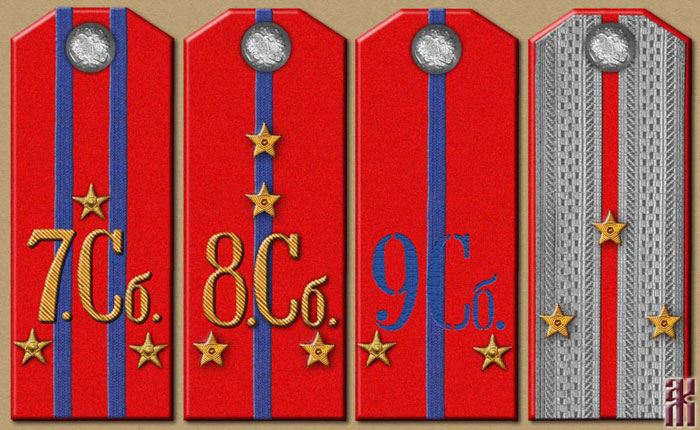
Shoulder-boards of officers of the 3rd Siberian Cossack Division:
1 – lieutenant-colonel of the 7th Siberian Cossack Regiment;
2 – staff-captain of the 8th Siberian Cossack Regiment;
3 – second-lieutenant of the 9th Siberian Cossack Regiment;
4 – lieutenant without unit cipher
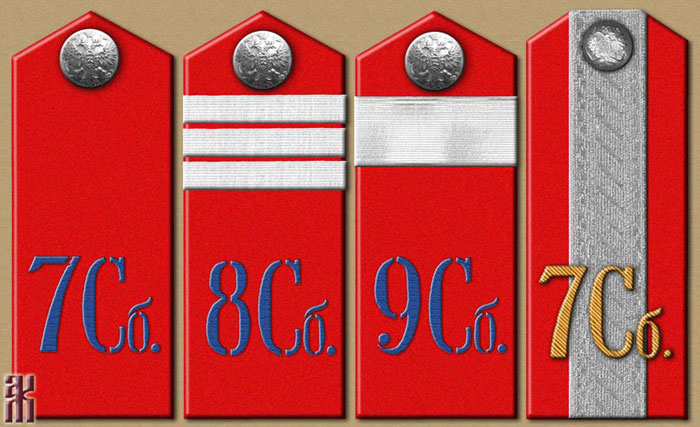
Shoulder-boards of other ranks of the regiments of the 3rd Siberian Cossack Division:
1 – cossack (private) of the 7th Siberian Cossack Regiment;
2 – sergeant of the 8th Siberian Cossack Regiment;
3 – sergeant-major of the 9th Siberian Cossack Regiment;
4 – sub-ensign of the 7th Siberian Cossack Regiment
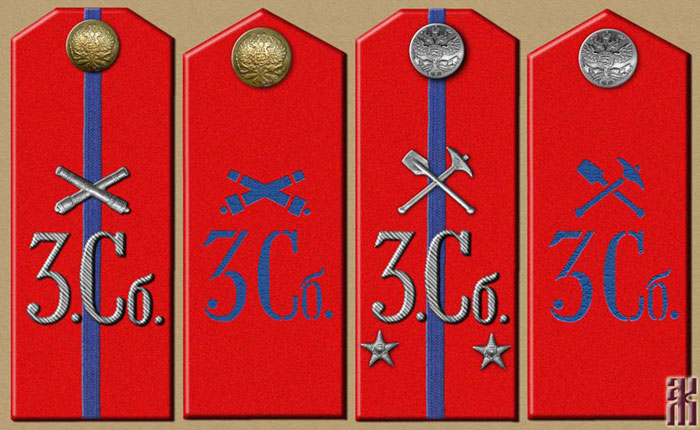
Shoulder-boards of artillery and technical units of the Siberian Cossack Corps:
1 and 2 – captain and gunner of the 3rd Siberian Cossack Artillery Divizion;
3 and 4 – second-lieutenant and sapper of the 3rd Siberian (Horse) Engineer Sotnia
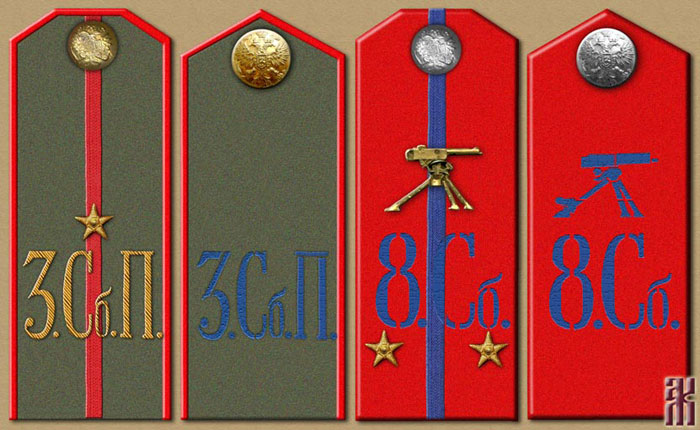
Shoulder-boards of the infantry and machine gun units of the Siberian Cossack Corps:
1 and 2 – ensign and cossack of the Plastun Battalion of the 3rd Siberian Cossack Division;
3 and 4 – second-lieutenant and private of the machine gun komand of the 8th Siberian Cossack Regiment
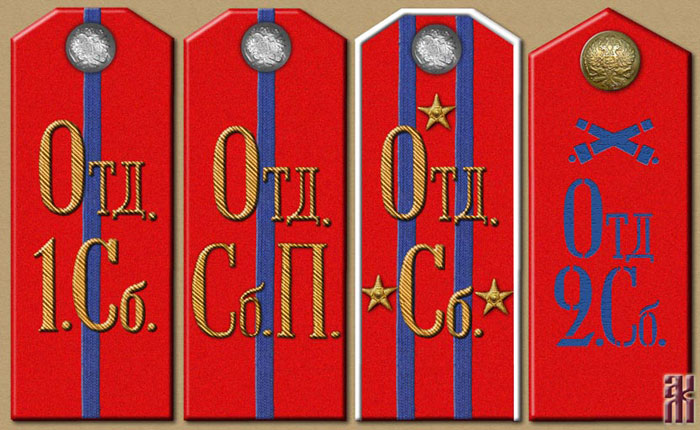
Shoulder-boards of the Independent Siberian Cossack Brigade:
1 – captain of the 1st Independent Siberian Cossack Regiment;
2 – captain of the Plastun Battalion of the Independent Siberian Cossack Brigade;
3 – lieutenant-colonel of the Independent Siberian Cossack Brigade's staff;
4 – gunner of the 2nd Independent Siberian Cossack Battery
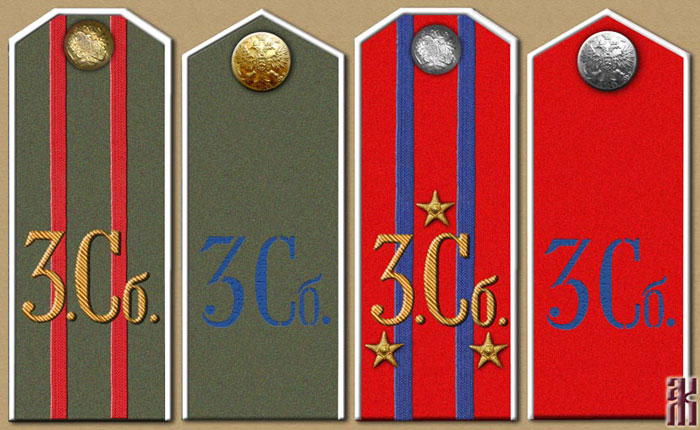
Shoulder-boards of the divisional staff of the 3rd Siberian Cossack Division:
1 and 2 – non-Cossacks, colonel and private;
3 and 4 – Cossacks, lieutenant-colonel and cossack
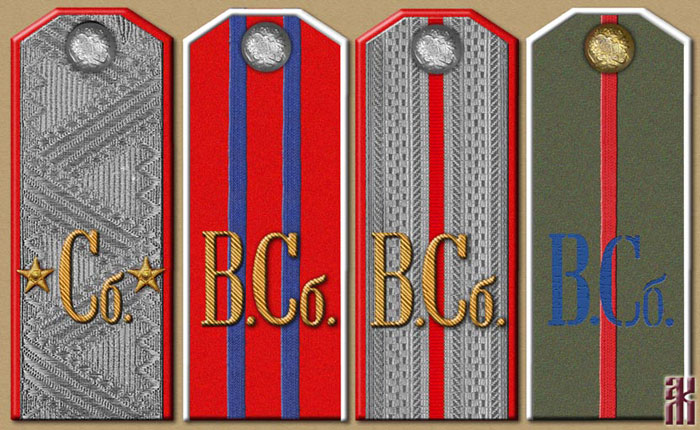
Shoulder-boards of the staff of the Siberian Host Cossack Corps:
1 – major-general in the Staff of the Ataman of the Siberian Cossack Host;
2 and 3 – Cossack colonel and captain in the staff of the Siberian Cossack Host;
4 – non-Cossack captain in the Staff of the Siberian Cossack Host
The ermakovka was a type of uniform blouse in the Siberian and Semirechensk Cossack regiments. Its distinctive features were a chest piece [over the blouse opening] and pockets for rifle cartridges. There was coloured braid along the edges of the chest piece, collar, and, less often, the sleeves. It dates back to the Cossack blouses of the Turkestan campaigns. At the beginning of the 20th century ermakovkas were prohibited as a piece of army uniform. During the First World War liberties in uniform started to be taken, for a number of reasons, and officers and Cossacks began to wear ermakovkas again. During the Civil War, they were widely worn in the Siberian and Semirechensk Cossack units and also by the partisans of the Annenkov and Krasilnikov detachments.
Shuldyakov, V. A. in "The Demise of the Siberian Cossack Army, 1917-1920, Book 1", Moscow, 2004, pp.664-665.
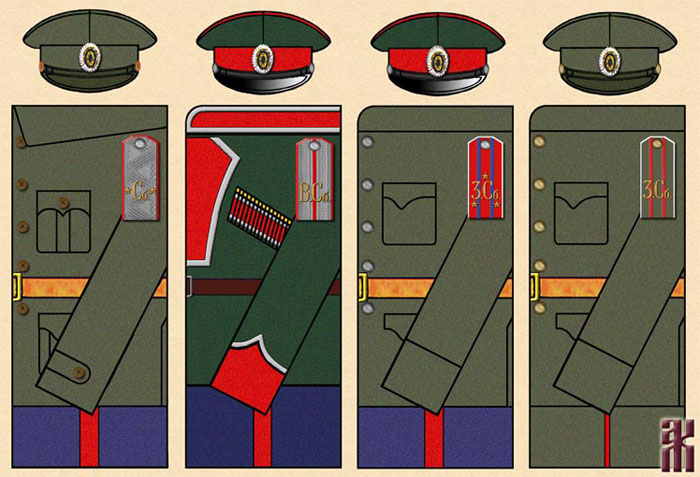
Uniforms of the Siberian Cossack Corps:
1 – major-general at the Headquarters of the Ataman of the Siberian Cossack Host;
2 – colonel at the Headquarters of the Siberian Cossack Corps (dress uniform ermakovka);
3 – Cossack lieutenant-colonel serving in a combat headquarters;
4 – non-Cossack colonel serving in a combat headquarters
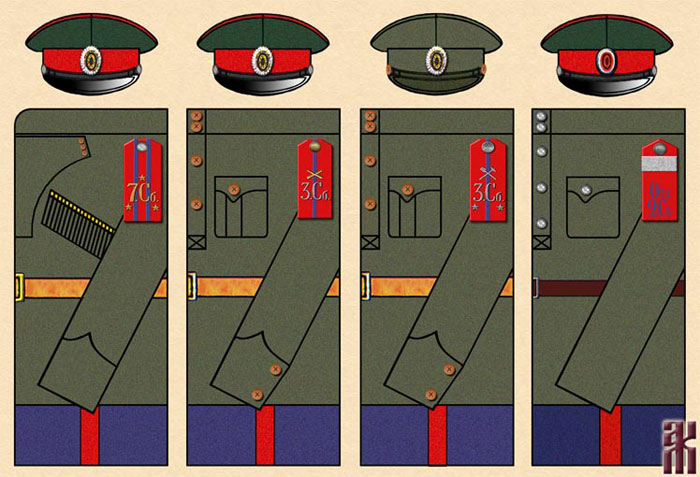
Uniforms of the Siberian Cossack Corps:
1 – lieutenant-colonel of the 7th Siberian Cossack Regiment, in an ermakovka;
2 – sub-ensign in the 3rd Cossack Artillery Divizion ;
3 – second-lieutenant in the 3rd Siberian (Horse) Engineer Company;
4 – sergeant-major in the 2nd Independent Siberian Cossack Regiment
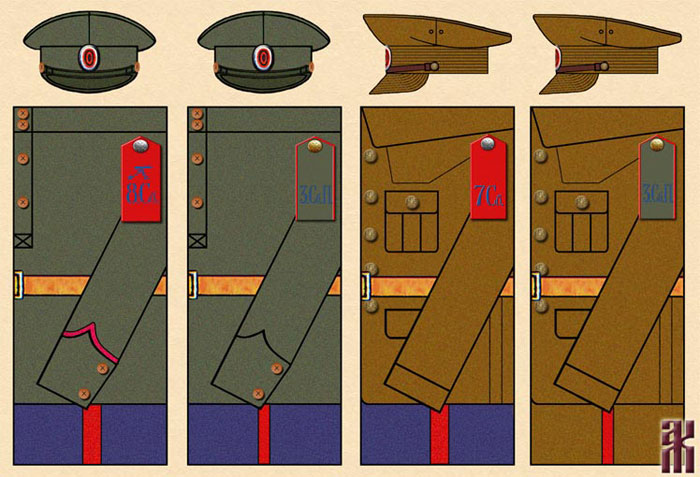
Uniforms of the Siberian Cossack Corps:
1 – private in the 8th Siberian Cossack Regiment's machine gun komand ;
2 – private in the Plastun Battalion of the 3rd Siberian Cossack Regiment;
3 – cossack in the 7th Siberian Cossack Regiment (in British uniform with Russian trousers);
4 – private in the Plastun Battalion of the 3rd Siberian Cossack Regiment (in British uniform)
Figure 1 has red braid on the cuffs. Figures 2 and 4 have narrower trouser stripes.
Home — State Symbols — Flags — Uniforms — Badges & Medals — Money — Other
Pygmy Wars Notes
The original for this page is at kolchakiya.ru/uniformology/siberiya_cossacs_corp.htm.
The "Siberian" in this case refers only to the specifically Siberian Cossack Host units, not Cossacks in Siberia as a whole. That host was actually quite small, and Kolchak's army had far more Orenburg and Ural Cossacks than Siberian.
"Сб" is "Sb" and was also the Imperial cipher for Siberian Cossacks, so there were likely some in stock.
It had been Tsarist practice for machine-gunners to have braid on their cuffs, which is why Figure 1 in the last scheme has it.
This illustration, by A. Lebedeva, was on the original page but later removed.
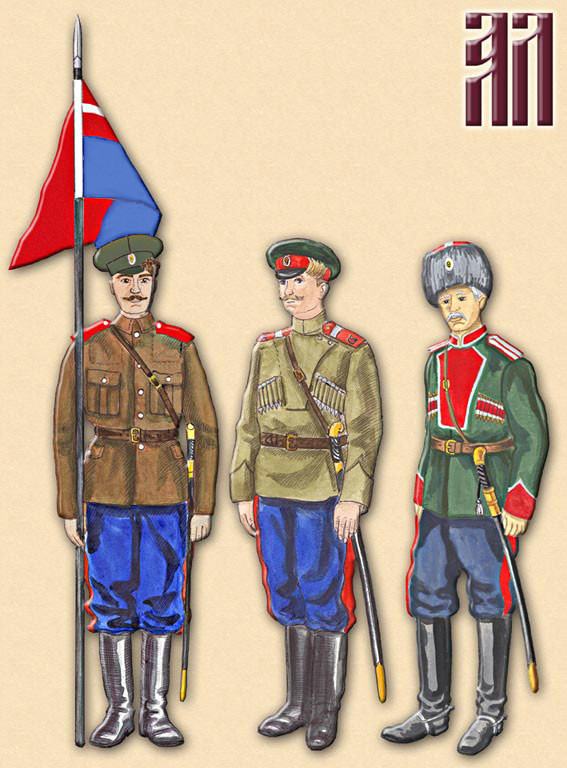
1 – Cossack of the 2nd Sotnia of a Siberian Cossack regiment (conscript in English tunic);
2 – sergeant-major of a Siberian Cossack regiment (former serving Cossack in ermakovka);
3 – officer of the Siberian Cossack Host (full dress uniform for 1919)
Figure 1 is carrying a 2nd sotnia pennon (the bottom half was in order: scarlet, light blue, white, dark green, yellow and brown). I have lightened the blue from the original, as it was a touch too dark.
Discussion on the translation choices I have made can be found here.
Flags
We know a few of the regimental flags, see here.
History of the Siberian Cossack Corps
Also known as the Composite Cossack Corps, it had a confusing set of reorganisations and units.
Formed mainly from units of the Siberian Cossack Host on 18 March 1919 and placed in the High Command's reserve (that is, avoiding action). In June 1919, a Southern Cavalry Group (comprising the 1st Cavalry Division, 2nd Ufa Cavalry Division and the 1st Siberian Cossack Division) was formed within the corps. This group (with the inclusion of a number of other units) became part of the 2nd Army in July 1919, taking the name Cavalry Group. Although titled a "group" I do not believe it operated militarily as one, being set out as separate divisions, even regiments.
In August 1919 the corps headquarters was reorganised (about 2,000 Siberian Cossacks at that time) and on 20 November 1919 was renamed the Siberian Cossack Group (3-4,000 men), as part of the 3rd Army. At that point it included the 1st, 2nd, 3rd, 4th and 5th Siberian Cossack Divisions, an Independent Cossack Brigade and the 6th Cavalry Regiment. On 30 December 1919 it was transferred to the 2nd Army.
Most of the men melted back to their homes at the start of the retreat in 1919. The Siberian Cossack regiments were consolidated into the Siberian Cossack Brigade, which arrived in Transbaikalia. Within the Far Eastern Army the Siberian Cossacks were represented by a brigade, a regiment and independent divizions.
In sum, although the Siberian Host fielded 15 cavalry regiments and 3 batteries during the Civil War, they saw very little action on the main fronts (although the ones that served in mid-1919 were good). The Siberian Corps was formed when the Siberian Host realised, far too late, that it needed to actively support the main front against the Reds. For more information about the Siberian Cossack Host in the Russian Civil War, go here.