
Model Uniforms of Russian Government Police, 1919-1920
All material and reconstructions are by A. Karevskiy unless noted otherwise.
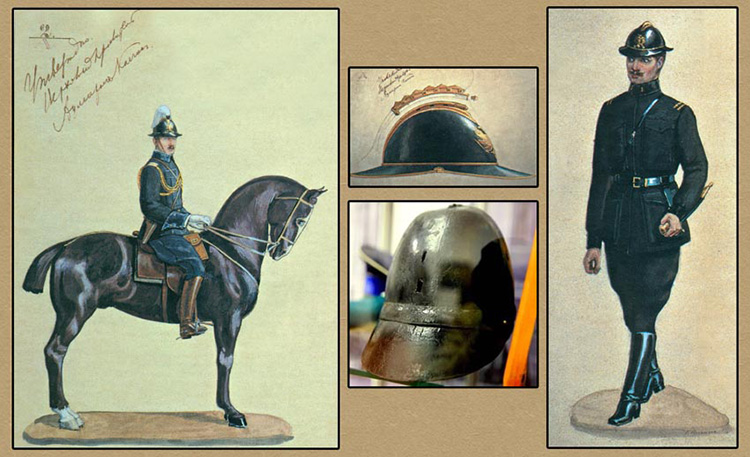
Sketches of new uniform designs for the Provisional All-Russian Government police,
signed by the Admiral Kolchak.
First published by Durov, V. in "Awards of the White Army // Rodina, No. 5 (Special issue 'Land of Siberia')", 2000, p.136 at siberia-miniatures.ru/forum/showthread.php?fid=12&tid=17
The approved description of the uniforms of police officers was published on 8 April 1919 in the Ministry of Internal Affairs circular No. 1516, signed by Acting Minister V. N. Pepelyaev. Police officers, including those in the districts, received their uniforms from the treasury. The list of items of clothing to be issued and the terms of their wear were established by the Minister of Internal Affairs.
The police uniforms included summer and winter versions. The winter uniforms were made of warm fabrics, greatcoats of broadcloth or drape and tunics and trousers of broadcloth. Summer tunics and trousers could be made of light fabrics of the appropriate colour.
Summer clothing
For officers, the tunic was single-breasted dark blue (or grey-blue) broadcloth "French" with four patch pockets. The stand-up collar was made of dark blue velvet. The "French" was fastened with five black buttons. The back was gathered with elastic. The trousers were made of dark blue (or grey-blue) broadcloth with black piping (cut like breeches). The boots were high, made of dark yellow or black leather. Low boots with gaiters were permitted instead of high boots. The helmet was made of patent black leather with a gilded metal coat-of-arms, comb and edging. The shoulder-boards were transverse, made of gold braid woven like a mat, with one or two blue stripes and white metal stars. The aiguillettes were blue for ranks no lower than 8th class. Greatcoats were black-grey broadcloth or drape, single-breasted, with a turn-down collar, five black buttons, two patch pockets with button flaps (on the chest) and two ordinary slanted slit pockets with flaps.
For mounted police. A "French" coat – dark blue (or grey-blue) broadcloth, single-breasted with five black buttons and four external patch pockets with buttoned flaps. Standing double collar of light blue velvet and cuffs of the same colour and material. Elasticated at the back. Worn with a black patent leather belt. Greatcoat – black (or grey-blue) broadcloth, single-breasted, with a turn-down collar, five black buttons, two outer patch pockets with buttoned flaps (on the chest), and two slit pockets. There was a flap with two buttons at the back. It was worn with a black patent leather belt. The trousers were made of blue broadcloth with black piping. The helmet was made of black patent leather with a gilded metal coat-of-arms, comb and edging. Above the coat-of-arms was a black plume. The boots were officer's style, made of black or dark yellow leather with attached spurs. Shoulder-boards were light green, worn transversely, made of gold braid woven like a mat, with light green stripes and white metal stars according to rank. Weapons were a revolver and a sabre on a black lacquered leather shoulder strap.
For external police. Tunic – "French" cut, dark blue or black-grey broadcloth, single-breasted with five buttons and four patch pockets with buttoned flaps. Cuffs also buttoned. Cuffs and stand-up collar in blue broadcloth. Elasticated at the back. Worn with a black patent leather belt. Trousers in broadcloth matching the tunic. The greatcoat was made of dark blue broadcloth, single-breasted with a turn-down collar, with five black buttons and two patch pockets (on the chest) and two slanted regular pockets. All pockets had flaps, with a strap at the back fastened with two black buttons. The helmet was made of black patent leather with a gilded metal coat-of-arms, comb and edging. The boots were made of black leather. Weapons: a revolver and a special type of cutlass in a black leather holster. For policemen on duty: a whistle and a rifle, which was carried on a black shoulder strap. Shoulder-boards: transverse, made of gold corded gold braid (two for senior policemen and one for junior men).
For police of the mounted detachment. Tunic – dark blue or grey-blue broadcloth, single-breasted, with five buttons and four outer patch pockets with buttoned flaps. Collar – double, stand-up. Collar and cuffs made of light blue broadcloth. Elasticated at the back. Worn with a black patent leather belt. Trousers – blue broadcloth with black piping. The greatcoat was made of black or grey broadcloth, single-breasted with a turn-down collar, with five black buttons, two slanted outer pockets with button flaps (on the chest) and two slanted regular pockets with flaps. There was a flap with two black buttons at the back. The helmet was made of lacquered black leather with a metal gilded coat-of-arms, comb and edging. There was a black plume on the comb. The boots were made of black leather with spurs. Shoulder-boards – transverse corded gold braid (two for senior policemen, one for policemen). Aiguilettes – black. Weapons – revolver and sabre on a black lacquered shoulder strap.
Winter clothing.
For external police officers. Fur greatcoat, of dark blue (or grey-blue) broadcloth or drape, with a grey lambskin fur collar and cuffs. The collar and cuffs had blue piping. The cut of the greatcoat was the same as that of the summer coat. A grey sheepskin ushanka with a black pointed broadcloth crown with cotton padding. There was a blue piping along the outer edge of the sheepskin and a gilded metal coat-of-arms on the forehead.
For mounted police officers. The greatcoat was of the same design and cut as that for the officers of the external police, but with light green piping around the collar and cuffs. The hat was a grey sheepskin ushanka with a flat black broadcloth crown on cotton padding and a yellow leather chin strap. Light green piping along the outer edge of the sheepskin. A gilded metal coat-of-arms on the forehead, above which was a black plume.
For external policemen. A coat of the same design and cut as that for police officers, with blue piping around the collar and cuffs. The hat was of the same type and design as that of the officers, with blue piping.
For mounted policemen. The coat and hat were of the same design and type as those of the external police, with light green piping and a black plume above the coat-of-arms on the hat.
For provincial and regional Special Purpose Units, the uniform was of the same cut as that of the external police, but with the following changes.
Summer clothing.
For officers of foot komands. On the tunic – light yellow piping on the collar, tunic opening and cuffs. Gold braid on the cuff of the right sleeve of the tunic and coat. The shoulder-boards were the same as those of the corresponding external police, but with yellow stripes. The aiguillettes were light yellow.
For mounted police officers. The same uniform as for foot, but the piping and braid around the sleeves of the tunic and coat, as well as the piping on the trousers, were white. The shoulder-boards had white stripes. The hair crest on the helmet and aiguilettes were white.
For foot policemen. The tunic had light yellow piping on the collar, sides and cuffs. The same piping was used on the trousers. There was yellow silk braid on the right sleeve of the tunic and coat at the cuff.
For policemen of the mounted detachment. Same as for foot komands, but the piping and braid around the sleeves of the tunic and coat, as well as the piping on the trousers, was white. The hair crest on the helmet and aiguilettes were white.
Winter clothing.
For officers of foot units. The coat had light yellow piping, and the right sleeve cuff had gold braid. The hat had light yellow piping.
For officers of mounted units. The uniform was the same as for foot, but the braid and piping around the coat sleeves, as well as the stripes on the trousers, were white. The shoulder-boards had white stripes. The plume on the cap was also white.
For foot policemen. The braid and piping, as well as the braid around the sleeves, was light yellow.
For mounted policemen. The braid and piping were white. The piping on the cap was white, with a white plume.
Special Purpose Unit of the Police Department. The ranks of this unit had uniforms corresponding to those of the provincial units, but with the following differences:
1. Shoulder-boards – double width.
2. On the right sleeve of the tunics and coats were three rows of braid, metal for officers and cloth for men.
3. The tunic collars of officers of the mounted units were velvet, dark cherry in colour, while those of the men were broadcloth of the same colour. For the officers of the foot units the collar was black velvet.
To distinguish between the external, mounted police and Special Purpose Units in summer uniforms (both officers and men), metal letter-numbers were attached to both collar tips of the "French" (tunic) and coat. For the external police, "Н5" (5th region), for the mounted police – "К4" (4th region) and for Special Purpose Units "ОН". On the winter uniform, the same letter-numbers were placed under the coat-of-arms.
All external police had black patent leather equipment, Special Purpose Units in the provinces (regions) had light yellow patent leather equipment, and the Special Purpose Unit of the police department had white patent leather equipment.
Gonyukhov, S. O. and Gorobtsov, V. I. in "Russian and Soviet police in uniform, 1917-1943", Moscow, 2000, pp.14-18.
Description of the uniforms of the external and mounted police, as well as the provincial and district special task forces and the special task force attached to the Police Department of the Ministry of Internal Affairs, approved by the Supreme Ruler
Police men and officers of the external and mounted police.
a) Summer clothing.
1) for officers of the external police.
"French" – dark blue broadcloth (or grey-blue), single-breasted, with a double stand-up collar of dark blue velvet, with five buttons and four patch pockets with button flaps. Elasticated at the back. To be worn with a black patent leather belt.
Trousers – dark blue broadcloth (or grey-blue) with black piping (styled as breeches).
Boots – high, made of dark yellow or black leather. Low boots with gaiters were permitted instead of high boots.
Helmet – patent black leather, with a gilded metal eagle, comb and edging.
Shoulder-boards – transverse, made of gold braid like a mat, with one or two stripes and white metal stars according to rank.
Weapons – revolver and special-design cutlass on black patent leather straps.
Aiguilettes – blue for ranks not lower than rank VIII.
Greatcoat – black-grey broadcloth or drape (grey-blue was permitted), single-breasted, with a turn-down collar, five black buttons, two patch pockets with button flaps (on the chest) and two ordinary slanted pockets with flaps. To be worn with a black patent leather belt.
2) for officers of the mounted police.
Tunic – dark blue (or grey-blue) single-breasted broadcloth, with five buttons (black) and four patch pockets with buttoned flaps. Double stand-up collar of light blue velvet and cuffs of the same colour and material. Elasticated at the back. To be worn with a black patent leather belt.
Greatcoat – black (or grey-blue) broadcloth or drape, single-breasted with a turn-down collar, with five black buttons, two external patch pockets with button flaps (on the chest) and two slanted regular pockets. At the back, a flap with two buttons; to be worn with a black patent leather belt.
Trousers – blue broadcloth with black edging.
Helmet – black patent leather with a metal gilded coat-of-arms, comb and edging. Above the coat-of-arms was a black hair crest.
Boots – officer's style, made of black or dark yellow leather with attached spurs.
Aiguilettes – light green.
Shoulder boards – transverse, made of gold braid woven like a mat, light green stripes and white metal stars according to rank.
Weapons: a revolver and a sabre on a black patent leather shoulder strap.
3) For external policemen.
Tunic – (French cut) dark blue or dark grey broadcloth, single-breasted, with five buttons, four patch pockets with button flaps, cuffs and double stand-up collar of blue broadcloth. Elasticated at the back, to be worn with a black patent leather belt.
Trousers – made of broadcloth to match the tunic.
Greatcoat – black or blue broadcloth, single-breasted with a turn-down collar, five black buttons, two patch pockets (on the chest) and two slanted regular pockets. All pockets had flaps. There was a strap with two black buttons at the back. To be worn with a black patent leather belt.
Helmet – black patent leather, with a gilded metal coat-of-arms, comb and edging.
Boots – black leather.
Weapons: revolver and special-design cutlass on black leather straps. For policemen on duty: whistle and rifle, the latter on a black shoulder strap.
Shoulder-boards: transverse gold braid (corded) – two for senior policemen and one for junior men.
4) For mounted policemen.
Dark blue or grey-blue broadcloth tunic. Light blue collar and cuffs (same cut as for foot police).
Blue trousers with black piping.
Black-grey broadcloth coat (same cut as for foot police).
Helmet – same as for foot police, but with a black plume.
Boots – black leather with spurs.
Shoulder-boards – same as for foot police.
Aiguilettes – black.
Weapons – revolver and sabre on a black lacquered shoulder strap.
b) Winter clothing.
1) For external police officers.
Greatcoat – fur-lined, dark blue (or grey-blue) broadcloth or drape with a grey lambskin fur collar and cuffs, with blue trim. Cut like a summer coat.
Hat – grey sheepskin ear flap hat with black pointed broadcloth crown padded with cotton. Blue piping along the outer edge of the sheepskin. Metal gilded eagle on the sheepskin forehead.
2) For mounted police officers.
Greatcoat – same as for foot, but with light green piping.
Hat – ear flap type with a flat black broadcloth crown with cotton padding and a yellow leather chin strap, light green piping along the outer edge of the sheepskin. A gilded metal eagle on the fur of the forehead, above which was a black plume.
3) For external policemen.
Coat and cap – as for officers.
4) For mounted policemen.
Greatcoat and hat – as for external police, but with light green piping and, in addition, a black plume above the eagle on the cap.
Special Purpose Units.
A) Provincial and regional.
Uniforms of the same cut as those of the external and mounted police, with the following changes:
a) Summer clothing.
1) Higher officers of foot komands.
Piping on the collars, tunic opening, tunic cuffs, and trousers, shoulder-boards and aiguillettes – light yellow. Around the right sleeve of the tunic and coat, above the cuff, there was gold braid.
2) officers of mounted komands.
All piping and braid were white. The crest on the helmet was white.
3) Foot policemen.
The piping was light yellow. The braid was yellow.
4) Mounted policemen.
All piping was white. The aiguilettes and hat crest were white.
b) Winter clothing.
1) Officers of foot komands.
Light yellow piping. The braid was gold.
2) Officers of the mounted detachment.
Piping, braid, and plume – white.
3) Foot policemen.
Same as officers, braid – silver.
4) Mounted policemen.
Same as officers. Hat – white plume.
B) Department of Police.
1) Shoulder-boards were double width.
2) Stripes on the sleeves in three rows.
3) The collars of the tunics were dark cherry for mounted police and black for all foot police: velvet for officers and broadcloth for men.
Note:
4) All buttons were black horn.
5) To distinguish between the external police, mounted police, district police and Special Purpose Units in summer uniform, both for officers and police officers, there were metal numbers on both ends of the collar of the tunic (jacket) and coat, namely: for external – "Н5" (5th district), for mounted – "К4" (4th district), for special purpose – "ОН". On the winter uniform, the same numbers were placed above the coat-of-arms.
6) All external police had black patent leather equipment, Special Purpose Units in the provinces had light yellow patent leather equipment, and Special Purpose Units at the Department had white patent leather equipment.
7) In summer, tunics, jackets and trousers were permitted in the appropriate colour of light-weight fabric, and in addition, they were entitled to raincoats in summer.
The document was published by Perm researchers D. Lobanov and K. Novikov at bergenschild.com [link dead]
Order of the Perm Provincial Government
To the heads of city and district police forces in the Perm province. 3 May 1919
Take measures to introduce the uniform specified in the circular of the Department of Police of the Ministry of Internal Affairs, and the headgear of policemen should had numbers, as was established for city police and guards.
The document was published by Perm researchers D. Lobanov and K. Novikov at bergenschild.com [link dead]
Report by Colonel Manucharov to the Governor of the Perm Province on the formation of a provincial special purpose detachment. June 1919.
The uniform should be made more similar to the army uniform, which is simpler, cheaper and more practical. Black helmets are unsuitable for both wear and field training in summer (during marches, helmets were thrown away because they pressed heavily on the head). Black helmets and black greatcoats were the best targets in the presence of the enemy at long distances. The helmet is very visible from the trenches. The practical Germans immediately understood this and very soon replaced their black greatcoats and helmets with khaki visorless caps and similar greatcoats.
Yellow boots are impractical – they will always be dirty.
White trim on cavalry uniforms is impractical: it is very conspicuous – they will always look dirty – and difficult for soldiers to clean.
... it is necessary ... to arm each company with 3-4 Lewis machine guns to had a moral impact on the soldiers and the population. ... to put the cavalry on cavalry-style saddles, not Cossack ones, as it is easier to train men on cavalry saddles.
The document was published by Perm researchers D. Lobanov and K. Novikov at bergenschild.com [link dead]
From the memoirs of Norwegian Consul Jonas Lid.
But it so happened that my audience with Kolchak in March 1919 turned out to be promising, and I did not notice that his power would soon come to an end. The commander of the Siberian police, Rossiyanov, gave me orders and colour drawings for 50,000 uniforms for the Siberian gendarmerie. How pathetic! The tailors in New York laughed at the design, but they sewed a simple, unobtrusive uniform, tailored on American mannequins made to fit Siberian policemen – an unusual look, but not the uniform of the future!
Lid., J. in "Siberia – Strange Nostalgia", Moscow, 2009, p.233.
Senior officers of the city police were given 2,000 rubles each for uniforms of the established form. But some officers, having received the money, began to spend it not on uniforms, but on other necessities and even on revelry. The chief of the city police ordered his subordinates to spend the money as intended and that each officer was to purchase a coat, tunic and breeches made of black broadcloth within two weeks.
"Russian Speech, No. 169 (242)", 9 August 1919. Material kindly provided by Voronezh researcher N. Zayats
Reconstructions
Glazkov, V. "Uniformed randomly and, of course, extremely diverse...: Uniforms and insignia of the Siberian police, 1918-1919 // Staryi Tseykhgauz, No. 83", Moscow, 2019, pp.47-50.
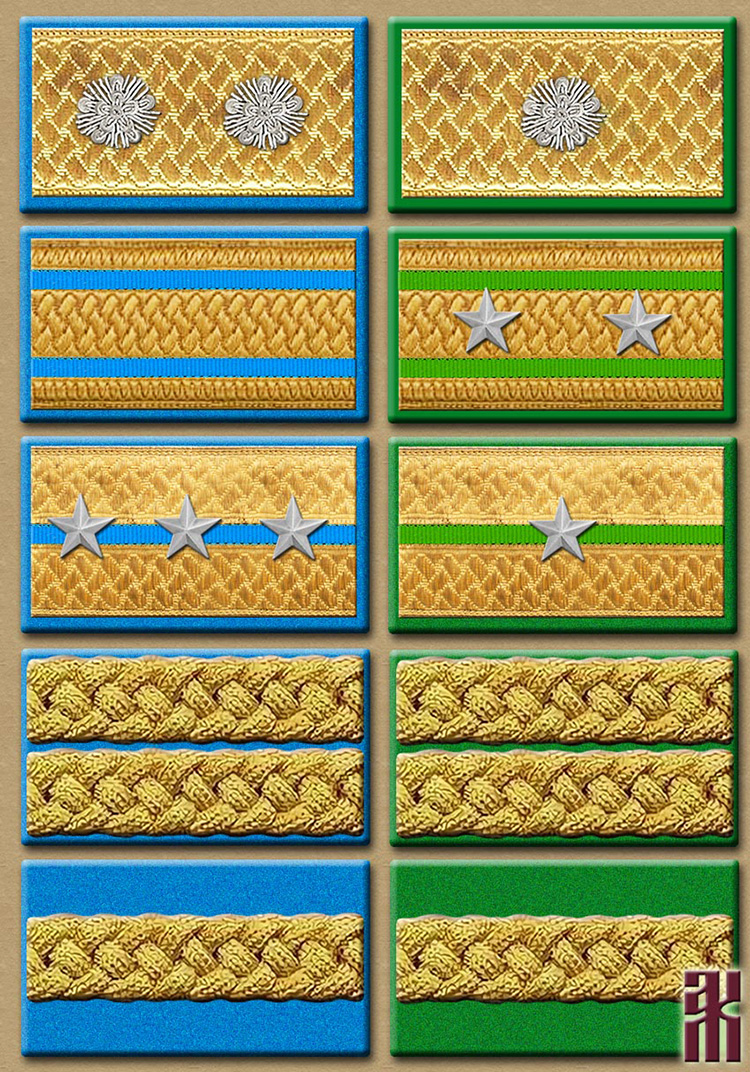
Shoulder shoulder-boards of the external (left) and mounted (right) police
Transverse shoulder-boards were to serve as insignia for the police. For higher officers, they were made of gold braid with a "mat" weave and stars depending on the rank. For police men, the distinguishing marks were corded gold braids – one for junior policemen and two for senior men. In the external police, the body and stripes were mid-blue, and in the mounted police, green.
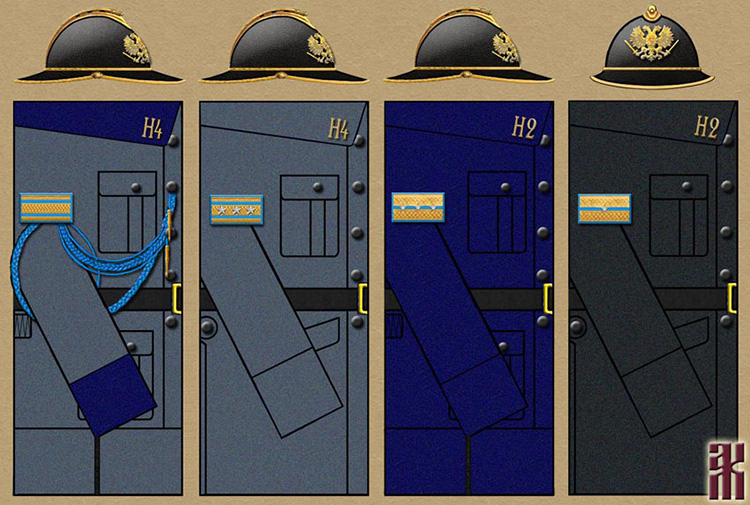
Summer uniforms of the officers of the external police force:
1 and 3 – in tunics; 2 and 4 – in summer coats
A characteristic difference between the summer uniforms of the officers and those of ordinary men was the shape of the breast pockets – with a straight flap and a vertical bow fold. All buttons on the police uniform were black horn. Another distinction for officers were the blue velvet collars and cuffs on their tunics.
Metal letter-number ciphers were placed on the collars of the tunics of all ranks of the external police, where the letter "Н" was combined with the district number. Shoulder-boards in the external police were worn by ranks starting from the 8th rank (collegiate assessor).
The weapons for the officers of the external police were a revolver in a black leather holster worn on a cross-body strap and a dagger on two belt straps.
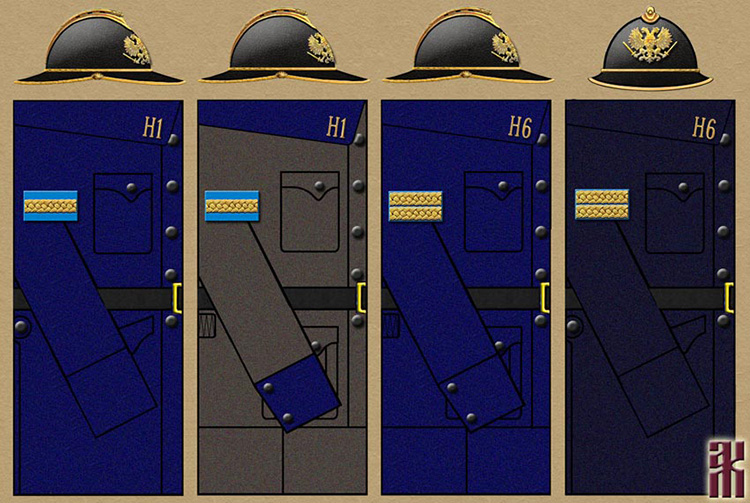
Summer uniforms of the lower ranks of the external police force:
2 and 3 – in tunics; 1 and 4 – in summer coats
Police men were distinguished in the summer uniform by breast pockets with shaped flaps, but without vertical bow folds. The summer headgear was a helmet made of thick embossed patent leather, with forward and rear visors joined at the sides, a metal comb on top and metal edging. The front featured a metal state coat-of-arms as used in Eastern Russia.
A distinctive feature of the external policemen were the blue broadcloth collars and cuffs on their tunics.
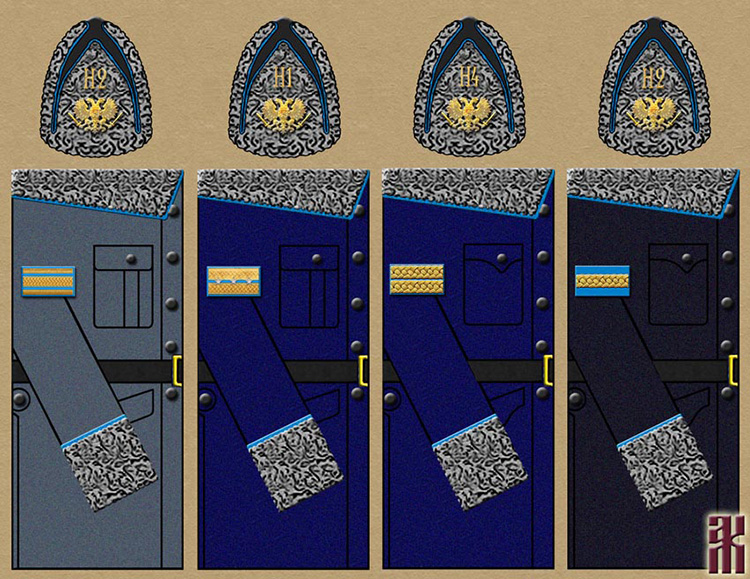
Winter uniforms of external police: 1 and 2 – officers; 3 and 4 – men
The winter headgear of the external police was a ushanka with a black pointed broadcloth crown padded with cotton. The outside of the hat was trimmed with grey lambskin. The forehead flap (front flap) repeated the pointed shape of the hat; it featured a metal state emblem, and above it – metal letter-number cipher, where the letter "Н" was combined with the district number. The entire fur was piped in blue cloth. The winter coat was identical in shape to the summer coat, but had a fur lining and was trimmed with grey lambskin fur on the collar and cuffs; here, too, cloth piping was added.
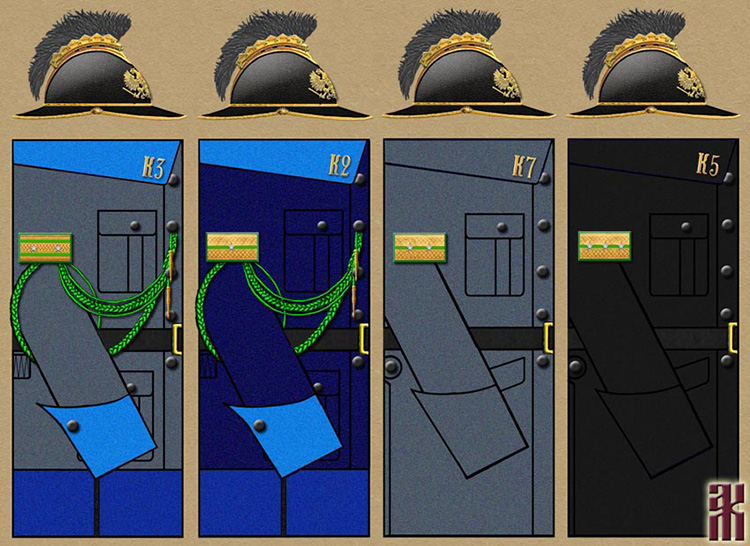
Summer uniforms of the officers of the mounted police detachment:
1 and 2 – in tunics; 3 and 4 – in summer coats
A distinctive feature of the officers of the mounted police were the light blue velvet collars and cuffs on the tunics. The cut of the uniforms of the mounted police officers differed in the shape of the cuffs (straight in the regular police, pointed in the mounted police). The trousers were not the same colour as the jacket, but were made of a mid-blue broadcloth. Light green aiguilettes were worn by all officers. The leather helmet of the mounted police had a black hair crest.
Metal letter-number ciphers were placed on the collar of the tunic for all ranks of the mounted police, where the letter "К" was combined with the district number.
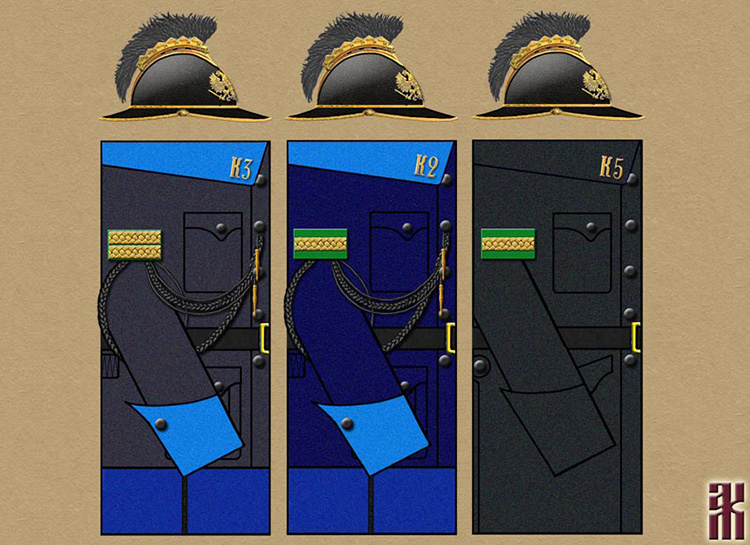
Summer uniforms of mounted police men: 1 and 2 – in tunics; 3 – in summer coat
Unlike the officers, mounted policemen were entitled to black aiguilettes, while the light blue collar and cuffs of the tunic were made of broadcloth.
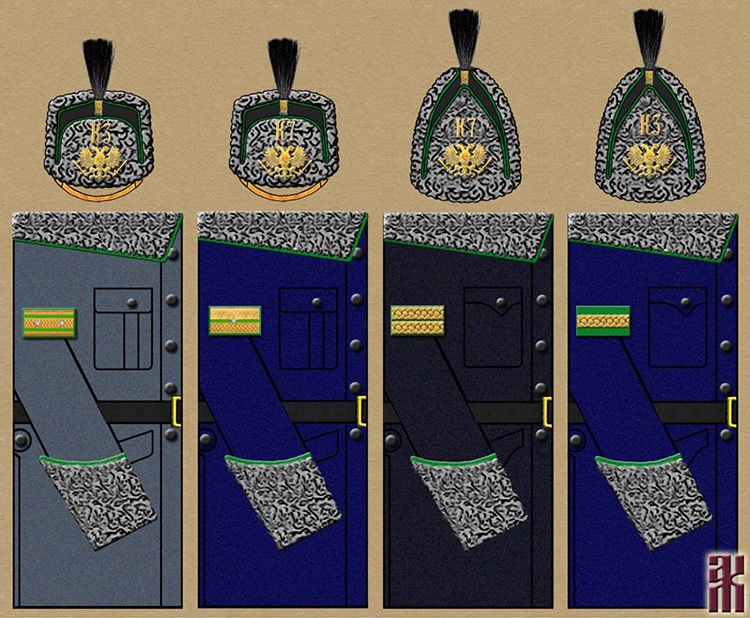
Winter uniforms of the mounted police: 1 and 2 – officers; 3 and 4 – men
Officers of the mounted police were issued with winter headgear that differed from the external model: the napka-ushanka was made with a flat crown and a similar shaped forehead flap, equipped with an internal chin strap made of yellow leather and decorated with a black hair plume. Mounted police men had pointed caps, similar to those of the regular police, but also decorated with a black plume. The winter headgear of the mounted police was trimmed with light green cloth edging.
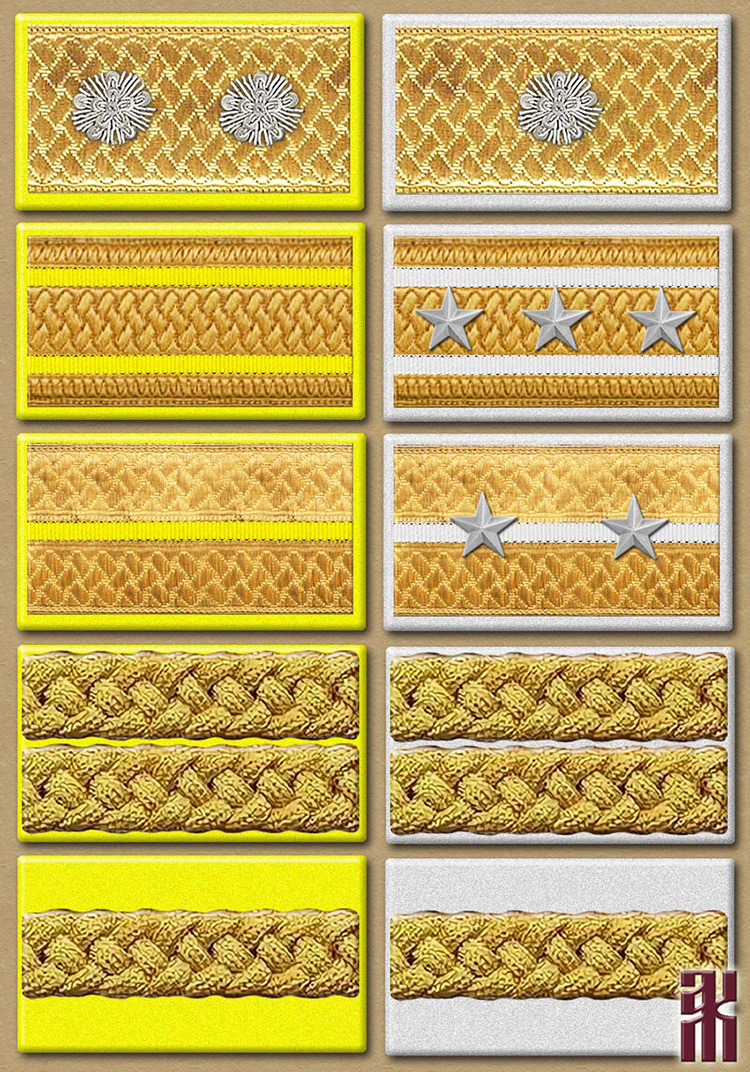
Shoulder-boards of the ranks of the foot (left) and mounted (right) komands of the provincial and regional Special Purpose Detachments
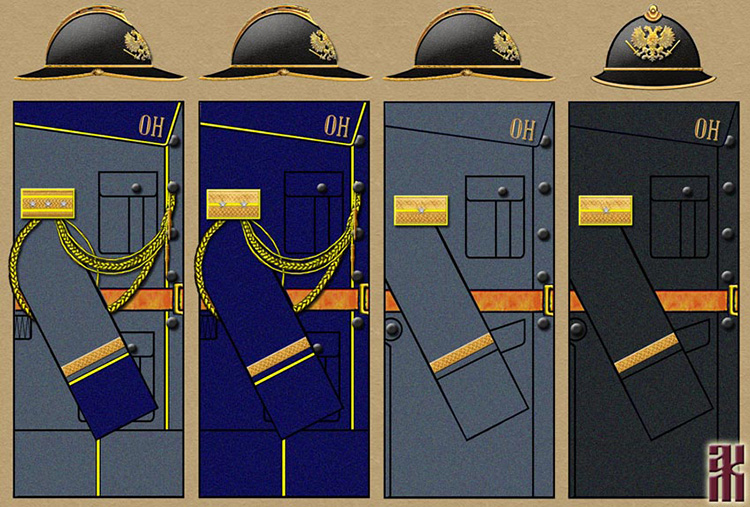
Summer uniforms of officers of the foot komands of the Special Purpose Detachments:
1 and 2 – in tunics; 3 and 4 – in summer coats
The ranks of the infantry units of the provincial and regional Special Purpose Detachments were distinguished by: yellow piping on the collar, tunic opening, cuffs and trousers, yellow aiguilettes and a single row of gold braid above the cuff of the right sleeve.
Leather equipment for all ranks of provincial and regional special purpose detachments was yellow.
The collar of the tunic for all ranks of provincial and regional special purpose detachments bore the letter cipher "ОН".
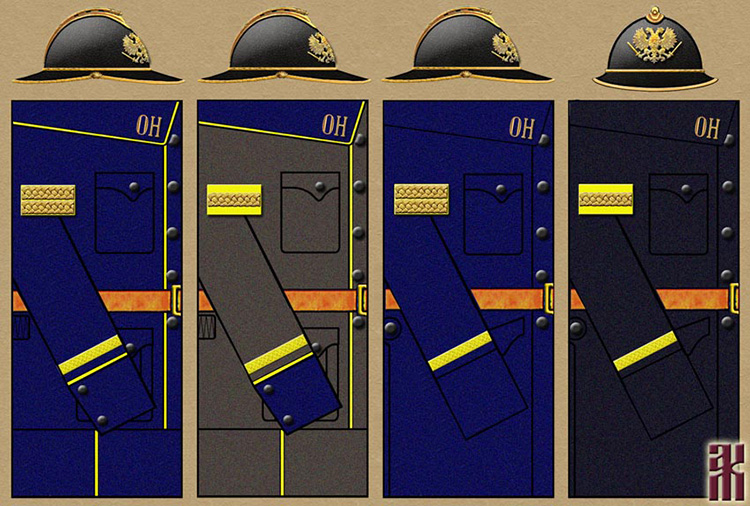
Summer uniforms of men of the Special Purpose Detachments:
1 and 2 – in tunics; 3 and 4 – in summer coats
Police men of the provincial and regional Special Purpose Units were distinguished by: yellow piping on the collar, tunic opening, cuffs and trousers and a single row of yellow braid above the cuff of the right sleeve.
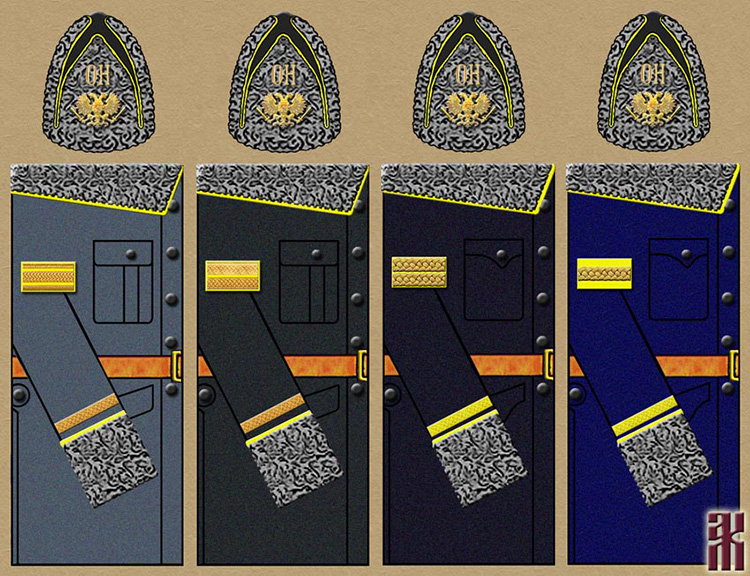
Winter uniforms of foot police of the Special Purpose Detachments:
1 and 2 – officers; 3 and 4 – men
The fur trim on the winter hats and coats of the ranks of the provincial and regional Special Purpose Units was finished with yellow broadcloth edging. Above the metal emblem on the ushanka hats was the letter cipher "ОН".
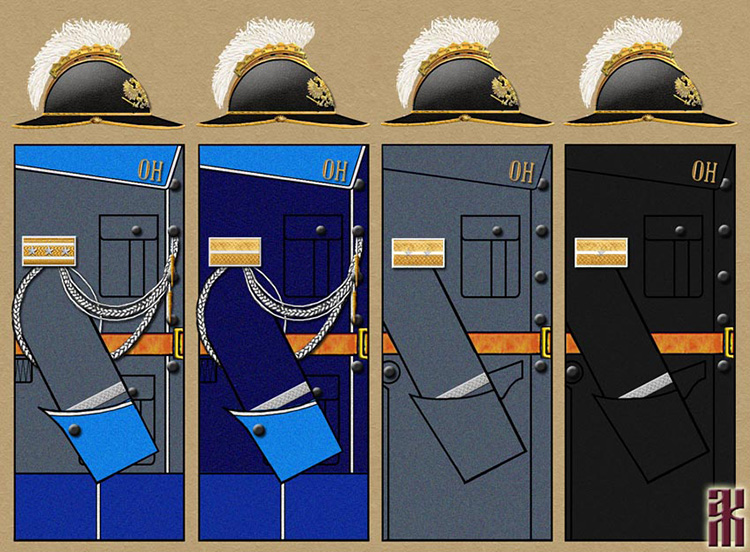
Summer uniforms of officers of mounted units of the special purpose detachments:
1 and 2 – in tunics; 3 and 4 – in summer coats
The ranks of the cavalry units of the provincial and regional Special Purpose Units were distinguished by: white piping on the collar, tunic opening, cuffs and blue trousers, white aiguilettes and a single row of silver braid above the cuff of the right sleeve. The summer cap was fitted with a white hair crest.
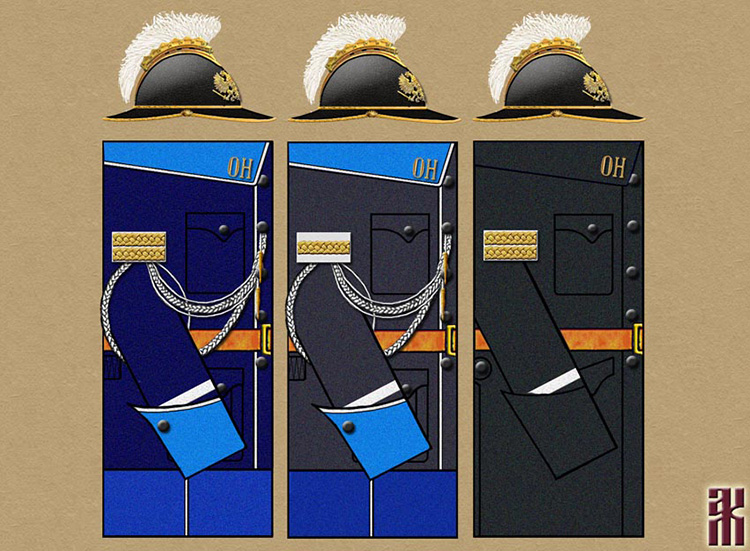
Summer uniforms of police men of mounted units of the special purpose detachments:
1 and 2 – in tunics; 3 – in summer coat
Police men of the provincial and regional Special Purpose Units were distinguished by: white piping on the collar, tunic opening, cuffs and blue trousers, white aiguilettes and a single row of white braid above the cuff of the right sleeve.
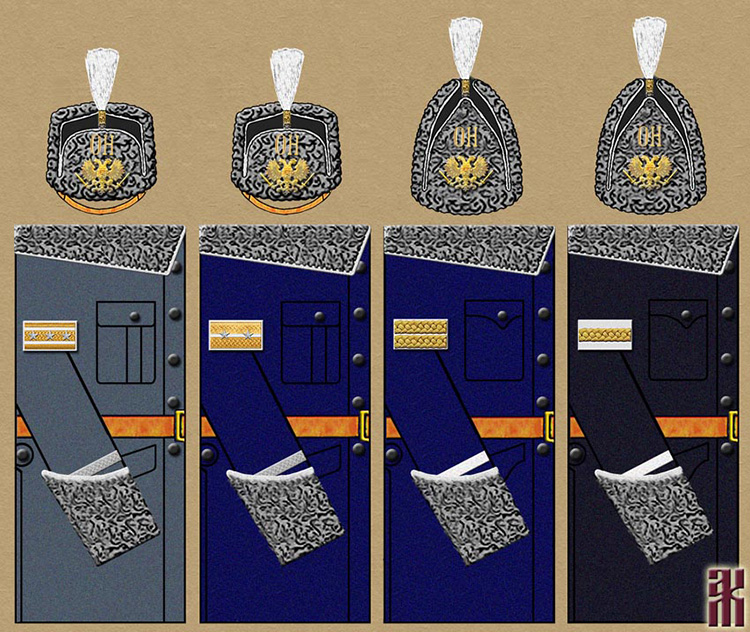
Winter uniforms of mounted units of the special purpose detachments:
1 and 2 – officers; 3 and 4 – men
The fur trim on the winter hats and coats of the mounted komands of the provincial and regional Special Purpose Units was finished with white cloth piping. Officers had flat-topped hats, while police officers had pointed hats; both types were fitted with white hair plumes. Above the metal coat-of-arms on the ushankas was the letter cipher "ОН".
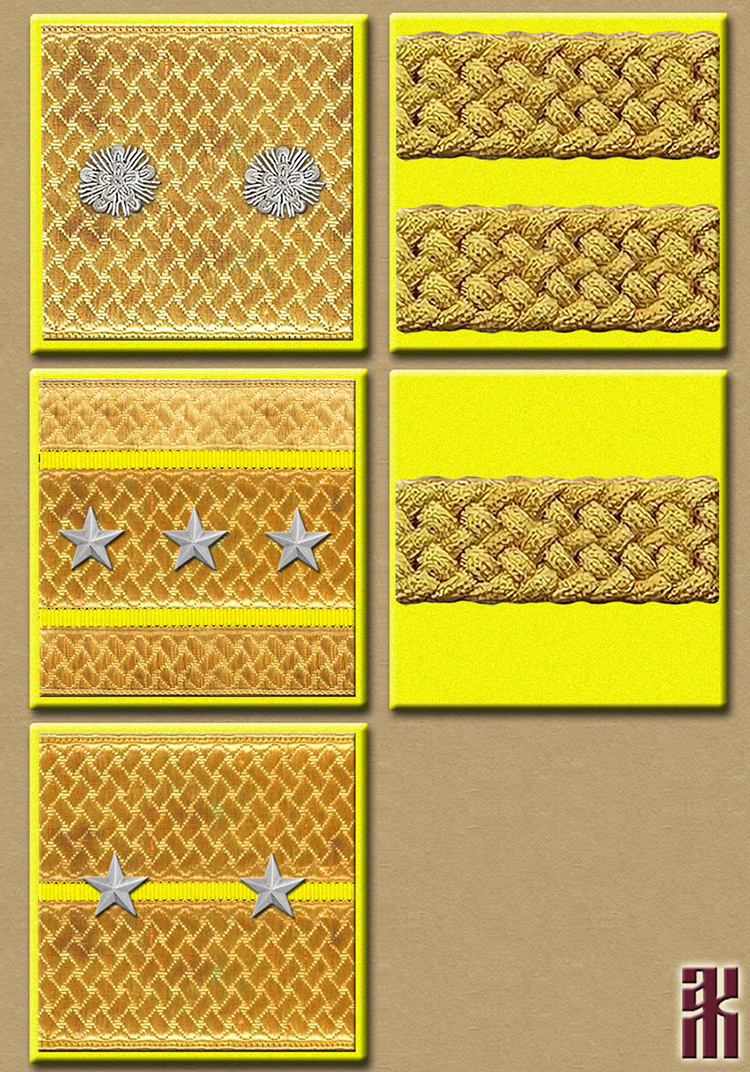
Shoulder-boards of the foot komands of the Special Purpose Unit of the Ministry of Internal Affairs Police Department. According to the circular, they had to be "double the width" of the shoulder-boards of other police officers.
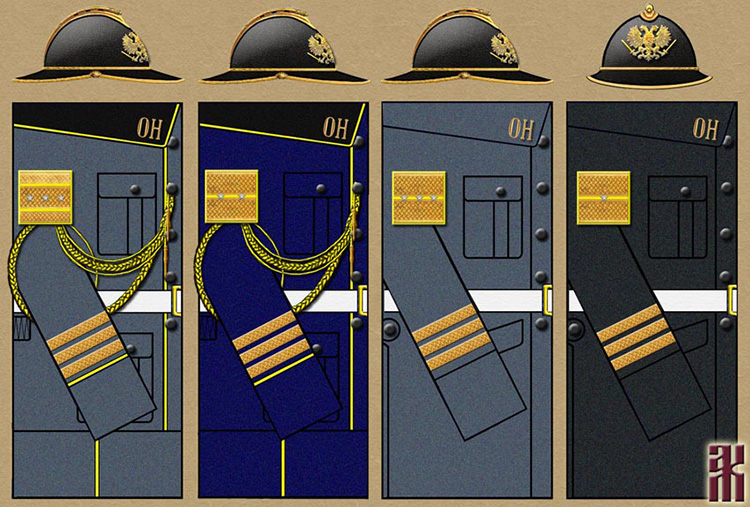
Summer uniforms of the officers of the foot komands of the Special Purpose Unit of the Ministry of Internal Affairs Police Department: 1 and 2 – in tunics; 3 and 4 – in summer coats
The officers of the Special Purpose Unit of the Police Department were distinguished by: a black velvet collar, yellow piping on the collar, tunic opening, cuffs and trousers, yellow aiguilettes and a three rows of gold braid above the cuff of the right sleeve.
Leather equipment for all ranks of the Special Purpose Unit was white.
The letter cipher "ОН" was placed on the collar of the tunic for all ranks of the unit.
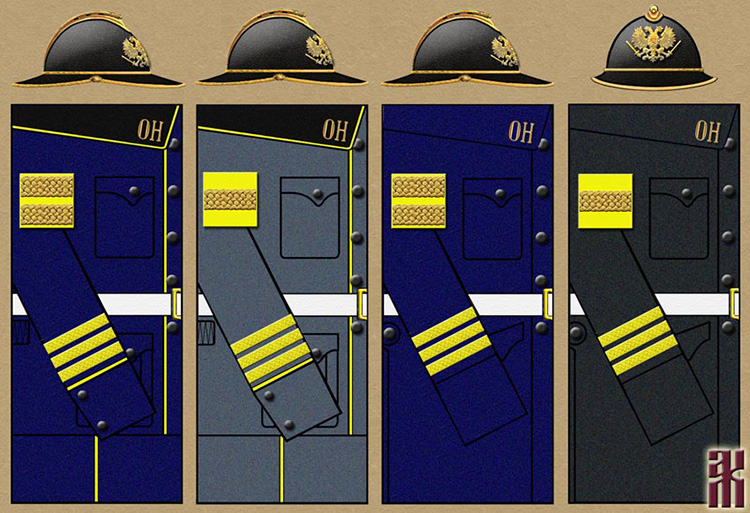
Summer uniforms of men of the foot komand of the Special Purpose Unit of the Ministry of Internal Affairs Police Department:
1 and 2 – in tunics; 3 and 4 – in summer coats
The foot komand of the Special Purpose Unit of the Police Department was distinguished by: a black broadcloth collar, yellow piping on the collar, tunic opening, cuffs and trousers and a three rows of yellow braid above the cuff of the right sleeve.
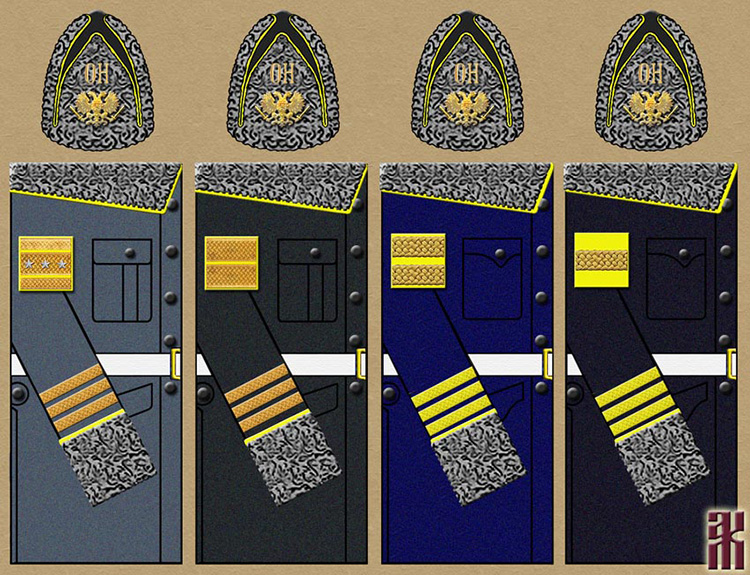
Winter uniforms of the foot komand of the Special Purpose Unit of the Police Department of the Ministry of Internal Affairs: 1 and 2 – officers; 3 and 4 – men
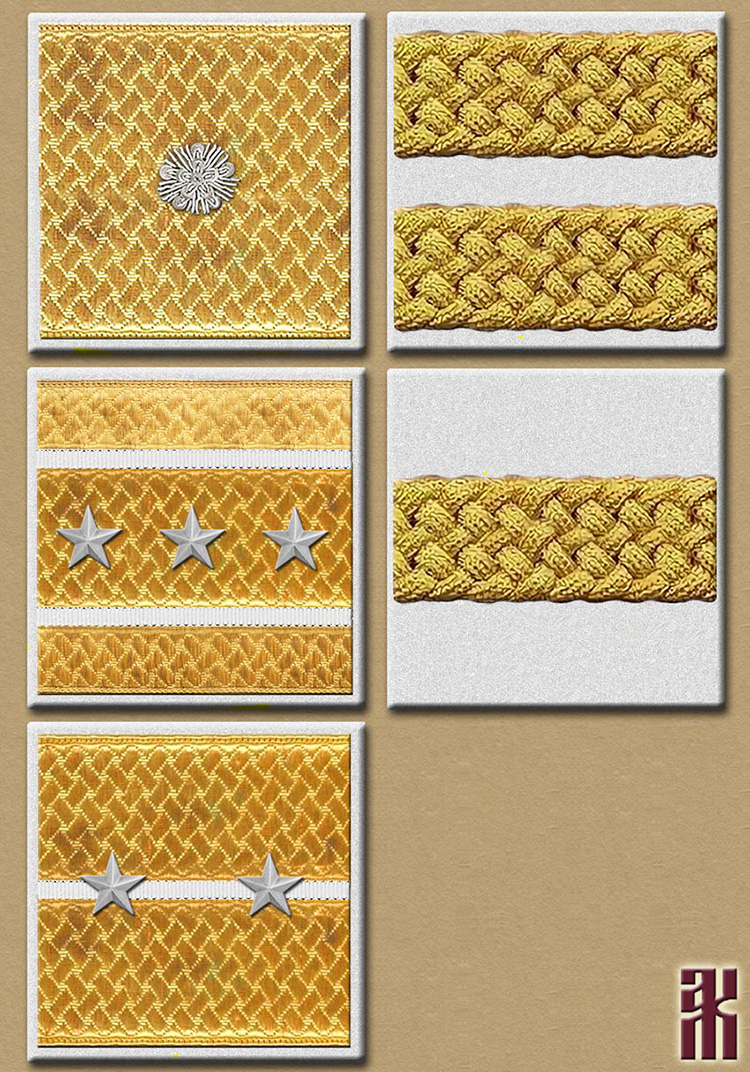
Shoulder-boards of the mounted komand of the Special Purpose Unit of the Police Department of the Ministry of Internal Affairs
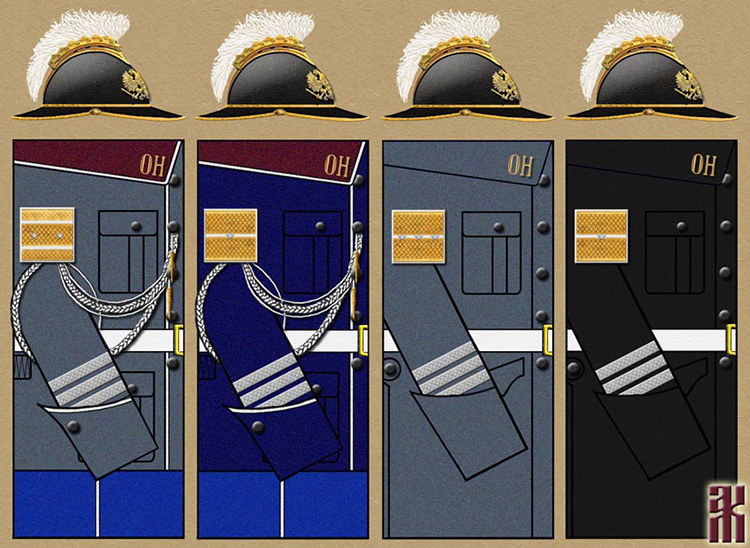
Summer uniforms of officers of the mounted komand of the Special Purpose Unit of the Ministry of Internal Affairs Police Department: 1 and 2 – in tunics; 3 and 4 – in summer coats
Officers of the mounted komand of the Special Purpose Unit of the Ministry of Internal Affairs Police Department were distinguished by: cherry-red velvet collars, white piping on the collars, tunic opening, cuffs and blue trousers, white aiguilettes and three rows of silver braid above the cuffs of their right sleeves. Their summer helmets were fitted with white hair crest.
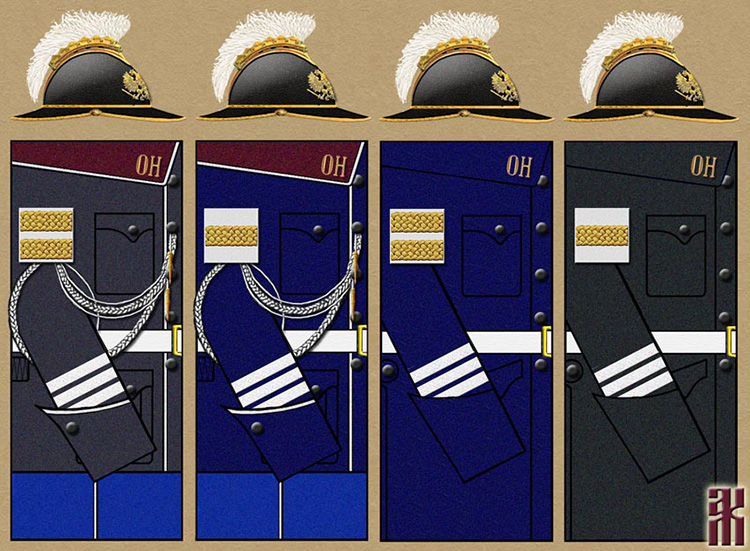
Summer uniforms of the mounted komand of the Special Purpose Unit of the Ministry of Internal Affairs Police Department: 1 and 2 – in tunics; 3 and 4 – in summer coats
The mounted men of the Special Purpose Unit of the Police Department were distinguished by: cherry-red broadcloth collars, white piping on the collars, tunic opening, cuffs and blue trousers, white aiguilettes and three rows of white braid above the cuffs of their right sleeves.
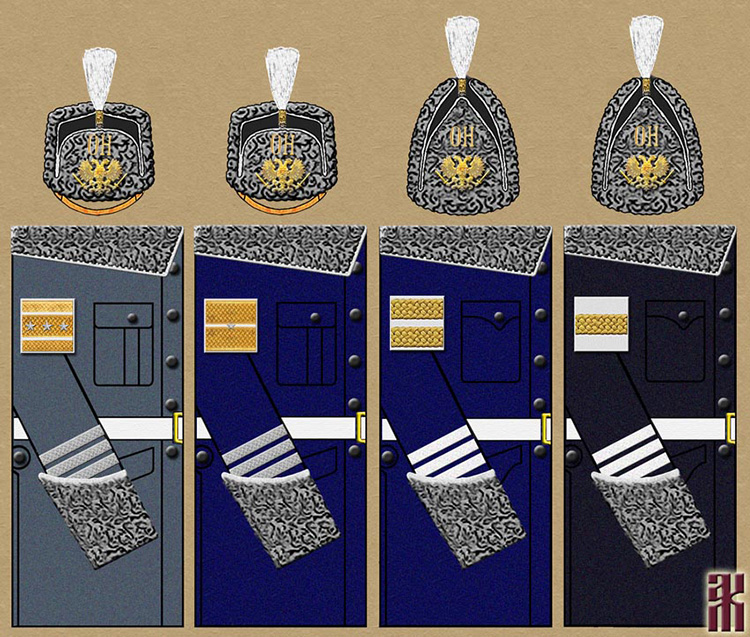
Winter uniforms of the mounted komand of the Special Purpose Unit of the Police Department of the Ministry of Internal Affairs: 1 and 2 – officers; 3 and 4 – men
The fur trim on the winter hats and coats of the mounted komand of the Special Purpose Unit of the Police Department were finished with white cloth piping. Officers had flat-topped hats, while police officers had pointed hats; both types were fitted with white hair plumes. Above the metal emblem on the ushanka hats was the letter cipher "ОН".
Home — State Symbols — Flags — Uniforms — Badges & Medals — Money — Other
Pygmy Wars Notes
The original for this page is at kolchakiya.ru/uniformology/Ekb_garrison.htm.
"External" police were just normal police, as opposed to the mounted or special purpose police. Discussion on other translation choices I have made can be found here.