
Uniforms of the The Siberian Flotilla in August-October 1918
On 6 August 1918, Captain 1st Rank A. N. Pell', commander of the Siberian Flotilla, announced the uniform for naval officers approved by Lieutenant-Colonel A. A. Krakovetskiy, head of the military department of the Primor'e Zemstvo Government. The uniform remained as before, but with minor changes to simplify it:
1) a tricolour national ribbon on the cockades of officers' and sailors' caps;
2) sleeve stripes: three wide stripes for captains of the second rank and four wide stripes for captains of the first rank;
3) as previously worn: a) white jacket, b) white tunic, c) blue jacket without ribbon trim, d) black or blue tunic;
4) shoulder insignia were worn instead of sleeve insignia with a white jacket, modelled on those of the British Navy, with corresponding sleeve insignia; the same insignia were worn on coats;
5) weapons (sabre and dagger) were not mandatory when off duty;
6) only military and foreign orders were worn; the Order of St. Vladimir, 4th class, for 25 years of service and for completing 20 campaigns was worn on a par with combat orders;
7) the anchor on the sleeve was removed for officers and sailors;
8) the ranks on the sleeves of sailors remained the same;
9) the uniform of civilian administrative naval officials was abolished;
10) for technicians: a) an officer's cap with the old-style officer's cockade covered with a tricolour national ribbon; b) officer's clothing without braid, but with one stripe on the left sleeve, a sharp chevron with the tip pointing downwards, made of yellow braid, with metal insignia.
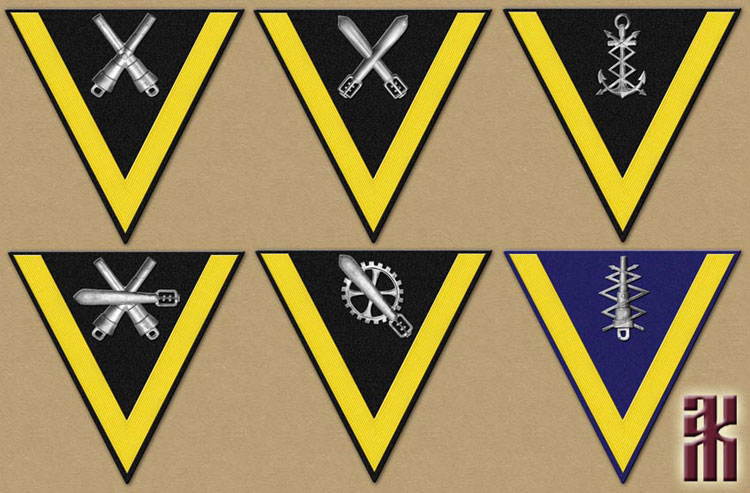
Sleeve insignia for technicians, as specified in the order of 6 August 1918:
1 – Artillery technician; 2 – Mine technician; 3 – Telegraph technician;
4 –Senior mine and artillery technician; 5 – Mine and mechanical technician;
6 – Electrical generator technician.
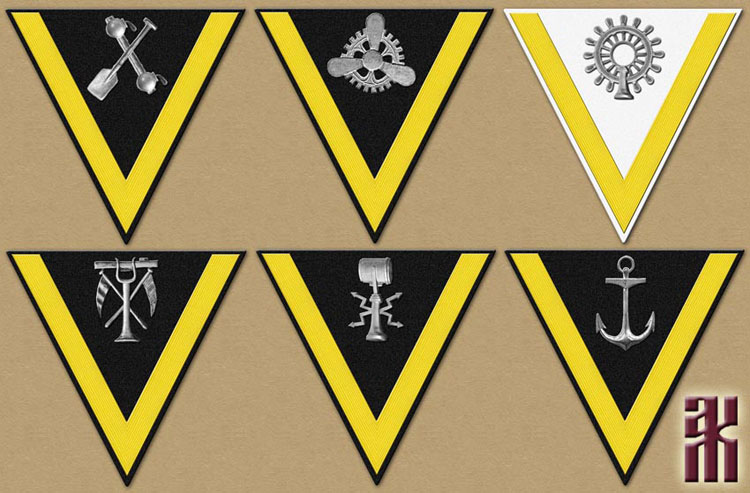
1 – Stoker; 2 – Hold or engine technician, senior engine technician; 3 – Helmsman;
4 – Signal and signal-rangefinder technician; 5 – Electrician;
6 – Senior boatswain, senior shore boatswain.
The officers of the Siberian Flotilla did not wear the uniform given above for long. On 15 October 1918, "acting in agreement with the Provisional Siberian Government", General D. L. Khorvat ordered all officers, doctors and officials of the Maritime Department to wear the old-style uniform with shoulder-boards in order to harmonise the uniforms of naval and army officers. The introductory part of the order stated:
In May 1917, under pressure from Bolshevik sentiment, a new uniform was introduced for Russian naval officers, with sleeve insignia instead of shoulder-boards and a new badge on the headgear replacing the cockade. This new uniform is inextricably linked to a dark period in the life of the Russian Navy, a period of Bolshevik destruction and bloody violence against officers, during which many valiant and loyal servants of the Motherland perished. Meanwhile, the shoulder-boards, so hated by unruly elements, were worn with honour by many generations of naval officers who wrote many glorious pages in the history of the Russian Navy.
After A. V. Kolchak came to power, an order of the head of the Ministry of the Navy, Rear Admiral M. I. Smirnov, dated 29 November 1918, re-introduced the caps and shoulder-boards of the type that existed prior to the issue of the 16 April 1917 order as the uniforms of all officers of the navy and the maritime department. The sleeve insignias established at that time to distinguish ranks and titles were abolished.
Simonov, D. G. in "The White Siberian Army in 1918", Novosibirsk, 2010, pp.178-179.
Shoulder insignia adopted for the ranks of the Siberian Flotilla
1 – Vice Admiral; 2 – Rear Admiral;
3 – State Councillor (medical officer); 4 – Captain 1st Rank.
1 – Captain 2nd Rank; 2 – Lieutenant-Colonel of the Admiralty (judicial officer);
3 – Senior Lieutenant; 4 – Collegiate Assessor (medical officer).
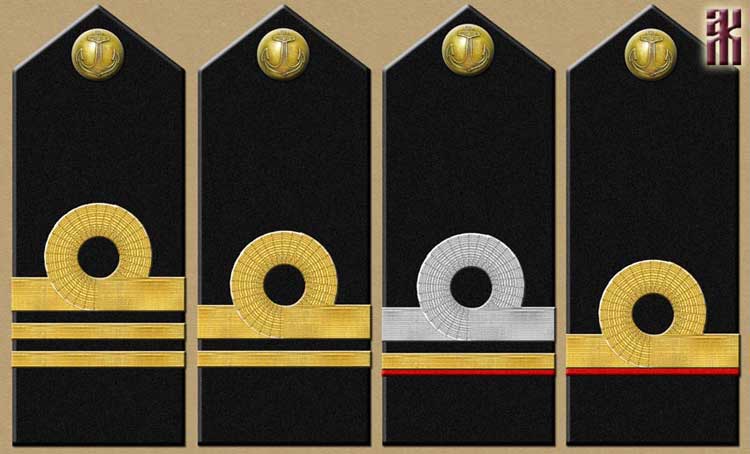
1 – Lieutenant; 2 – Midshipman; 3 – Second Lieutenant of the Admiralty (engineer);
4 – Second Lieutenant of the Admiralty (engineer directly serving in the ship's crew)
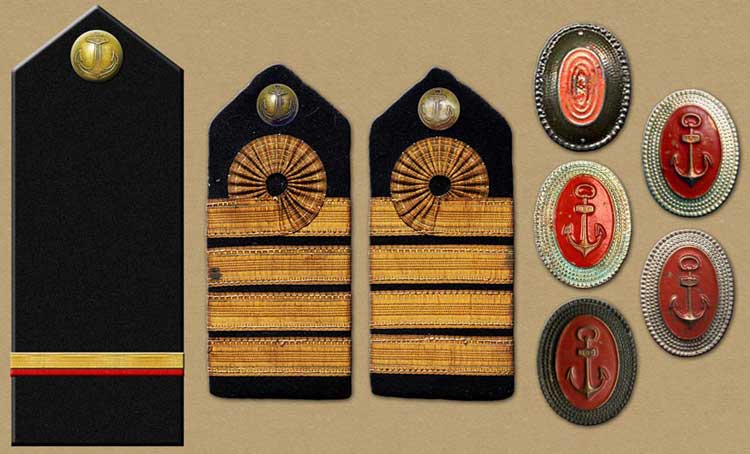
1 – Ensign of the Admiralty (engineer directly serving on ships).
2 and 3 – shoulder insignia for the coat or white jacket of a captain 1st rank;
4 – variants of cockades for lower naval ranks of 1917
Orders in force in the Siberian Flotilla regarding the dress code for naval officers,
approved during the Provisional Government in 1917
Order of the Minister of the Navy, No. 125 of 16 April 1917
In accordance with the dress code established in the navies of all free countries, I hereby announce the following changes to the dress code for naval officers and the Naval Department until its final development in accordance with the established procedure:
1) all shoulder-boards shall be removed from use;
2) the wearing of scarves shall be abolished;
3) the monogram on weapons shall be removed;
4) the centre of the cockade shall be painted red until a new model of cap is established.
Instead of shoulder-boards, I establish sleeve insignia made of braid, for frock coats, jackets and tunics, around the entire sleeve, on coats, only on the outer edge.
In accordance with rank, the stripes are arranged as follows:
1) for ensigns and clerks, one narrow braid stripe of ¼ [inch] without a curl;
2) for second lieutenants and secretaries, one wide braid stripe of ¾" with a curl;
3) for midshipmen, lieutenants and clerks – one wide braid ¾" with a curl and one narrow braid without a curl;
4) for lieutenants, captains and titular councillors – one wide braid ¾" with a curl and two narrow braids without a curl;
5) for senior lieutenants, captains, and assistant councillors – one wide braid in ¾" with a curl and three narrow ones without a curl;
6) for captains of the 2nd rank, lieutenant colonels, and court councillors – one wide braid with a curl and one wide one without a curl, both ¾";
7) for captains of the 1st rank, colonels and councillors, one wide braid with a curl and two wide braids without a curl, all three ¾";
8) for state councillors, one wide braid with a curl, under it one wide braid without a curl: both ¾" and a third braid 1" without a curl;
9) for rear admirals, major generals and active state councillors – one wide braid at ¾" with a curl and two wide braids below it, each 1" without curls, and a five-pointed star above;
10) Vice admirals, lieutenant generals and privy councillors have the same braids as rear admirals, but with two five-pointed stars beneath them;
11) Admirals, generals and privy councillors have the same braids as vice admirals, but with three five-pointed stars beneath them.
Gold braid is worn by naval officers, engineer-mechanics, admiralty officers who have passed the full officer's examination, ensigns and hydrographers.
Silver braid is worn by admiralty officers who have not passed the full officer's examination, judicial officials, ship engineers and doctors.
To distinguish between specialities, stripes are sewn under the lower braid:
1) red for ship engineers;
2) raspberry for judicial officials;
3) blue for hydrographers;
4) white for doctors.
If it is impossible to obtain braid, and on blue tunics and jackets in general, it is permissible to have stripes made of black braid.
Sleeve stripes for sailors of the non-commissioned officer rank will be announced separately, as will all further clarifications.
Naval officers wear the same sleeve insignia as doctors, but without the piping and curls.
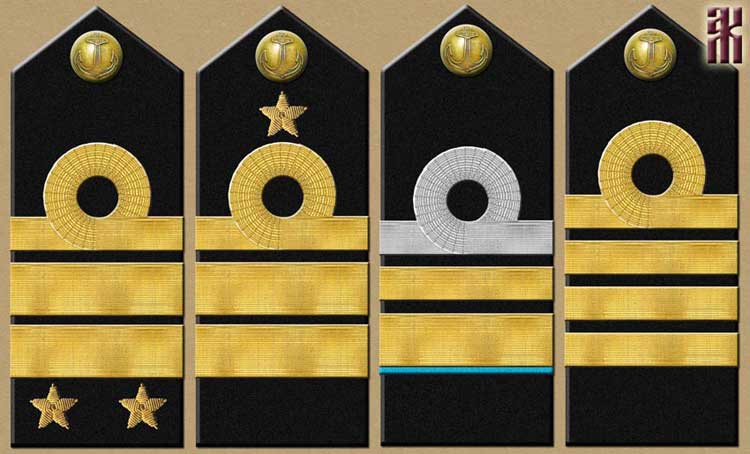
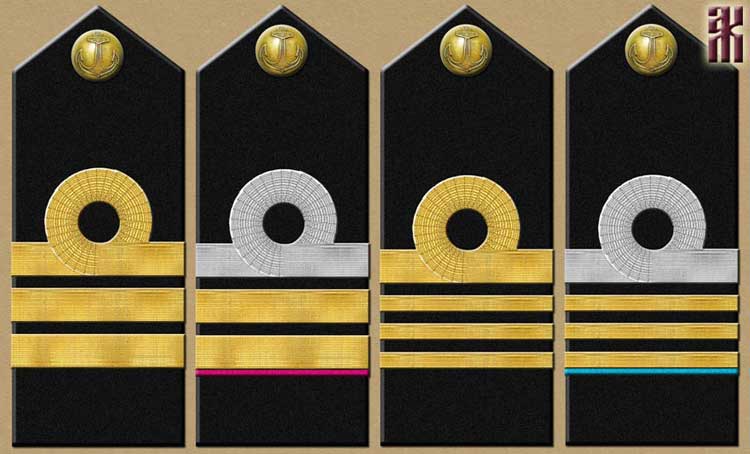
Sleeve insignia adopted for the Siberian Flotilla
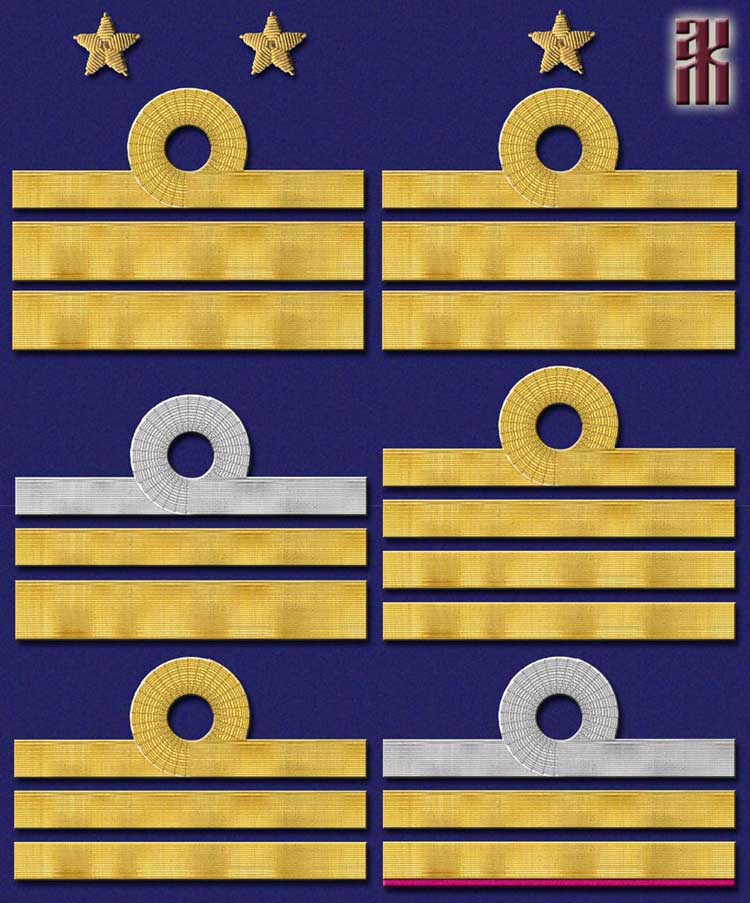
1 – Vice Admiral; 2 – Rear Admiral; 3 – Civil Councillor (shore personnel);
4 – Captain 1st Rank; 5 – Captain 2nd Rank; 6 – Lieutenant Colonel (judicial).
Note that the order of the Minister of the Navy placed any stars under the braid, but in practice they were worn above it. The order also specified three braids for a Captain 1st Rank but, due to the similarity with the English Captain 2nd Rank, the wearing of four braids was introduced on the Black Sea Fleet in 1917, and this practice was also retained on the Siberian Flotilla.
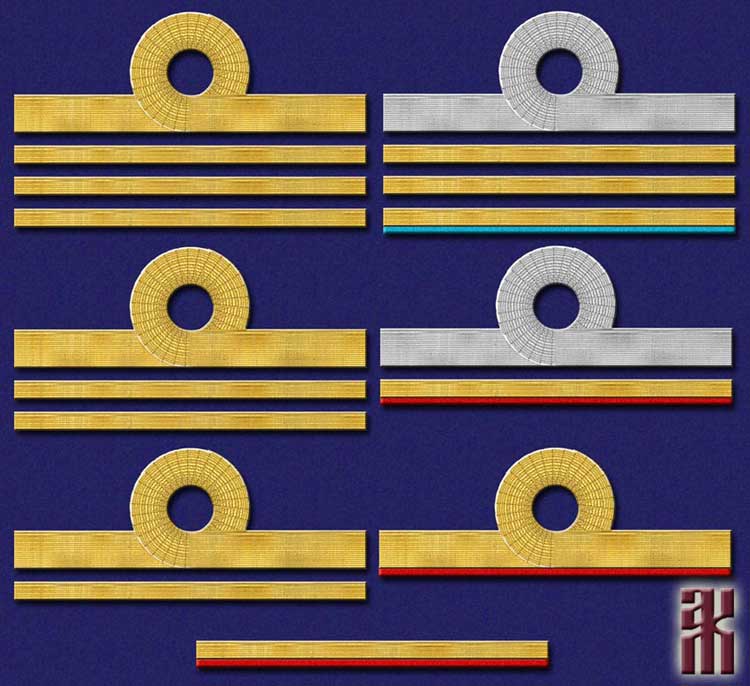
1 – Senior Lieutenant (for Admiralty captains, the upper braid with a curl is silver);
2 – Collegiate Assessor (medical); 3 – Lieutenant (staff captains have silver upper braid);
4 – Lieutenant of the Admiralty (engineer); 5 – Midshipman;
6 – Second Lieutenant of the Admiralty; 7 – Ensign of the Admiralty.
Order of the Minister of the Navy, No. 150 of 21 April 1917
I hereby announce the following changes to the uniforms assigned to naval officers and naval officials:
1. Coat
a) collar loops are paired,
b) sleeve stripes of the established pattern – gold or silver (may only be sewn on the outer half of the sleeve) ...
...
3. Cap
a) the rim is 1½ inches high and covered with black ribbon of the same width,
b) the visor is almost flat and straight,
c) the leather chin strap is replaced with a gold cord,
d) the crown is soft black cloth. The brim is the same on all sides and is about 1 inch wide,
d) In summer the black crown is covered with a white linen cover,
e) The white piping on the old-style caps is completely removed,
f) Instead of the old-style cockade, a new one is installed, as shown in the attached drawing.
The cockade may be stamped metal or embroidered, as desired. The colour of the cockade is the same as the colour of the device, while the anchor is the opposite (i.e., with a gold cockade, the anchor is silver, and vice versa).
h) Old caps may continue to be worn, in which case the black colour on the inner shield of the cockade shall be replaced with red.
Order of the Minister of the Navy, No. 151 of 23 April 1917
In amendment to the order of the Navy and the Naval Department, No. 125 of 16 April, I hereby announce:
1. Coastal officers, admiralty officers, naval doctors, ship engineers, judicial department officials and naval officials shall have silver braid with curls on the upper part and gold braid on the lower part, with the following colours sewn under the lower braid:
a) for ship engineers - red
b) for judicial officials - raspberry
c) for doctors - blue
d) for officials - white
2. Those of the ranks mentioned in paragraph 1) who sail on ships of the active fleet shall wear all gold braid while on these ships, but with the appropriate stripes.
Uniforms of the Siberian Flotilla
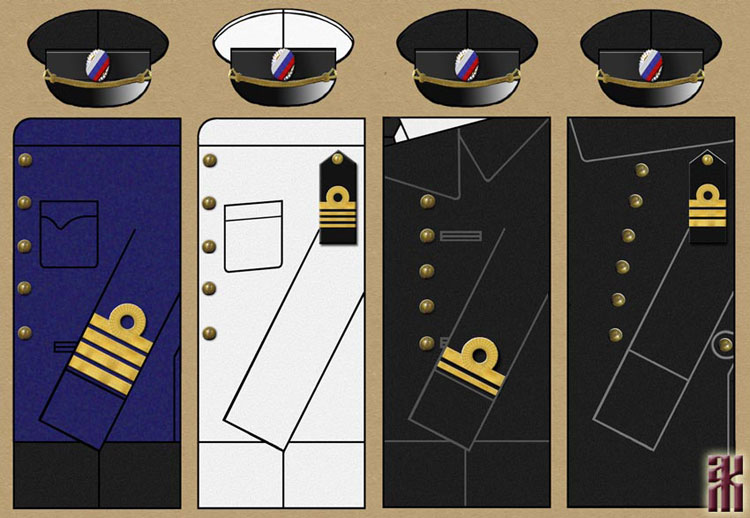
Officers: 1 – in blue jacket; 2 – in white jacket; 3 – in short coat; 4 – in coat
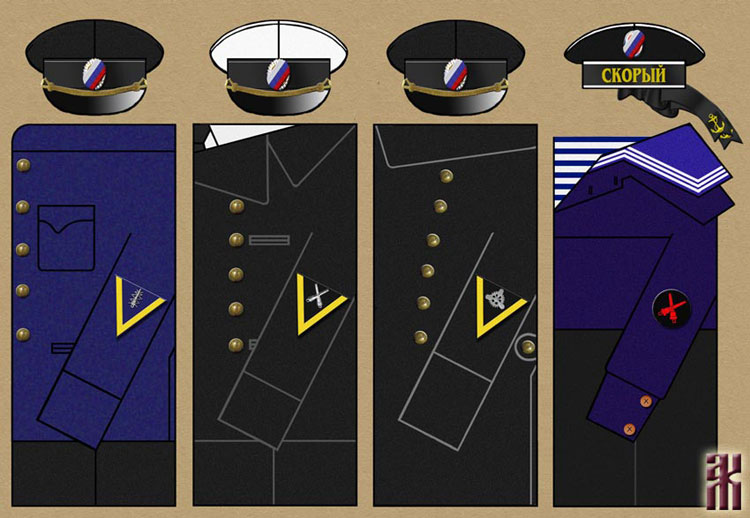
Technicians: 1 – in blue jacket; 2 – in short coat; 3 – in coat;
4 – sailor in blue flannel blouse (ship's uniform)
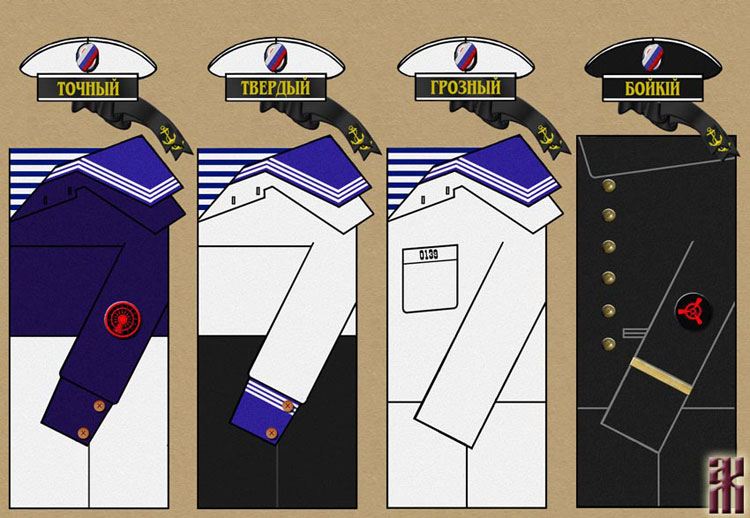
Lower ranks: 1 – sailor in blue flannel blouse (ship's uniform); 2 – sailor in white flannel blouse; 3 – sailor in work smock; 4 – boatswain in pea jacket (retaining the cuff piping)
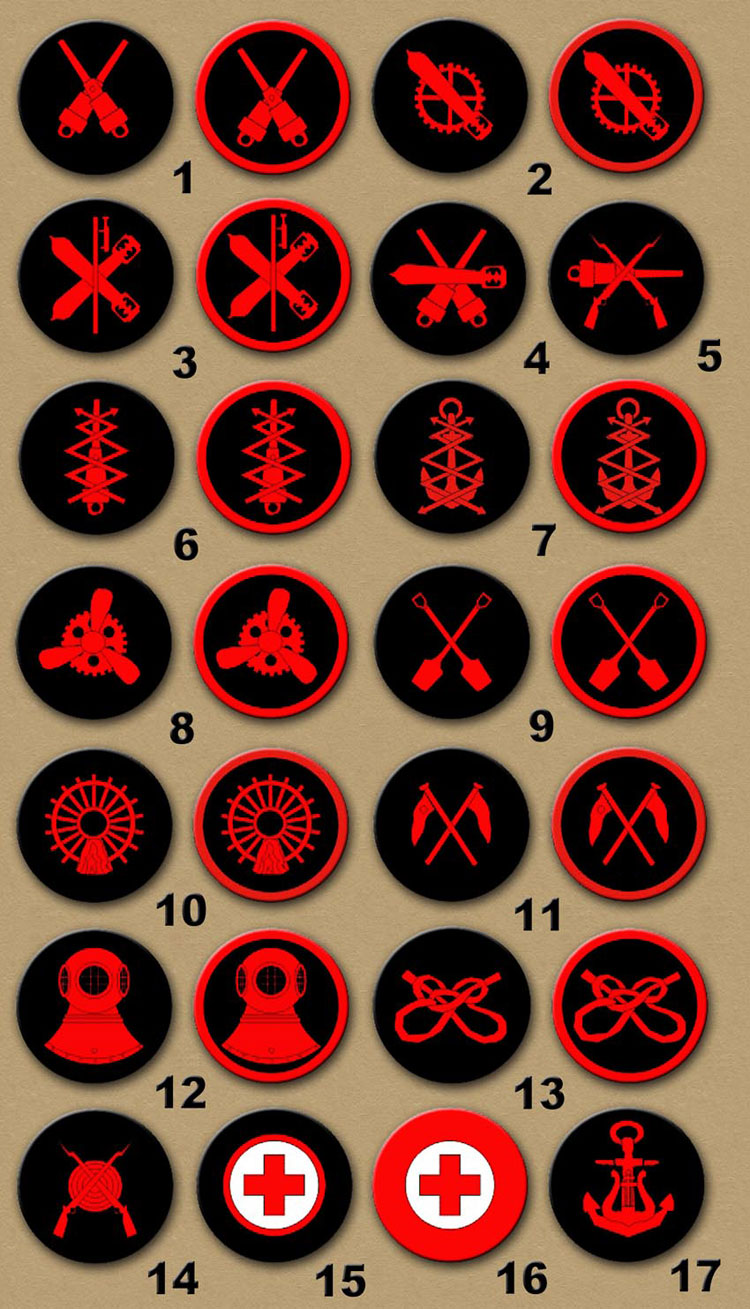
Sleeve insignia for lower ranks technicians. Those for senior specialists are bordered in red:
1 – commanders; 2 – mine engineers; 3 – mine layers; 4 – mine and artillery maintenance;
5 – commander-gunners; 6 – electrical generation; 7 – telegraph operators;
8 – engineers, engine maintenance, hold specialists; 9 – stokers; 10 – helmsmen;
11 – signalmen; 12 – divers; 13 – marshals; 14 – armourers, senior rifle instructors;
15 – field medics; 16 – medics; 17 – musicians
Images taken from antologifo.narod.ru/tabk/tabzrf.htm.
Home — State Symbols — Flags — Uniforms — Badges & Medals — Money — Other
Pygmywars Notes
The original for this page is at kolchakiya.ru/uniformology/sib_flot.htm.
The Imperial Russian Navy had a special technical body, the "Fleet Conductors Corps", who were not officers nor sailors but who had positions parallel to the normal naval ranks. This makes translation difficult, as there are no English equivalents.
Discussion on the other translation choices I have made can be found here.