
The Holy Cross and Green Banner Militia
of the Russian Army of the Supreme Ruler
Material and reconstructions by A. Karevskiy, unless noted otherwise.
This page assumes background knowledge of these units, you may wish to read the notes at the end first.
Two previous attempts have been made to reconstruct the appearance of the volunteers of the Holy Cross and Green Banner Brigades.
The first version was by A. Karashchuk: in it the crusader is dressed in winter campaign uniform, with a light grey cloth overcoat, a soldier's cap with an imperial cockade, and boots. An Orthodox eight-pointed cross made of white braid is sewn onto the left side of the chest. The shoulder-boards and tabs are black with white piping; the shoulder-boards bear a stenciled monogram in Old Slavonic script, "ИС.ХС".
Durov, V. I. in "Awards of the White Army // Rodina, No. 5", 2000, p.137.
The second option belongs to V. Zh. Tsvetkov and A. A. Karevskiy and drawn by A. Lebedeva. The Old Believer crusader is dressed in an English soldier's tunic with a cross sewn on his chest, a civilian-cut cap with a militia cross, Chinese warm trousers and boots. Around his neck is a copper cast icon.
Tsvetkov, V. Zh. in "General Diterikhs", Moscow, 2004.
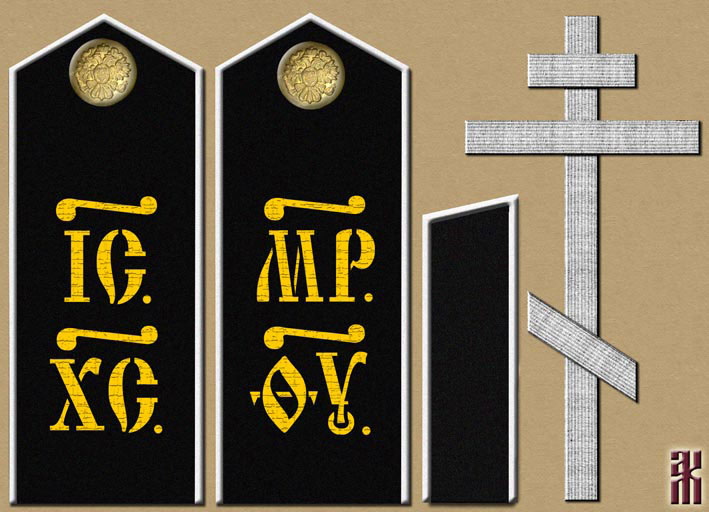
1 and 2 – shoulder-boards of the so-called "Holy Brigade" of the Regiments of Jesus Christ and the Virgin Mary; 4 – breast cross of a volunteer member of the Holy Cross Militia
The reconstruction of the shoulder-boards of the volunteers of the Regiment of Jesus Christ was made based on the Karashchuk illustration. The reconstruction of the shoulder-boards of the volunteers of the Virgin Mary Regiment was made by analogy with the previous shoulder-board, and the monogram was taken from drawings of icons of the Blessed Virgin Mary. The breast crosses were presumably made for officers from metal braid, and for volunteer militiamen from cloth braid or ribbon.
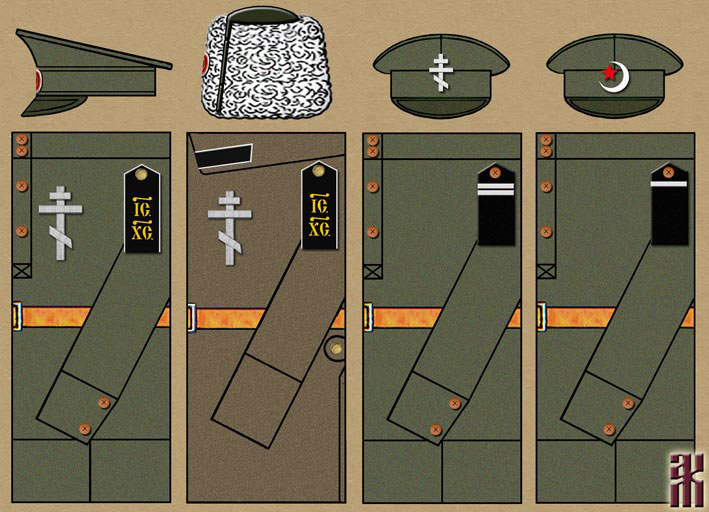
1 and 2 – uniforms of volunteers of the Regiment of Jesus Christ;
3 – uniform of the 1st Omsk Militia of the Holy Cross and Green Banner, Cross company;
4 – uniforms the 1st Omsk Militia of the Holy Cross and Green Banner, Crescent company
In October 1919 the Omsk Company of the Holy Cross and Green Banner was reorganised into the 3rd Battalion of the 41st Ural Rifle Regiment of the 11th Ural Rifle Division.
According to information kindly provided by V. Zh. Tsvetkov, to distinguish them from other servicemen of the Russian Army of the Supreme Ruler, emphasising their character as a formation that was both a military unit and a religious brotherhood, the Holy Cross Militia was given a special uniform. A white eight-pointed cross was sewn onto the left side of the chest of their uniforms and greatcoats. Their headgear also bore the sign of the cross. Muslims were distinguished by a green arm-band with a white crescent.
Since the formation of the militia began only in August 1919, there was little central supply of uniforms. Most likely any various supplies that were available (according to V. Zh. Tsvetkov mainly British) were used, supplemented by the volunteers' own clothing, including civilian clothing.
Shoulder-boards were apparently not widely worn in the militias. There is a vague reference attributed to the well-known J. Haček:
Today, the regiment of Jesus Christ entered the city. The soldiers have white crosses instead of insignia.
"From the Diary of a Ufa Bourgeois // Our Way [newspaper]", 1919 at dozor.org/forum/post8955.html [link dead].
In general, among the more or less large crusader units, the following can be distinguished: the "Holy Brigade" (with regiments named for the Aksunsk Christ, Holy Mother of God and Sterlitamak Nicholas the Wonderworker), the 333rd Mary Magdalene Regiment and the Elijah the Prophet Regiment.
Zolotarev, O. V. in "The Christ-loving Russian Army", Moscow, 1994, pp.86-87.
Regulations on the Holy Cross Brigades
2) Each member of the Holy Cross Brigade, in addition to the usual oath, takes a vow of allegiance to Christ and to each other before the Cross and the Gospel and, as a sign of service to Christ's cause, wears an eight-pointed cross over their uniform.
Note: The cross is worn only in formation.
Egorov, N. in "The Church and the White Army // Military Reality, No. 8", Moscow, 1996, p.46.
These militias are so called because those who join them wear a cross on their chest, showing that they are fighting not for class, but for faith, for Christianity, against apostates who want to destroy Christianity.
"General Diterikhs", Moscow, 2004, p.317, citing "What are the Militias of the Holy Cross // Our Newspaper, No. 3", Omsk, 19 August 1919.
On 18 September 1919 a ceremony was held in Omsk Cathedral to consecrate the crosses and place them on the soldiers of the Battalion of the Holy Cross. There was a prayer service. Before it began, His Eminence Silvestr spoke about the significance of the Holy Cross Militia and blessed the militiamen with a copy of the icon of St. Nicholas (a copy of the icon of the saint on the Nikolai Gate of the Kremlin). Then, the banner and crosses for the battalion, made by the Brotherhood of St. Hermogenes, were consecrated. The crosses were placed on the soldiers by the chairman of the brotherhood, Archpriest Rozhdestvensky.
"General Diterikhs", Moscow, 2004, p.331, citing "The Holy Cross Militia // Russian Army [newspaper], No. 14", 19 September 1919.
Oh, those crusaders, those militias of the Green Banner, who provided a significant number of troops, in total up to 6,000 reliable fighters. What was done to them! ... Of course, there were the issues with clothing and equipment. They were issued new rifles – American ones, the very ones whose bolts stopped working after a dozen shots. As warm clothing they were given the widest Chinese quilted blue trousers without holes.
Ivanov, V. in "In the Civil War: from the Notes of an Omsk Journalist", Harbin, 1921, p.26.
Omsk, September 1919
[Professor Boldyrev] was dressed in English military uniform with a white cross on his chest. Over his uniform he wore a green church vestment with braid.
Ivanov, V. N. in "Exodus. A story about the times and about myself // Far East, No. 12", 1994, p.19.
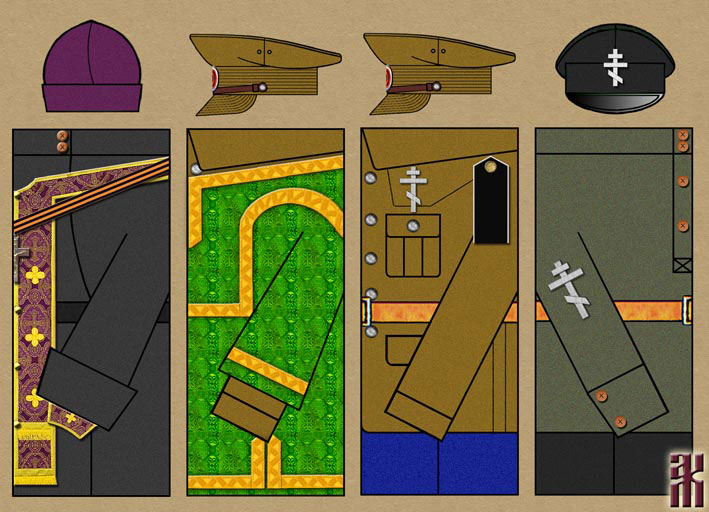
1 – representative of the military clergy; 2 – Professor D.V. Boldyrev;
3 and 4 – volunteer militiamen
Figure 1 is depicted in a cassock, with ecclesiastical scarf and cuffs. He wears an awarded purple skullcap and an awarded pectoral cross on a St. George ribbon. Figure 2 shows the ideologist of the crusader movement in a green deacon's stole over a British uniform. Figure 3 is in British tunic and Chinese warm cotton trousers. Figure 4 is in military-style blouse with civilian trousers and cap. Crosses are sewn onto the right sleeve, left side of the chest, and headgear.
Omsk, September and October 1919
Bearded men from the "Holy Cross" militia marched with white crosses sewn on the left side of their overcoats, above their hearts.
Cherkashin, N. A. in "Admiral Kolchak // Admirals of the Rebel Fleets", Moscow, 2004, p.221.
3. Muslims who wished to defend their faith formed special detachments with a special green banner as part of the Holy Cross militia.
"General Diterikhs", Moscow, 2004, p.325, citing "Resolution of the meeting of representatives of refugee camps in Omsk on 27 August 1919 // Our Newspaper, No. 15", Omsk, 3 September 1919.
The Holy Cross militia will go into battle against the enemies side by side with the Muslim militias marching under the green banner of the Prophet to defend their faith.
"General Diterikhs", Moscow, 2004, p.327, citing "Declaration of Holy War // Russian Army, No. 4", Omsk, 6 September 1919.
Crusaders who had joined the army to defend the Orthodox faith marched through the streets. Muslims marched alongside them with the crescent moon symbol. It was the movement of the "holy cross" and the "green banner".
Gins, G. K. in "Siberia, the Allies and Kolchak", Moscow, 2007, p.532.
October 1919
Intelligence reports of the [Soviet] 26th Division. According to statements taken on 15 October 1919 from prisoners of the 41st Ural Regiment of the 11th Ural Rifle Division, the 3rd Battalion of the regiment consists of volunteers who recently arrived from the Ural Crusader Brigade. Their caps are embroidered with a white eight-pointed cross, and on the caps of Muslims there is a crescent, one half red and the other white.
RGVA F.1317 Op.2 D.891 L.32. Information kindly provided by Moscow researcher O. Vinokurov.
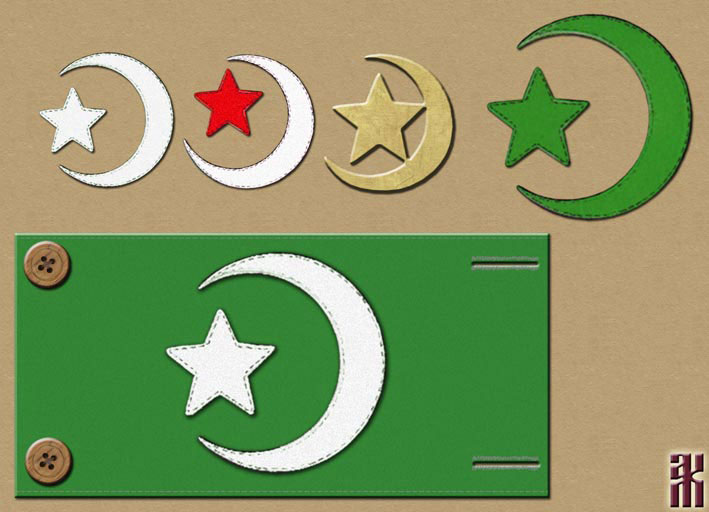
Insignia of the volunteers of the Green Banner Detachments and the crescent companies
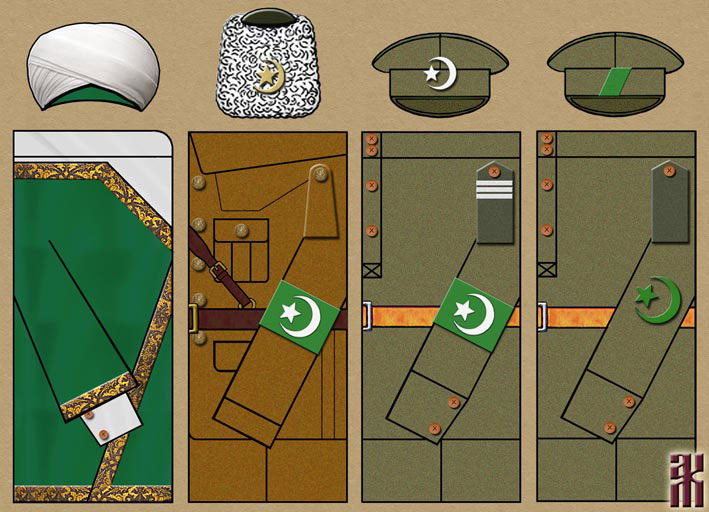
Uniforms of volunteers of the Green Banner militias
Omsk, mid-1919
A company of volunteers from the Brotherhood of the Holy Cross, commanded by Captain P. P. Rusin (now a colonel), was to march to the front. Upon learning of this, I hastened to enlist as a private crusader, and before departure, the company gathered at the cathedral to hear a farewell prayer service. The prayer service was conducted by Archbishop Silvestr, who, during the anointing, personally pinned the signs of a crusader on me, Boldyrev and Rusin: a white eight-pointed cross on a green shield. I stood on the right flank of the formation, with Professor Boldyrev next to me, both of us with rifles.
Enborisov, G. V. in "From the Urals to Harbin: Memoirs of what I experienced", Shanghai, 1932. Digitalised by S. Yu. Vasilenko in 2009 for www.elan-kazak.ru [link dead].
Now it is our turn to defend our faith. For this purpose, a Holy Cross Militia will be formed. These militias are so named because their members wear a cross on their chests, showing that they are fighting not for power, but for their faith, for Christianity, against apostates who want to destroy Christianity.
Anyone can join the Holy Cross militias, whether they are subject to conscription or not.
Soldiers and officers on active duty can also join, but, of course, they will remain in their units to form their own crusader groups with the permission of their superiors.
Women can also join the Holy Cross Militia to perform medical, domestic and transport duties.
All believing Christians can join the Militia, regardless of their denomination.
"Our Newspaper", Omsk, 19 August 1919, at siberia.forum24.ru/?1-4-0-00000029-000- 10001-0
Semipalatinsk, 19 October 1919
I demonstrated this to the assembly with the Ivanov family. On the eve of the meeting, 43-year-old postal official Kuzma Ivanov, his 40-year-old wife, his 17-year-old son and his 13-year-old son volunteered to join the Crusader Brigade, and all four donned the Crusader insignia.
It was a ridiculous meeting – after it the audience, fired up with mass enthusiasm, decided to petition the Supreme Council to ensure that "all citizens of Semipalatinsk ..., moved by a sense of loyalty to the Motherland, should join the ranks of volunteers in the Brotherhood of the Holy Cross and others between the ages of 18 and 55 within two weeks", and those who do not want to, then (!) "petition you for the immediate mobilisation of that age group".
This short, modestly worded solemn promise of a true Russian man who renounced his personal life and set himself the sole goal of wresting his motherland, Holy Russia, from the hands of the devil, is in essence and in its deeper meaning very eloquent and comprehensive. It clearly states that the devil reigns in Russia, and victory over the devil can only be achieved under the sign of the Holy Cross, and that those who walk under the Holy Cross bring peace to the world, not cruelty and revenge. That is why these people, having agreed to take on the great responsibility of standing under the Holy Cross and calling themselves "Militia of the Holy Cross", pledged to remain faithful to the idea of liberating Holy Russia from the devil until the end of their lives, and to preserve their banner – the Holy Cross, which they attached to their pure Russian chests, and before going into battle, they received the blessing of spiritual pastors, giving this significant promise and renouncing personal vendettas. The Muslims did the same before their Holy Koran, standing under the sign of the "Green Banner", attaching it to their chests, and regardless of where this movement begins, whether it will be necessary to stand under the common Chinese flag, Japanese or other, but we have the Russian tricolour flag as our goal and keep it in our souls and hearts, for we are deprived of the opportunity to hoist it.
Enborisov, G. V. in "From the Urals to Harbin: Memoirs of what I experienced", Shanghai, 1932.
In 1919 the Bolshevik magazine "Revolution and the Church" wrote about them as ordinary military formations, distinguished from other units by an eight-pointed cross sewn onto their uniforms: 'The soldiers of these regiments, as eyewitnesses describe, are dressed in special uniforms with the image of a cross. At the front of the regiments ... are clergymen dressed in robes, singing prayers and carrying a forest of banners. These regiments consist of the most ... fanatical soldiers of Kolchak's army.' There were also preaching detachments in the White ranks, led by the head of the All-Russian Orthodox Church, Archbishop Silvestr of Omsk.
Cherkasov-Georgievsky in "History of the Russian Orthodox Church Outside Russia, VI" at www.russned.ru/istoriya/letopis-cerkovnyh-sobytii.-1918-god [link dead]
November 1919
Address to the employees of the Altai Provincial Administration
Two companies of peasant volunteers have now been organised under the 5th Barnaul Brigade of the Holy Cross and Green Banner to fight the Bolsheviks. Until recently, these companies took part in the fight against Rogov's band, which they successfully eliminated.
Due to the interruption of communications with Omsk, that organisation of the Holy Cross, which is very useful in the fight against the gangs that pose a threat to the peaceful population, is experiencing great difficulties in material terms.
It is the duty of each of us to come to the aid of the Holy Cross militias, who are defending our well-being and our very lives, and to satisfy their urgent needs with generous donations.
Assistant Governor of the Altai Province
Acting Head of Department
Senior Clerk
GAAK F.1061 Op.1 D.11 L.13 at siberia.forum24.ru/?1-4-0-00000029-000-10001-0
From the appeal for the formation of the Holy Cross Militia, 1919.
May God rise again, may His enemies be scattered. For two years, holy Russia has been bleeding and weeping under the yoke of demons. The labour and blood of its faithful sons, the power of weapons and gold have not been able to overcome the strongholds of Satan. Orthodox Christians!
The weapon against Satan is the Holy Cross, "which the demons themselves tremble before". Take up the Holy Cross. Not secretly under your clothes, but openly, for the glory of God, above your military equipment. Raise the cross above the House of the Most Holy Mother of God of Orthodox Russia. The eight-pointed white cross will serve you on your journey from the Holy Sites of Moscow. Wear the white cross on your chest and on your right hand, with which you do God's work. May the doors of your houses, your wives and your children be sanctified with the cross. Pray! Let every church be filled to capacity with believers, let processions stretch from all corners of our bloodied, ravaged, crucified Mother Russia to Moscow; let the ringing of bells drown out the clamour of demons. With one voice and one heart, cry out: "Lord Jesus Christ, Son of God, have mercy on us sinners".
Zalygin, S. P. "Solenaya Pad", Moscow, 1981, p.389
On black-clad units
We had barely left the bureau meeting when a liaison officer ran into headquarters: some strange chains were moving towards the positions located near the lakes. The commissar and I rushed there. Indeed, an incomprehensible army was approaching our lines. We were used to seeing enemy soldiers in English, French and American uniforms, but these were dressed in black.
"Calm down!" Bondar encouraged the Red Army soldiers. "Let them come closer. We'll get them for sure!"
We dealt with the black target in a matter of minutes. It turned out that it belonged to the so-called "Holy Votkinsk Divizion", composed of monks, priests, psalm readers, and deacons from Votkinsk during the counter-revolutionary uprising in 1918.
The angry enemy threw its forces around the village. There was a danger of encirclement. Willingly or unwillingly, we were forced to leave Armiisonskoe again.
Ivanov, D. I. in "I'm a sailor of the Gangut!", Moscow, 1987, at militera.lib.ru/memo/russian/ivanov_di/06.html.
Here they gathered fresh forces, where we met new forces, where there were only officers and priests. The name of this enemy unit was Jesus Christ, where silver crosses and golden shoulder-boards shone. But our proletarian-conscious 25th Chapaev Division, despite all their crosses and gold shoulder-boards, gathered proletarian spirit and threw themselves into the attack and defeated them and their regiments. We took the city of Ufa, and other units replaced us.
Memoirs of S. F. Ryliev at TsDOOSO F.41 Op.2 D.19 L.10. The language style of the original has been preserved. The material was kindly provided by Ekaterinburg researcher D. V. Kadochnikov.
When they arrived in Levshino, questioning of the local population revealed that the barges contained children, women, Red Army soldiers, and people who had been arrested on suspicion of being enemies of the state – in short, people from all walks of life. Their fleet had come from Cherdyn to go downstream. They left a lot of guns in Solikamsk, and they had to load the barges with ammunition, food, salted fish, meat, all of which they left in Levshino because they couldn't take it with them. I'm telling this story briefly because that's how it turned out. Later we met these sailors, who were wearing black Votkinsk-Izhevsk overcoats, on the Irtysh River, where the Tatar yurts were located, and where the Votkinsk-Izhevsk division was stationed on the riverbank. It was a holy regiment, consisting exclusively of priests and deacons.
From the transcript of the Uralistpart meeting on the History of the 23rd Upper Kama Regiment, dated 18 January 1933 at TsDOOSO F.41 Op.2 D.35. L.37-39.
Note by Voronezh researcher N. Zayats: This "Jesus Christ Regiment", mentioned near Perm and then Ufa and on the Irtysh River, is a very strange unit that exists only in the memories of Red memoirists. However, the mention of black coats (navy or black beaver fur – there were warehouses with both types in the Perm area) gives reason to believe that it was the black colour of the greatcoats that gave rise to the legend of this "holy regiment" consisting entirely of clergy.
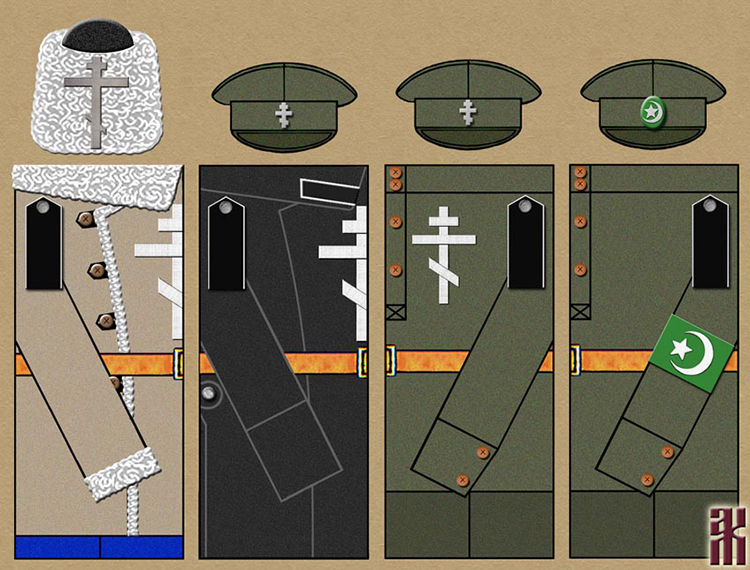
Uniforms of the Holy Cross Militia and Green Banner Militia
Figure 1 is a reconstruction of a militiaman in a white sheepskin coat, from the picture by M. I. Avilov, "The Surrender of Kolchak's Troops near Krasnoyarsk", 1921. Figure 2 is a militiaman in the frequently mentioned black beaver coats, which gave rise to the myth about the recruitment of clergymen into the militia. Figure 3 is of the 1st and 2nd companies of the 2nd Battalion of the Omsk Militia of the Holy Cross and Green Banner. Judging by the description, the white cross on the caps was made of metal. Figure 4 is of the 3rd and 4th Companies of the 2nd Battalion of the Omsk Militia of the Holy Cross. Different descriptions mention either a green cockade or a star and crescent on the cap, or perhaps all were present together.
Review and Departure of the Omsk Holy Cross Militia, September 1919
At one o'clock in the afternoon on 18 September, a public prayer service was held in front of the cathedral. The square was filled with people. Afterwards, the first review of the first Omsk Orthodox Militias of the Holy Cross and Muslim Militias of the Green Banner was held.
Generals Diterikhs, Khoroshikhin, Dutov, and Golitsyn arrived. Diterikhs inspected the parade. The militiamen marched in orderly rows. The Orthodox wore eight-pointed crosses on their caps and chests, while the Muslims wore stars and crescent moons on their caps and sleeves.
At the head of this militia marched the initiator of the crusader movement, Professor Sergeant Boldyrev.
"Our Newspaper", Omsk, 19 August 1919, at siberia.forum24.ru/?1-4-0-00000029-000- 10001-0
In connection with the great successes and the publication of the Supreme Ruler's decree on the convening of the State Zemstvo Council, a national prayer service was held at 1 p.m. on 18 September in the square in front of the cathedral.
... After the prayer service, a review of the first Omsk Orthodox Militia of the Holy Cross and Muslim Militia of the Green Banner was held.
... General Diterikhs reviewed the parade. The militiamen marched in orderly rows: the Orthodox with eight-pointed crosses on their caps and chests, and the Muslims with stars and crescent moons on their caps and sleeves. After the review, one of the priests blessed the commander of the 1st Company of the Holy Cross Militia with an icon of St. Nicholas, a copy of the miraculous icon at the Nikolai Gate of the Moscow Kremlin.
"Our newspaper,No. 32", Omsk, 21 September 1919. Material kindly provided by Voronezh researcher N. Zayats
Crusade
Today, the second battalion of crusaders is leaving for the front. The preparations are complete. Everyone is dressed for the march. They are just waiting for the command.
... At about two o'clock in the afternoon, the crusaders lined up on the street. Two companies of Russians and two companies of Muslims. The Russians have an eight-pointed cross on their caps and a cross on their chests. The Muslims have green cockades and green arm-bands with a star and crescent moon. Many have flowers on their buttonholes and caps: someone's care and affection has had an effect.
Command: Attention! And everyone froze. New command: At guard! Rifles flew up and froze. A banner covered with flowers was carried out of the doors. The orchestra struck up a welcome. The soldiers stood at attention in the crowd, with their hands on their caps. Everyone saluted the banner – the image of the Motherland.
Then the solemn, prayerful sounds of the hymn "How Glorious is Our Lord in Zion" poured forth.
"Our newspaper,No. 32", Omsk, 21 September 1919. Material kindly provided by Voronezh researcher N. Zayats
Happy Journey
Yesterday, Omsk sent a second battalion of crusaders to the front. These troops have a special spirit! Despite the fact that the crusaders have only spent a few days together, there is a strong bond between them. There are old people here – sturdy farmers with grey beards – and very young people – almost boys. They have a good bearing. There is a sense of conscious discipline. The Muslim units are united and cohesive.
On their caps is a small white eight-pointed cross, and on their chests is a green shield also bearing the image of a cross. The Muslim units have cockades and green arm-bands with the image of a crescent and star.
The farewells were touching and heartfelt. Speeches were made, striking familiar and dear chords... There was a large crowd at the farewells, excited and moved. There were moments reminiscent of the nationwide upsurge at the beginning of the war with Germany.
"Our newspaper,No. 34", Omsk, 23 September 1919. Material kindly provided by Voronezh researcher N. Zayats
Altai
The preaching of the crusader movement in Barnaul was even more successful.
The local Stock Exchange Committee donated around 400,000 rubles for the formation of volunteer militias.
The recruitment of Muslims into the volunteer militias yielded significant results. 4,000 Turkish prisoners of war volunteered to join the Green Banner detachments.
... The Zemstvo Assembly in Biysk, consisting entirely of Siberian peasants, decided to immediately send delegates to the districts to recruit peasants into the Holy Cross militias.
It is interesting to note that in Barnaul and Biysk, many people do not even know what Russia's national flag looks like, and in Biysk, despite all efforts, there was no fabric available to make a flag.
"Volunteering in Altai // Our Newspaper, No. 63", Omsk, 23 October 1919. Material kindly provided by Voronezh researcher N. Zayats
Peasant Regiment of the 24th Simbirsk Iron Division, 1919
In January of that year, our Peasant Regiment approached the Baiman factory. Our infantry fought near Baiman. I went around the enemy's left flank and rode onto the threshing floor. Suddenly, a Bashkir horseman appeared from around the corner and shouted to me from afar:
"Sir, run away quickly, the Reds are advancing!"
Apparently, my horse was better than his, and I caught up with him:
"Stop, or I'll cut you down!"
I rode up close to him, snatched the rifle from his shoulder, and he cried out:
"Don't hit me, sir! I am a Bashkir priest from the Plastun Regiment!"
I took him to my men. On the way, mixing Russian words with Bashkir, he tried to convince me:
"Comrade, I am not a Cossack, I am a Bashkir, a worker at the Aktobe factory."
But I could see that he was lying. He wore a turban around his papakha, and under his belt he had a book that looked like a prayer book. He turned out to be a Bashkir military mullah of the Dutov Regiment.
Yakov Yakovenko ( a.k.a. Korshun) in "The mullah himself was caught // Stages of the Long Road. Memories of the Civil War" Moscow, 1962. pp. 466-467
Home — State Symbols — Flags — Uniforms — Badges & Medals — Money — Other
Pygmy Wars Notes
The original for this page is at kolchakiya.ru/uniformology/sacred_cross_green_flag.htm.
A copy of the Karashchuk illustration can be seen here
A copy of the A. Lebedeva illustration is below. The Old Believer is Figure 2.
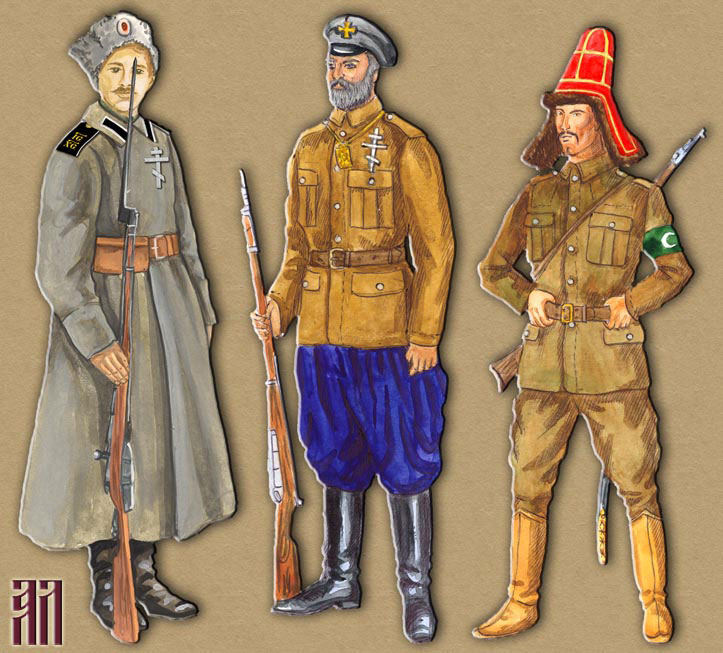
Uniforms of volunteers of the Holy Cross and Green Banner:
1 – Regiment of Jesus Christ; 2 – Omsk Company of the Holy Cross;
3 – Kyrgyz Green Banner Detachment
The Enborisov article can be seen here in pdf form. A version of the Avilov picture can be seen here.
Jaroslav Haček was the author of the classic book on the Russian Civil War, "The Good Soldier Švejk".
I have used "militia" for the Russian word druzhina, because these units were volunteer, locally raised and could be any size. However words like "squad" and "detachment" are equally applicable. Discussion on other translation choices I have made can be found here.
Flags
A few flags for these units are shown here.
History of the Holy Banner units
Information on these units can be found at the relevant Russian Wikipedia page with a translator.