
Uniforms of the Romanian Legion of Transylvanian and Bukovinian Riflemen
All material and reconstructions are by A. Karevskiy unless noted otherwise.
The following were used in the reconstruction of the uniforms of the Royal Romanian Army:
"Uniforms of the Romanian Army 1912-1930" at uniforma-army.ru/rymynia-1912.php
Funken, F. and Funken, L. "The First World War 1914-1918. Vol. 1", Moscow, 2002.
The formation of Romanian units from Austria-Hungarian subjects (from Transylvania, Banat and Bukovina) began in 1916 after Romania entered the war. By the spring of 1918 those Romanian volunteers were concentrated in Samara (1st Battalion) and Chelyabinsk (2nd Battalion). With the outbreak of the Civil War the Samara Battalion was transferred to Kurgan, and then both battalions ended up in Petropavlovsk. In early 1919 they were transferred to Irkutsk, where they began to be reorganised into the Romanian Legion of Transylvanian and Bukovinian Riflemen on 25 November. A military school was established in Irkutsk, with officers from the Royal Romanian Army sent as instructors. The formation of the legion was completed in June 1919.
Since the legion was considered part of the Royal Romanian Army, its servicemen emphasised their national identity, including through their appearance. With regard to the legion's uniforms, based on photographs on the Internet, it can be confidently stated that they corresponded to the established field uniforms of the Royal Romanian Army.
Initially the khaki of the Romanian army was grey-green in colour, but was then gradually changed to blue-grey and finally to grey-blue. Most likely, the material used to make the uniforms in Siberia was "horizon-blue".
The reconstructions are based on the units in the legion having the following:
1st "Horia" and 2nd "Mărceşti" Rifle Battalions – uniforms of vînatori (light infantry) with dark green piping (the battalions were distinguished by the numbers on their caps);
Engineer Company – sapper uniforms with black piping;
Legion HQ Commandant's Company – infantry unit uniforms with red piping;
Artillery Companies of the 1st and 2nd Rifle Battalions – uniforms of artillery units with black piping;
Commands of the armoured trains "Horia" and "Mărceşti" – uniforms of artillery units with black piping;
Communication teams of the 1st and 2nd Rifle Battalions – uniforms of technical units with black piping;
Cavalry squadron of the 1st rifle battalion – uniforms of calarasi (territorial cavalry) units with red piping;
Quartermaster and transport companies of the 1st and 2nd Rifle Battalions – quartermaster and administrative service uniforms with red piping;
Medical hospital – uniforms of the military medical service with black piping;
Reserve battalion – unclear (did it only supply the rifle units, or did it serve to reinforce all the units?).
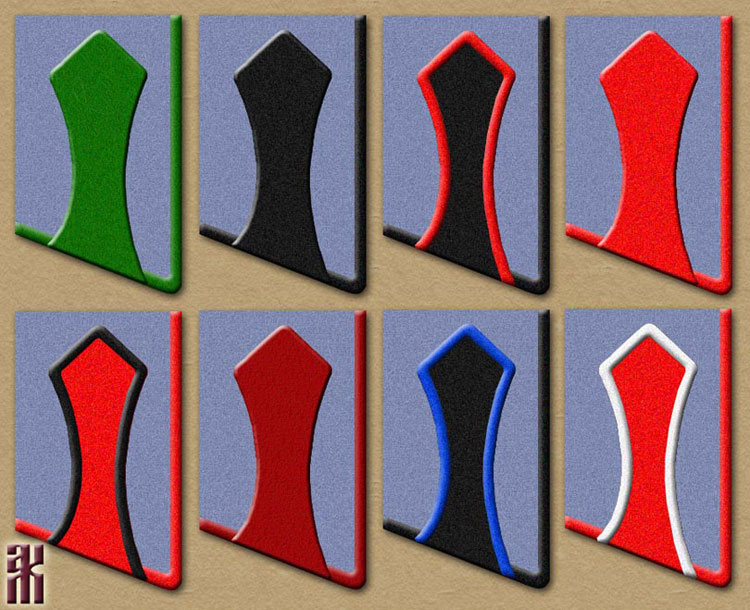
Buttonhole tabs of the 1912 model by branch of service:
1 – vînatori ; 2 – artillery; 3 – sappers and signals; 4 – infantry (commandant's company);
5 – cavalry; 6 – staff (legion HQ); 7 – medical hospital; 8 – quartermaster and transport
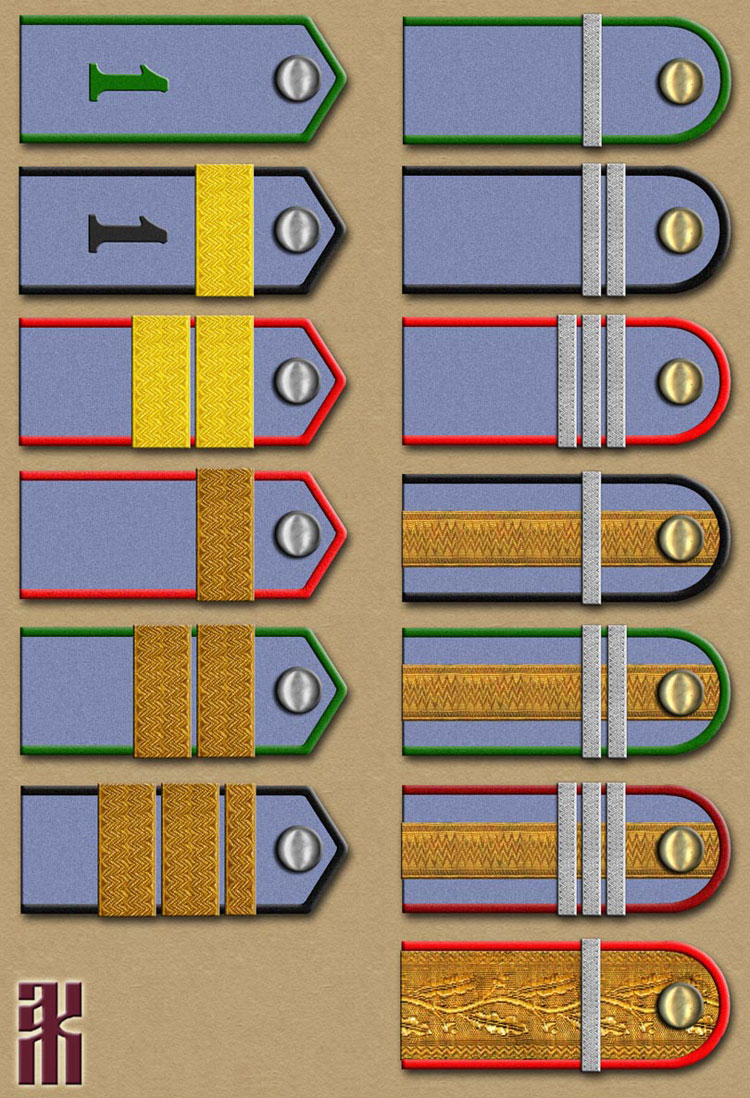
Rank markings of the Royal Romanian Army, used by the Transylvanian-Bukovinian Legion: (going down) 1 – private (soldat ) of the 1st Rifle Battalion;
2 – lance-corporal (fruntas) of the artillery company of the 1st Rifle Battalion;
3 – corporal (caporal ); 4 – lance-sergeant (sergent );
5 – sergeant/platoon commander (plutonier ); 6 – sergeant-major (plutonier-major );
7 – second-lieutenant (sublocotenent ); 8 – lieutenant (locotenent );
9 – captain (capitan); 10 – major (major ); 11 – lieutenant-colonel (locotenent-colonel );
12 – colonel (colonel ); 13 – brigadier-general(major-general )
On officers' shoulder-boards, the transverse stripes were made of white metal braid for combatants, i.e. officers who took direct part in combat operations, and of gold braid for non-combatant officers. On the shoulder-boards of privates and NCO, the colour of the braid was the opposite: yellow for combatant military personnel and white for non-combatants.
It remains unclear whether there were individuals with general's rank in the Legion – due to a shortage of senior command personnel in the winter of 1919, the Legion was led by Colonel E. Kadlec of the Czech service.
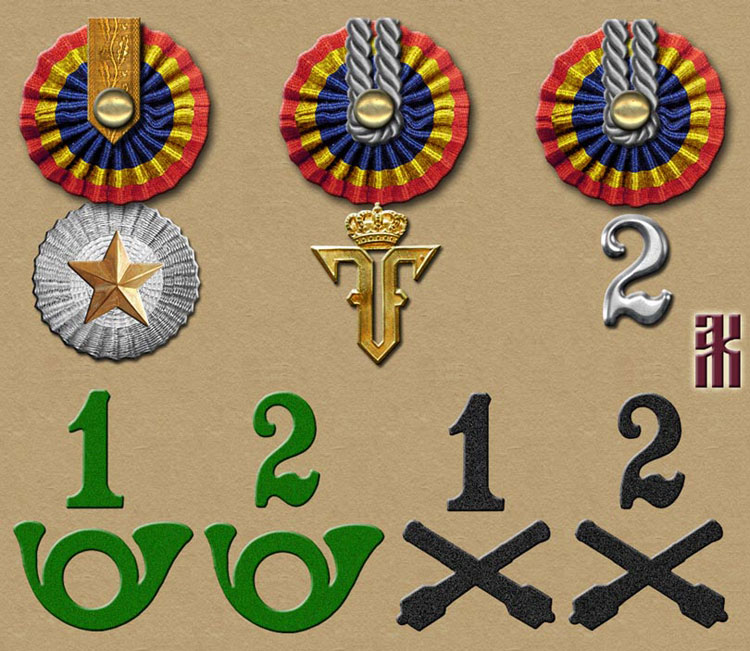
Cap insignia (note these are pairs):
1 – general; 2 – senior officer, 3 – officer of rifle battalion;
4 and 5 – other ranks of the 1st and 2nd infantry battalions;
6 and 7 – artillery companies of the 1st and 2nd infantry battalions
Senior and staff officers, Figure 2, had the monogram of King Ferdinand I below the cockade itself.
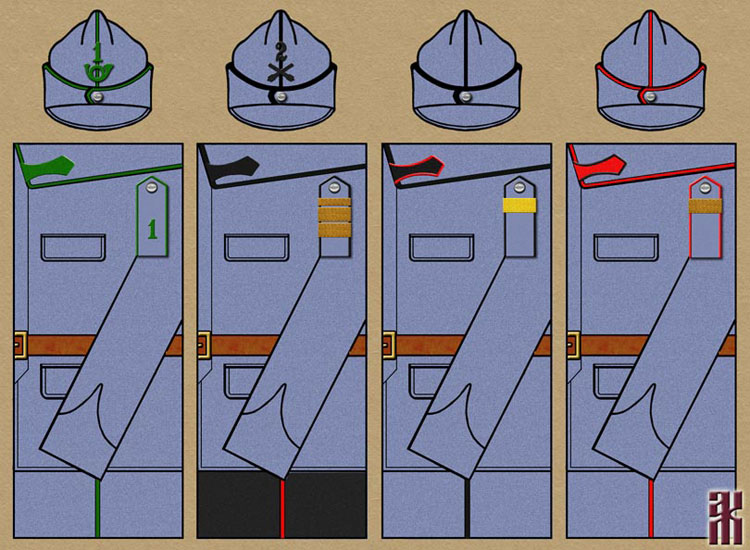
Uniforms of the Transylvanian-Bukovinian Legion:
1 – 1st infantry battalion; 2 – artillery company (2nd infantry battalion);
3 – engineer company; 4 – cavalry squadron (1st infantry battalion)
A distinctive detail of the artillery uniforms were the black trousers with red piping.
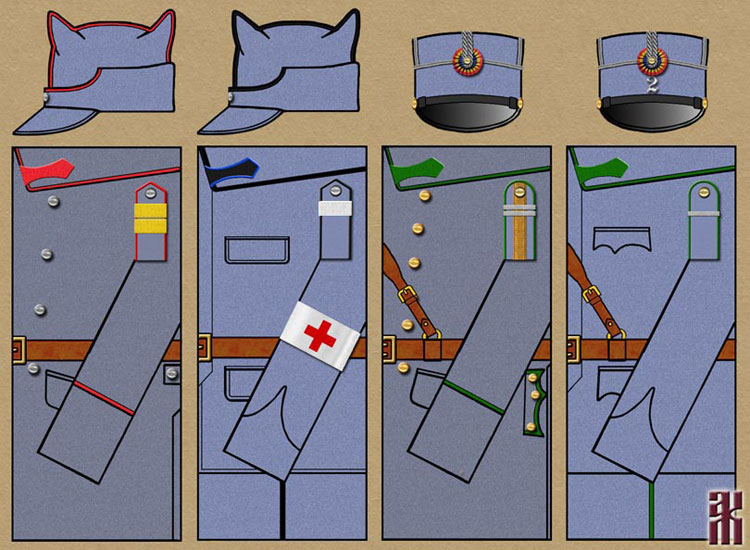
Uniforms of the Transylvanian-Bukovinian Legion:
1 – commandant's company; 2 – medical hospital; 3 and 4 – officers of rifle battalions
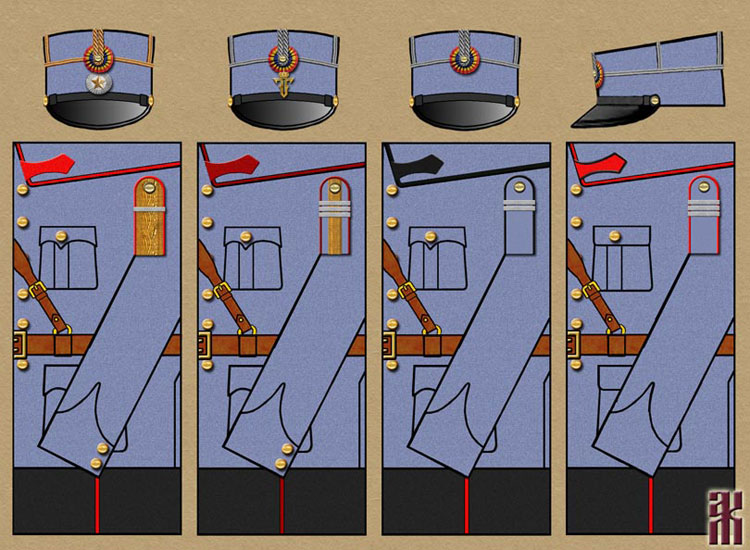
Uniforms of the Transylvanian-Bukovinian Legion:
1 – general; 2 – officer at legion headquarters; 3 – officer of an artillery company;
4 – officer of the cavalry squadron of the 1st infantry battalion
In general officer uniforms included black trousers, but during the First World War the practice of wearing trousers of the same color as the tunic spread. A plain red colour was established for generals.
Home — State Symbols — Flags — Uniforms — Badges & Medals — Money — Other
Pygmy Wars Notes
The original for this page is at kolchakiya.ru/uniformology/Romanians_legion.htm.
Discussion on the translation choices I have made can be found here.