
Official Uniforms of the Army of the Provisional Siberian Government
June-October 1918
All reconstructions are by A. Karevskiy.
Orders of the Provisional Siberian Government
Order No. 3 to the Units of the West Siberian Military District, 13 June 1918
The commander of the troops has ordered that, until approved by the Minister of War, a white and green parallelogram be worn on caps as a cockade. The cockade should be worn diagonally on the cap, similar to how Czechoslovakian troops wear their insignia. The vertical side of the quadrangle should be the same width as the cap-band, and the horizontal side should be half that width.
Only military personnel serving in units, institutions and establishments of the Siberian Volunteer Army are entitled to wear this insignia.
Acting Chief of Staff of the District, General Romanov
RGVA F.39504 Op.1 D.57 L.2.
Order No. 3 to the Units of the East Siberian Military District, 17 June 1918
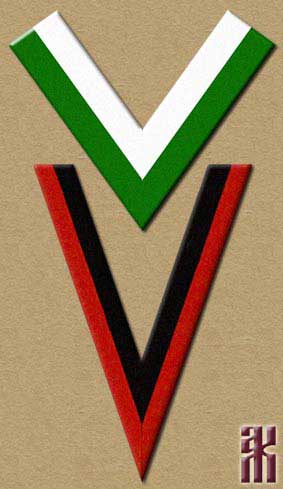
Paragraph 3. I hereby establish the following distinctive insignia for all military ranks: a two-coloured ribbon (white and green), replacing the cockade, 1/2 inch wide, 1.5 inches long, slanted from left to right with green at the bottom, and the same colours on the right arm above the elbow, 1 inch wide and 4 inches long. The distance in the corner opening is 3 inches.
RGVA F.39515 Op.1 D.2 L.3.
To the left are the sleeve chevrons used by servicemen of the Siberian Army.
Top is normal, bottom is for shock units.
Order No. 77 of the Units of the East Siberian Military District, 29 July 1918.
With regard to uniforms, all doctors have the same uniform as officers, with insignia on the sleeve and cap, as established in Order No. 3, paragraph 1, of the East Siberian Military District this year, but to distinguish their type of service, they shall have a red cross on the space in the open corner of the sleeve shield, each stripe being 3 centimetres long and 1 centimetre wide.
Medical assistants and pharmacists shall have the same insignia, but with stripes 1/2 centimetre wide.
Firearms, edged weapons, and spurs are not assigned to medical personnel, temporarily, until permission is granted by the Minister of War.
RGVA F. 39515 Op.1 D.2 L.38ob.
Order No. 10 of the Military Department of the Provisional Siberian Government, 24 July 1918.
I hereby announce the description and drawing of the arm-band insignia approved by me for distinguishing the ranks of officers and soldiers of the army of the Provisional Siberian Government.
This insignia shall be worn on the left sleeve, half an inch above the elbow.
Sleeve insignia and stencils with regiment numbers and capital letters of their names and special insignia for special types of weapons shall be prepared by order of the quartermaster's department and distributed free of charge to all military units according to the number of officers and soldiers available.
Description
Sleeve insignia for distinguishing the ranks of military personnel of the Siberian Provisional Government.
The sleeve insignia is made of coloured cloth measuring 2-2⅛ inches in length and 1-1¼ inches in width. To distinguish between ranks, white and green braid ⅛ inch wide is sewn onto the insignia according to the pattern shown in the drawing. Officer ranks are also indicated by stars (one for an ensign, two for a second lieutenant, three for a lieutenant, four for a staff captain, and three for a lieutenant-colonel) and braid of the same colour as the insignia: two stripes for captains, three for staff officers, and [wide] zigzag braid for generals.
At the bottom of the sleeve insignia, there is a stencil of the unit with its number and the first letter of its name, above which insignia are displayed the branch of service.
The colour of the cloth for sleeve insignia is as follows:
For riflemen – raspberry,
For Cossacks – the host colour,
For cavalry – blue,
For artillery and engineers – black (may be velvet) with scarlet piping,
For the judicial department – raspberry,
For headquarters – white,
For the General Staff – black (may be velvet) with white piping
For other departments and institutions – dark green without piping.
Grishin-Almazov.
RGVA F.39597 Op.1 D.12 L.25-25 bob.
Order No. 12 of the Military Department of the Provisional Siberian Government, 27 July 1918
To distinguish officers and soldiers serving in the army of the Provisional Siberian Government, a coloured cloth strip shall be affixed to cotton and woollen cloth blouses and greatcoats as follows:
- On cotton and woollen blouses: on the chest slit from the upper edge of the collar along the lapel to the end of the opening, along the outer edge of the opening.
- On greatcoats: along the upper edge of the greatcoat lapel.
- The cloth strip should be a ¼ vershok wide, with the outer edge folded inward on the blouse, and a ¼ vershok wide without folding on the greatcoat.
- For riflemen, a raspberry strip is used, and for other branches of the military, the colour of the sleeve insignia, temporarily red.
- The strips are to be applied by the units themselves, with the quartermaster's office providing 7/30 verchka of cloth for each rank (officer or soldier), counting 2/30 for the blouse and 5/30 for the greatcoat, and 40 kopecks for sewing on both strips.
- On officer-style tunics and French-style tunics, similar stripes are placed on the sleeves (as on the greatcoat) and also on the flaps of the side pockets, made of white and green braid.
Grishin-Almazov.
RGVA F.39597 Op.1 D.12 L.27.
Order No. 79 of the Chief Commander of the West Siberian Military District, 27 July 1918
For the release from the quartermaster's department of the arm-bands and cloth for trimming cotton and woollen blouses and greatcoats established for the army of the Provisional Siberian Government, I order the headquarters, units, administrations, institutions and establishments of the West Siberian Military District to immediately submit directly to the district quartermaster's office one general requisition list in triplicate for these types of supplies, compiled according to the actual number of officers and soldiers, the presence of which must be certified by persons exercising the rights of division commanders.
A detailed list of officers and soldiers by rank must be attached to the requisition list, as well as the number and initials of the unit name, for cutting out stencils.
The request shall be drawn up on the basis of two sleeve insignia and 7/30 verchka of uniform cloth (raspberry for riflemen, red for others) for each rank present.
Major General Mende.
RGVA F.39515 Op.1 D.2 L.85ob.
Order No. 39 to the Siberian Army, 4 August 1918
Paragraph 5. Following the petition initiated by the Military Academy conference, based on historical data and traditions of the Russian Army, I approve the shield for officers of the General Staff who are permanent members of the Academy to be worn on the left sleeve of their greatcoat, uniform, etc., in accordance with the description presented to me. The size and shape of the shield shall be in accordance with the Order of the War Department of 24 July of this year (No. 10).
RGVA F.39617 Op.1 D.256 L.17.
Order No. 22 of the War Department of the Provisional Siberian Government, 5 August 1918
The shock troops and death battalions, formed on the basis of Order No. 439 of the Supreme Commander-in-Chief dated 13 July 1917 and authorised by the Minister of War, fought the Bolsheviks with all their might until the last days of their existence. I therefore authorise the officers and soldiers who served in those units and who are currently in the army of the Provisional Siberian Government to wear the arm insignia assigned to the shock troops, and those who have the breast badge established by the same order No. 439 may wear it.
Provisional Administrator of the War Ministry, General Mende.
RGVA F.39597 Op.1 D.12 L.53.
On wartime salaries for military specialists serving in the Siberian Army, 31 July 1918
3) To maintain the following staff in the Army Headquarters motor pool: volunteer drivers may have a salary of 250 rubles per month, their assistants one of 150 rubles. In addition, they are to be provided with the other allowances established for volunteer soldiers, as well as clothing appropriate for their service (leather tunics, mittens, sheepskin coats in winter, etc.) to the extent possible.
"Siberian Herald, No. 5", 22 August 1918, p.1
Information on the availability of uniforms and equipment in the warehouses of the Quartermaster of the West Siberian Military District, 1 August 1918
| Name of items | Required | Available | |
|---|---|---|---|
| Uniforms and equipment | Army of 200,000 | in warehouses | Shortfall |
| 1. Uniforms: | |||
| Cloth field caps | 200,000 | 4,500 | 195,000 |
| Summer field caps | 200,000 | – | 200,000 |
| Winter blouses | 200,000 | 48,000 | 152,000 |
| Summer cotton blouses | 200,000 | 29,000 | 171,000 |
| Cloth trousers | 200,000 | 17,000 | 183,000 |
| Summer trousers | 200,000 | 19,000 | 181,000 |
| Greatcoats | 200,000 | 2,000 | 198,000 |
| Boots | 400,000 | 4,000 | 396,000 |
| 2. Underwear: | |||
| Undershirts | 600,000 | 388,000 | 212,000 |
| Underpants | 600,000 | 388,000 | 212,000 |
| Pairs footcloths | 600,000 | 4,500 | 595,500 |
| Towels | 600,000 | 3,000 | 597,000 |
| Handkerchiefs | 600,000 | – | 600,000 |
| 3. Equipment: | |||
| Belts | 200,000 | 300,000 | – |
| Greatcoat belts | 200,000 | 250,000 | – |
| Rifle straps | 200,000 | 385,000 | – |
| Chest cartridge pouches | 200,000 | 69,000 | 131,000 |
| Belt cartridge pouches | 400,000 | 218,000 | 182,000 |
| Spare cartridge pouches | 200,000 | 75,000 | 125,000 |
| Haversacks | 200,000 | 49,000 | 151,000 |
| Portion bags of dry rations | 600,000 | 1 million | – |
| Cooking pots | 200,000 | 255,000 | – |
| Flasks | 200,000 | 240,000 | – |
| Flask covers | 200,000 | 107,000 | 93,000 |
| 4. Warm clothing: | |||
| Short sheepskin coats | 200,000 | 1,300 | 198,700 |
| Felt boots | 200,000 | 7,400 | 192,600 |
| Cotton-padded vests | 198,700 | 94,000 | 104,700 |
| Cotton-padded trousers | 200,000 | 128,000 | 72,000 |
| Quilted jackets | 200,000 | 238,000 | – |
| Warm long johns | 200,000 | 238,000 | – |
| Woolen mittens | 200,000 | 24,500 | 175,500 |
| Mittens, gloves | 200,000 | 10,000 | 190,000 |
| Papakhi | 200,000 | 2,200 | 197,000 |
Compiled from RGVA F. 39617 Op.1 D.99 L.56.
Order to the West Siberian Military District, No. 29 of 29 August 1918
Establish the following maximum prices for items brought by those called up for mobilisation and recognised as fit for wear:
| Boots | 25.83 r |
| Winter blouse | 27.50 r |
| Winter trousers | 21.25 r |
| Cotton blouse | 8.00 r |
| Summer trousers | 6.00 r |
| Grey broadcloth greatcoat | 28.75 r |
| Cloth field cap | 8.75 r |
| Belt | 1.98 r |
RGVA F.39504 Op.1 D.57 L.23.
Order No. 61 to the troops of the Ural Separate Corps, 30 August 1918
Paragraph 3. Recently I have noticed a wide variety of military uniforms being worn. Corps Order No. 31 of 8 August 1918 specifies the uniform to be worn by units of the Siberian Army, and no unauthorised insignia, either on the sleeves or on the shoulders, other than those specified in the order, are to be worn.
I order the commanders of the units to immediately request from the quartermaster's department the sleeve insignia established by Order No. 31, and I warn that I will severely punish any unauthorised changes to the uniform.
Garrison commanders shall ensure that Order No. 31 on the uniform of the corps troops is correctly implemented.
RGVA F.39512 Op.1 D.58.
Order No. 64 to the troops of the Siberian Army, 6 September 1918
Until the All-Russian Army is revived and new distinctive insignia for uniforms are established, I hereby order the immediate restoration of the khaki shoulder-boards, collar tabs and cockades abolished by the Bolshevik authorities for officers, doctors, officials and soldiers in the army entrusted to me at the front and in the rear; the latter should be piped with a two-colour white and green ribbon.
With shoulder-boards being worn, the wearing of sleeve insignia, established by Order No. 10 of the War Department this year, is cancelled.
RGVA F.39617 Op.1 D. 256 L.32.
Order No. 11 of the Siberian Army, 10 September 1918
The army commander orders that in cases where officers, doctors, officials and riflemen are unable to purchase khaki shoulder-boards, they are permitted to wear braided or unit-coloured shoulder-boards instead.
Reference: Order No. 64 to the Siberian Army,dated 6 September 1918
Chief of Staff, General Staff, General Belov.
RGVA F.39512 Op.1 D.58 L.77.
Order No. 73 of the Siberian Army, 1 October 1918
The troops of the army entrusted to me, by my Order No. 64 of 6 September, wear shoulder-boards. These shoulder-boards have been washed with the sacred blood of those who fell in the struggle to rebuild the Motherland against the enemies of the people – the Bolsheviks – and have become a symbol of service to the highest military duty for the Fatherland and the oppressed Russian people.
I order military personnel to remember this and wear their shoulder-boards with honour. Everyone who wears military insignia is particularly obliged to protect the dignity of the entire army. For all are judged on the occasion of violations by individuals.
I impose a special duty on commanders and senior officers to completely eradicate all signs of licentiousness in the military environment and to prosecute with particular severity all offences that discredit the military.
The army should not be an enemy to the people, but a bastion of law and order; every officer and soldier should inspire not hidden ill will, but a sense of pride and deep respect.
RGVA F.39617 Op.1 D.256 L.38.
Order No. 4 of the 4th East Siberian Army Corps, 4 October 1918
Paragraph 4. Desertion is a serious offence for every defender of our long-suffering Motherland. ... Unfortunately, among young soldiers who have not yet developed a sense of love for their Motherland, such a phenomenon does occur.
Explaining cases of desertion only as extreme recklessness and in order to mark the guilty, I order that, in addition to being brought to trial, they wear a black arm-band with the white inscription "Deserter" on their right sleeve.
Commanding officers shall have the right to petition me to remove this shameful insignia if the offender atones for his misdemeanour by honest service to the Motherland.
(Appendix) Description of the arm-band for deserters.
A black calico arm-band 5 vershki wide shall be sewn onto the right sleeve above the elbow on the greatcoat and blouse, with white letters 4 vershoks high sewn onto it.
RGVA F.39513 Op.1 D.22 L.28-29
Order No. 19 to the 4th East Siberian Army Corps, 21 October 1918.
By order of the Corps Commander, I hereby announce for information and execution that only cadets currently enrolled in military academies have the right to be called cadets and wear the insignia assigned to this rank, while those who were dismissed for various reasons in the past, including those discharged on leave during the disbanding of cadet schools and who did not re-enroll in military schools, do not have the right to wear cadet uniforms and cadet insignia.
Chief of Staff of the Corps, Colonel Tonkikh
RGVA F.39513 Op.1 D.22.
Order No. 140 to the 3rd Ural Army Corps, 22 October 1918
In addition to Order No. 110 of 5 October, I authorise my representatives to make exceptions for the poorest citizens when requisitioning government cloth and soldiers' uniforms, and not to demand the surrender of such items from soldiers discharged from military service due to wounds or illness, nor may it be requisitioned from the Cossack population, who enter service in their own uniforms.
RGVA F.39512 Op.1 D.58 L.201.
Order No. 149 to the 3rd Ural Army Corps, 30 October 1918
Paragraph 2. Division commanders and regimental commanders shall take measures to ensure that all officers of their units are fully equipped and dressed in uniform.
RGVA F.39512 Op.1 D.58 L.215.
Sleeve Insignia in accordance with Military Department Order No. 10 of 24 July 1918
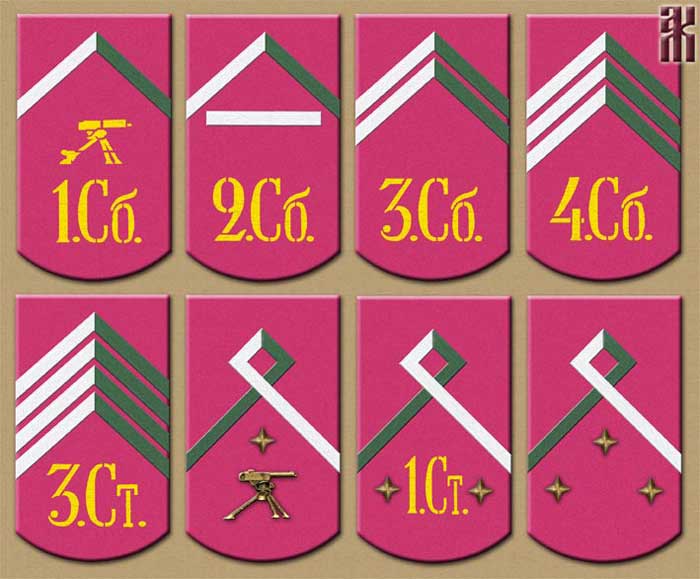
Rifle units: 1 – machine-gunner private; 2 – lance-corporal; 3 – corporal;4 – sergeant;
5 – sergeant-major; 6 – ensign in MG unit; 7 – second-lieutenant; 8 – lieutenant.
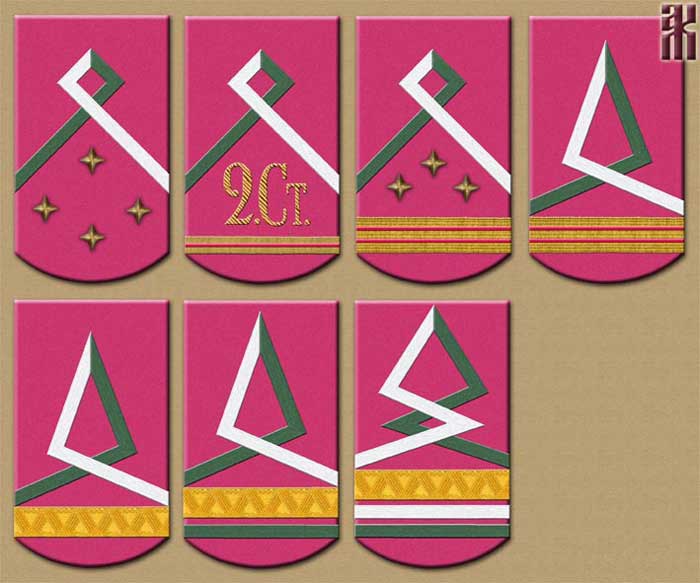
Rifle units: 1 – staff-captain; 2 – captain; 3 – lieutenant-colonel; 4 – colonel;
5 – major-general; 6 – lieutenant-general; 7 – general of infantry (there were none)
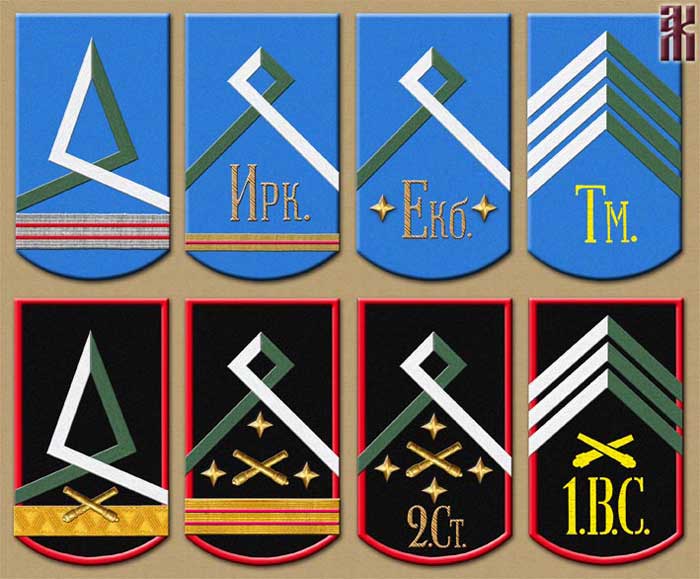
Cavalry and artillery units:
1 – colonel (unstated cavalry unit); 2 – captain (Irkutsk Hussar Divizion);
3 – 2nd-lt (Ekaterinburg Lancer Divizion); 4 – sergeant-major (Tomsk Hussar Divizion);
5 – major-general of artillery; 6 – colonel of artillery;
7 – lieutenant (2nd Independent Steppe Battery); 8 – sergeant (1st East Siberian Battery)
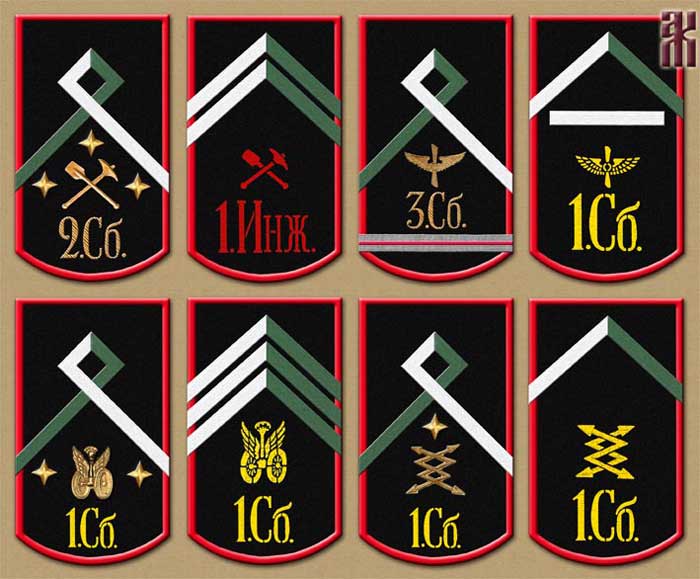
Technical units
1 – lieutenant (Engineer Comp. of the 2nd Siberian RD); 2 – corporal (1st Engineer Divizion); 3 – captain (3rd Siberian Air Squadron); 4 – lance-corporal (1st Siberian Air Squadron);
5 – second-lieutenant (1st Siberian Motorised Company); 6 – sergeant (same unit);
7 – ensign (1st Siberian Telegraph Company); 8 – private (same unit).
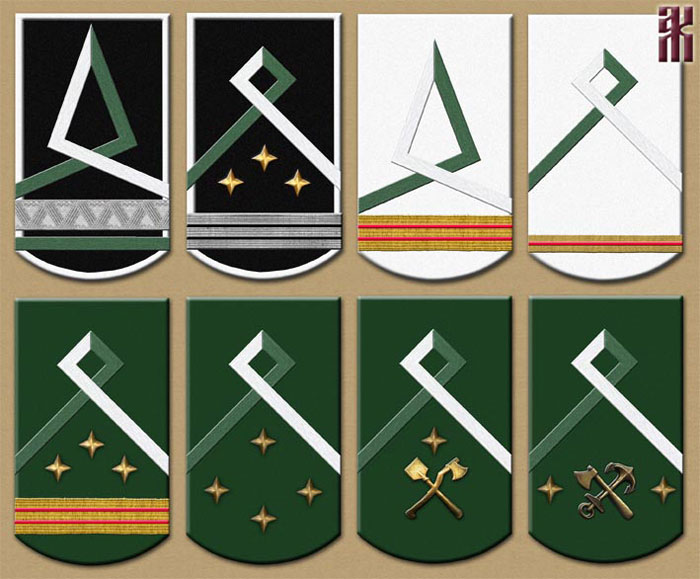
Headquarters and technical services:
1 – major-general (General Staff); 2 – lieutenant-colonel (General Staff);
3 – colonel (staff of a rifle unit),; 4 – captain (staff of a rifle unit);
5 – lieutenant-colonel (War Department); 6 – staff-captain (quartermaster service);
7 – collegiate registrar (civilian engineer); 8 – second-lieutenant (railway battalion).
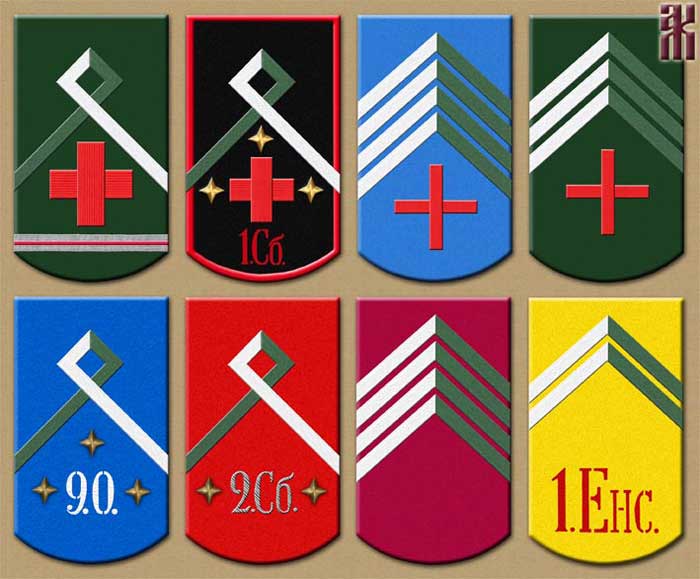
Medical service and Cossack units:
1 – collegiate assessor (doctor); 2 – collegiate secretary (doctor);
3 – sergeant-major (paramedic); 4 – sergeant (medical assistant or pharmacist);
5 – lieutenant (9th Orenburg Cossack Regt); 6 – 2nd-lieutenant (2nd Siberian Cossack Regt);
7 – sergeant-major (Independent Semirechensk Cossack Sotnia);
8 – corporal (1st Enisei Cossack Regiment).
Uniform Schemes for the Siberian Army
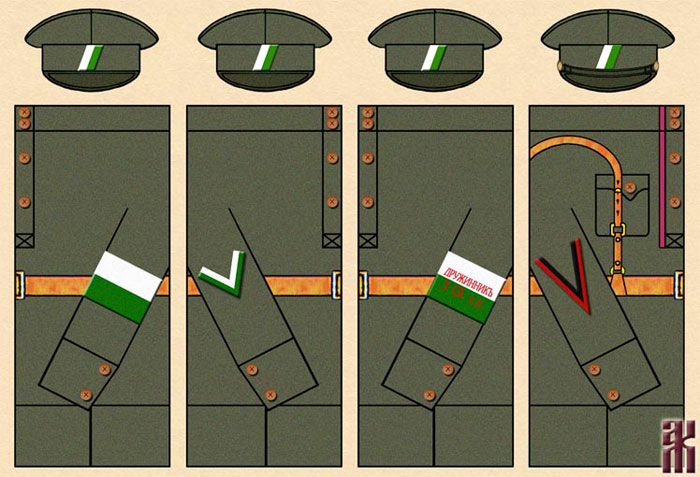
Uniforms of volunteers of the Siberian Army (Independent West Siberian Army) during the period of armed uprising
1 – with arm-band; 2 – with white and green chevron (July 1918);
3 – with a military unit arm-band (here – 1st Novonikolaev Siberian Rifle Regiment);
4 – with a black and red chevron of shock units (kept by order No. 22 of 5 August 1918)
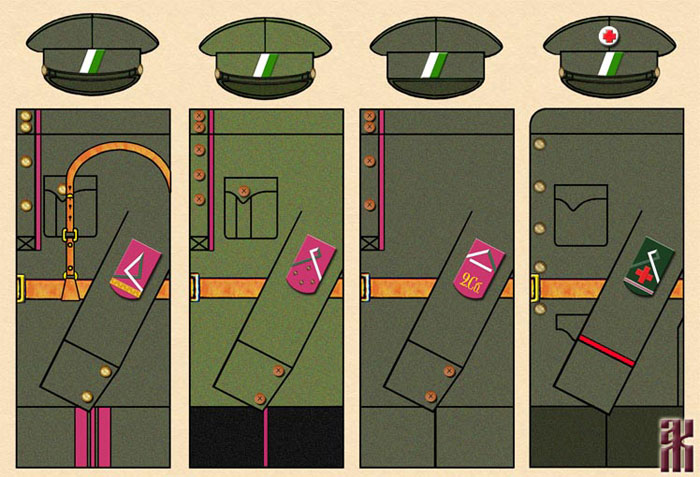
Uniforms of the Siberian Army (rifle units and medical service)
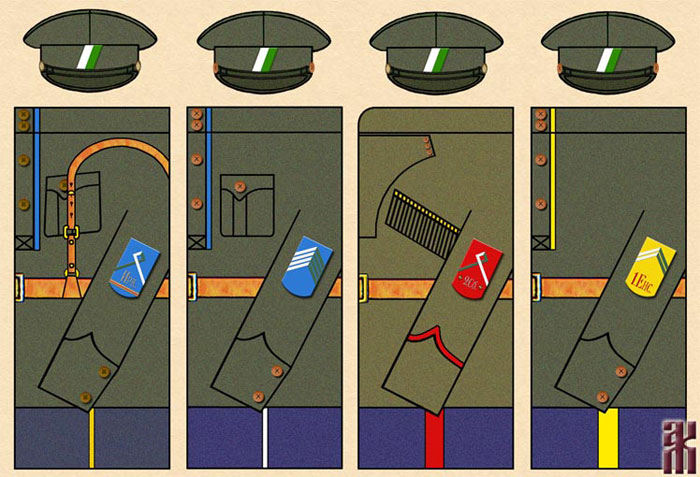
Uniforms of the Siberian Army (cavalry and Cossack units)
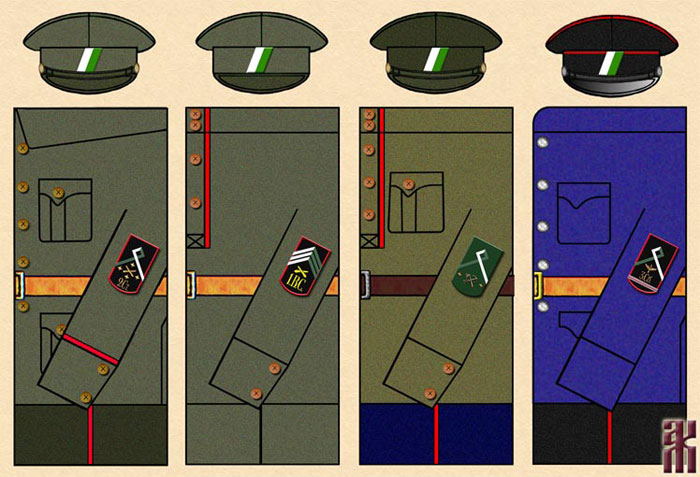
Uniforms of the Siberian Army (artillery officer, artillery NCO, railway and aviation units)
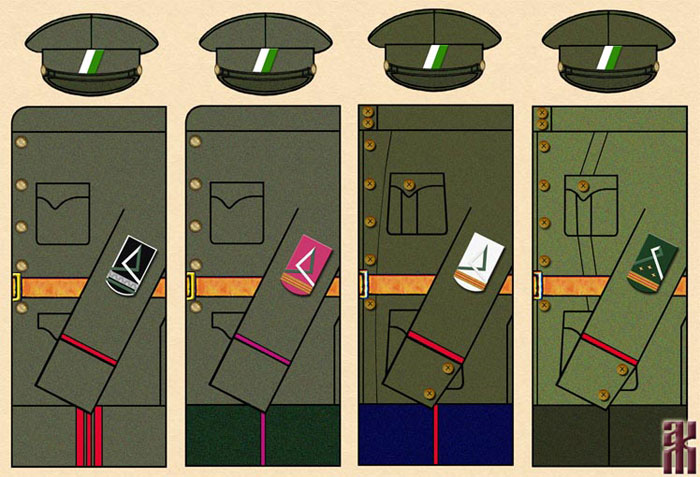
Uniforms of the Siberian Army (General Staff, judicial authority, headquarters and quartermaster service)
Home — State Symbols — Flags — Uniforms — Badges & Medals — Money — Other
Pygmy Wars Notes
The original for this page is at kolchakiya.ru/uniformology/vps_orders.htm.
Discussion on the translation choices I have made can be found here.