
Actual Appearance of the Provisional Siberian Government Army in 1918
according to memoirs and historiography
Officers, volunteers and soldiers wore white and green Siberian "national" ribbons on their headgear, which had appeared during the "democratisation" and final collapse of the old army at the end of 1917, and, in some places, white and green arm-bands.
Deryabin, A. I. in "The Siberian Army in 1918 // Tseykhgauz, No. 2", Moscow, 1993, p.26.
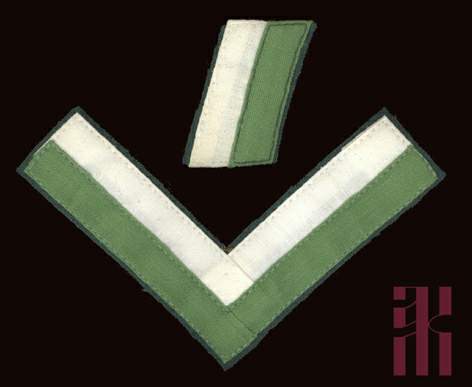
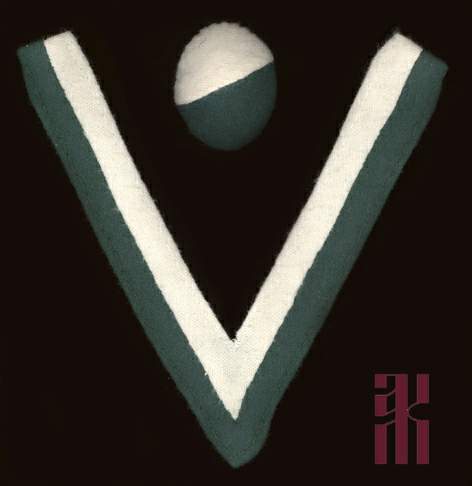
Almost immediately after the Conference of Siberian Public Organizations approved the regulation on the Siberian National flag on 5 August 1917, the Siberian rifle units stationed on the Romanian front began wearing white and green greatcoat tabs on their own initiative.
Private communication from A. B. Ezeev.
Tomsk, 29 May 1918
The first battalion of rebels was quickly formed, armed with rifles distributed to them, and headed for Cathedral Square singing songs. ... On the street, the battalion of rebels encountered an old grey-haired general without shoulder-boards. I shouted:
"At ease, left face. ... Gentlemen officers!"
The general took off his cap, crossed himself and began to cry.
Kirilov, A. A. in "The Siberian Army in the Struggle for Liberation // Free Siberia, Vol. 4", Prague, 1928, p.43.
Boldly believing that "everyone" supported him, Colonel Sumarokov began by putting on his shoulder-boards and rejoicing when he saw them on other officers.
Kirilov, A. A. in "The Siberian Army in the Struggle for Liberation // Free Siberia, Vol. 4", Prague, 1928, p.45.
On the night of 31 May 1918, local counter-revolutionaries and Czechoslovak legionnaires seized power in Petropavlovsk. On 2 June I was arrested by Officer Batalov and brought to the stanitsa ataman at two o'clock in the morning. Near the building where the ataman was located, a crowd of Cossack men and women with white arm-bands rushed at me and began to beat me.
Dubynina, D. in "Heroines-Communists // Kazakhstan in the Fire of Civil War", Alma-Ata, 1960, p.402.
June 1918
As an innovation, shoulder-boards were not introduced as a concession to democracy. If we recall how much hatred the soldiers felt towards officers' shoulder-boards during the revolution, and how all the excesses began with the tearing off of shoulder-boards, we cannot but admit that Grishin acted prudently in this matter. Experience was to justify his caution: later, when clashing with the Bolsheviks, the Siberians, calling on the Red soldiers to surrender, shouted to them as an argument: "Come over, don't be afraid! We are the same, without shoulder-boards." After all, the French army does not have shoulder-boards, and this does not make it any worse.
Filatyev, D. V. in "The Catastrophe of the White Movement in Siberia: Eyewitness Impressions", Paris, 1987, p.48.
Grishin-Almazov built his army on the principles of strict discipline, but he did not introduce shoulder-boards or medals. It seems to me that both of these decisions were entirely correct. Giving awards for victories in the Civil War would have erased the ideological nature of the struggle and demoralised the military, infecting them with a corrupting ambition.
As for shoulder-boards, they would have revived the old military hierarchy and restored the importance of rank, whereas the new army was supposed to promote its leaders not by rank but by merit.
Gins, G. K. in "Siberia, the Allies and Kolchak", p.131.
The Siberian army, which gravitated towards the separatist sentiments that were then very popular in Siberia, had its own special colours (white and green) on its banners and uniforms.
Boldyrev, V. G. in "The Directory, Kolchak, the Interventionists: Memoirs", Novonikolaevsk, 1925, p.30.
Petropavlovsk, June 1918
The uprising was carried out under the banner of democracy and, for a number of reasons, the rebels did not wear shoulder-boards. So when several officers from Annenkov's detachment arrived from the steppes wearing their shoulder-boards, the day after the city was liberated from the Bolsheviks, they attracted the attention of the population. The district chief asked them to remove their shoulder-boards, but they refused and left for the steppes.
Filimonov, B. B. in "On the Way to the Urals: The Campaign of the Steppe Regiments, Summer 1918", Shanghai, 1934, p.20.
Ekaterinburg area, June 1918
Summer 1918. The Chekists' coup in Omsk. The first volunteer regiment was formed. The commander was Staff-Captain Zhilinsky. It was not a regiment, but a battalion, not even a battalion – a small battalion! Four companies of fifty bayonets each.
In terms of numbers it may have been a small battalion, but in terms of spirit, readiness to fight, and will to win, it was a tightly knit, heroic unit. The rank and file were officers: strong-armed, sharp-shooting Siberian ensigns – young people burning with enthusiasm – and students, high school pupils, cadets.
Your humble servant was in the fourth company, with three stars on his shoulder-boards. ... True, there were no shoulder-boards yet, no distinctions. We wore the summer soldier's khaki uniform. We were volunteers.
Nesmelov, A. in "Ekaterinburg Prisoner: Memories of the 1st Siberian Volunteer Regiment // Military Reality, No. 3", Moscow, 1993, p.6.
Mariinsk, June 1918
The area around Mariinsk Station is a bustling military camp, where there is a constant rush of Czechs and Russians mixed together, distinguished by white-green (Siberians) or white-red (Czechs) insignia on their caps instead of cockades (officers also have arm-bands of the same colours on their left sleeves and markings indicating their rank).
"Siberian Life, No. 40" 20 June 1918. The material was published at www.siberia.forum24.ru/?1-3-0-00000020-000-0-0-1271424860.
Announcement.
I have noticed that officers and military officials are still wearing old-style cockades and do not have the required white and green arm-band on their left arm. I order that all officers, officials and military doctors serving in the troops of the Siberian Provisional Government wear a white and green ribbon instead of the old-style cockade and an arm-band of the same colours on their left sleeve. Those guilty of failing to comply with this order will be arrested and taken to the commandant's office.
City Commandant Lieutenant Lopatchnikov
Adjutant Second Lieutenant Arbuzov
"Siberian Life, No. 44", 26 June 1918 at www.siberia.forum24.ru/?1-8-0-00000003-000-40-0-1271785951
Mariinsk, Tomsk, Novo-Nikolaevsk, 18 June
"The commander has ordered. ... those commanding to pay attention: some officers are wearing cockades – remove them and replace them with white and green ribbons.
Duty officer Captain Ivanov
GATO, F.r.1362 Op.1 D.213 L.51 at www.siberia.forum24.ru/?1-8-0-00000003-000-40-0-1271785951
Ekaterinburg area, July 1918
The 1st Independent Steppe Battery was attached to the Czech battalion. Of the 33 crew in the battery, 25 were officers. Although few people at the front wore shoulder-boards or other insignia indicating their rank, it was not difficult to recognise Russian officers by their general appearance and, to some extent, their uniforms.
Filimonov, B. B. in "On the Way to the Urals: The Campaign of the Steppe Regiments, Summer 1918", Shanghai, 1934, p.136.
Irkutsk, 12 July 1918
The Siberian volunteers of General Pepelyaev's detachment made a favourable impression. They were young, mostly intelligent people. Among them were many [tertiary] students or pupils of secondary educational institutions. I met two volunteers on the street, both natives of Altai. ... The volunteers did not wear shoulder-boards, but had white and green stripes – a sign that they were soldiers of the Independent Siberian Government. The revolutionary reality gave the Siberian regionalists more than they had dared to dream of: they now had their own army, led by the brave commander General Pepelyaev.
Serebrennikov, A. I. in "My Memoirs, Vol. 1 // The Civil War in Russia: The Great Retreat", Moscow, 2003, p.339.
Lake Baikal, July 1918
In his old, worn-out greatcoat, which he had worn since the German War, and his ordinary soldier's field cap, pushed to one side, Pepelyaev looked more like a soldier than a senior officer in charge of the lives of these people.
Kirilov, A. A. in "The Siberian Army in the Struggle for Liberation // Free Siberia, Vol. 4", Prague, 1928, p.52.
July 1918
Temporarily, pending approval by the Minister of War, a four-sided badge in white and green, in the form of two stripes of the aforementioned colours, is to be worn on caps as a cockade. The cockade shall be worn diagonally on the cap, in accordance with the manner in which similar insignia are worn by Czechoslovak troops. The dimensions of the quadrangle shall be: vertically – the width of the entire cap; horizontally – half that width. Only military personnel serving in the ranks of the Siberian Volunteer Army are entitled to wear this insignia.
"Omsk Herald, No. 113", 3 July 1918, quoted from: Deryabin, A. I. "The Siberian Army in 1918 // Tseikhgauz, No. 2", Moscow, 1993, p.26.
Along with the sleeve insignia, according to the order of the War Department of 27 July 1918, officers and soldiers were issued with a cloth stripe [½ a] vershka wide. The strip was located on the chest opening of cotton and cloth blouses from the collar to the end of the opening with a fold along its outer edge, and on greatcoats along the upper edge of the cuffs without a fold. For riflemen it was to be a raspberry strip, and for other branches of the armed forces, the colour of the sleeve insignia, temporarily red. For officers' tunics and coats, a similar stripe of white and green braid was established, located on the sleeves and flaps of the side pockets. In addition, white and green braid was sewn onto the sleeves of officers' greatcoats.
Simonov, D. G. in "The History of the Armed Forces of the Provisional Siberian Government (1918) // Siberia during the Civil War", Kemerovo, 1995, p.81.
On 27 July 1918, Order No. 12 was issued on the introduction of a coloured cloth strips, 11 mm wide, on blouses and greatcoats. ... The text of the order does not specify the colour of the strips, but logically, it would match the colour of the sleeve insignia. However, Order No. 79 of the Chief Commander of the West Siberian Military District, dated the same day, specifies the colour of the piping: "... arm of service broadcloth (raspberry for riflemen, red for others)..." ... Coloured strips were placed on the officer's tunic and coat cuffs and, in addition, a white and green braid stripe was to be placed on the side pocket flaps.
However, on 8 August, Order No. 38 of the commander of the Central Siberian Corps, referring to a telegram from the Chief Commander of the District, announced: "The placement of white and green braid strips on the side pockets of tunics is to be suspended..." Order No. 98 of 7 August to the Steppe Siberian Corps was more specific on this matter: "...the white and green braid on the pockets of officers' tunics and "French" tunics is to be cancelled."
Deryabin, A. I. in "The Siberian Army in 1918 // Tseikhgauz, No. 2", Moscow, 1993, p.28.
Omsk, August 1918
Omsk made a good impression with its military units. Soldiers could be seen everywhere on the streets marching in formation, their bearing and dashing appearance speaking of discipline and the revival of combat strength.
Lieutenant NN, in "Notes of a White Guard // Archive of the Russian Revolution, Vol. 10", Berlin, 1923, p.89.
Second Chelyabinsk Conference, August 1918
Both camps, incidentally, tried to impress each other and the moderate, undecided elements with the external splendour of their speeches at the conference. The Siberian delegates, led by I. Mikhailov and General Ivanov-Rinov, therefore arrived in Chelyabinsk in a special train, above which flew the white and green banner of Independent Siberia. They brought with them a large entourage, among whom the numerous military uniforms of all branches of the armed forces stood out brightly.
Maisky, I. M. in "Democratic Counterrevolution", Moscow-Petrograd, 1923, p.202.
August 1918
An order issued on 16 August to the Steppe Siberian Corps announced temporary instructions for the formation of "Military Militia" to be formed within the rifle regiments, recruited "from local (in the combat zone) volunteer patriots familiar with military affairs who have expressed a desire to assist the Siberian Army in cleansing the area of Bolshevik gangs." Volunteers were required to wear their own uniforms with a white and green arm-band sewn onto the left sleeve bearing the inscription "Member of such-and-such regiment."
Deryabin, A. I. in "The Siberian Army in 1918 // Tseikhgauz, No. 2", Moscow, 1993, p.29.
September 1918
The very next day after Ivanov-Rinov took command of the Siberian Army, he issued an order to restore shoulder-boards. This order, which at first glance seemed insignificant, was in fact very important. It revived not only shoulder-boards, but also the associated respect for rank and the outdated hierarchy, restoring the significance and power of the former general staff. This was the beginning of the restoration of the old army regime, where position was determined by rank rather than ability.
Gins, G. K. in "Siberia, the Allies and Kolchak", pp.200-201.
Column of the 6th Steppe Siberian Regiment, near Irbit,3 August 1918
A detachment with a guard post was in the rye. After arguing about whose detachment it was, Elizariev rode up to them and saw green twigs on their caps, a sign of the Whites. But he did not lose his composure and demanded to see the guard commander. Seizing the moment, he turned around and rode back. Meanwhile Stepanov, commander of the Reds' Irbit detachment, apparently convinced himself that he was facing his own side and asked, "Is this Hans's detachment?" In response, he received shots and was killed.
Borozdin, K. A. in "The Irbit Factory in the Civil War // The History of the Red Guards", Ekaterinburg, 2008, p.28.
In February 1918, in Balakhta of the Achinsk District, local residents created a self-defence detachment of 200 people, distinguished by green arm-bands.
Sheksheev, A. P. in "Power and the Peasantry: The Beginning of the Civil War on the Enisei (October 1917-end of 1918)", Abakan, 2007, p.73. Material kindly provided by Votkinsk researcher S. K. Prostnev
Alapayevsk, Autumn 1918
Ensigns, lieutenants, and captains flooded the city, strutting down the main street with local young ladies "from educated families" with a victorious, arrogant look. Each carried a whip in his hand. The revived bourgeoisie strolled around with blissful expressions on their faces, gazing fondly at the officers and their daughters walking with them. High school students looked enviously at the spurs and whips of their heroes, drooling with envy and wishing to be such heroes themselves. Many of them volunteered to join the Whites and immediately equipped themselves with whips.
"Na smenu" (On Duty), No. 88", 6 December 1925, p.6.
Tomsk, 2 June 1918
At the same time, the issue of shoulder-boards was resolved. Captain Vasilenko announced that until the uniform of the Siberian troops was established, the only distinguishing feature of those serving in the Siberian army would be a white and green arm-band worn on the left sleeve two inches above the elbow and a white and green ribbon instead of a cockade.
Simonov, D. G. in "The White Siberian Army in 1918", Novosibirsk, 2010, pp.68-69 citing GARF F.170 Op.1 D.16 L.12-13.
Ekaterinburg, 25 July 1918
Officers, high school students and citizens appeared on the streets with swords and white cotton or ribbons hastily pinned to their caps.
"The capture of Ekaterinburg // People's Power, No. 48", 1 August 1918.
Three Red Army comrades who fled from Omsk to Tyumen, in a conversation with an employee of the Tyumen newspaper K Oruzhiu [To Arms], told of the horrors that are now taking place in the nest of the black forces. ... Initially there were no pogroms in Omsk. The "front line headquarters," organised by railway and other workers, still wielded considerable authority there. After the fall of Soviet power in Omsk, the officers put on their shoulder-boards and cockades, but the front line headquarters passed a resolution: to immediately stop this masquerade under threat of reprisals against those dressing up. After that, the officers removed their shoulder-boards.
"In Omsk // Northern Commune: Organ of the Central Executive Committee of the Union of Communes of the Northern Region and the Petrograd Soviet, No. 64", 29 July 1918, p.3
Dalmatovo Region, Shadrinsk District, 12 July 1918
On the morning of 12 July, we received news that the Whites were advancing on us from three directions. Our outposts were taken by surprise and almost entirely destroyed. Only two survived and reported the White Army's advance in time. They managed to escape by a miracle. They had pretended to be White Guards by sticking green twigs in their caps (green twigs were a "symbol of rebirth", and were worn by White Army volunteers in the early days instead of the tricolour badge). Two White Guard units were advancing on us: the 2nd Czechoslovak Steppe Regiment, which had arrived from Omsk, and the Shadrinsk volunteer group, which later formed the core of the Shadrinsk Shock Regiment.
Gryazny, A. N. in "Notes from the Life of the 4th Ural Rifle Regiment // In Battles and Campaigns", Sverdlovsk, 1959, p.235.
Dalmatovo, 11 July 1918
The Reds pursued the White Guards, finishing off the wounded along the way: killing and impaling those who pretended to be dead. Most of the White Guards tore off their caps and sleeves with white and green ribbons or threw away the green twigs out of their buttonholes in full view of the Reds.
Kashevarov, M. S. in "The Red Page: from the history of the 4th Ural Regiment. The Battle of Dalmatovo on 11 July 1918, based on the recollections of participants and archival materials", Shadrinsk, 1928, p.23.
Boganino, Yalutorovsk area, July 1918
Towards evening, we noticed a cavalry detachment of forty men approaching Boganino. At first we thought they were our cavalry and began waving our arms at them. But soon one of the Red Guards noticed white and green badges on the detachment's caps.
Maslennikov, F. A. in "The Struggle for Perm // In Battles and Campaigns", Sverdlovsk, 1959, p.259
The moment we stopped in bewilderment, the gates of the cold storage facility, which seemed to be tightly locked, suddenly swung open. A crowd of men poured out of it, with rifles in their hands, white arm-bands on their sleeves, shouting "Surrender!". We did not have time to remove the machine guns from the line before we were encircled by a tight ring. Here and there we could see men in khaki military clothing or wide Cossack trousers with raspberry stripes, but wearing jackets. ... As it later turned out, this was Ensign Solovyov's cavalry detachment, sent to liquidate our Red Guard detachment.
Olenich-Gnenko, A. G. in "Harsh Days // Harsh Times", Novosibirsk, 1959. pp.133,135.
The Omsk SR organisation "Land and Freedom" that day issued an appeal to its members. It stated that the "Socialist" rebels should wear arm-bands, but only "no paler than pink"! When Cadet Tokarev of the SRs was putting this appeal on a wall, he was seized by passing Krasilnikov officers wearing white arm-bands, and shot at the same wall.
Olenich-Gnenko, A. G. in "Harsh Days // Harsh Times", Novosibirsk, 1959. p.140.
Tomsk, 1 June 1918
I stayed in my apartment in the House of Science, locked the door, and sat there wondering what would happen next. Less than two hours later, White Guards wearing white and green arm-bands came running and started banging on the door.
Skvortsova, P. M. in "Unforgettable Years // In the Fire of Revolutionary Battles", Tomsk, 1964, p.258
The White Czechs entered Omsk. The counter-revolutionary underground became emboldened. Many of them, with rifles and revolvers in their hands and white arm-bands on their sleeves, literally hunted down Bolsheviks, conducting widespread searches.
Soldatov, A. F. in "In Kolchak's Rear // In the Fire of Revolution and Civil War", Omsk, 1959, p.138.
Omsk
Officials with white arm-bands on their sleeves bustled about the platform.
Zens, Ya. Ya. in "Prisoner of a Concentration Camp // In the Fire of Revolution and Civil War", Omsk, 1959, p.153
Irkutsk, 11 July 1918
... and one after another, figures with white arm-bands on their left arms and rifles in their right hands began to appear on the adjacent streets. We looked closely: many, almost all of them had Berdan rifles, but there are also quite a few three-line [Moisin-Nagant] rifles, carbines, and Winchesters.
"The Elimination of Soviet Power // Siberian Life, No. 76", 3 August 1918.
Tomsk, 1918
... They led him to the balcony and pointed to the street, where [tertiary] students, high school pupils and other scum were already parading down the street with rifles and white and green arm-bands on their arms.
"The story of worker Glukharev // Siberian Antiquity, No. 26" 2010, p.34 at siberia.forum24.ru/?1-4-0-00000027-000-0-1-1392578799.
Order of the commandant of Alapayevsk, Lieutenant-Colonel V. A. Parfenov, July 1918
People are strutting around the city in soldiers' and Cossacks' greatcoats, even though they have never served in the army, while the army is suffering from a shortage of uniforms. In this regard, it is ordered that military uniforms in the possession of civilians be taken from them, under threat of a fine, and handed over to the commandant's office, upon payment of a specified amount.
Dmitriev, N. I. and Nemytov, O. A. in "White Alapayevsk", Ekaterinburg, 2012, p.176, citing TsDOOSO F.41 Op.1 D.126 L.10.
The Ekaterinburg newspaper Zauralsky Krai published the following order for the Ekaterinburg garrison, No. 57 of 1 September 1918: "The food warehouse of the Verkh-Isetsk factory has provided the 7th Ural Mountain Rifle Division with 1,370 greatcoats, 85 boots, 179 trousers and underwear, 400 blouses and vests, 43 sheepskin coats, 144 hats, and 5 poods [80 kg] of knapsacks and belts."
"Siberian Life, No. 111", 17 September 1918.
According to information from 20 August, in all the places where reserve regiments were being formed, premises were allocated for half of the regular personnel, but only a quarter of the beds had been built. Omsk had planned to prepare premises for only 2,000 people, while in reality more than 12,000 recruits had to be accommodated. According to L. D. Vasilenko, the quartermaster's department promised to provide the reserve units with only an eighth of the necessary uniforms and bedding. There were no blankets at all. The issue of supplying the reserve regiments with weapons was no less acute. The total number of rifles available to the corps headquarters allowed for one rifle for every 6-7 men.
A bleak picture of the living conditions of the 5th Steppe Reserve Regiment was painted by the senior adjutant of the operations department of the Steppe Siberian Corps headquarters, Staff-Captain V. A. Zavyalov, who was in Semipalatinsk in late August-early September. In a report to the chief of staff of the corps, he noted that several shops and large private houses had been allocated to accommodate the sixteen companies of the 5th Reserve Regiment, but by the time the recruits arrived, they were totally unequipped, due to a lack of building materials in the city. The recruits arrived at the regiment without outer clothing or shoes. There were no greatcoats, boots or underwear in the warehouses. There were no public baths in Semipalatinsk, and the young soldiers had to make do with bathing in the Irtysh River. It should be noted that at the time a cholera epidemic was raging in the city.
Simonov, D. G. in "The White Siberian Army in 1918", Novosibirsk, 2010, p.165.
Sleeve insignia for military ranks
An order from the military department announces the approval of special sleeve insignia for military ranks.
These sleeve insignia are made of coloured cloth, measuring 2-2⅛ inches in length and 1¼ inches in width. To distinguish between ranks, white and green braid ⅛ inch wide is sewn onto the insignia in a special pattern. Officer ranks are also indicated by stars (one for an ensign, two for a second lieutenant, three for a lieutenant, four for a staff-captain, and three for a lieutenant colonel) and braid of the same colour: for staff officers with three stripes, generals zigzag braid.
At the bottom of the sleeve insignia, there is a stencil of the unit with its number and the first letter of its name, above which there are insignia for some particular arm of service. The colour of the cloth for sleeve insignia is as follows: raspberry for riflemen, host colour for Cossacks, blue for cavalry. For artillery and engineering troops it is black (may be velvet) with scarlet piping, for the judicial department in raspberry, for headquarters in white, for the general staff in black (may be velvet) with white piping, for other departments and institutions in dark green without piping."
"Sleeve insignia for military ranks // Siberian Life, No. 80", 8 August 1918, p.3 at siberia.forum24.ru/?1-8-0-00000008-000-0-0-1346700110.
Aleiskaya station, reinforcements from Barnaul to pursue Sukhov's detachment, end of August 1918
My military officers, realising the dire situation they were in, completely lost heart and began to weep. And there was good reason for that. Each of us had only the clothes on our backs: some had low boots, some had jackets, but September was just around the corner and the nights were getting cold. No one even had the basic soldier's equipment (no spoons, no mugs).
The commander of the detachment, Lieutenant Serebrenikov, a tall fellow with a revolver tucked into his belt without a holster, gave my soldiers a lecture on the subject, mentioning patriotism and traitors to the Motherland along the way. I saw that all this ranting was useless, and I stood there with a sullen, concentrated look on my face, trying to put my thoughts in order. We were given a label for enrollment on the payroll and for the issue of summer blouses and trousers. I put the blouse on and made something like a kit bag out of the trousers, tucking one leg into the other, because there was nowhere else to put a piece of bread or any other provisions, without which, as I knew, a soldier is not a soldier.
So, we found ourselves as soldiers in a newly formed unit, or more precisely, punitive pursuit detachment.
A day later, an entire Cossack regiment arrived with its commander, a colonel. It was from a real army, nothing like us starving men. True, hastily called up from the reserves, they were in the various uniforms of their regular regiments: there were ordinary Cossacks, guardsmen, and [men from] the Ataman [Regiment]. Everyone had a horse to match. They were fully equipped with rifles, sabres, and a whole forest of lances. Hundreds of flags fluttered above their ranks. The entire regiment was made up of Cossacks from the nearest villages and settlements located in the foothills of the Altai.
Polkovnikov, V. L. in "On the Waves of the Sea of Life", St. Petersburg: ZAO "Polygraphic Enterprise No. 3", 2013, p.85.
Omsk, 14 August 1918.
Colonel Belov: Discipline is certainly necessary, but there should be no so-called "tsukaniya", or senseless tightening of the reins. We do not hear the voice of the masses now, but that voice exists, and we must not forget about it. What we see now is that young people are putting on shoulder-boards and do not want to wear "lozenges", since the police also wear them. Remember when permission was given to carry sabres in the infantry and this led to all cavalrymen immediately stopping wearing them. In my opinion, if the police are given shoulder-boards, the officers will be against them. In any case, shoulder-boards should not be introduced before conscription.
Simonov, D. G. and Shishkin, V. I. in "The introduction of shoulder-boards is undesirable at present: a meeting of the commission on the introduction of shoulder-boards in the Siberian Army // Bulletin of Novosibirsk State University, Vol. 12. No. 1. Series: History, Philology", 2013, p.120.
Bogandinka, July 1918
Petka, a fifteen-year-old lad who was in the detachment, suddenly shouted:
"Comrade commander. They have white and green ribbons on their hats!"
We looked closely – they really were Whites. We let them come closer and fired a volley. The cavalry turned back, leaving five men dead.
Zvezdov, A. A. in "The Grey Urals in the Civil War" quoting TsDOOSO. F.41 Op.2 D.86 L. 30. Material kindly provided by Ekaterinburg researcher D. V. Kadochnikov
Order for the Barnaul Garrison, No. 28 of 27 August 1918
3. I have noticed that some of the soldiers of the garrison horse scout komand and the Novo-Nikolaevsk Cavalry Squadron are behaving inappropriately.
1/ They ride recklessly along the sandy streets of the city, throwing dust and mud at passers-by.
2/ They behave boisterously and loudly in public places, making remarks to the public.
3/ They do not salute their superiors.
4/ They wear some fantastic gendarme cords on their shoulders, which are not permitted by the regulations.
To eliminate these shortcomings in the Novo-Nikolaevsk Squadron, I order:
1/ You explain to the soldiers of the komand and squadron that every soldier, especially in Siberia, must always and everywhere behave modestly, decently and with dignity, never allowing incorrect behaviour towards citizens, remembering that the behaviour of one soldier informs the opinions towards the entire military unit and even the entire army.
2/ Riding around town in uniform is only allowed in emergencies for official business.
3/ Strictly and clearly follow the rules of military courtesy when meeting with superiors and in your attitude towards all citizens in general.
4/ Immediately remove any fancy cords, not allowing any deviations from the uniform.
I instruct the commandant's adjutant and the chief of staff of the garrison to monitor the mixing of uniforms by the garrison's military units and their behaviour on the streets and in public places.
I order that violators of order and public peace be immediately arrested and sent to the garrison guardhouse.
Garrison Commander Staff Captain Rakin
Chief of Staff Lieutenant Reverdatto
Certified: ChVV Lyamkin
siberia.forum24.ru/?1-9-0-00000233-000-40-0.
6th Steppe Regiment, Tobolsk, Summer 1918
The regiment commander [was] Colonel Kiselev. He was tasked with removing various materials from the prison that had been left there from the preparation of uniforms for the army during the German war. This included prisoners' underwear, tunics, trousers, and robes, as all the officers were literally stripped of their clothes due to a lack of funds.
Sitnikov, M. G. and Veber, M. I. in "In military affairs, if I ever knew anything, I forgot it long ago: Lieutenant A. M. Smirnov's report on Major-General A. V. Bordzilovsky // Idnakar: Methods of Historical and Cultural Reconstruction: Scientific and Practical Journal: Izhevtsy and Votkintsy in the Civil War, No. 1 (30)", 2016, p.198.
Chelyabinsk, Summer 1918
On 1 June 1918 a White Guard coup took place in Chelyabinsk. The counter-revolution organised its political domination under the banner of the "Committee for People's Power", which included workers, Socialist Revolutionaries, and Mensheviks such as Shulov, Milovanov, and others. The Tsarist colonel Sorochinsky, a Socialist Revolutionary, was appointed commander of the garrison. White Guard detachments were formed from the reactionary part of the population, which wore insignia – ribbons on their caps with green and white stripes.
Cherepanov, P, p. in "How we fought for Soviet power // Pages of the heroic past", Chelyabinsk, 1958, p.35.
Omsk, Summer 1918
Small wooden houses of ordinary people, large stone buildings with white and green flags, markets and shops float past me. The city is filled with movement and noise.
The city resembles a huge military camp. In the squares, officers teach young village boys the art of war. The lads are dressed in a motley fashion – some in colourful village blouses and shaggy sheepskin hats, others in light village jackets and summer caps, others in quilted jackets and sheepskin hats, and still others in military greatcoats and field caps. The lads are poor at turning, they get their rows mixed up and wave their arms around comically. You can hear the officers swearing, who are just as young and beardless as the village recruits. Well-uniformed Russian cadets and Czech military units march through the streets. Military convoys are a common sight. Field kitchens rumble. Cossacks in black trousers with red stripes and black papakhi sit in their saddles, above which sharp-pointed lances sway like a thick palisade. Many officials in military and civilian uniforms prowl the streets.
Berezovsky, F. in "In Captivity // Siberian Lights, No. 4", 1935. pp.3-4
Omsk, June 1918
The following order was issued for the Steppe Corps on 10 June in Omsk, signed by the commander of the Steppe Corps, Colonel Ivanov, the representative of the Provisional Siberian Government, Kuznetsov, and the chief of staff of the artillery, Lieutenant Yachevsky:
The name "White Guard" has appeared, which the locals incorrectly use to refer to the local detachments formed to fight the previous Soviet power. On behalf of the Provisional Siberian Government, I declare that there will be no "coloured" army on the territory of the Provisional Siberian Government. All military units are to be called "soldiers of the Provisional Siberian Government".
"Siberian Life, No. 44", 26 June 1918 at http://siberia.forum24.ru/?1-8-0-00000003-000-40-0.
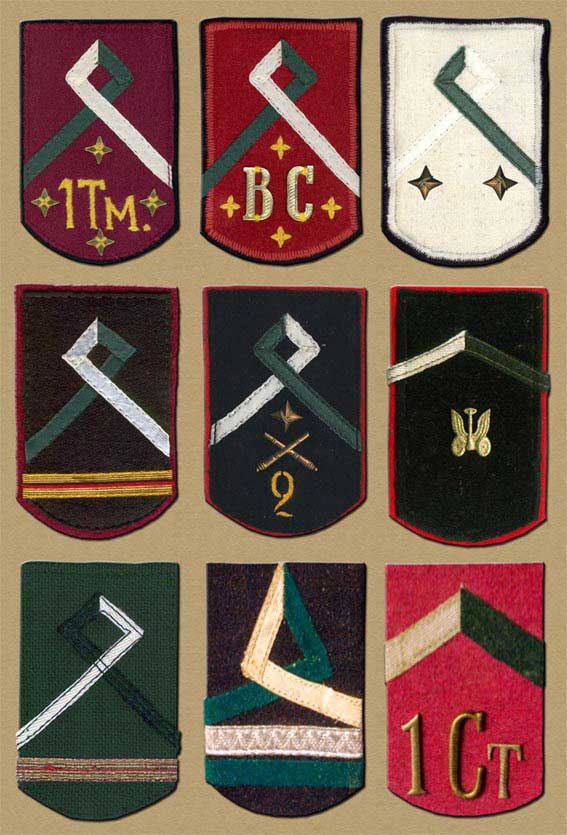
Modern Reconstructions of sleeve insignia of Siberian Army servicemen in accordance with Military Department Order No. 10 of 24 July 1918
1, 2 and 4 – A. Karevskiy; 3 and 5 – K. Kulagin; Nos. 6 and 7 – I. Ladygin;
8 and 9 – from the book "Admiral. Film Encyclopedia", St. Petersburg, 2008, pp.64,75.
Selivanov, M in "Distinguishing Marks and Differences of the Civil War Era in Russia" at www.mirnagrad.ru.
Ladygin, I. in "Novonikolaevsk in Uniform" at www.novonikolaevsk.com/glava3.htm.
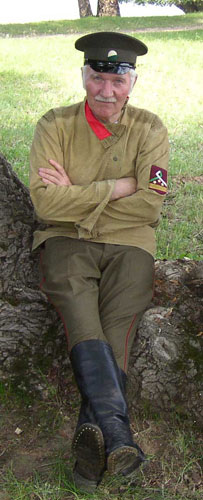
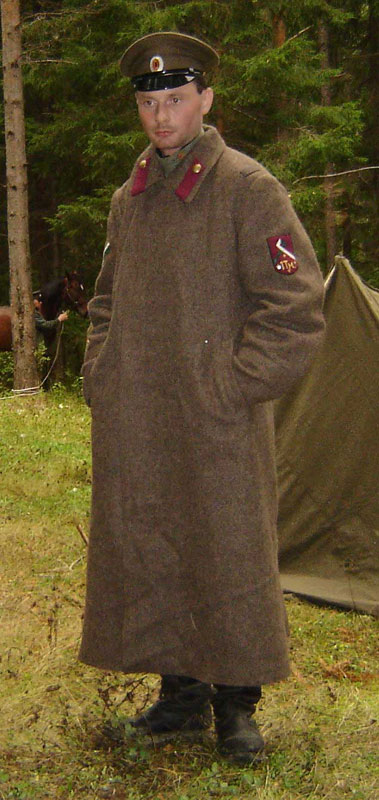
Impression of a Lieutenant Colonel of a Rifle Unit of the Provisional Siberian Government by A. M. Kruchinin
Impression of Staff-Captain of the 1st Tomsk Rifle Regiment of the Provisional Siberian Government Army by A. Karevskiy.
Home — State Symbols — Flags — Uniforms — Badges & Medals — Money — Other
Pygmy Wars Notes
The original for this page is at kolchakiya.ru/uniformology/vps_memoirs.htm.
The following illustration by A. Lebedeva was originally on this page but was removed at a later date.
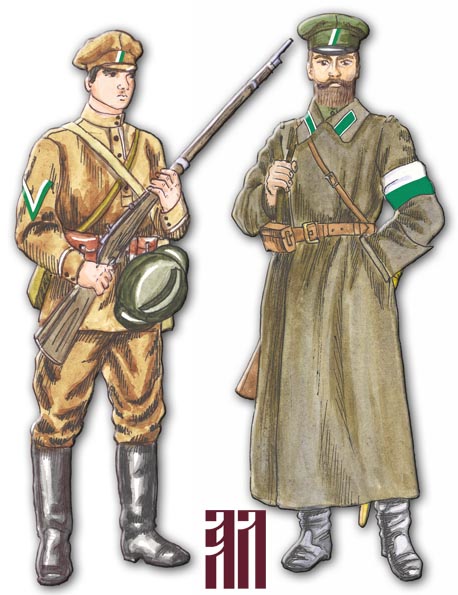
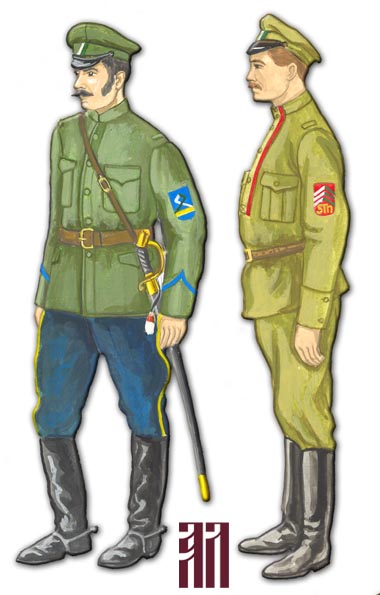
1 – Siberian rifleman, demobilised from the Romanian front (late 1917)
2 –volunteer soldier in the Siberian Army
3 – captain of the Novonikolaevsk Cavalry Squadron
4 – sergeant of the 5th Tomsk Rifle Regiment (note coloured braid on the blouse opening)
Discussion on the translation choices I have made can be found here.