
Uniforms of Prison Guards and Wardens, 1918-19.
All material and reconstructions are by A. Karevskiy unless noted otherwise.
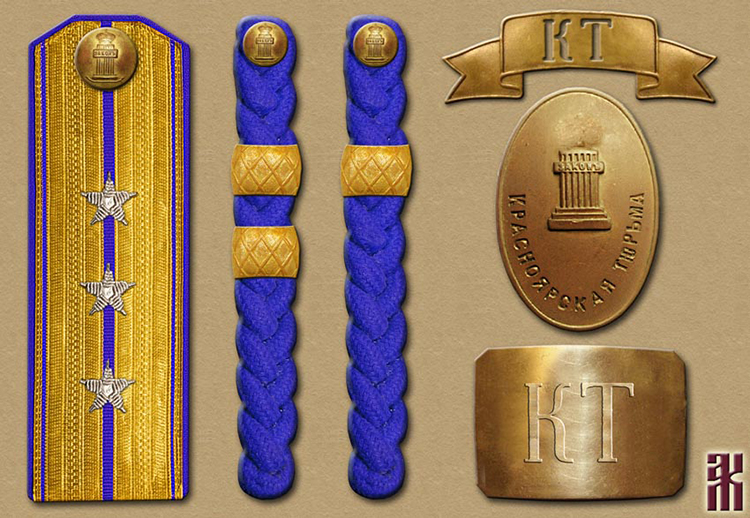
Insignia of prison guards and prison wardens (based on the example of Krasnoyarsk prison):
1 – shoulder-board of officer guard or wardens (here, collegiate secretary);
2 and 3 – lower ranks (senior warden or guard and warden or guard;
4 – metal hand band insignia; 5 – chest badge, worn on a pin on the left; 6 – belt buckle
The metal insignia was for lower ranks. "KT" are the first letters in the name "Krasnoyarsk Prison". The chest badge is the previous model with the imperial crown on the "Pillar of the Law" sawn off after February 1917.
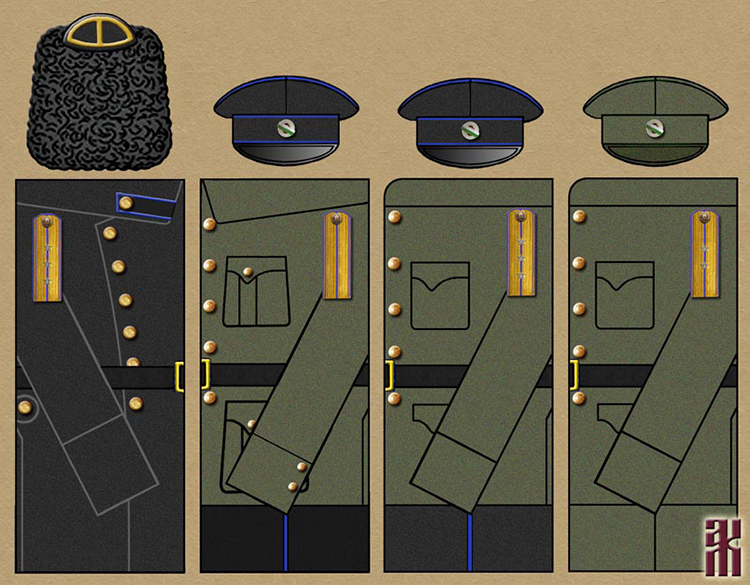
Uniform of officer prison guards and prison wardens
Presumably, in the absence of a uniform, the prison administration followed the example of the police and used army uniforms in khaki, with some senior officers being allowed to keep individual items of the old model. Judging by numerous photographs, this practice existed back at the beginning of the 20th century.
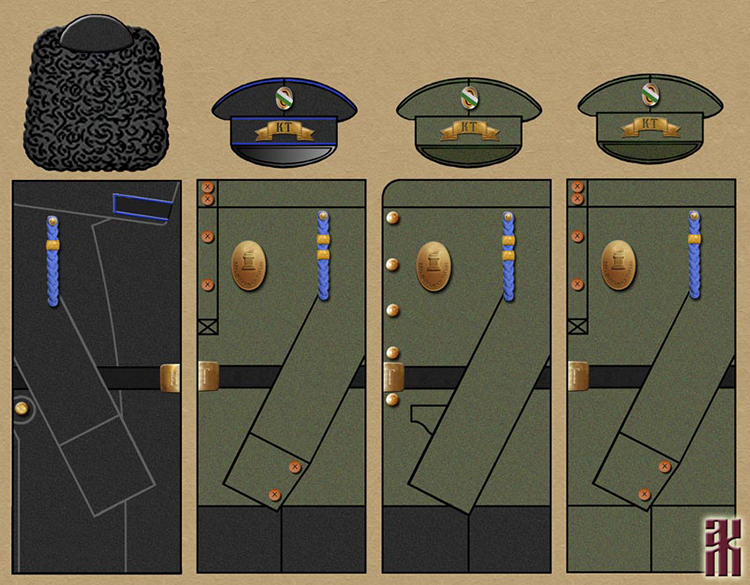
Uniforms of lower ranks of prison guards and prison wardens
Lower ranks differed from higher ranks primarily in their blue shoulder cords (instead of narrow shoulder-boards), the absence of piping on their trousers (if any had been preserved from the previous period), and the presence of a breast badge and metal band on their caps.
The ban on military personnel carrying cold weapons and shoulder-boards, which followed the October Revolution, forced prison officials to abandon important elements of their uniform, approved by the regulation of 13 October 1904. {1} In a report to the provincial commissioner, the assistant to the Tomsk Inspector, V. E. Nechiporenko, pointed out the connection between the decline in respect for representatives of the administration on the part of the supervisory authorities and the abolition of the longitudinal shoulder insignia, which demonstrated the rank of the position held.
The consequence of this measure was the arbitrary refusal of guards to wear the mandatory uniform, preferring to perform their duties in clothing that was comfortable for them. During searches for escaped prisoners, guards were often detained by the police to establish their identity and right to carry weapons, given that they did not differ in appearance from civilians. Taking into account the absence of new legal provisions regarding work uniforms, Nechiporenko asked the local authorities to instruct the heads of detention facilities to restore the previous rules. {2}
1. Zheltov, A. A. in "The History of the Uniforms and Equipment of the Prison Service of the Russian Empire // Monograph, VIPE FSIN of Russia", Vologda, 2011, p.63.
2. GATO F.r.839 Op.1 D.2 L.2-2ob.
Timerbulatov, D. R. in "The Penitentiary System of Western Siberia under Anti-Bolshevik Governments (May 1918-December 1919) // Dissertation for the degree of Candidate of Historical Sciences", Kemerovo, 2017, pp.130-131.
Home — State Symbols — Flags — Uniforms — Badges & Medals — Money — Other
Pygmy Wars Notes
The original for this page is at kolchakiya.ru/uniformology/Prison_guard.htm.
Discussion on the translation choices I have made can be found here.