
Uniforms of V Polish Corps in Siberia
(5th Polish Siberian Rifle Division, June 1918 – January 1920)
All material and reconstructions by A. Karevskiy unless noted otherwise.
The following sources were used in the reconstruction of the uniforms:
Zygylski, Z. and Wielecki, H. "Polski mundur wojskowy.", Krakow, 1988, pp.108-109, 242, 350.
Wielecki, H. "Uniforms of the Polish Army 1918-1921" at siberia-miniatures.ru/forum/ [link dead]
Mozejko, I. "Polish Badges of the Civil War Era in Russia // Tseykhgauz, Mo. 4", Moscow, 1995, p.48.
Shakhov, L. V. "Uniforms of the Polish Army in 1917-1920 // Sergeant, No. 7", Moscow, 1998, at siberia-miniatures.ru/forum/ [link dead].
Deryabin, A. I. "The Civil War in Russia 1917-1922: National Armies", Moscow, 1998, pp.30, 44.
Deryabin, A. I. "The Civil War in Russia, 1917-1922: Interventionist Forces", Moscow, 1999, pp.35-43.
Photo collection on the website: siberia-miniatures.ru/forum/
Polish military formations began to appear in eastern Russia in the summer of 1918. In January 1919 they were united into the Polish Corps in Siberia (5th Polish Rifle Division), consisting of: the 1st "Tadeusz Kościuszko" Regiment, 2nd and 3rd Polish Siberian Rifle Regiments, 1st and 2nd Polish Siberian Lancer Regiments, the 5th Polish Siberian Artillery Regiment, assault, engineer and reserve battalions, as well as a divisional train and artillery park. A 4th Rifle Regiment existed for a very short time, but was reorganised into a reserve battalion and a NCO school. The 2nd Lancer Regiment never fully formed.
Early Period
On 7 December 1917, after a series of incidents, Russian shoulder-boards were replaced by insignia in the form of chevrons on the left sleeve: made of silver braid for officers, gold braid for staff officers, and red cloth for lower ranks. The insignia of the branches of the armed forces, regimental services and regimental numbers were worn on the collar at the buttonhole. This decision was taken at a meeting of senior generals and officers of the 1st Polish Corps – the Polish Military Committee.
The Polish units in Siberia were characterised by a mosaic of uniforms. In 1919 the 5th Polish Rifle Division received 2,800 sets of uniforms from the British, uniforms and equipment from the Czechs, and horizon-blue uniforms, equipment and rogatywka caps from the French. The division's units tried to wear eagles and insignia like those of the 1st Polish Corps and the Polish Army in France in 1919. ... Russian collar tabs were replaced with coloured diamond-shaped ones, with branch of service insignia and braid along the upper edge. The most common headgear were Russian caps, Czech "maciówka" caps (with scarlet piping), British caps and Cossack-style papakhi.
No. 183. Winter cap of a private in the 5th Polish Rifle Division in Siberia. Made of light green worsted fabric, with a visor of the same fabric. Green piping (the colour of the riflemen) along the seams of the crown and the upper edge of the brim. Polish eagle on the crown. Height 11.2 cm, crown side 18.2 cm.
No. 184. Winter rogatywka cap of a lieutenant of the 5th Polish Rifle Division in Siberia. Made of coarse cloth, without a visor. Amaranth piping along the seams of the crown and the upper edge of the brim. The brim is trimmed with brown fur. Green cloth ear flaps, also trimmed with fur, are sewn to the brim. The crown features a Polish eagle, and the brim features a dark green cloth oval with two silver braids sewn horizontally (in accordance with the Polish Army's rank designation system in France).
Cockades:
No. 1. A silver single-headed eagle with outstretched wings.
No. 2. A silver single-headed eagle with raised wings standing on two circular medallions. In the medallions are crosses of St. Constantine. At the bottom is the motto "Za ojczyznę i wolność" ("For the Fatherland and Freedom"). Below the eagle but above the motto is a small shaped shield with the unit number in Roman numerals, between the letters "W. P." (for "Polish Army");
Rank markings:
NCOs – chevrons made of amaranth cloth; ensigns and officers – chevrons made of silver braid; staff officers – chevrons made of gold braid; generals – chevrons made of wide gold "hussar" braid.
Cavalry:
1st Polish Lancer Regiment – red piping, trouser stripes and hat-band.
2nd Polish Lancer Regiment – red piping, white trouser stripes and hat-band.
Zygylski, Z. and Wielecki, H. in "Polski mundur wojskowy", Krakow, 1988, pp.108-109, 242, 350.
The officers of the 1st Polish Corps wore the field uniform of the Russian army, but with English caps, and had Russian weapons and equipment. ... In addition, all servicemen wore stripes of various colours on their field and parade trousers. From December 1917 coloured chevrons were introduced throughout the corps, worn only on the left sleeve above the elbow, to replace Russian rank insignia (shoulder-boards). They were amaranth for NCOs, silver and gold for officers, and gold with a "hussar" zigzag for generals.
In 1918-early 1919, soldiers of the Polish units in Siberia wore Russian uniforms and equipment. Their headgear bore the emblem of the Polish eagle. Their rank insignia consisted of sleeve chevrons; later, the 5th Division received light blue French uniforms.
Deryabin, A. I. in "The Civil War in Russia in 1917-1920: Nationalist Armies", Moscow, 1998, p.30.
The basis for the creation of the first uniforms of the Polish armed forces in Eastern Russia was that introduced in April 1918 for the units of General J. Dowbor-Muśnicki's 1st Polish Corps. Amaranth was chosen as the main colour. Since the corps' units mainly used Russian uniforms, the distinctive elements of the Polish soldiers were a white metal cockade with a Polish eagle on an antique shield, amaranth stripes on trousers and breeches, and their own system of rank insignia in the form of sleeve chevrons made of amaranth braid (for NCOs), silver braid (for officers) and gold braid (for staff officers).
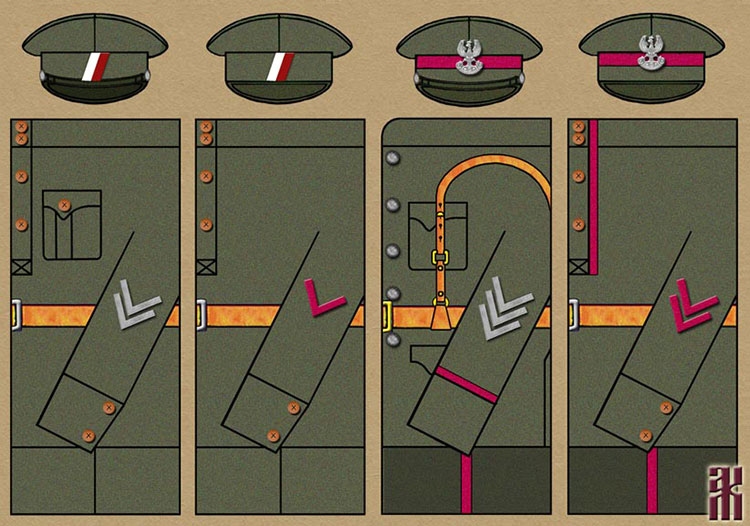
Uniforms of the first Polish military formations in Eastern Russia:
1 and 2 – lieutenant and lance-corporal of the 1st Polish Infantry Battalion, People's Army;
3 and 4 – staff-captain and corporal of the 1st Steppe-Siberian Polish Legion, Siberian Army
All the above reconstructions are in Russian uniforms. In the Volga People's Army, Figures 1 and 2, the cockade was replaced by a ribbon in the national colours and the shoulder-boards replaced by sleeve chevrons, as adopted by the 1st Polish Corps. Other distinctions of the 1st Corps were unlikely to have existed in the People's Army due to a lack of time and resources for their manufacture. The Siberian Army uniforms, Figures 3 and 4, have amaranth ribbons on the hatband, with white metal eagle cockades, and trousers with amaranth stripes – like the 1st Polish Corps. The officer's tunic cuffs have amaranth braid, as does the opening of the soldier's blouse – distinctions established in the Siberian Army.
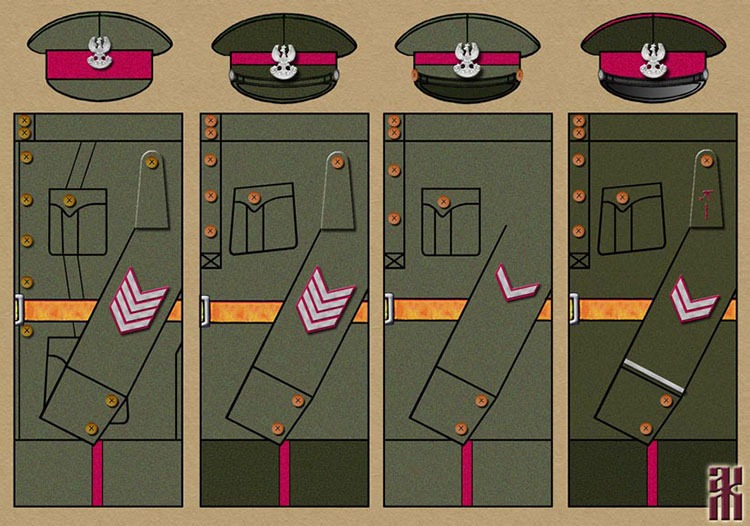
Uniforms of Polish units in summer-autumn 1918
The main features indicating that a soldier belonged to a Polish unit were the amaranth stripes on the trousers, white metal Polish eagle cockades, amaranth hat-bands or ribbons on the hat-band – distinctions introduced in 1917 by the units of the 1st Polish Corps, which the Poles tried to follow in Eastern Russia. After a while, the rank insignia began to be sewn onto a cloth base – officers' markings on a amaranth base, NCOs' markings on a khaki base. Figure 4 shows a volunteer, with narrow silver braid sewn onto the left sleeve cuff.
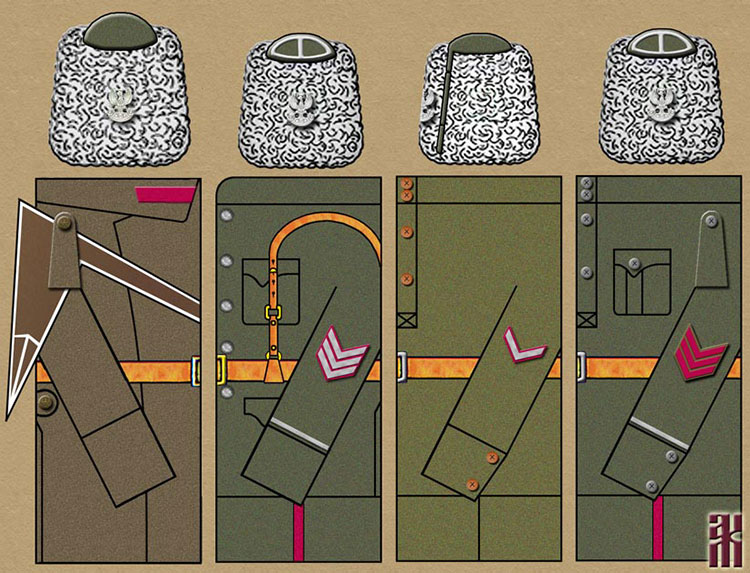
Uniforms of Polish units in summer-autumn 1918
Numerous photographs show that the Polish units in eastern Russia used a wide variety of outer garments and headgear.
Middle Period
The second period of development of the Polish army's uniform is associated with an attempt to standardise uniforms and develop a system of distinctive elements (taking into account the experience of the 1st Polish Corps). It is curious that the shoulder-boards used in the latter were not worn at all in eastern Russia, and in the cavalry the blue piping on the cap was replaced with white, the khaki trousers with blue, and the white piping between the double amaranth trouser stripes with amaranth. Leather equipment was introduced based on the British model for officers and the Russian model for lower ranks. As a result, the new uniform, conditionally called "model", was supposed to look as follows:
Appendix to Order No. 62.
Uniform of the Polish Army
Infantry
Cap: English-style. Khaki, with a visor of the same colour and a smooth strap with two buttons of the same khaki colour. The hat-band and crown piping are dark amaranth.
An eagle emblem, the type of which will be specified, is on the crown.
Greatcoat: Existing cut, five buttons in a row, English collar. The sleeve cuffs are cut level. English shoulder-straps with a dark amaranth number (stencil) on them.
The collar tabs are dark amaranth, as shown in the diagram: 1.5 centimetres wide and 7 centimetres long. The distance from the top of the collar (where the hooks are sewn on) is 2 centimetres.
The edges of the tabs on officers' uniforms are piped with silver braid, and on staff officers' uniforms with gold braid.
Officers wear one khaki button on each tab.
"French" tunic: khaki, semi-turn-down collar. English shoulder-straps 3 centimetres wide at the top and 6 centimetres wide at the bottom, sewn into the sleeve, with khaki buttons.
Trousers: English cut, khaki, with one 2 cm wide dark amaranth stripe.
Cavalry
Cap: Same as the infantry. Dark amaranth hatband, piped white, and white piping on the crown.
Greatcoat: Same as in the infantry. Tabs piped with white braid. Round cuffs.
"French" tunic: Same as the infantry. Tabs piped with white braid. Round cuffs.
Trousers: English cut with two dark amaranth stripes, each 2 centimetres wide, with piping down the middle, as shown in the illustration.
The trousers are dark blue, but may be replaced with khaki trousers if unavailable.
Artillery, Engineers, Medical, Quartermaster
Same as for the infantry.
Staff
Staff officers wear the uniform assigned to the unit in which they previously served.
Notes:
1. Officers' greatcoat and tunic collars are edged with dark amaranth piping.
2. NCOs wear rank markings (patches) on the left sleeve made of dark amaranth braid on a khaki background.
Lance-corporal – one chevron; corporal – two; sergeant – three; and sergeant-major – four (as illustrated).
3. Officers of all branches of the army wear rank markings on the left sleeve, sewn onto a dark amaranth background, in the form of a pointing downwards chevron.
Ensign – one chevron of smooth silver braid; second lieutenant – two; lieutenant – three; staff captain – four; captain – three chevrons of smooth silver braid and one upper chevron of gold braid; lieutenant-colonel – two chevrons of gold braid; colonel – three; major-general – one chevron of [zigzag] gold braid; lieutenant-general – two.
4. Officers wear one silver braid stripe 5 centimetres long and 0.5 centimetre wide on their left sleeve for each wound or concussion received in battle, as long as these are certified in a formal list or officially certified by the signatures of three officer witnesses. Only those concussions that resulted in the evacuation of the officer are counted.
5. Soldiers wear a dark amaranth braid 5 centimetres long and 0.5 centimetre wide on the left sleeve for wounds and concussions received in battle.
6. Officers and soldiers wear the following embroidered in dark amaranth on the shoulder-boards of their tunics and greatcoats:
a) infantry and cavalry – the regiment number;
b) artillery – the number and two crossed cannons;
c) machine-gun units – the number and a machine gun;
d) engineer units – the number, a shovel and a pickaxe;
e) medical and sanitary units – the number and a cross;
f) quartermaster's department – the letters "Int";
g) signals service – two zigzag lines intertwined.
7. Doctors and officials wear distinctive insignia corresponding to their officer ranks on the left sleeve with the tip pointing upwards.
8. All soldiers and officers who have joined the Polish army as volunteers wear a 0.5 cm wide silver braid on the left sleeve cuff.
Out of formation: all officers are entitled to wear dark blue trousers tucked into boots.
From a photograph of the document posted on the forum: http://siberia-miniatures.ru/ [link dead]. It is undated, but it is most likely from the autumn-winter of 1918.
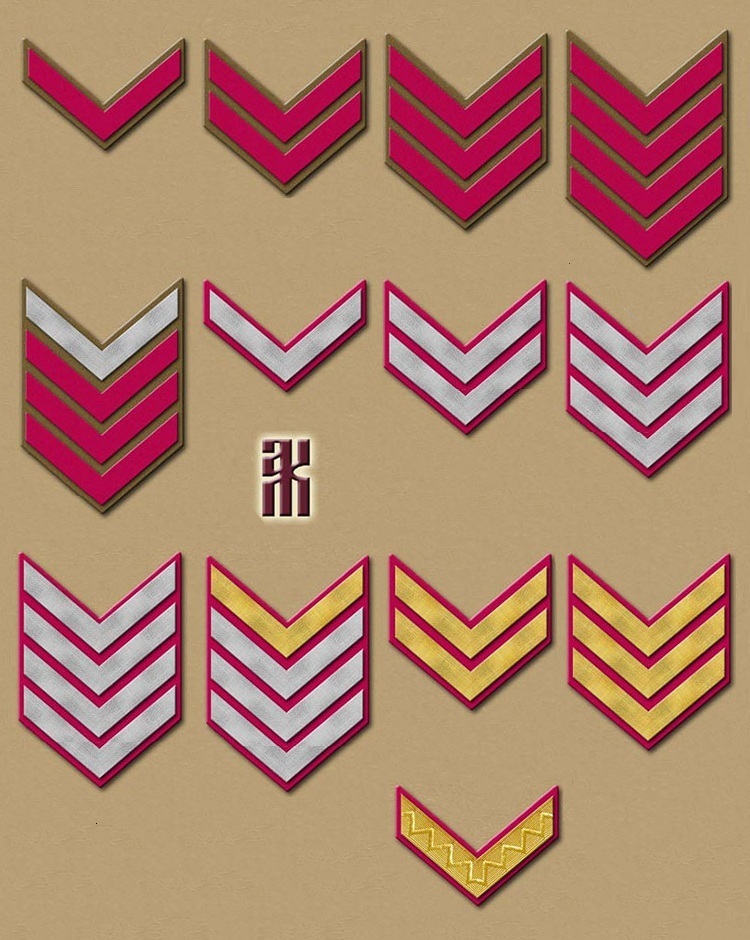
Rank markings of Polish soldiers in Eastern Russia, 1918-1919:
1 – lance-corporal (kapral ); 2 – corporal (mlodszy podoficer );
3 – sergeant or platoon commander (plutonowy); 4 – sergeant-major (sierżant );
5 –sub-ensign (pod chorąży); 6 – (chorazy); 7 – second lieutenant (podporucznik);
8 – lieutenant (porucznik); 9 – captain (kapitan); 10 – major (major);
11 – lieutenant-colonel (podpułkownik); 12 – colonel (pułkownik);
13 – major general (general-podporucznik)
Figure 13, with "hussar" braid in a zigzag pattern, is provided for reference purposes, as there were no Polish military personnel with that rank in Siberia and the Far East.
While the 1st Polish Corps' insignia had sewn directly onto the sleeves of tunics and greatcoats, in Siberia the officer insignia were worn on a amaranth lining, and those of privates and NCOs on khaki lining. Non-combatants and military officials wore similar chevrons, in accordance with their rank, but pointing upwards. The arms of the chevrons were 5 cm long and 1 cm wide.
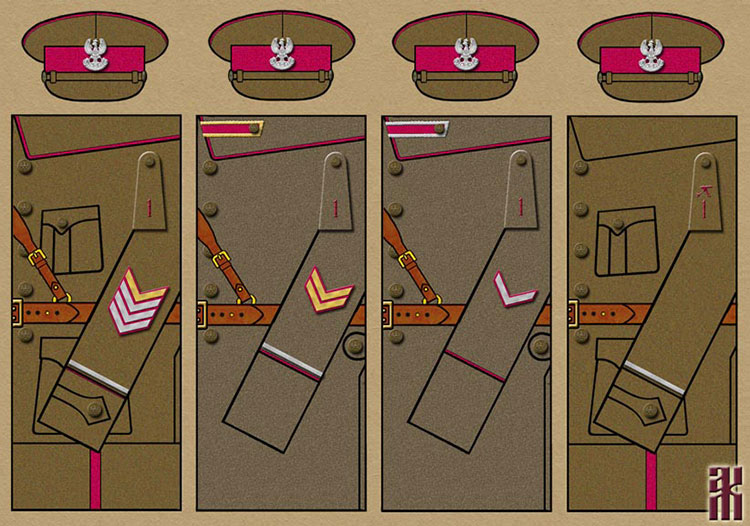
"Model" uniforms of Polish infantry in the East of Russia:
1 – major in "French" tunic; 2 – lieutenant-colonel in greatcoat;
3 – lance-corporal in greatcoat; 4 – private of a machine-gun unit in "French" tunic
All the figures are from the 1st Rifle Regiment. Figures 1, 2 and 4 are volunteers.
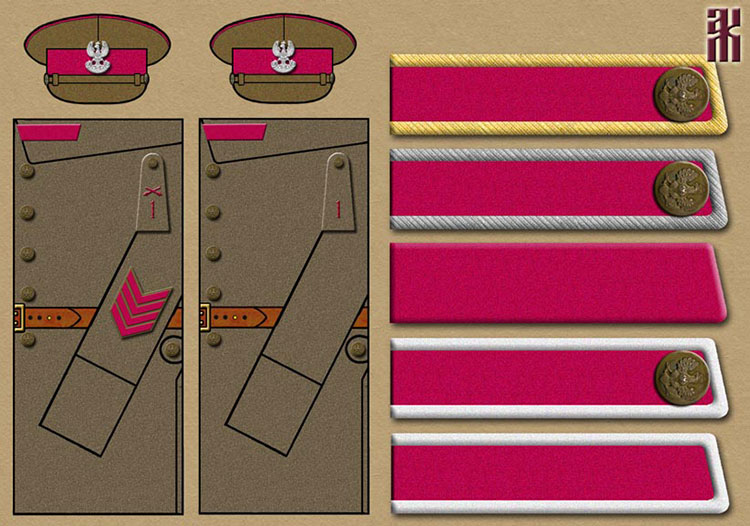
"Model" uniforms and greatcoat tabs of Polish soldiers in the East of Russia:
1 and 2 – sergeant-major of artillery and rifleman in greatcoats;
3 – staff officer tab (not cavalry); 4 – other officers (not cavalry);
3 – other ranks (not cavalry), 4 – cavalry officers; 5 – cavalry other ranks
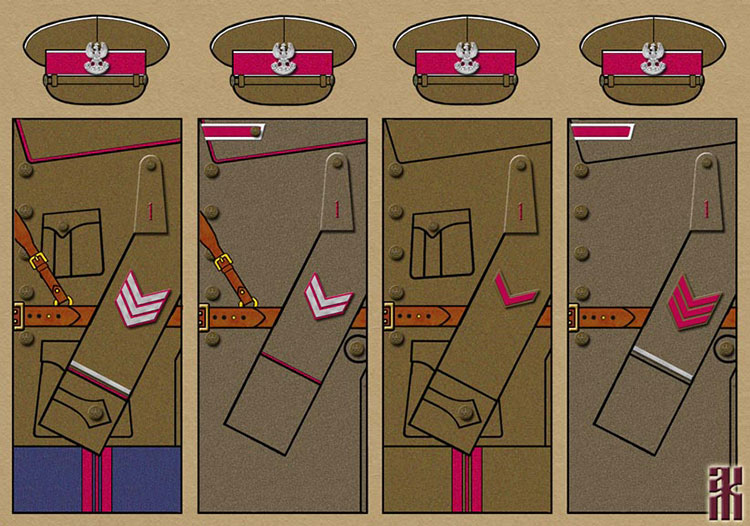
"Model" uniforms of Polish cavalry in Siberia:
1 – lieutenant in "French"; 2 – second-lieutenant in greatcoat;
3 – lance-corporal in "French"; 4 – sergeant in greatcoat
All the figures are from the 1st Polish Lancer Regiment. Figures 1 and 4 are volunteers.
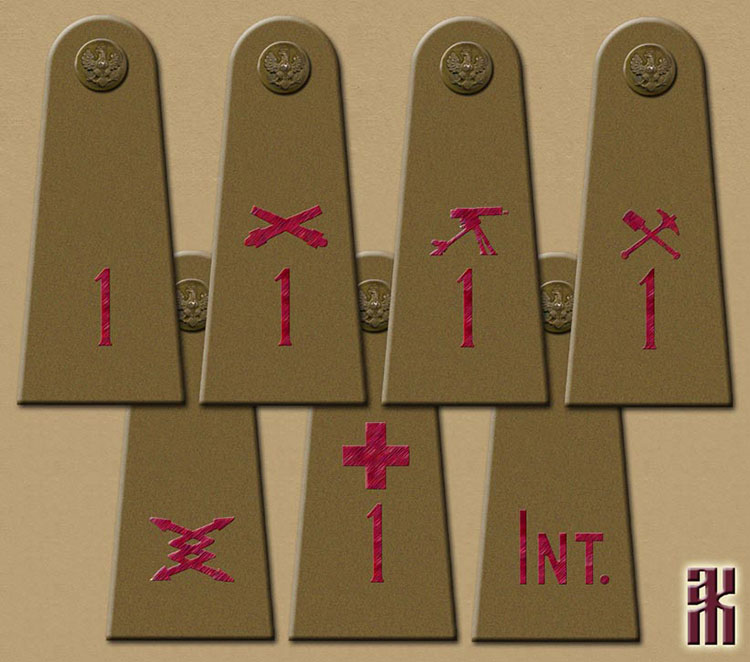
Shoulder-straps for the "model" uniform of Polish military personnel in Siberia:
1 – 1st Rifle Regiment or 1st Cavalry Regiment; 2 – artillery; 3 – machine gun unit;
4 – engineer (sapper); 5 – communications (signals); 6 – medical and sanitation;
7 – quartermaster corps
The "Int" is short for the Polish "Intendentura" for supply department.
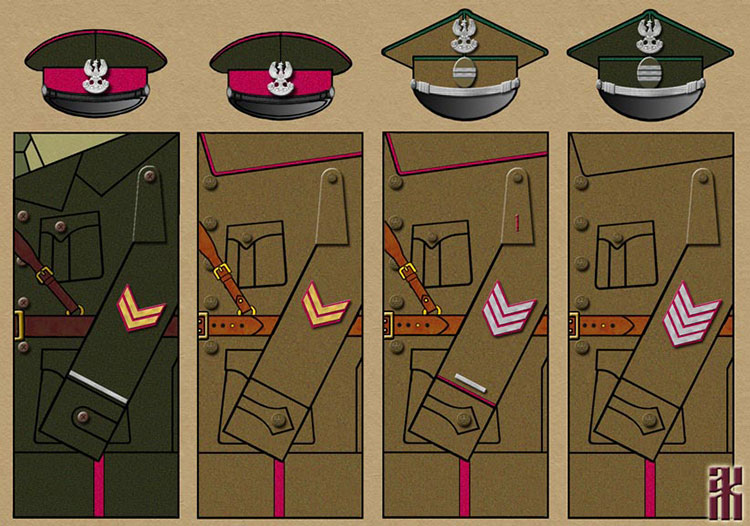
"Transitional" variants of the uniforms of Polish military personnel in Siberia:
1 – in open British-style tunic; 2 – in "model" uniform except Russian cap with black visor;
3 and 4 – in "model" uniforms but with rogatywka caps
The rogatywka were sewn based on the model of the Polish units in France, with a braid chin strap, rank markings on the band, cockade on the crown, and piped in the branch of service colour, here dark green for rifle units. They were made of khaki in various shades.
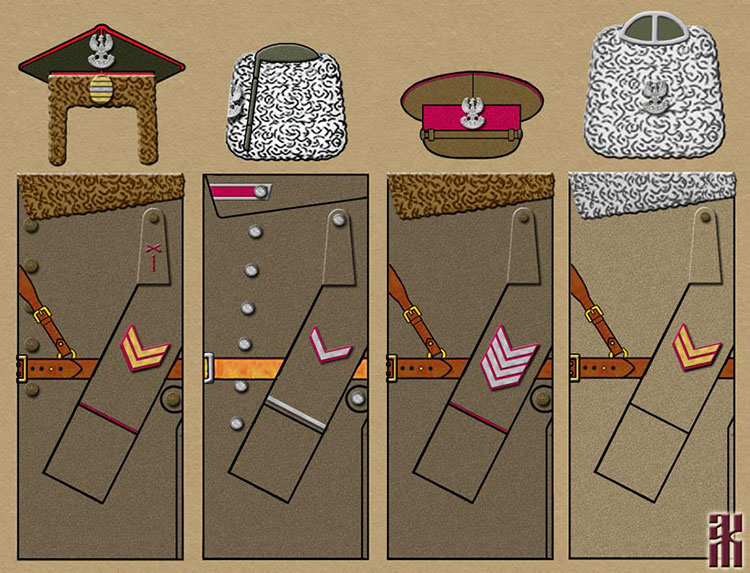
"Transitional" variants of the uniforms of Polish military personnel in Siberia:
1 – lieutenant-colonel of the 5th Polish Artillery Regiment; 2 – ensign of a rifle regiment;
3 – captain of a rifle regiment; 4 – lieutenant-colonel of a rifle regiment
Figure 1 has an original winter rogatywka with amaranth piping, no visor, fur collar and ear flaps and rank markings based on the Polish units in France. Photographs show a wide variety of greatcoats used in the division, but the most common were variants with one row of 5 buttons or two straight rows of 6 buttons.
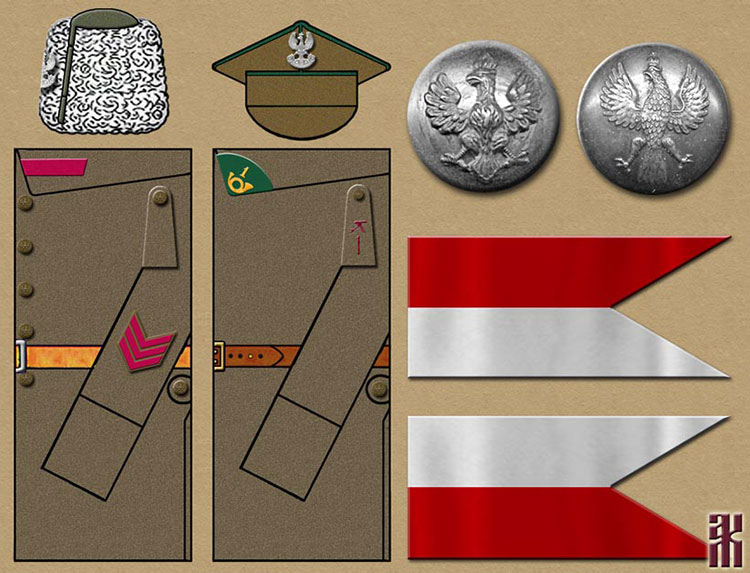
"Transitional" variants of the uniforms of Polish military personnel in Siberia:
1 – sergeant of a rifle regiment; 2 – private of an MG unit in the 1st RR;
3 and 4 – buttons used in Siberia; 5 – lance pennon for the 1st Polish Lancer Regiment;
6 – lance pennon for the 2nd Polish Lancer Regiment;
Figure 1 has a "standard" greatcoat and Russian soldier's papakha. Figure 2 has a "standard" greatcoat, but with collar tabs and rogatywka modelled on the Polish units in France.
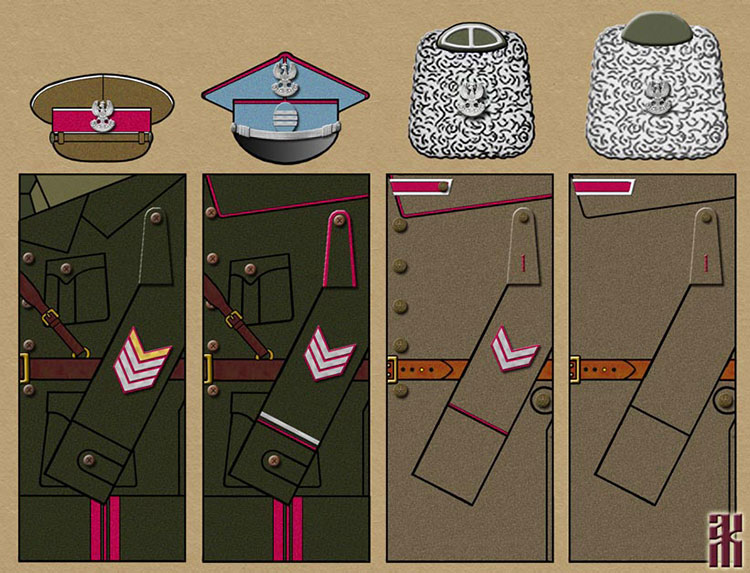
"Transitional" variants of the uniforms of Polish military personnel in Siberia:
1 to 3 – officers of Lancer regiments; 4 – private of a Lancer regiment
Figure 1 wears an open British-style tunic. Figure 2 wears a similar tunic, but closed and with the markings of the "model" uniform and piping on the soft shoulder-straps. He also wears a rogatywka, based on that of the Polish units in France, with the corresponding insignia. Judging by photographs, Russian papakhi were used as winter headgear, with some wearing the tall "Manchurian" papakhi.
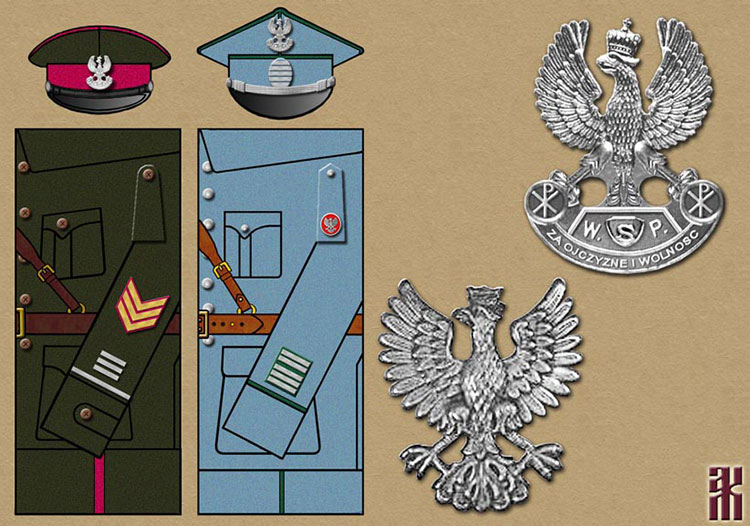
Uniforms worn by Colonel K. Rumsza and cockades
Colonel Rumsza was commander of the 5th Polish Siberian Rifle Division from its formation in January 1919. Figure 1 shows him from 1918-early 1919 as part of the "model" uniform, with a closed tunic and a coloured Russian cap, a volunteer stripe on the cuff, three stripes for wounds and the gold chevrons indicating the rank of colonel. Figure 2 is later in 1919, after the introduction of French-style uniforms in the division. The rogatywka, tunic cuffs and trousers all have the dark green piping of rifle units, and the sleeve has the rank markings of a colonel.
On the right are cockades used by the Polish units in Siberia. At the top is the original eagle, modelled on the one used in the 1st Polish Corps, and below is the eagle modelled on that used by Polish units in France.
Last Period
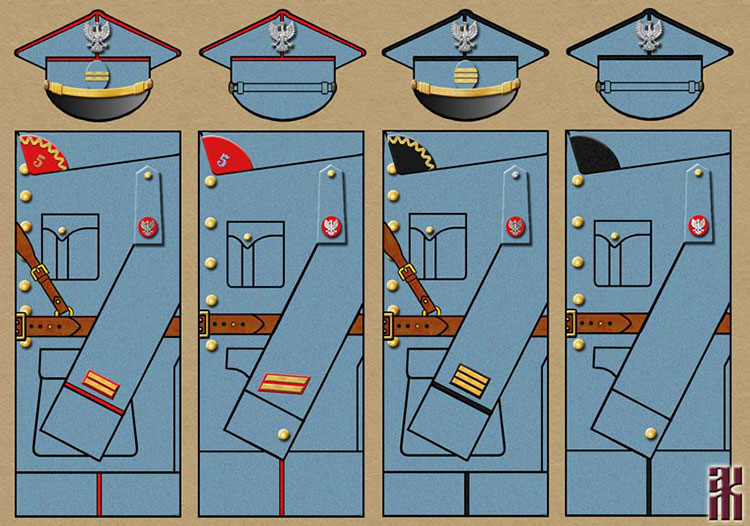
In the second half of 1919 the Polish forces in Siberia began to adopt uniforms closely linked to the those developed by the Polish Army in France in January 1919 (this was General J. Haller's "Blue" Army). After the 5th Polish Siberian Rifle Division was formally subordinated to the command of the Polish Army in France, it began to be gradually supplied with French horizon-blue uniforms, worn with adapted French insignia. The Polish rogatywka became the standard headgear, with coloured piping along the edge and side seams of the square crown, as well as along the upper edge of the band. Officers had cloth ovals attached to the brim of their caps with braid sewn on indicating their rank, duplicating the sleeve insignia.
The branch of service colours were: dark green for infantry and auxiliary units; carmine (bright scarlet) for artillery; black for engineers; and amaranth for cavalry. Coloured diamond-shaped tabs were worn on the point of the collar (officers having zigzag braid trim along the upper edge), and there was piping on the tunic cuffs and trouser seams. Officers and sergeant-majors had silver braid in the infantry and cavalry, and gold in the artillery, engineers and medical corps.
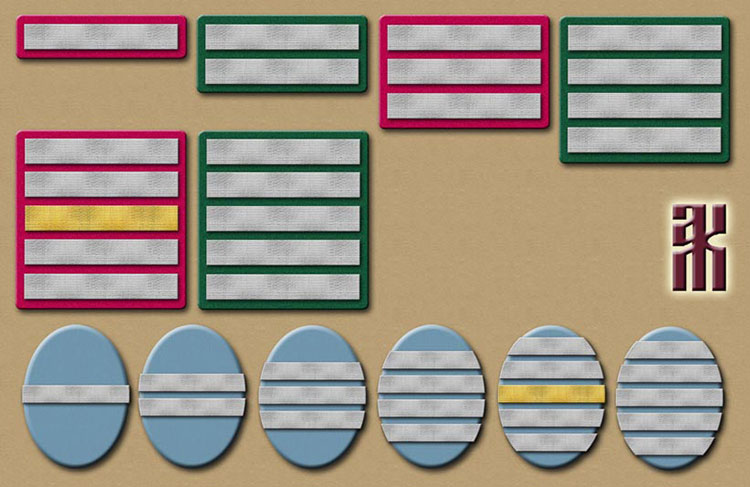
Rank markings of Polish cavalry and infantry officers, French-style uniforms of late 1919:
Sleeve insignia: 1 – second lieutenant; 2 – lieutenant; 3 – captain; 4 – major;
5 – lieutenant-colonel; 6 – colonel; 7 to 12 – cap insignia, the same ranks respectively
Unlike the French army, the insignia for the rogatywka was sewn onto a lining of the same colour as the uniform. The arrangement and colour of the stripes also differed: for example, in the French army, a lieutenant colonel was designated not by one but by two middle stripes of a contrasting colour, and a colonel had two upper stripes separated from the three lower ones (that is how, for example, division commander Colonel Rumsza wore his).
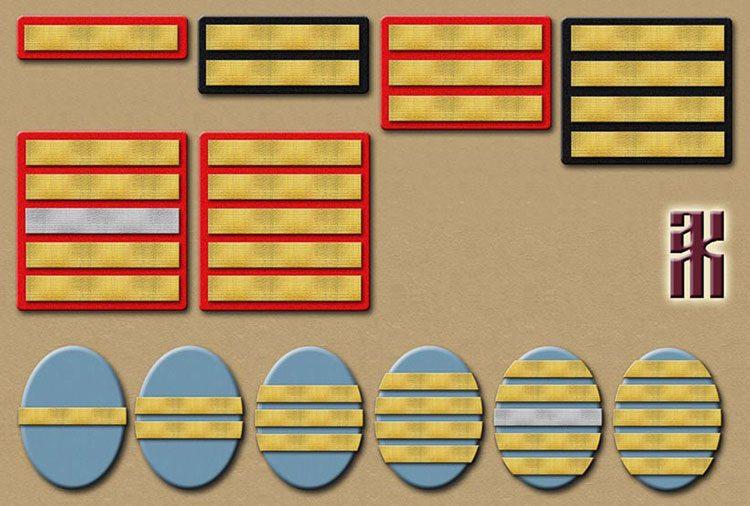
Rank markings of Polish artillery and engineer officers, French-style uniforms of late 1919:
Sleeve insignia: 1 – second lieutenant; 2 – lieutenant; 3 – captain; 4 – major;
5 – lieutenant-colonel; 6 – colonel; 7 to 12 – cap insignia, the same ranks respectively
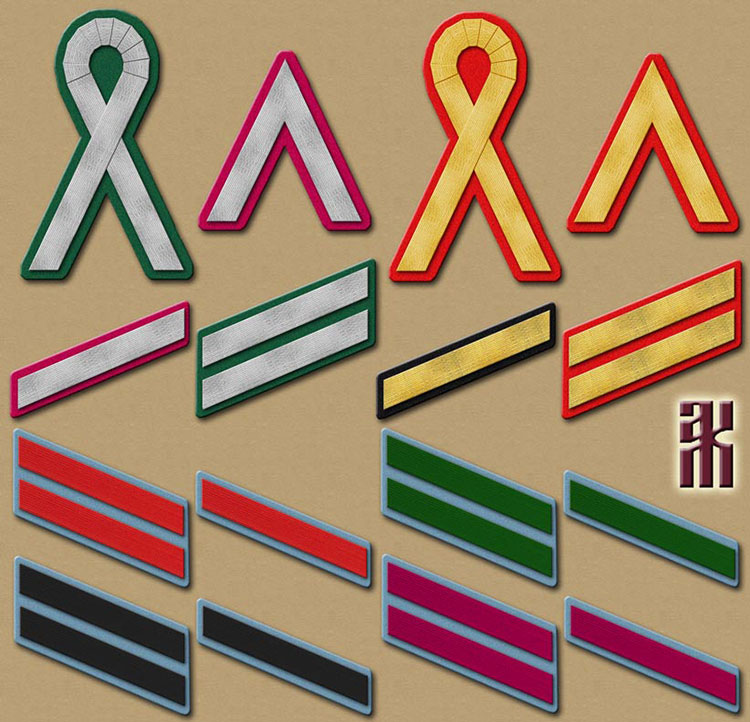
Rank markings of Polish other ranks, French-style uniforms of late 1919:
Sleeve insignia: 1 and 3 – sub-ensign; 2 and 4 – sergeant-major; 5 and 7 – corporal;
6 and 8 – sergeant; 9, 11, 13 and 15 – lance-corporal; 10, 12, 14 and 16 – private first class
The colour of the lining and braid was based on the arm of service: dark green for rifles; amaranth for cavalry; red for artillery; and black for engineers, with silver braid for senior NCOs in the infantry and cavalry and gold for artillery and engineers. Unlike the French army, the direction of the slant of sergeant and lower insignia was different.
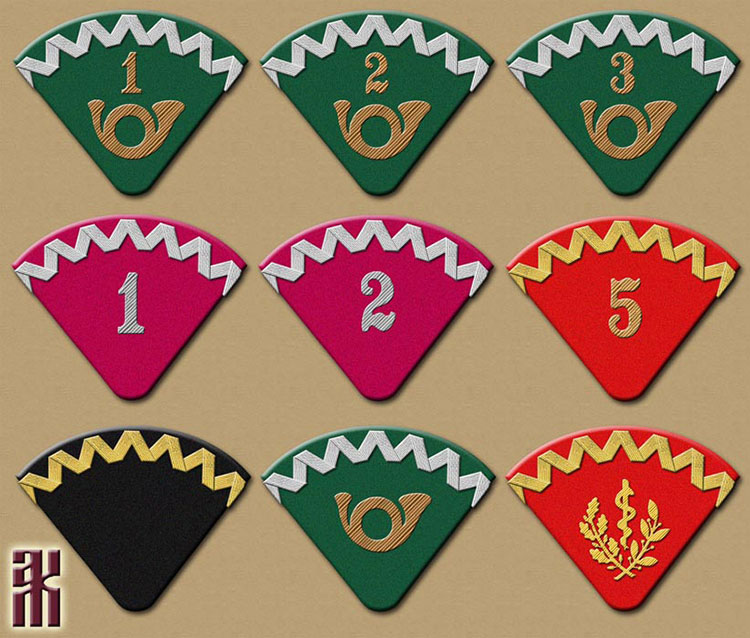
Collar tabs of Polish officers, French-style uniforms of late 1919:
1 – 1st Polish Rifle Regiment; 2 – 2nd Polish Rifle Regiment; 3 – 3rd Polish Rifle Regiment;
4 – 1st Polish Lancer Regiment; 5 – 2nd Lancer Regiment; 6 – 5th Polish Artillery Regiment;
7 – divisional sapper battalion; 8 – divisional assault battalion; 9 – medical service
The colour of the zigzag upper edge of the officers' tabs corresponded to the metal trim for the branch of service. Emblems and numbers were embroidered with metal thread or braid. The medical emblem has been copied from the corresponding emblem of the French army.
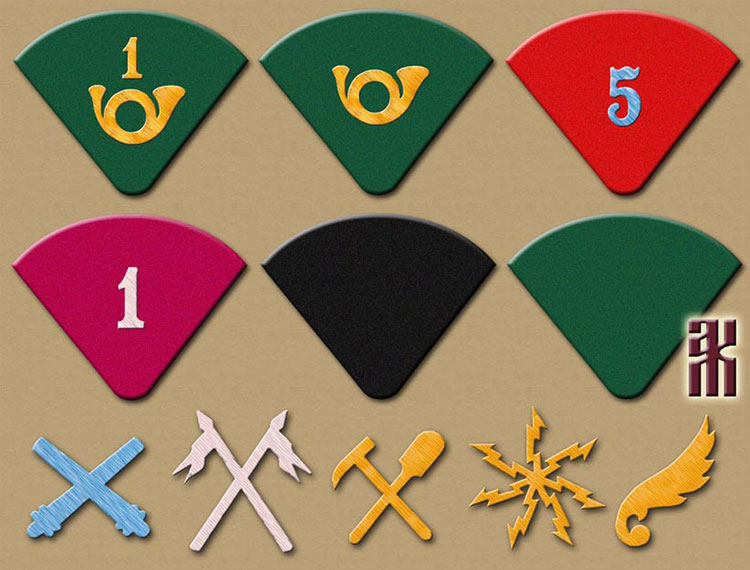
Collar tabs and branch of service emblems for Polish other ranks, from late 1919:
1 – 1st Polish Rifle Regiment; 2 – divisional assault battalion; 3 – 5th Artillery Regiment;
4 – 1st Polish Lancer Regiment; 5 – sapper battalion; 6 – non-combatant;
7 – artillery; 8 – cavalry; 9 – engineers; 10 – signals; 12 – quartermasters
The emblems and numbers on the lapels were embroidered with coloured silk cord: yellow for rifle units, light blue for artillery (based on the French field artillery model), and white for cavalry. The branch of service emblems are those from General Haller's' army in France. Presumably, with the introduction of the French-style uniforms, these emblems would have been used in the division, but there is no confirmation of that. Non-combatant units included the quartermaster service and divisional transport.
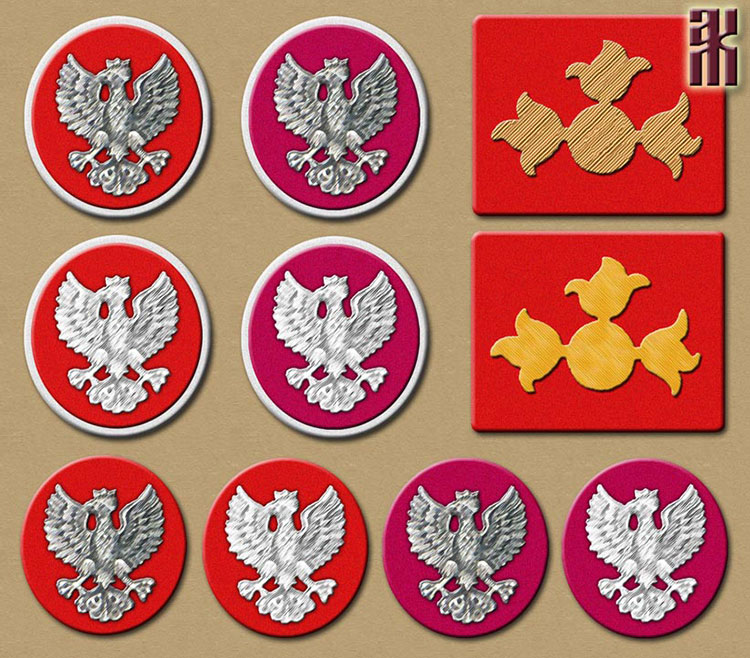
Shoulder-strap insignia and assault battalion sleeve insignia
The shoulder-straps carried an eagle on a red circle. For officers the eagle was embroidered with silver thread, and for other ranks with white silk. Judging by the photographs, some officers had a white lining visible under the red cloth circle, forming a kind of edging, while others did not. In the lancer regiments, the circle could be amaranth rather than red, to match the uniform. The sleeve insignia of the assault battalion soldiers was a grenade with three tongues of flame on a red rectangular background.
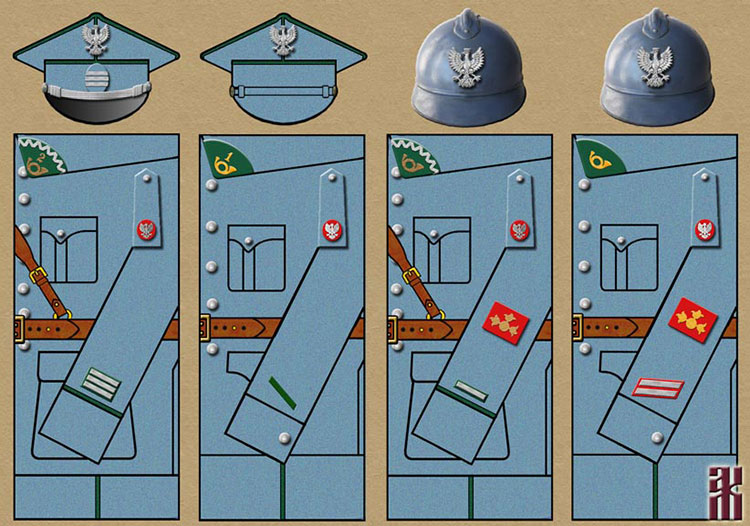
Uniforms based on the model of the Polish Army in France:
1 – captain of the 2nd Rifle Regiment; 2 – private first class of the 1st Rifle Regiment;
3 – second-lieutenant of the assault battalion; 4 – sergeant of the assault battalion
Uniforms based on the model of the Polish Army in France:
1 – lieutenant of the 5th Polish Artillery Regiment; 2 – sergeant of the Artillery Regiment;
3 – captain of the sapper battalion; 4 – private of the sapper battalion
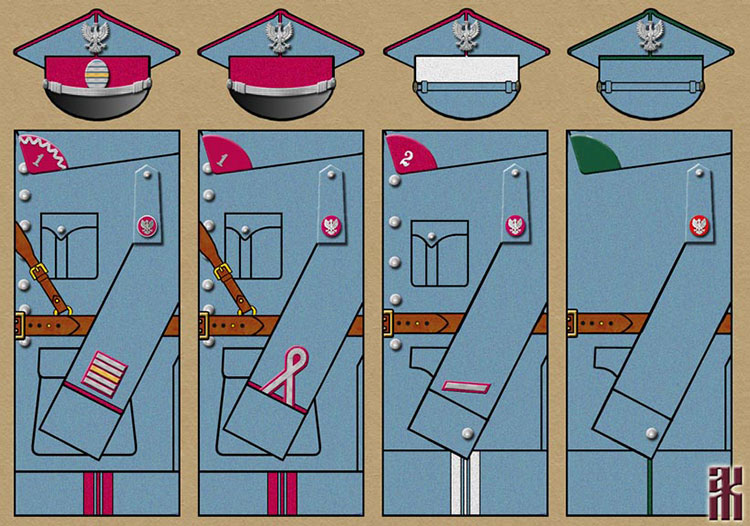
Uniforms based on the model of the Polish Army in France:
1 – lt-colonel of the 1st Lancer Regiment; 2 – sub-ensign of the 1st Lancer Regiment;
3 – lance-corporal of the 2nd Polish Lancer Regiment; 4 – private of the divisional transport
Uniforms in Memoirs and Histories
Krasnoyarsk, December 1919
Before us stood a soldier dressed in a green military coat, worn by all the Allied troops. He had a fur collar and cuffs, a wide belt with a revolver, and a rifle in his hands.
Vitolova-Lyutik, S. in "To the East ...// The Great Siberian Ice March", Moscow, 2004, p.529.
Soldier of the 5th Polish Rifle Division in Siberia. Russian-style greatcoat without shoulder-boards, white fur hat with silver eagle, blue gloves
Mozeyko, I. in "Polish breastplates of the Civil War era in Russia // Tseykhgauz, No. 4", Moscow, 1995, p.48.
A photo of a Polish machine gun crew in similar uniform was published at siberia.forum24.ru/? 1-5-0-00000005-000-10001-0 [link dead]
Outwardly, the commanders and soldiers of the International Regiment made a strange impression. Many of them were dressed in light grey, well-made uniforms, which they had captured from Polish legionnaires fleeing the Red Army in the Irkutsk region. These uniforms often led to various misunderstandings, but the red stripes and stars on their papakhi saved the internationalists.
Kladt, A. and Kondratiev, V. in "The truth about the 'golden train' ", Moscow, 1966, p.114.
There is evidence from B. B. Filimonov that during the Khabarovsk campaign in the winter of 1921-1922 some of the soldiers of the 1st Rifle (Gludkinsk) Brigade and the overwhelming majority of the officers of the 3rd Plastun Brigade still continued to wear "raincoats (red-brown in colour, used by Admiral Kolchak's army and also worn by the 5th Polish Division)". These coats were too thin and proved completely unsuitable for the Siberian winter. It can be assumed that these "red-brown raincoats" were in fact nothing more than old US Army greatcoats from 1883 or 1904, which were indeed reddish-brown in colour.
Petrov, A. A. in "Uniforms of the Students and Cadets of Admiral Kolchak's army training and instructor schools: an attempt at reconstruction // Dobrovolets, No. 2 (4)", Moscow, 2004, pp.52-53.
By the summer of 1919, the Polish division was supplied with uniforms and armed with Japanese carbines, French guns, and Maxim and Colt machine guns. The division did not have uniform clothing, and soldiers and officers often sewed their own clothes and headgear, using family photographs as models. Captain Kukaczewski was the division's chief quartermaster. In addition to assembly points, Polish formations from Omsk to Vladivostok set up a network of quartermaster bases and hospitals. Thanks to Kukaczewski's efforts, the division was provided with dress uniforms and sufficient food supplies. Contemporaries recall that the soldiers of the Polish division "were well dressed, well fed" and provided with tobacco.
Ostrovsky, L. A. in "The Poles in Western Siberia in the late 19th and early 20th centuries", Dissertation for PhD, Novosibirsk, 2014, p.390: at www.history.nsc.ru/website/history-institute/var/custom/File/Avtoref/diss_ostrovski.pdf [link dead]
One of the distinctive external features within the division was the uniform. In general, men wore whatever was available in snow-covered Siberia; often the clothes were full of holes and patches, but even then certain trends were evident. There were soldiers of the imperial army who proudly wore their personal Austrian uniforms with an eagle sewn on them. The same was observed in the Prussian army. However, most soldiers wore Russian uniforms (the most accessible) with papakhi, red stripes sewn on them, and even red buttons. They often sewed their own uniforms based on stories from their fathers and grandfathers. Such people held their heads high, showing off their eagles and stripes. The demand for amaranth fabric was so acute that in areas where Poles were stationed, there was a shortage of that fabric in stores. Later, French and Japanese uniforms became the standard. Nevertheless, the uniform and armament of the elite assault battalion, which wore French, Japanese and American uniforms of the highest quality, aroused universal envy.
The previously mentioned Benedikt Mikhailovskiy said to the young Poles: "Sew it on, sew it on, you'll tear it off later anyway. That's how it was with Dowbor. I also had an amaranth badge sewn on tightly, then I tore it off with my teeth and nails. You will do the same." It can be said that these words of the former "Dowbor" and Bolshevik commissar turned out to be prophetic.
Bienias, D. in "Everyday Life of the Siberian 5th Division of Polish Riflemen during its stationing in Novonikolaevsk, Siberia, in 1919 // Zeslaniec: Organ of the Scientific Council of the Siberian Association, No. 52", 2012, pp.6-7 at zeslaniec.pl/52/Bienias.pdf. Material kindly provided by Voronezh researcher N. Zayats
Now they were mobilised and forcibly conscripted into our army. Bearded, unshaven, wearing Austrian caps on their heads, they did not want to remove the "top hats" bearing Franz Joseph's monogram. ... And when the Austrian badges began to be forcibly removed from them, they hid their caps in their baggage, saying that they would be useful later. They still hesitated to pin on the Polish eagles.
Bohdanowicz, S.in "Ochotnik", Warsaw, 2014, quoted at plyzinski.historia.org.pl/2015/05/04/jak-to-na-wojence-ladnie-czyli-z-pamietnikow-zolnierzy-dywizji-syberyjskiej/ [link dead] Material kindly provided by Voronezh researcher N. Zayats
15 October 1918
I was summoned to the office. There I received a Russian rifle; a greatcoat made of poor Russian soldier's broadcloth, resembling a peasant's smock; a green woollen blouse, which was to replace the tunic; cotton-padded trousers, which Russian soldiers wore during the winter; and a papakha hat. I was told that the rest had been delivered to Novonikolaevsk.
... The soldiers gathered, and the ensign who was to train us arrived. I saw many volunteers in a wide variety of uniforms. In addition to Russian, Austrian and German greatcoats, there were quite a few greatcoats from various Russian educational institutions.
... The army was organised as follows: two infantry regiments (the 2nd and 4th), formed in August from former soldiers of the Austrian army, the 3rd Regiment from soldiers of the Russian army, the cavalry and artillery consisted of prisoners of war from the German army, mainly field gendarmes. I do not mention the 1st Regiment, as it did not yet exist in Novonikolaevsk at that time. The so-called motorised company consisted of volunteers from various units.
The uniforms and weapons were very varied, and many soldiers were not much different from Kolchak's troops, except that they were better fed and cleaner, while at the same time wearing Polish eagles on their goatskin hats. ... But there was so much amaranth that it ran out in the shops. Everyone used it for badges, piping, buttonhole tabs and trouser stripes to their liking. I saw dandies who even covered their buttons with amaranth.
... In accordance with the agreement, the Czechs supplied us with Russian trophies, and therefore uniforms, weapons and supplies were organised along the lines of the former Russian army.
... However, General Janin's command was unable to supply the entire 5th Rifle Division. As reported, on 25 March 1919 the provisioning and arming of the division was still incomplete, despite repeated requests. The uniforms and weapons were Russian, and the insignia were the same as those used by General Haller's army in France. When Major Okulicz arrived in Siberia as an authorised representative (summer 1919), the insignia of the former Polish army were adopted.
Baginski, H. in "Wojsko Polskie na Wschodzie: 1914-1920", Warsaw, 1921 cited at forum.dobroni.pl/f,5-dywizja-syberyjska-11-listopada-2011,30703,25.html [link dead]. Material kindly provided by Voronezh researcher N. Zayats
In Novo-Nikolaevsk there are Polish legions, rumoured to number up to 12,000, armed with Russian rifles, dressed in serge coats, sewn in the English style, with narrow shoulder-boards and insignia on the right sleeve. The soldiers have yellow cloth chevrons, pointing down – one for a lance-corporal, two for a corporal, and so on. Senior officers have the same shoulder-straps, but made of silver braid, and staff officers have them made of gold.
"Interrogation of Ensign Anatoly Shapiro of the 4th Enisei Regiment, who defected on 6 June 1919 in the 30th Division sector" at TsDOOSO F.41 Op.1 D.83 L.112-112ob. Material kindly provided by Ekaterinburg researcher D. V. Kadochnikov.
Home — State Symbols — Flags — Uniforms — Badges & Medals — Money — Other
Pygmy Wars Notes
The original for this page is at kolchakiya.ru/uniformology/Poles.htm.
The cross of St. Constantine is the "Chi-Rho" symbol.
The Poles had a slightly different rank system from the Russians, with the ranks after lieutenant being captain then major, rather than staff-captain then captain. I have translated the lower ranks in the same system as the British and Russian systems for continuity with the other pages on this site, but that does yield oddities – in particular, kapral being lance-corporal rather than corporal.
"Amaranth" was translated to "raspberry" in the Russian. In the Polish context it is a very dark shade of pink. Discussion on other translation choices I have made can be found here.