
Proposed uniforms for Policemen of the Russian Government
December 1918
All material and reconstructions are by A. Karevskiy.
On 18 December 1918 the director of the Police Department, V. N. Pepelyaev, sent the following order to the representative of the Ministry of Internal Affairs, Lieutenant-Colonel V. N. Russyanov:
In order to distinguish policemen from other citizens wearing military uniforms, we need to establish a special uniform for policemen. ... I propose that you urgently form a special commission under your chairmanship at the Police Department with the following composition: the Akmolinsk Regional Commissioner, the Chief of the City Police, and two representatives from the Military and Naval Departments.
The draft, dated 26 December 1918, was adopted at a meeting of the commission for the Department of Police, consisting of the Akmolinsk Regional Commissioner S. S. Rezanov, the Head of the Omsk City Police, Senior Sergeant Mikhalev, and a representative of the Military Department, Captain Timaev, chaired by the Head of the State Supervision Department, Lieutenant-Colonel V. N. Russyanov. The police uniform included the following items:
Tunic – black broadcloth, with two breast pockets, turn-down collar, five black buttons, elasticated back. To be worn with a belt.
Trousers – black broadcloth without piping.
Greatcoat – sailor's cloth, single-breasted, with five silver-plated buttons with an eagle. At the back was a flap with sewn-in hems and two buttons in the middle. The button hole tabs were black with orange piping.
Shoulder-boards – made of triple cord: red, blue and white, with buttons according to rank.
Kepi – black cloth, with orange piping, on the front a number and the [regional] coat of arms, and a black lacquered visor.
Ushanka fur hat – black cloth with cotton padding, with a number and the regional coat of arms.
Weapons and equipment – revolver, sabre and whistle on an orange cord. Sentries add a white baton. For the reserve, rifles and carbines.
The distinguishing features of mounted policemen were to be orange plumes on their ushankas and kepis, spurs on their boots, and two 1 cm wide stripes on their trousers. They were to be armed with a revolver and a sabre.
The uniforms of officers were distinguished by an black broadcloth shoulder-board with orange piping and narrow silver braid stripe (vertically). They were to be armed with a sabre, carried on a black lacquered sword belt.
For senior police officers (district police chiefs and their assistants), the following uniform was proposed:
A single-breasted tunic made of black broadcloth with five silver-plated buttons, an eagle, a turn-down collar fastened with two hooks, and a flap at the back.
Trousers – black, without piping.
Greatcoat – black broadcloth, double-breasted, with 12 silver-plated buttons with an eagle, with a flap at the back 1 inch wide, with sewn-in hems and 2 buttons in the middle, black buttonhole tabs with orange piping.
The ushanka fur hat was black, with the [regional] coat of arms and cockade.
The kepi was made of black broadcloth, with sewn-in silver cords, a coat of arms and official cockade.
Shoulder-boards – narrow ? inch silver braid, according to rank, with orange piping and black stripes. Stars on the stripes.
Aiguillettes – for officials of the 7th class and above – black, and for the rest – orange.
Weapons– a dagger on a silver braid sword belt and a revolver.
Rural policemen were to be given the same uniform, but with gold metal fittings instead of silver.
Glazkov, V. in "Uniformed randomly and, of course, extremely diverse...: Uniforms and insignia of the Siberian police, 1918-1919 // Staryi Tseykhgauz No. 83", Moscow, 2019, p.45.
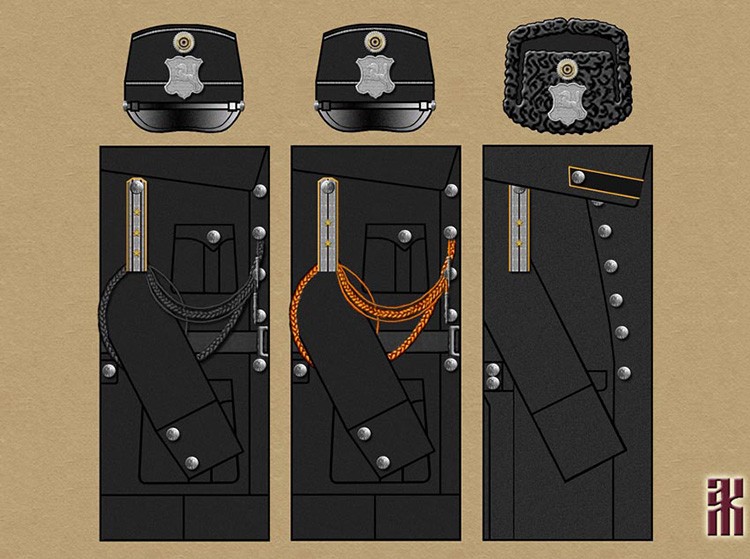
The proposed uniform of the city police officers, based on the December 1918 designs of the Police Department Commission: summer and winter
The cap's appearance has been reconstructed based on the 1862 model police cap, which is the most suitable from the description.
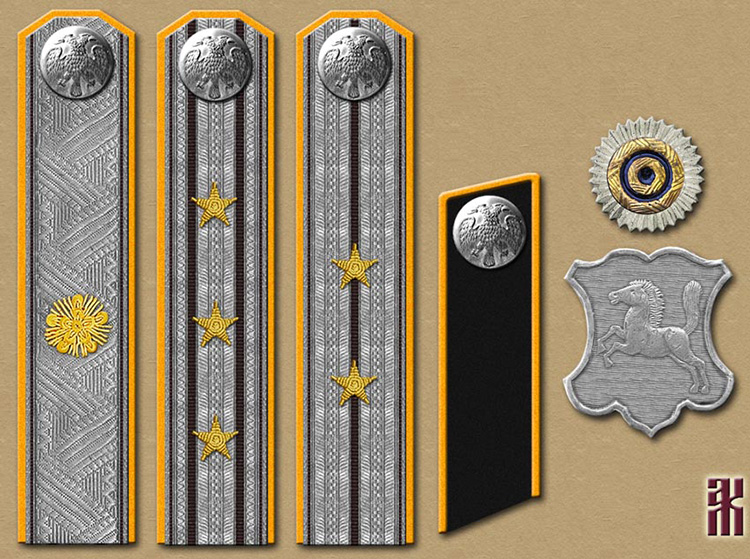
The proposed insignia of the city police officers, based on the December 1918 designs of the Police Department Commission
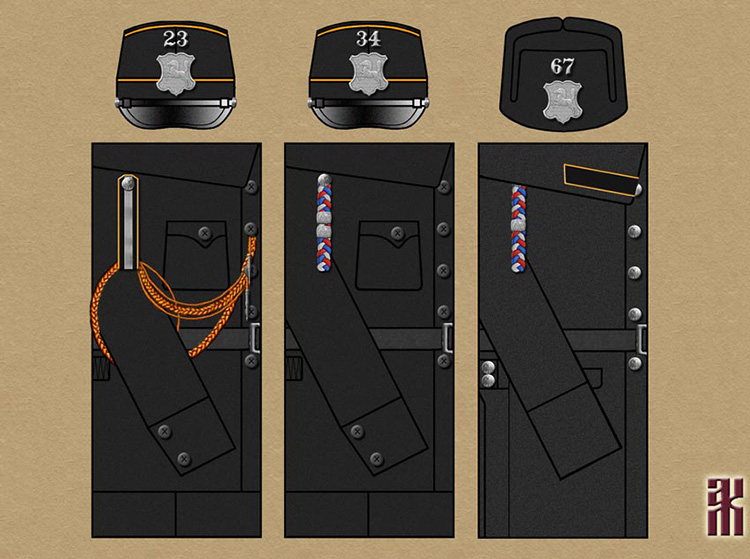
The proposed uniform for foot policemen, based on the December 1918 designs of the Police Department Commission: 1 – senior policeman
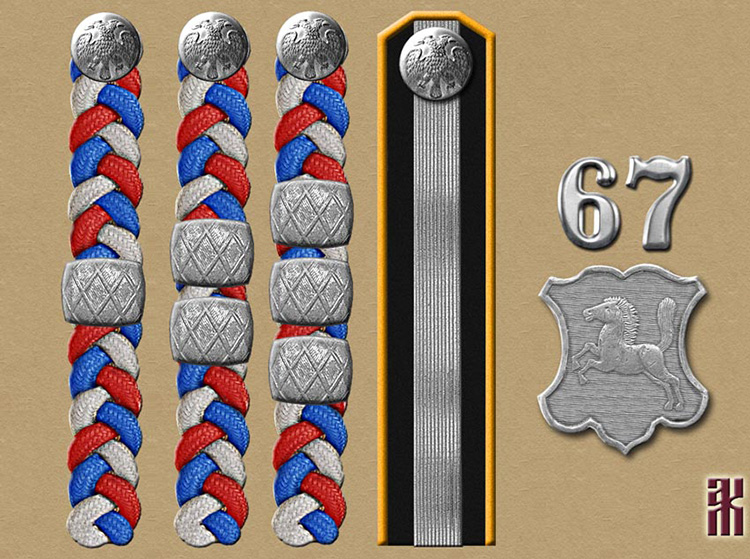
Insignia of foot policemen of the city police, based on the December 1918 designs of the Police Department Commission
The number of buttons on the shoulder cord indicated the rank, so Figure 1 to 3 are junior, middle and senior policemen. Senior policemen were distinguished by shoulder-boards with narrow silver braid stripe.
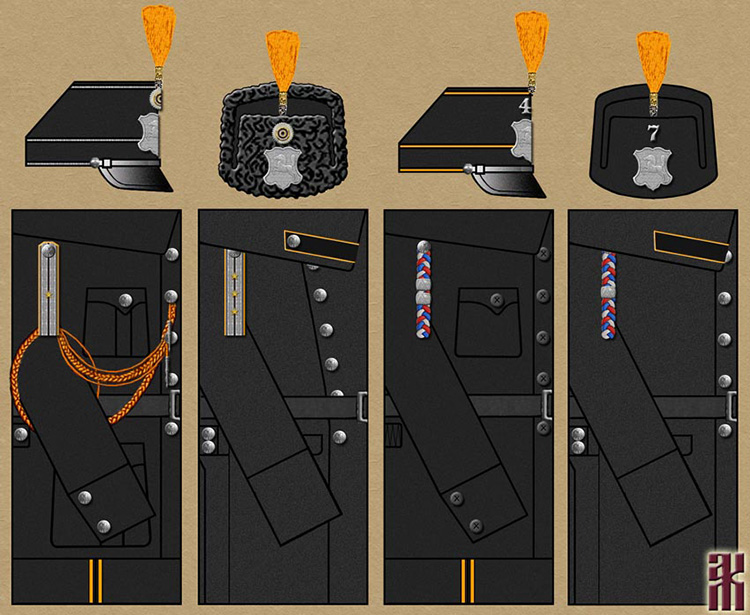
Proposed uniform of the mounted city policemen, based on the December 1918 designs of the Police Department Commission: 1 and 2 – officers; 3 and 4 – men
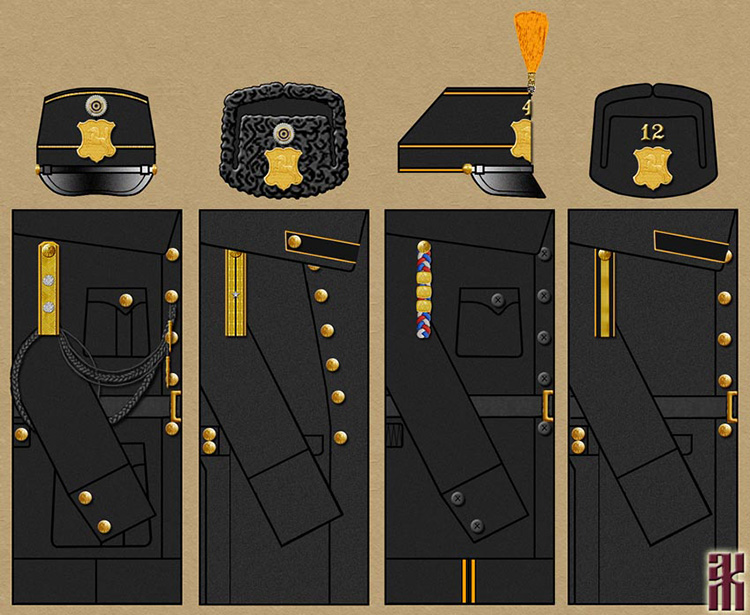
Proposed uniform of the rural police, based on the December 1918 designs of the Police Department Commission: 1 and 2 – officers; 3 – mounted policeman; 4 – senior policeman
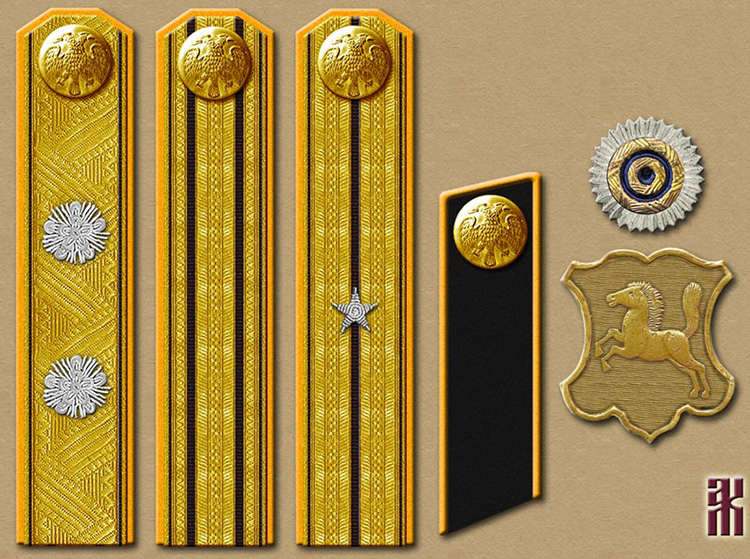
Proposed insignia for county police, based on the December 1918 designs of the Police Department Commission: officer shoulder-boards, buttonhole tab, cockade and coat of arms
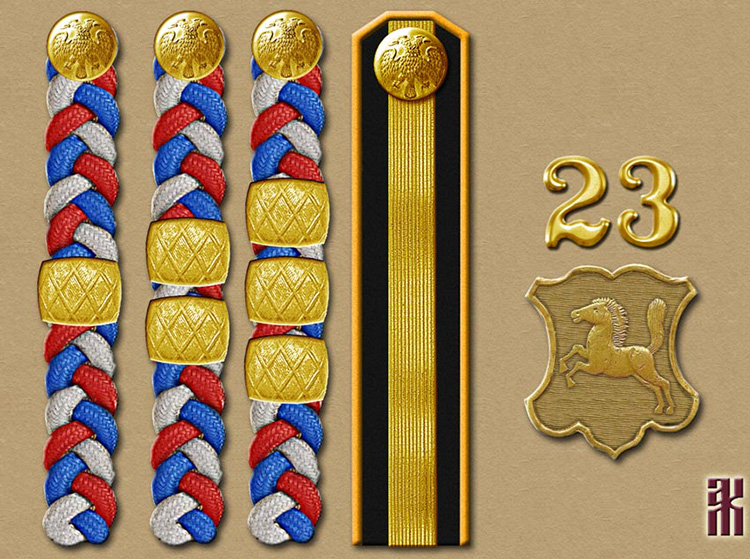
Proposed insignia for county policemen, based on the December 1918 designs of the Police Department Commission
Home — State Symbols — Flags — Uniforms — Badges & Medals — Money — Other
Pygmy Wars Notes
The original for this page is at kolchakiya.ru/uniformology/TRG_militia_2.htm.
Discussion on the translation choices I have made can be found here.