
Uniforms of Naval Forces in the East of Russia
All material and reconstructions are by A. Karevskiy unless noted otherwise.
Among other issues concerning the activities of the Naval Department, it was necessary to clarify the rules for wearing uniforms in its units and institutions. On 29 November 1918, Order No. 19 was issued for the fleet and the Naval Department:
The uniforms of all ranks of the Navy and the Naval Department shall include caps and shoulder-boards of the type that existed prior to Order No. 125 of the Navy dated 16 April 1917. Established by Order No. 125 of 16 April 1917, 21 April 1917 No. 142 and the circular of the Main Directorate for Fleet Personnel Affairs of 16 April 1917 No. 325 – sleeve insignia to distinguish ranks and titles – are cancelled. Samples of shoulder-boards for admirals will be established additionally.
The Russian State Naval Archive has preserved a record of negotiations between Rear Admiral G. K. Stark in Ufa and Senior Lieutenant N. G. Fomin in Omsk. It is not dated, but during the conversation it is mentioned that "yesterday a decree was issued appointing Admiral (A. V. Kolchak) as Minister of War and Navy". At the end of the negotiations, the question of naval uniforms is also raised:
[Stark] – Please inform me, what is the current uniform for officers?
[Fomin] – We have put on gold shoulder-boards and removed our sleeve badges, following the admiral's example, but the uniform has not yet been approved due to the absence of a Ministry of the Navy.
[Stark] – What shoulder-boards does the admiral have?
[Fomin] – For now, those of a lieutenant-general of the Admiralty, as there are no eagles. They have been ordered from Vladivostok.
This excerpt allows us to conclude that Admiral Kolchak refused to wear the insignia of the Provisional Government even before their official abolition. His entourage in Omsk followed the admiral's example.
On 20 November Rear Admiral M. I. Smirnov was appointed head of the Ministry of the Navy, and on 28 December, the general Ministry of the Navy was divided into two: military and naval. The Ministry of the Navy was responsible for the Far Eastern Naval Forces, as well as the newly created river flotillas, the land units of the Naval Department (an independent brigade of naval riflemen) and naval educational institutions.
Officers of the fleet and the Naval Department who were part of land units or serving in coastal formations were instructed to wear the standard army uniform in khaki, but with naval shoulder-boards and weapons.
The designs for the new shoulder-boards for admirals were finally approved by Order No. 22 of the Navy and the Naval Department on 6 December 1918. The shoulder-boards were of the traditional Russian hexagonal shape, covered with gold braid. The lining was black cloth. Two crossed admiralty anchors were superimposed on a double-headed eagle with outstretched wings and without crowns. The eagle's talons were not embroidered: instead, a blue ribbon was depicted at the bottom. The eagle and anchors were embroidered with black cotton thread. The shield on the eagle's chest was yellow, with a red shield in the centre depicting St. George the Victorious, embroidered with white thread. The shoulder-boards were fastened with a button.
On 15 December 1918 Circular No. 7 of the Fleet Personnel Department was issued, signed by the acting head of the Department, Rear Admiral A. A. Kovalevskiy, which announced:
Lieutenants and midshipmen in wartime shall be assigned the uniform of a lieutenant or midshipman in active service, with the distinction that on the shoulder-boards, one inch from the outer edge, there shall be one transverse silver braid, 1/2 inch wide.
At the same time, the restoration of the rank of conductor was also announced. That rank was assigned to NCOs who had served the established term and passed the corresponding exam in one of the main naval specialities: senior boatswain, helmsman, signalman, telegraph operator, artilleryman, galvaniser, miner, mine engineer, engineer, stoker, hold conductor, electrician, skipper, senior butler, field medic, senior mine and artillery manager, and engine room manager. The most knowledgeable sailors became conductors, and they were undoubtedly the "golden reserve" of the fleet. But they were also the main support for the officers on the ship, and therefore the corps of conductors, as "old regime", had been abolished by the Provisional Government at the end of April 1917. On 14 January 1919 the Council of Ministers of the All-Russian Government in Omsk adopted a resolution "On the restoration of the abolished corps of fleet conductors".
Buyakov, A., Kritsky, N. and Kuznetsov, N. in "The Admiral's shoulder-boards of A. V. Kolchak // Tseikhgauz, No. 17, Moscow, 2002, p.35.
Kuznetsov, N. A. and Petrov, A. A.in "Admiral Kolchak's White Sailors: The History of the White Fleets in Eastern Russia in 1918-1919 and the Uniforms of their Ship Crews // Serzhant No. 24, Moscow, 2002, p.42.
The classic winter "Nansen-type hat" was also used by the White Army in Eastern Russia. Thus, the new uniform regulations for navy volunteers, approved by the Ministry of the Navy in January 1919, include, among other things: "One warm Nansen hat per two years".
Petrov, A. A. in "Uniforms of the Jaegers and Cadets of Admiral Kolchak's Army Training and Instructor Schools: an Attempt at Reconstruction // Dobrovolets, No. 2(4)", Moscow, 2004, p.52.
It can be assumed that the sailors of the flotilla did receive naval uniforms. Thus, in early October 1919, Admiral Kolchak undertook a trip by steamer to the front of the Tobolsk Group. The combined crew of the ship consisted of 14 people from the Ministry of the Navy and 7 people from the crew of the armed steamer Belevets. On 3 October, 25 sets of uniforms were issued to them from the warehouse of the Maritime Economic Administration, which included winter hats, sailor's jackets and trousers, sleeveless blouses and cockades. Thus, the combined crew of the steamer was entirely dressed in uniform naval uniforms. However, it is unlikely that the crews of all ships were dressed in this manner. In one of the few photographs depicting the crew of the armed steamer Katun of the Ob-Irtysh Flotilla, one can see ordinary crew members dressed in the field uniforms of the land army, and naval officers wearing double-breasted English-style "French" tunics and army-style tunics (the latter suggests that these were army officers who, for some reason, were on board the ship).
A note to the Omsk District Quartermaster from the head of the Maritime Economic Administration, Major General Yegunov, dated 23 July 1919, has also been preserved, with the following content: "The Maritime Economic Administration requests that 5½ arshins of white cloth for the trimmings of the caps of the Maritime Department crews be released for cash payment." According to the above draft, white piping on caps was not provided for sailors, which suggests that some of the crews of the Maritime Department actually returned to the uniform of the sailors of the Imperial Russian Navy.
Kuznetsov, N. A. and Petrov, A. A.in "Admiral Kolchak's White Sailors: The History of the White Fleets in Eastern Russia in 1918-1919 and the Uniforms of their Ship Crews // Serzhant No. 24, Moscow, 2002, pp.46-47.
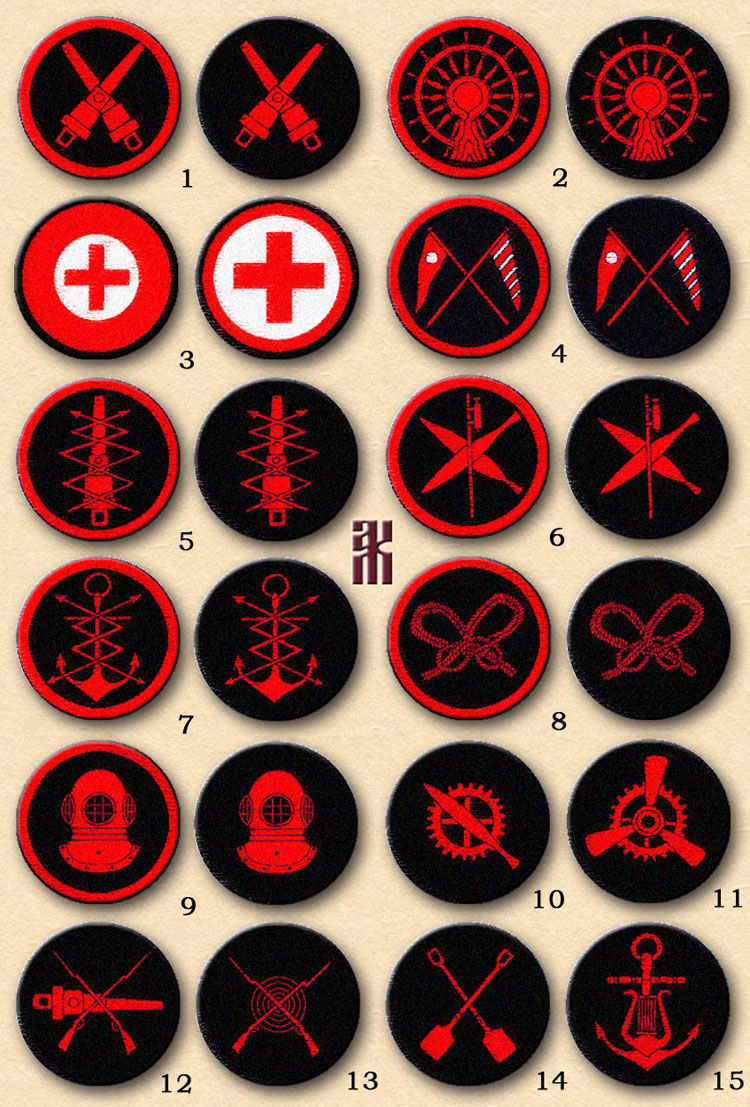
Sleeve insignia for specialists (senior specialists are bordered in red:
1 – commanders and artillery quartermasters; 2 – helmsmen; 3 – medics; 4 – signalmen;
5 – electroplaters; 6 – miners; 7 – telegraph operators; 8 – marshals; 9 – divers;
10 – mine operators; 11 – operators; 12 – commanders-gunners; 13 – weapons instructors; 14 – stokers; 15 – musicians, buglers and drummers
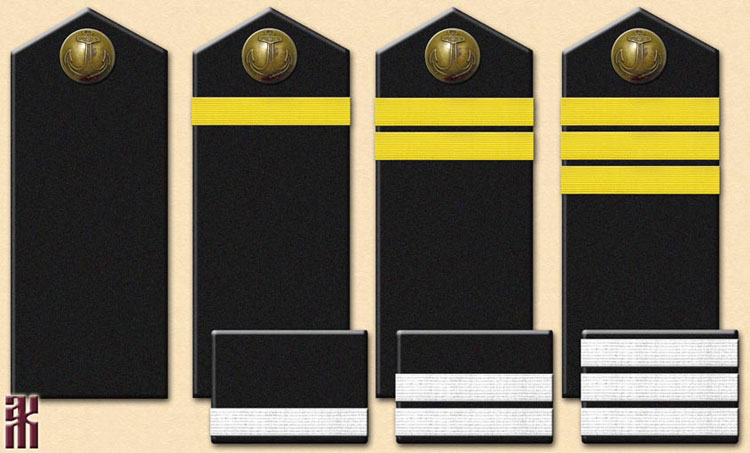
Shoulder-boards of lower ranks of the naval forces:
1 – sailor 2nd class; 2 – sailor 1st class; 3 – quartermaster;
4 – boatswain's mate; 5 to 7 – markings for the white work blouse
White braid was intended for military personnel in non-combat or shore positions.
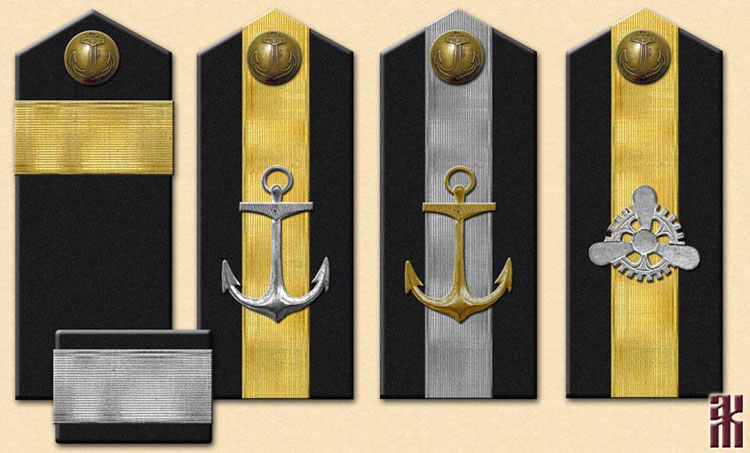
Shoulder-boards of senior NCOs of the naval forces:
1 – boatswain; 2 – senior boatswain; 3 – senior shore boatswain;
4 – conductor (here, engine or hold)
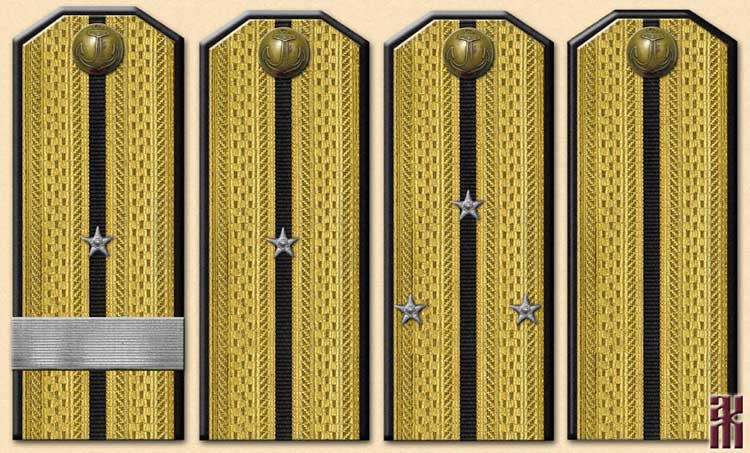
Shoulder-boards of naval officers:
1 – wartime midshipman (as per the 15 December 1918 circular);
2 – midshipman (from among career officers); 3 – lieutenant; 4 – senior lieutenant.
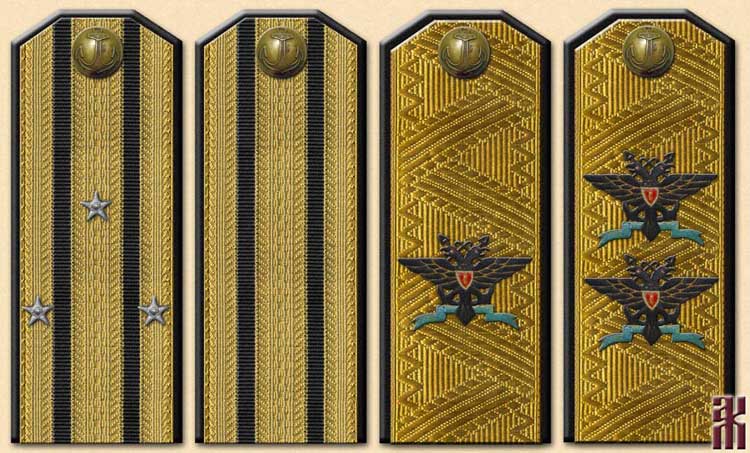
Naval officers' shoulder-boards: 1 – captain 2nd rank; 2 – captain 1st rank;
3 – rear admiral (as per the 6 December 1918 order); 4 – vice admiral.
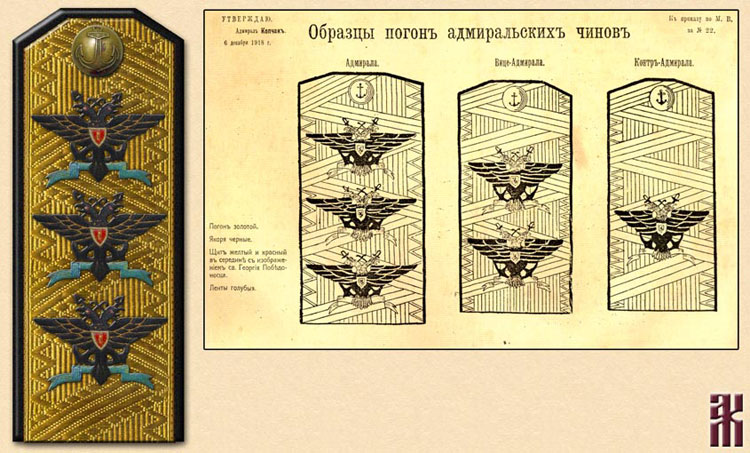
Admiral's shoulder-board. Sketch attached to Order No. 22 of 6 December 1918
Only the Supreme Ruler of Russia, A. V. Kolchak, held the rank of admiral in the East of Russia.
Legal Acts and Government Orders
Decree of the Council of Ministers of 4 February 1919
On the approval of the Provisional Regulations on the pay of officers and non-commissioned officers of the Navy and the Maritime Department and the general table of monthly salaries for the same ranks.
The Council of Ministers has decided:
To approve the Provisional Regulations on the remuneration of officers and non-commissioned officers of the Navy and the Maritime Department and the general table of monthly salaries for officers and non-commissioned officers of the Navy and the Maritime Department, attached hereto.
Chairman of the Council of Ministers, P. Vologodskiy
Head of the Naval Ministry, Rear Admiral Smirnov
Administrator of the Supreme Ruler and the Council of Ministers, Telberg
Provisional Regulation on the remuneration of officers and non-commissioned officers of the Navy.
III. On the provision of uniforms
...
23. Officers and soldiers of the Naval Rifle Brigades shall be provided with full uniforms free of charge as necessary, with the issue of such uniforms being justified by certificates issued by superiors with authority not lower than that of a brigade commander.
24. Officers of coastal combat units: junior and company commanders receiving regular pay shall be issued uniforms once a year, and all officers of these units who have been awarded combat pay with a 20 per cent bonus to their regular pay shall be issued uniforms twice a year.
25. Officers and non-commissioned officers, whether in active service or in the armed reserve, shall, after six months, be issued with money for one set of uniforms per half-year, in accordance with the table established by the Naval Council, in lieu of uniforms in kind.
Head of the Naval Ministry, Rear Admiral Smirnov
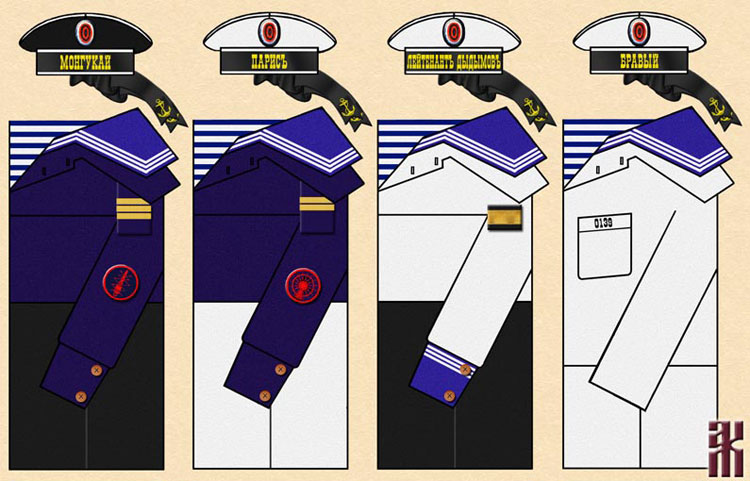
Uniforms of lower ranks of the naval forces:
1 – boatswain in a blue flannel blouse (ship's uniform);
2 – quartermaster in a blue flannel blouse (ship's uniform);
3 – boatswain in a white flannel blouse;
4 – sailor 2nd class in a work dress
NCOs (quartermasters, boatswains) were required to wear shoulder-boards with the appropriate insignia.
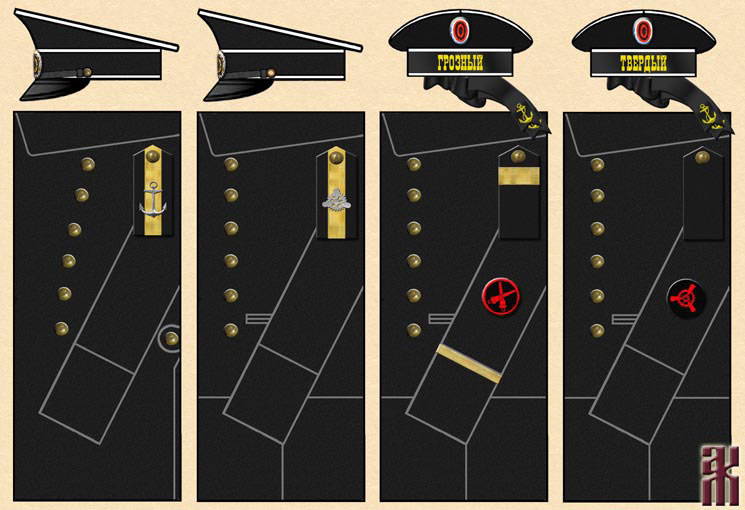
Uniforms of conductors and lower ranks of the navy:
1 – senior boatswain in coat; 2 – conductor in pea jacket;
3 – boatswain in pea jacket; 4 – sailor 2nd class in pea jacket.
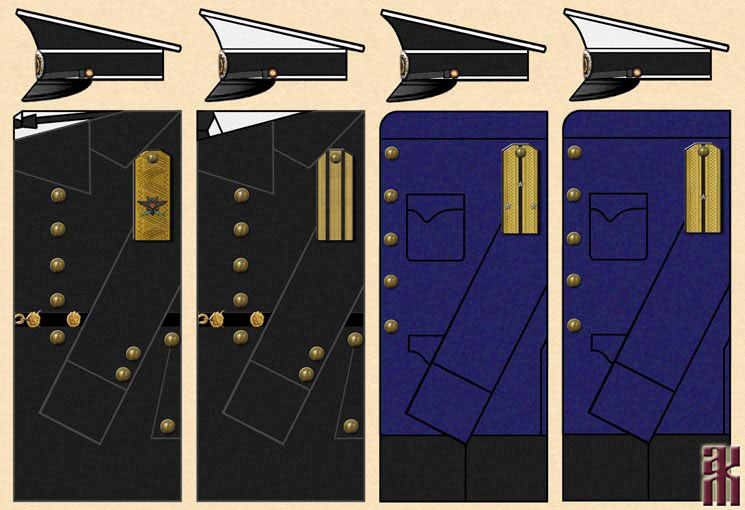
Uniforms of naval officers: 1 and 2 – in frock coats; 3 and 4 – in blue jackets
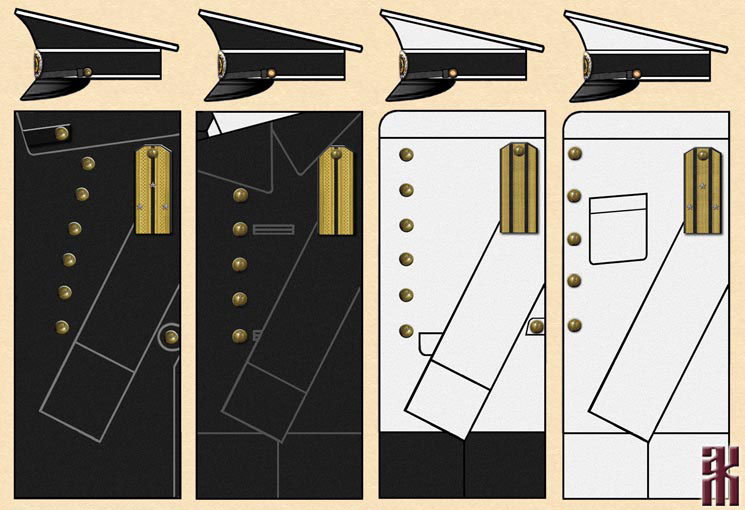
Uniforms of naval officers: 1 – in coat; 2 – in short coat;
3 – in white double-breasted jacket; 4 – in white linen jacket
A curious description of the commander of the seaplane squadron attached to the White river flotilla, Lieutenant V. M. Marchenko, was given in his memoirs by naval officer D. N. Fedotov:
The head of our aviation was a colourful fellow, his clothing as striking as his character. He was dressed in a blue flannel blouse, buttoned up to the neck and belted, boots with turn-ups, and an old worn navy cap. A military pistol tucked into his belt without a holster and a couple of hand grenades hanging from the same completed his outfit. Only a very perceptive observer could recognise him as an officer of the Imperial Navy.
The average person would most likely suspect him of being a communist worker. Marchenko's dislike of generals was perhaps even stronger than his dislike of the Bolsheviks. I believe that if he had the opportunity to do things his way, he would have been happy if they had all been shot.
Fedotoff White, D. N. in "Survival through war and revolution in Russia", Philadelphia, 1939, p.245.
Home — State Symbols — Flags — Uniforms — Badges & Medals — Money — Other
Pygmy Wars Notes
The original for this page is at kolchakiya.ru/uniformology/naval_uniforms.htm.
Discussion on the translation choices I have made can be found here.