
Uniforms of the Naval Training Institutions in Siberia and the Far East
All material and reconstructions are by A. Karevskiy unless noted otherwise.
Independent Naval Training Battalion
From 23 October 1919, the Independent Naval Training Regiment.
The uniforms were obtained directly from the British and consisted of a variety of items. Only the greatcoats were French – light grey with a bluish tint. Right at the beginning of the training, the issues with the British boots became apparent.
Meyrer, G. A. in "A brief history of the actions of the Independent Naval Training Battalion // Bizerte Naval Collection", Moscow, 2003, p.169.
According to Red intelligence reports, near Tulun the White Army's Eastern Front "split into several detachments and is moving in different directions". One of them, calls itself a naval training regiment (in naval uniform) ...
Novikov, P. A. in "The movement of White troops in the north of Irkutsk Province in early 1920 // History of White Siberia: Abstracts of the 4th scientific conference, 6-7 February 2001", Kemerovo, 2001, p.118.
A few words should be said about the battalion's uniform. From the very beginning of the battalion's formation, on 31 July 1919, the acting commander of the of the 1st Divizion of the River Combat Flotilla, which no longer existed at that time, the future commander of the 4th Company of the battalion, Lieutenant G. A. Meyrer, sent a request to the head of the Naval Supply Administration, Major-General Egunov. In the request he asked:
... to issue or order the following items of clothing for the aforementioned battalion: 1) 500 sets of French uniforms (each set includes a tunic and trousers); 2) 500 anchors cut from black fabric; 3) 1,500 anchors embroidered with black satin stitch; 4) 1,500 pairs of black shoulder-boards with the letters "M.S."; 5) 1,500 soldier's cockades... {23}
Attached to the request was a drawing of an anchor, possibly made by Meyrer himself. It is not known what exactly was issued from the request. All that is known is that, at the request of the head of the Maritime Economic Administration, on 5 August 1919 the representative of the Ministry of Supply and Procurement for the Akmolinsk region ordered the allocation of 55 square arshins of khaki fabric, on which black anchors were to be embroidered. {24} Apparently, some of the requested uniforms were also received. According to Meyrer's memoirs:
The uniforms were received directly from the British and consisted of a variety of items. Only the greatcoats were French – light grey with a bluish tint. From the beginning of the training the inconvenience of English boots became apparent, and many riflemen had to be excused from classes. ...{25}
According to the operational report of the headquarters of the East Siberian Soviet Army dated 29 January 1920, the regiment's uniform was naval. {26} This report is related to the fact that at that time there were quite a few naval officers in the regiment (or rather, what was left of it) who had previously served in the River Combat Flotilla and retained the uniform of the Imperial Navy.
dobrovoletz.narod.ru/morstrel2.html
23 RGA VMF F.r-1722 Op.7 D.198 L.221-221ob.
24 Ibid. L.220.
25 Meyrer, G. A. above, p.169.
26 "The Last Days of Kolchakism: Collection of documents", Moscow-Leningrad, 1926, p.198.
On 11 August 1919, at the Ministry in Omsk, a charity sale will be held of the belongings of Lieutenant Gesse, who shot himself, to compensate his relatives. The list of items belonging to Senior Lieutenant Gesse: old jacket, old black trousers, woollen socks, grey woollen blouse, yellow canvas trousers, matching jacket, white jacket, old double-breasted jacket, yellow woollen furry gloves, brick-coloured woollen gloves without fur, knitted woollen blouse with buttons, knitted balaclava, white trousers ... new waistcoat, canvas boots, cloth shoes, new white knitted blouse, black fur hat, checkered shirt, old leather gloves, suspenders, old cloth jacket, old cloth coat, pipe, tobacco pouch, new white silk shirt.
kortic.borda.ru/?1-17-60-00000006-000-30-0, citing RGA VMF. F.r-1722 Op.5 D.254 L.50-51ob.
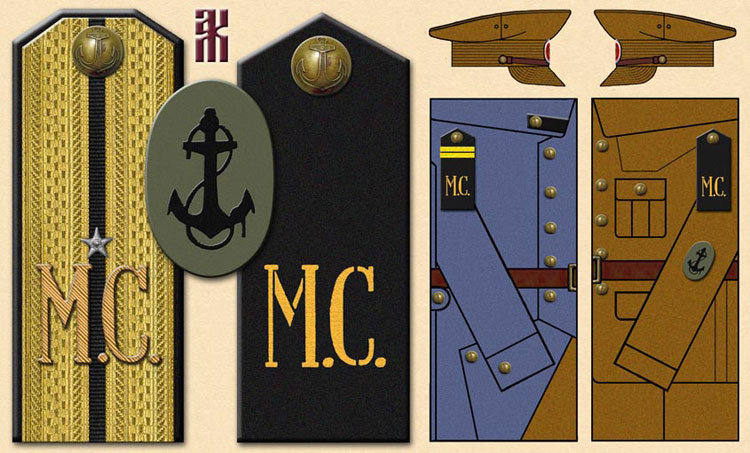
Uniforms of the Independent Naval Training Battalion/Regiment
Machine and Motor School of the Naval Department of the All-Russian Government
On 3 April 1919, by Order No. 50 of the Machine and Motor School, a khaki uniform was introduced for the school's volunteers, the same as established for army units, but with the following distinguishing marks: on the left sleeve – an embroidered blue anchor; on the shoulder-boards of privates and NCOs – yellow letters "М.Ш." with yellow arms. In our opinion, the "arms" refers to the image of a three-bladed ship propeller superimposed on a gear wheel.
Kuznetsov, N. A. in "On the history of the Machine and Motor School of the Naval Department of the All-Russian Government of A.V. Kolchak (1919) // Siberia during the Civil War: Materials from the International Scientific and Practical Conference (6-7 February 2007)", Kemerovo, 2007, p.218.
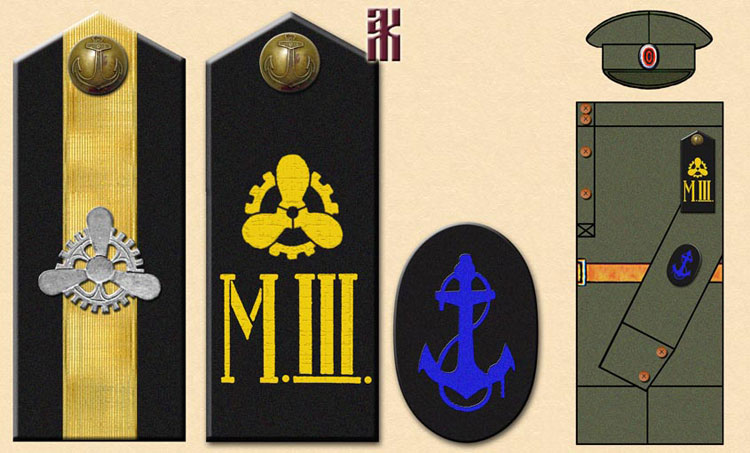
Uniform for a machine conductor from among the teaching staff of the Machine and Motor School of the Maritime Department of the All-Russian Government
Home — State Symbols — Flags — Uniforms — Badges & Medals — Money — Other
Pygmy Wars Notes
The original for this page is at kolchakiya.ru/uniformology/naval_educational_institutions.htm.
Discussion on the translation choices I have made can be found here.