
Uniforms of Military Educational Institutions in the East of Russia
All material and reconstructions are by A. Karevskiy unless noted otherwise.
I. Naval Military Educational Institutions
1. Independent Midshipman Course (until November 1918)
Midshipmen, Nagasaki, January 1918
The Provisional Government abolished shoulder-boards and some elements of the uniform in the navy. For midshipmen of the 3rd Company of the Independent Midshipman Classes, a V-shaped chevron made of golden braid with an anchor above it was temporarily introduced to be worn on the left sleeve of the Dutch jacket, pea coat, and greatcoat.
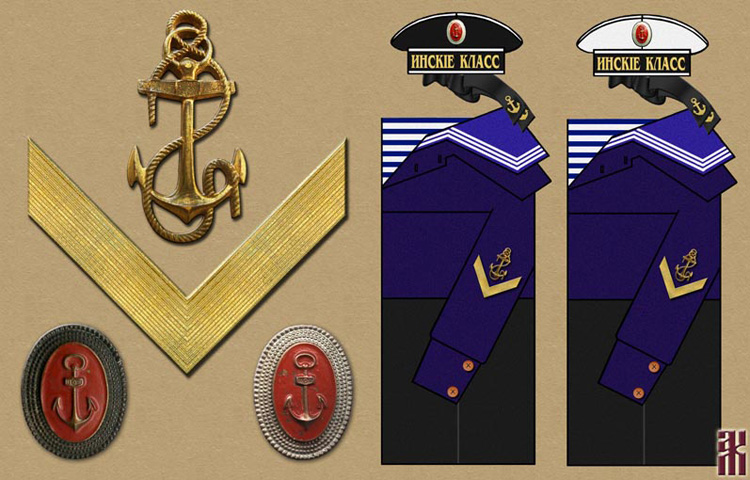
Sleeve chevron, 1917-style cockades and uniforms of midshipmen of the
Independent Midshipman Classes
After the crew left the ship, all the cadets remaining on board were assigned to specialities, becoming helmsmen, engineers, gunners, signalmen, miners and stokers. M. A. Kititsyn relinquished his duties as commander of the detachment, ceding his position to Senior Lieutenant M. M. Afanasyev, and took command of the training company himself.
Having abolished shoulder-boards for officers (made of braid with stars and stripes), the Provisional Government introduced sleeve insignia to replace them made of gold, silver braid, or black ribbon in the form of chevrons with a curl ("Nelson's loop"). To be worn on a white tunic, the sleeve insignia were transferred to black shoulder-boards. The changes affected the cut of the cap and the appearance of the cockade. Back in Hong Kong, at a general meeting of the crews of the Orël, Boykiy, and Grozny, the sailors demanded an explanation from Captain Kititsyn regarding the officers' black shoulder-boards with insignia. The crew was told that these were shoulder insignia and had nothing to do with the old-style gold shoulder-boards, and a debate ensued. Mikhail Alexandrovich addressed the meeting with the words: "You are all here against these so-called black shoulder-boards. Fine, I will cancel them, but will you really be pleased when your officer goes on a visit to a foreign ship in civilian clothes? We still do not have a precise and definite uniform, and no one knows when we will have one." The resolution of the general meeting was neutral.
The Provisional Government did not manage to issue any orders regarding the insignia of midshipmen for summer uniforms No. 1 and No. 2, and on 16 December 1917, by decree of the All-Russian Central Executive Committee and the Council of People's Commissars, the new government abolished all existing insignia altogether. The photographs show that the command of the training detachment ignored this decree, and officers and trainees continued to wear the uniform and insignia previously introduced by the Provisional Government. As an element of the uniform, shoulder-boards (of the Tsarist model) were returned to the White formations of eastern Russia on 28 November 1918, but at the time of the photos there were no White formations in Vladivostok. In order to wear insignia on their uniforms, the detachment command ordered that the sleeve insignia be transferred to the black shoulder-boards. A V-shaped chevron, known as Nelson's loop, was sewn onto the shoulder-boards under the anchor. This achieved uniformity for insignia for the white uniforms of officers and midshipmen (author's opinion).
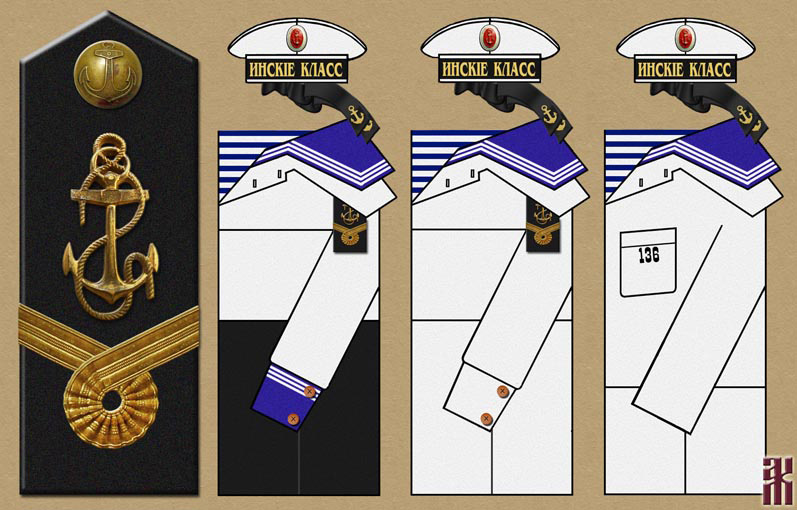
Black shoulder-straps (shoulder-boards) and uniforms for the midshipmen
of the Independent Midshipmen Course, late 1918
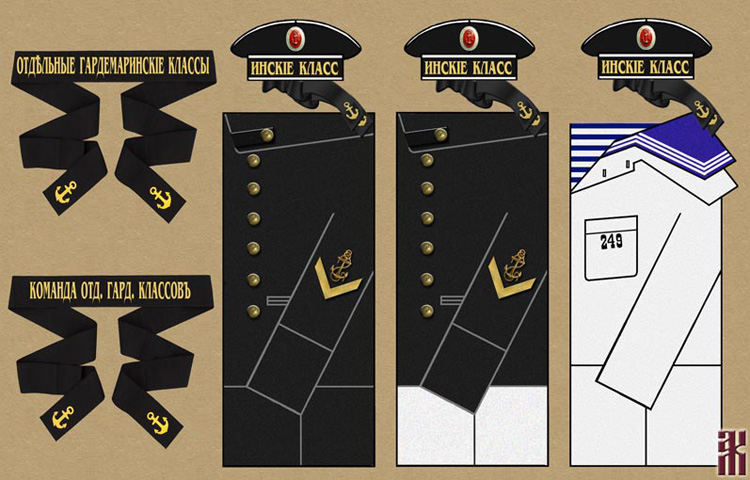
1 – hat band for the Independent Midshipmen Course;
2 – hat band of the technical staff (ships crews); 3 to 5 – midshipmen uniforms
2. Naval Academy in Vladivostok
Vladivostok, November 1919
The cadets presented an exceptionally colourful picture as they marched in close formation, in their black greatcoats with white shoulder-boards, with their banner unfurled, under enemy fire along Aleutskaya Street...
Hartling K. in "Guarding the Motherland // The Great Siberian Ice Campaign", Moscow, 2004, p.606.
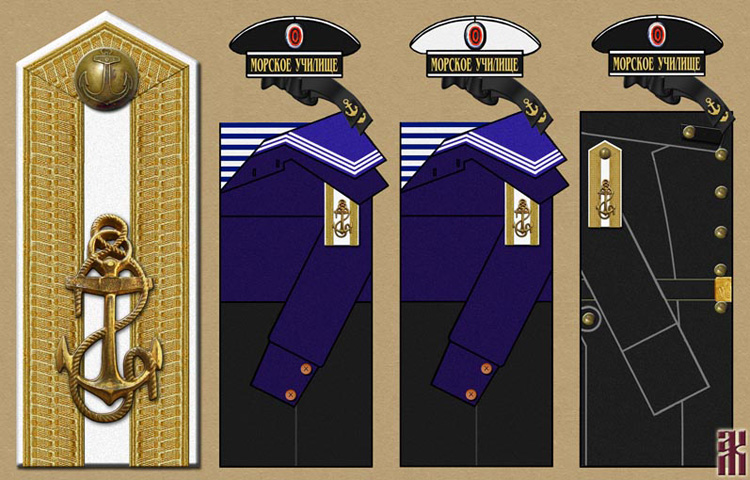
Shoulder-boards and uniforms worn by cadets of the Vladivostok Naval Academy
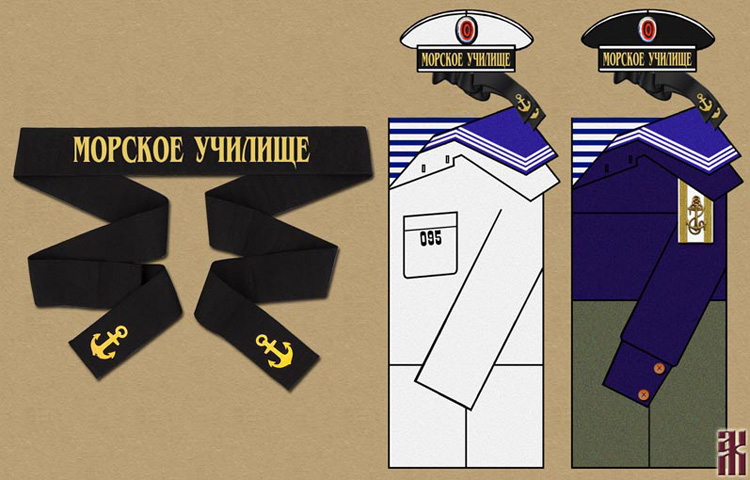
1 – hatband for (visorless) caps of cadets of the Vladivostok Naval Academy;
2 – uniforms of cadets of the Vladivostok Naval Academy
3 – the landing uniform used in the April 1919 operation to rescue General Volkov's detachment in the Suchan [Partisansk] mines area
In early November, the cadets began to return to Vladivostok. A group consisting of five officers and forty-five cadets arrived from Saigon, and more than a hundred people arrived from Harbin. The school's ranks were replenished with naval cadets and midshipmen from other companies of the Midshipman Course and the Naval School who had ended up in the Far East, while some of the midshipmen were expelled for various reasons. As a result of the selection process, 129 remained at the school, and qualified teachers were recruited from among the naval officers. On 29 November 1918, Order No. 19 was issued to the fleet and the Naval Department: Sleeve insignia for ranks and titles are abolished. ... Officers and midshipmen donned the uniforms and insignia they had worn before the 1917 February Revolution. For cadets of the Naval Academy, white shoulder-boards as for the Petrograd Naval Academy, but without monarchical monograms were approved.
The only graduation ceremony of the Vladivostok Naval Academy in was held on Easter Sunday, 11 April 1920, in Singapore. The first company of the academy, consisting of 119 cadets, were commissioned as midshipmen. Captain Kititsyn did not actually have the authority to commission them, but he assured them that this would happen as soon as the opportunity arose. Midshipmen wore officer's uniforms, with wide black shoulder-boards with gold braid and an anchor.
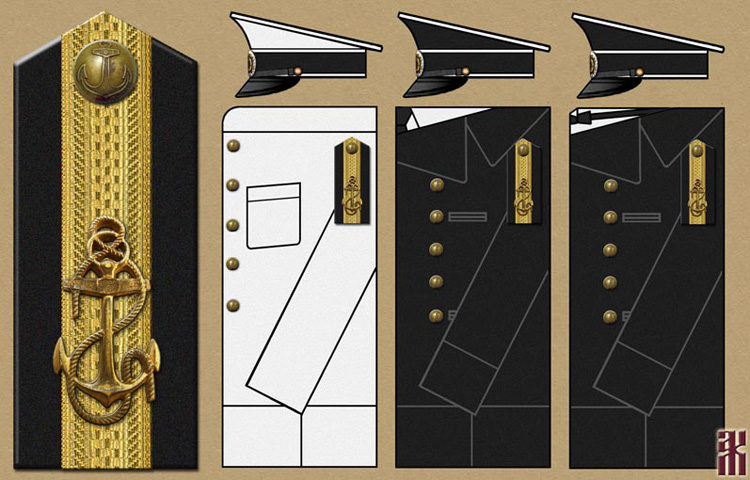
Uniforms worn by midshipmen of the Naval School after graduation on 11 April 1920
According to the recollections of midshipmen of the 1st Company of the Naval Academy, Czechs and Slovaks were included in the academy in October 1919 as an autonomous detachment of the 2nd Company (under Captain V. Odengal). Judging by the only photograph (found at GARF), the Czechoslovaks were re-uniformed in Russian naval uniforms (but obviously with their own external insignia, as Czechoslovakian cockades are clearly visible on their caps).
Kritsky, N. N. in "The Training of the Czechoslovak Navy Officers at the Naval School in Vladivostok, 1919-1920 // Notes of the Society for the Study of the Amur Region, Volume XLI", Vladivostok, 2013, p.173.
On 1 March Rear Admiral Timirev telegraphed from Vladivostok that the urgent procurement of uniforms had begun, but the process was being slowed down by the lack of samples and descriptions of naval uniforms. The Minister of the Navy, Rear Admiral Smirnov added the following resolution to the telegram the next day in Omsk: "Establish the uniform as brought in the samples with Senior Lieutenant Kharin. Work out the details on site."
Description of the uniform of cadets, conductors and volunteer sailors
Cap with visor and chin strap. Made of dark blue cloth: large visor made of lacquered hard leather, almost straight, with a slight downward slope; chin strap made of lacquered soft leather, fastened to the cap with two small copper buttons with anchors.
Cockade on the cap. For midshipmen ... the officer model.
Covers for caps. Made of white cotton fabric, that fits over the crown down to the hatband.
Tunic for midshipmen. Made of dark blue broadcloth, single-breasted, fastened with four gilded copper buttons with anchors; pockets with flaps are sewn on both sides of the chest; straight pockets are cut on the sides of the tunic; shoulder-boards made of the same material with narrow gold braid sewn along the edges and a gold anchor in the middle. A frock coat with a turn-down collar and lapels, which is worn with a white shirt with a starched collar and a long silk tie.
Trousers for midshipmen. Made of dark blue broadcloth of the standard pattern.
Boots for midshipmen. Black leather lace-ups with straight toes.
The design differed significantly from the uniform of the Imperial Russian Navy and in many ways copied the uniform of the British Royal Navy. ... In general, of the traditional uniform details unique to the Imperial Russian Navy, only the shoulder-boards of conductors, midshipmen, and Russian cockades remained in this design. In addition, the drawings themselves were sloppy, showing signs of haste, and there are many discrepancies between the approved colour drawings and the accompanying description. Thus, in the original version of the drawings, the colour of the jackets, uniform shirts, trousers and caps was light blue, and the overcoats were dark grey, almost black; in the approved drawings, the jackets, trousers and caps are depicted as grey-blue, even with a slight purple tinge, while the overcoats are still grey-black; finally, in the text, all these items are described as dark blue. But what is even more interesting is that in the approved drawings, the colour of the shoulder-boards and cap bands of conductors and midshipmen is shown as black (with a grey-blue tunic and cap crown), while in the description it is dark blue (the same colour as the tunic and cap crown).
No order introducing this uniform has been found, but the available documents suggest that the order for the naval uniform was placed by the Ministry of the Navy, and money was sent to Vladivostok to pay for the first batch. However, it remains unclear whether the order was fulfilled and whether the White sailors received the uniform.
Kuznetsov, N. A. and Petrov, A. A. in "Admiral Kolchak's White Sailors: the History of the White Fleets in Eastern Russia in 1918-1919 and the uniforms of their ship's crews // Sergeant, No. 24", Moscow, 2002, pp.44-45.
3. Midshipman Course of the Siberian Flotilla, 1921-1922
The cadets were dressed in naval uniforms found in the crew's storerooms.
Elenevskiy, A. in "Military Schools in Siberia (1918-1922) // Cadets and Junkers in the White Struggle and Abroad", Moscow, 2003, p.455.
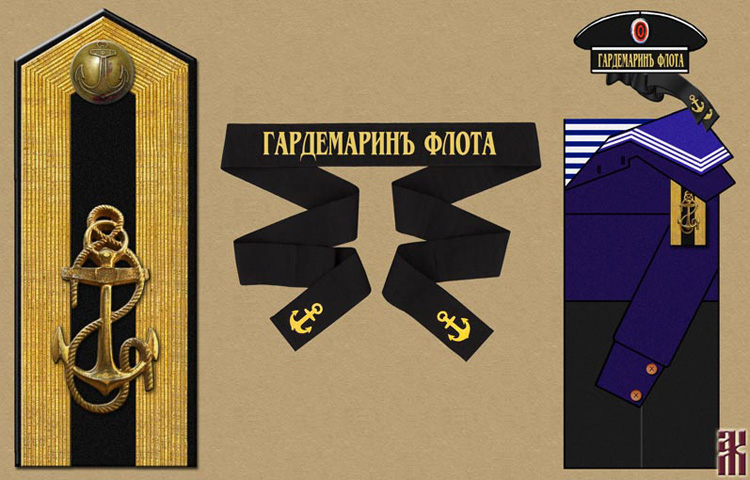
Shoulder-boards and uniforms of the cadet class of the Siberian Flotilla, Vladivostok
based on a photograph in the "White Russia Photoalbum"
"White Russia Photoalbum", Moscow, 2003, p.235.
4. Machine and Motor School of the Maritime Department, Tomsk
On 3 April 1919, by Order No. 50 of the Machine and Motor School, a khaki uniform was introduced for the school's volunteers, as established for army units, with the following distinguishing marks: on the left sleeve – an embroidered blue anchor; on the shoulder-boards of privates and NCOs – the yellow letters "М.Ш." with yellow insignia. In our opinion, the insignia refers to the image of a three-bladed ship propeller superimposed on a gear wheel.
Kuznetsov, N. A. in "On the history of the Machine and Motor School of the Maritime Department of the All-Russian Government of A.V. Kolchak (1919) // Siberia during the Civil War: Proceedings of the International Scientific and Practical Conference, 6-7 February 2007", Kemerovo, 2007, p.218.
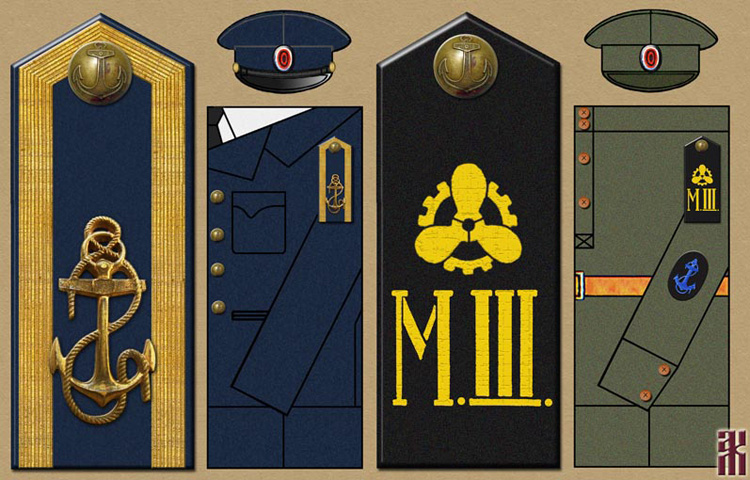
1 and 2 – proposed everyday uniform for midshipmen
3 and 4 – uniforms of the volunteers of the Tomsk maritime Machine and Motor School
Kuznetsov, N. A. and Petrov, A. A. in "Admiral Kolchak's White Sailors: the History of the White Fleets in Eastern Russia in 1918-1919 and the uniforms of their ship's crews // Sergeant, No. 24", Moscow, 2002.
5. Independent Naval Company of Colonel Orlov's Detachment
Far Eastern Railway Exclusion Zone, Summer 1918
According to memoirs, the naval officers and midshipmen of the company wore the uniforms and external insignia of the Russian Imperial Navy, with the midshipmen wearing shoulder-boards with the white field of the Naval School rather than the black field of the Independent Midshipmen Courses. The company had a sleeve insignia, the description of which has not yet been found. In his memoirs, A.A. Rakhmaninov wrote on this subject: "The guards immediately put on white shoulder-boards and naval company insignia on their sleeves". . It can be stated with some certainty that this was the insignia of the Imperial Russian Navy's marines – a blue embroidered admiralty anchor on the left sleeve. This was the first external insignia of the White movement's marines.
Kritsky N.N. On the question of external insignia of the White movement's naval rifle formations in the Far East and Siberia (1918-1922)// History of White Siberia. Materials from the 6th international conference, 7-8 February 2005. Kemerovo, 2005, p.77 citing Rakhmaninov, A. A. "A Brief History of the 1920 Graduating Class of the Naval Academy", manuscript no later than 1931.
II. Instructor Schools
1. Instructor Schools (Vladivostok, Ekaterinburg, Chelyabinsk, Irkutsk, Tomsk)
Order No. 174 of 7 August 1919 also established distinctive insignia for junior and senior cadets. According to this order, cadets were given soldier-style uniforms with cadet shoulder-boards made of khaki cloth with yellow braid around the sides instead of metal. Senior cadets were given soldier-style uniforms, with a quarter-inch-wide yellow braid sewn along the entire length of the cadet shoulder-board, from the top to the collar; the width of the base of the braid at the shoulder was the same as the width of the shoulder-board. The headdress had an officer cockade, and they were armed with a revolver and a sabre with an officer's sword knot.
Petrov, A. A. in "Admiral Kolchak's Senior Cadets // History of White Siberia: Materials from the 6th International Conference, 7-8 February 2005", Kemerovo, 2005, p.74, citing RGVA F.39499 Op.1 D.13 L.122.
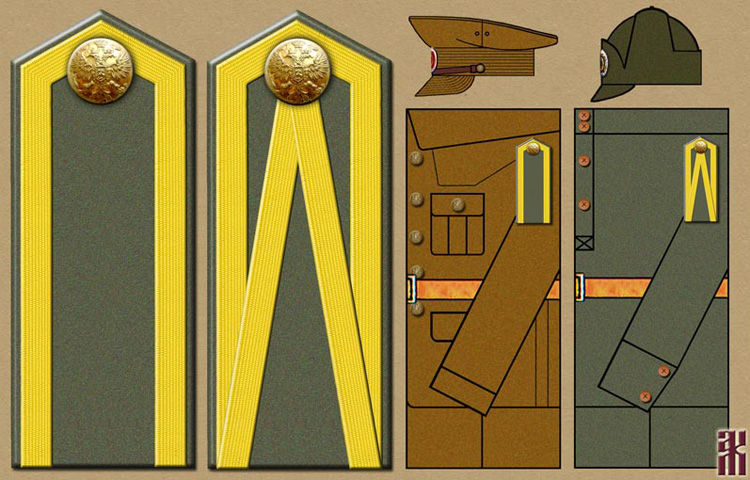
Shoulder-boards and uniforms of the Training and Instruction Schools
1 and 3 – junior cadets; 2 and 4 – senior cadets
The idea of reconstructing the uniform with the "Kolchakovka" headdress is taken from the Petrov article.
Petrov, A. A. "Uniforms of the Junior and Senior Cadets of the Training and Instruction Schools of Admiral Kolchak's Army: an Attempt at Reconstruction // Dobrovolets, No. 2 (4)", Moscow, 2004, p.50.
The legal status of students and graduates of the Training and Instruction Schools was finally determined by Order No. 174 of the Supreme Ruler and Supreme Commander-in-Chief dated 7 August 1919:
1. Soldiers and volunteers trained at the officer course of the Training and Instruction Schools shall be called jaegers and shall be issued with soldier's uniforms with cadet shoulder-boards made of khaki broadcloth with yellow braid on the sides instead of metal.
3. Senior yunkers shall be assigned soldier-style uniforms, with cadet shoulder-boards sewn along the entire length of the shoulder-board with a quarter-inch-wide yellow braid at the top towards the collar, and the base of the braid at the shoulder shall be the width of the shoulder-board. Arms: revolver and sabre with officer sword knot, officer cockade on headgear.
5. Upon graduation from training and instructor schools, senior cadets shall be provided with the following from the treasury: clothing, footwear, underwear and bed linen in accordance with the table attached to the Regulations on the supply of cadets of military schools upon promotion to the first officer rank, developed by the Military Council and approved by the Minister of War on 14 June 1919.
Petrov, A. A. in "Uniforms of the Jaegers and Senior Yunkers of Admiral Kolchak's Army Training and Instruction Schools: an Attempt at Reconstruction // Dobrovolets, No. 2 (4)", Moscow, 2004, p.50.
Ekaterinburg, Summer 1919
The cadets were dressed in brand new English uniforms.
Elenevskiy, A. in "Military schools in Siberia (1918-1922) // Cadets and Junkers in the White Struggle and Abroad", Moscow, 2003, p.446.
2. Training Instructor School on Russkiy Island
The school was excellently equipped: smart, brand new English uniforms, excellent equipment and weapons.
Elenevskiy, A. in "Military schools in Siberia (1918-1922) // Cadets and Junkers in the White Struggle and Abroad", Moscow, 2003, p.449.
November 1919
Finally, during the battle near the railway tracks, Cadet Zubarev ran up to me and reported: "Our boys (that is, my 3rd platoon) have captured a carriage with uniforms and are asking for your permission to change into rubberised boots". Knowing that all the "boys" were wearing boots and puttees that had gotten wet during yesterday's rain, and understanding that each of the fighters would be flattered to have "rubberised boots" on their feet instead of boots with puttees, I allowed them to change their footwear.
Hartling, K. in "Guarding the Motherland // The Great Siberian Ice March", Moscow, 2004, p.612.
Officers from General Knox's school
Over the past few days, individual officers have involuntarily been attracting attention when seen on the streets of Irkutsk. The colour and cut of their clothing is English, but their cockades and shoulder-boards are Russian. These are officers who have completed refresher courses at General Knox's school, organised on Russkiy Island near Vladivostok. The officers are going to the front.
S. K. in "Russian Speech [newspaper] No. 68 (141)", 1 April 1919. Material kindly provided by Voronezh researcher N. Zayats.
3. Tyumen Instructor School.
October 1918
The school was dressed in Russian uniforms brought from Kazan. ... At the end of 1918, the school was transferred to Ekaterinburg and formed into the 16th Sarapul Division.
Elenevskiy, A. in "Military Schools in Siberia (1918-1922) // Cadets and Junkers in the White Struggle and in Exile", Moscow, 2003, p.445.
III. Military Schools
1. Orenburg Cossack Military School
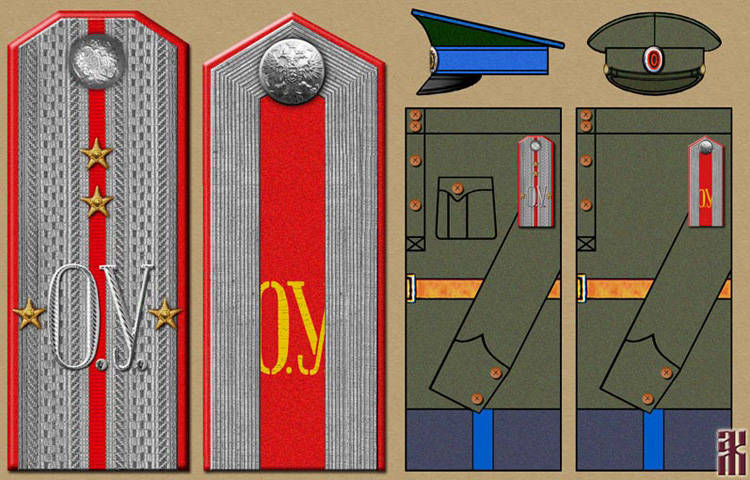
Shoulder-boards and uniforms of the staff and students of the
Orenburg Cossack Military School
The reconstruction of the coloured details of the uniforms was based on the tables by V. K. Shenk.
Orenburg, July 1918
The administrative department managed to provide uniforms, and the cadets were dressed in khaki blouses, blue breeches and leather boots, although the uniforms were crudely sewn.
Irkutsk, February 1919
Since the graduates left in their own uniforms, the ranks of the young cadets became motley – there were now both Russian and Japanese greatcoats, some wore sheepskin coats, the same was true of boots – which were both Russian and Japanese ones, even some of the rifles were replaced with Japanese ones.
Elenevskiy, A. in "Military Schools in Siberia (1918-1922) // Cadets and Junkers in the White Struggle and Abroad", Moscow, 2003, pp.414, 417.
2. Khabarovsk Ataman Kalmykov Military School
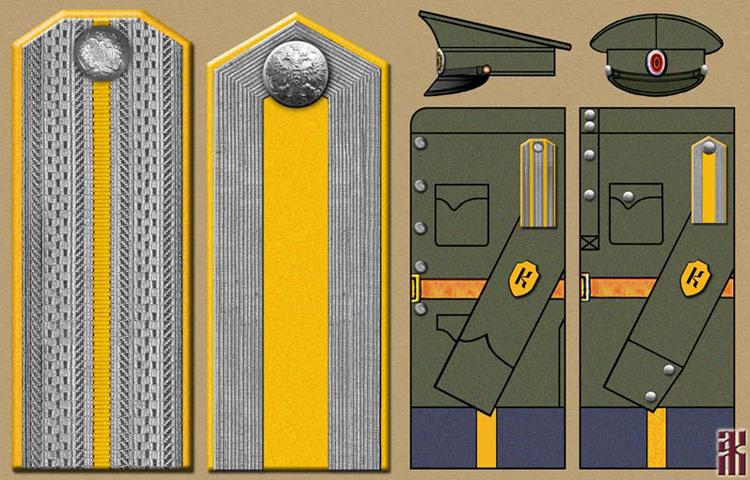
Shoulder-boards and uniforms of the staff and students of the
Khabarovsk Ataman Kalmykov Military School
Reconstruction based on a photograph at vl150.ru [link dead]
The school was located and supplied by the former Khabarovsk Cadet Corps. The school uniform consisted of green khaki blouses, blue trousers with yellow Ussuri stripes, papakha hats, and green greatcoats. The cadets were armed with Russian three-line rifles and sabres.
Elenevskiy, A. in "Military Schools in Siberia (1918-1922) // Cadets and Junkers in the White Struggle and Abroad", Moscow, 2003, p.420.
3. Chita Ataman Semenov Military School
Order to the troops of the Independent East Siberian Army, Chita, 11 December 1918
§10. I approve the uniform for officers of the Chita Military School:
1) Infantry.
a) Rifleman's cap – raspberry piping on the band, white piping on the crown.
b) Rifleman's shoulder-boards [i.e. raspberry], white piping.
c) White piping on the tunic (collar, sleeves, pockets) and trousers.
2) Cavalry – Cossack uniform with white piping.
3) Artillery – field artillery uniform with white piping on the shoulder-boards, tunic and trousers.
4) Sappers – engineer corps uniform with white piping, as for artillery.
5) The cipher "Ч.В.Ш." on the shoulder-boards.
Reference: Report of the Head of Chita Military School No. 117
Ataman of the Far Eastern Forces, Colonel Semenov.
Document kindly provided by Moscow researcher V. V. Romanov.
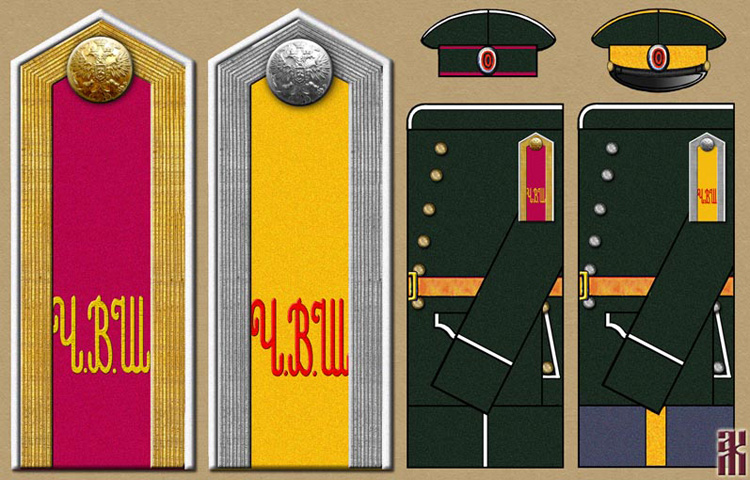
Shoulder-boards and uniforms of students of the Chita Military School,
Infantry and Cavalry Departments, 1918 model
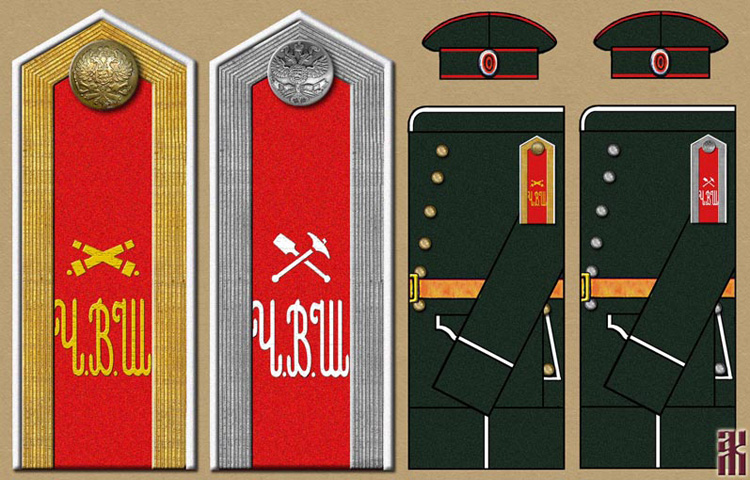
Shoulder-boards and uniforms of students of the Chita Military School,
Artillery and Engineer Departments, 1918 model
November 1918
One of the cadets described the composition of the first graduating class as follows: "Among all kinds of blouses, 'French' tunics, and pea coats, there were two or three students and secondary school pupils wearing tunics that looked strange in this military setting. ... There were many cadets from the Irkutsk, Khabarovsk, and Siberian corps."
The variety of uniforms was eliminated after the school was given the clothing warehouse of the Chita regional prison. Although it was not very attractive, a uniformity was achieved in the regiment: wide, grey soldier's broadcloth trousers, grey flannel blouses, soldier's boots, sheepskin coats and papakhi. Strangely enough, in the nearby Chinese Eastern Railway exclusion zone, where it seemed that one could buy everything one needed, in reality there was either nothing or something like the infamous blue uniform made of dyed burlap, which had to be withdrawn after two weeks of wear because it not only stained underwear but also caused skin diseases. The cadets' appearance remained unpresentable, and the administrative staff had to work hard before they finally managed to obtain decent uniforms. Overcoming this difficulty required not only the establishment of an administrative system, but also an understanding of psychology. ... Eventually, well-tailored and neatly fitted yellow cloth great coats and black uniforms appeared – the uniforms and trousers of the Chita escort komand – which immediately made the Chita cadets on leave noticeable on the streets of Chita and other cities.
Elenevskiy, A. in "Military Schools in Siberia (1918-1922) // Cadets and Junkers in the White Struggle and Abroad", Moscow, 2003, pp.425-426.
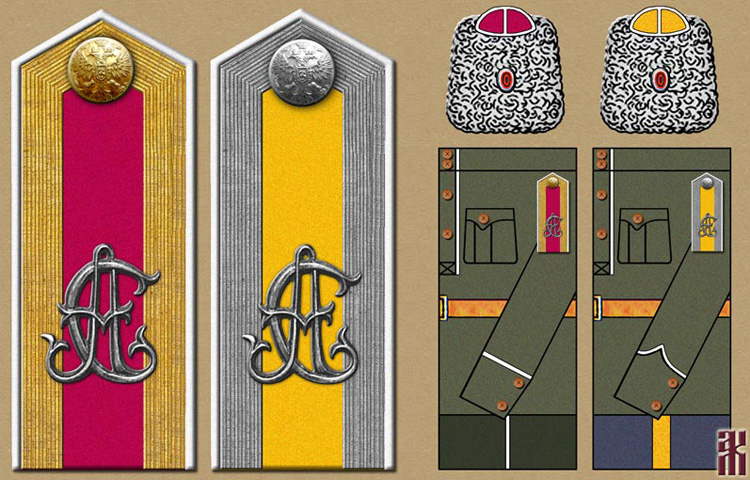
Shoulder-boards and uniforms of students of the Chita Military School,
Infantry and Cavalry Departments, 1919 model
The monogram changed after the reorganisation of the school into a military school on 17 April 1919 and the assignment of Ataman Semenov as its patron. The reconstruction is based on a photograph of cadets from the infantry company and an shoulder-board from the infantry department of the school, published in Selivanov.
Selivanov, M. in "History of Civil War Insignia in Russia: Cossack Troops // Antiquities, No. 11", Moscow, 2012, p.127.
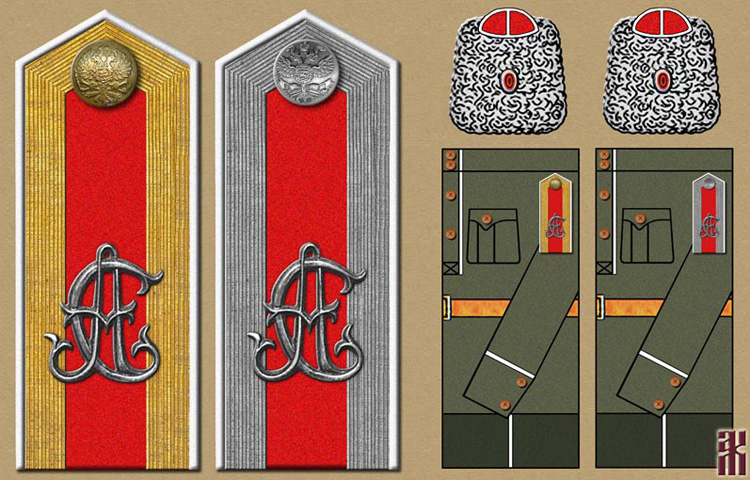
Shoulder-boards and uniforms of students of the Chita Military School,
Artillery and Engineer Departments, 1919 model
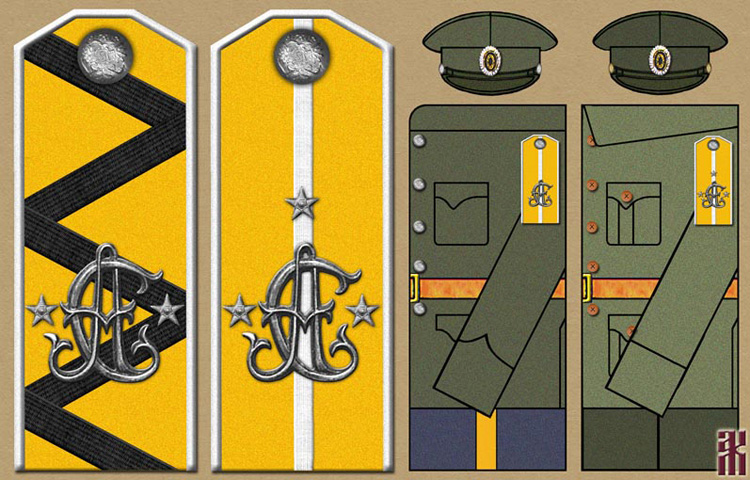
Shoulder-boards and uniforms of the permanent staff of the Chita Military School,
1919 model
Figure 1 is a general's shoulder-boards, based on a photograph of an original shoulder-board belonging to the school's commander, General M. M. Likhachev, published in Selivanov
Summer 1920
The summer uniform was new and smart, and made the formation look good. Cadets who did not have greatcoats were given short brown American cavalry greatcoats to go with their summer uniforms.
Elenevskiy, A. in "Military Schools in Siberia (1918-1922) // Cadets and Junkers in the White Struggle and Abroad", Moscow, 2003, p.432.
November 1920
When the Far Eastern Army left Transbaikalia, physically broken but still strong in spirit, a handful of young people in officer and cadet uniforms with silver "A.C." insignia marched alongside it. These were officers and cadets from the Chita Military School.
"Cadets from Chita // Ray of Asia, No. 1", Harbin, 1934, p.47.
Order No. 154 of the Commander-in-Chief of all Armed Forces of the Russian Far East, Chita, 12 February 1920
I hereby announce the new uniform I have established:
Papakha – grey, without cockade
Cap – khaki, existing model, without braid, with existing model cockade
Tunic and blouse – khaki, existing model, with yellow piping on the cuffs of the sleeves for officers of all units, departments and institutions (for cavalry units on the caps) and yellow ribbon for soldiers.
Trousers – short or long (off duty) made of khaki material of the existing model. ... Trouser stripes for the cavalry units and the Military Academy:
a) Military Academy – white...
Greatcoat – grey, standard model.
Shoulder-boards – khaki, with a stripes, piping and edging: (...)
24) Military Academy:
For infantry officers – raspberry stripes and white piping. For cadets – standard yellow metal braid with raspberry edging and white piping;
For cavalry officers – yellow stripes with white piping. For cadets – standard white metal braid with yellow edging and white piping;
For artillery officers – red stripes with red edging and white piping and the standard yellow metal artillery insignia. Cadets have standard yellow metal braid with red edging and white piping and the standard yellow metal artillery insignia;
For engineer officers – black stripes with white piping and the standard white metal engineer insignia. Cadets have standard white metal braid with black edging and white piping and the standard white metal engineer insignia.
Romanov, A. in "Ataman Semenov's Special Manchurian Detachment", Irkutsk, 2013, pp.281-283.
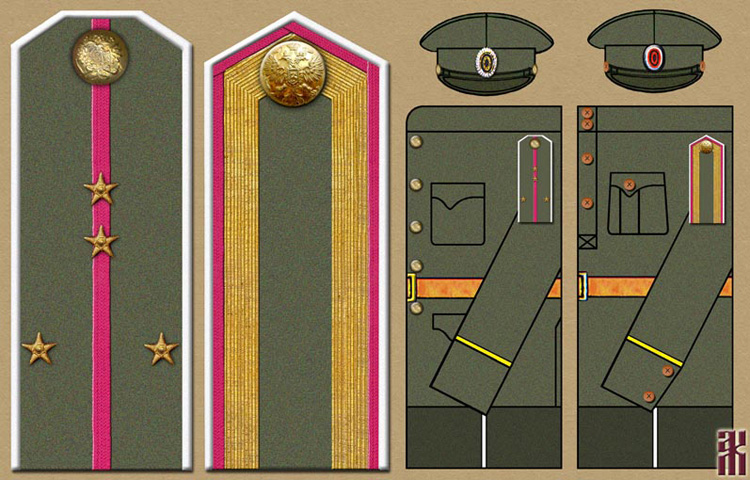
Shoulder-boards and uniforms and of the staff and students of the infantry department
of the Chita Military School, 1920 model
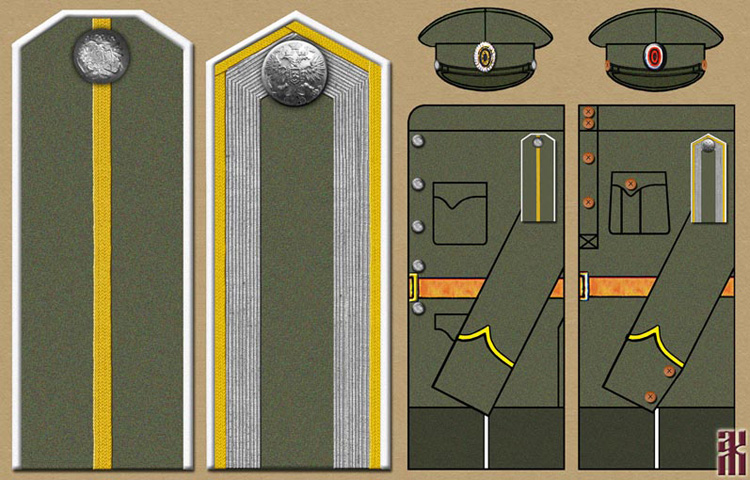
Shoulder-boards and uniforms and of the staff and students of the cavalry department
of the Chita Military School, 1920 model
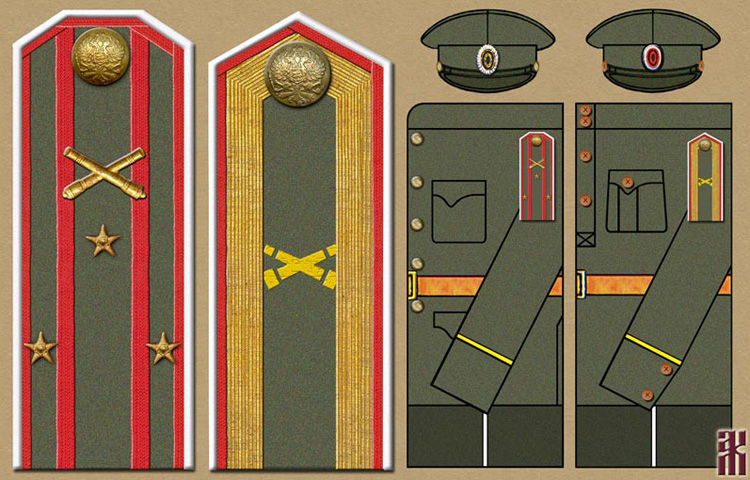
Shoulder-boards and uniforms and of the staff and students of the artillery department
of the Chita Military School, 1920 model
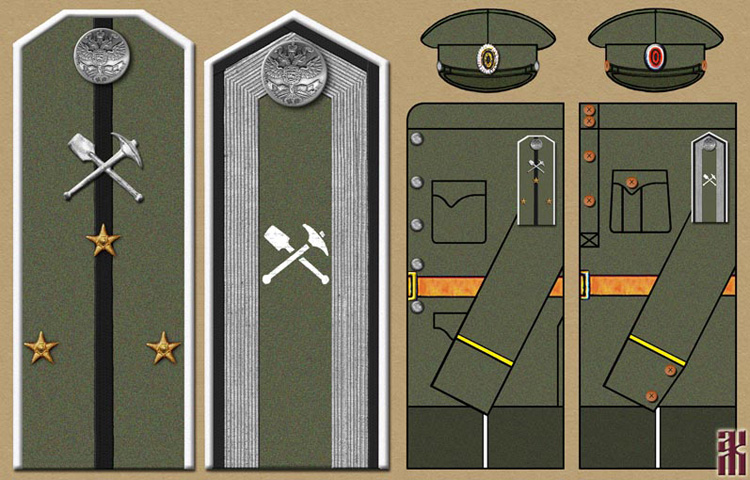
Shoulder-boards and uniforms and of the staff and students of the engineer department
of the Chita Military School, 1920 model
4. Tomsk Infantry Military School
April 1919
The cadets were dressed in brand new English uniforms and provided with all the necessary equipment, weapons, bedding, etc. – nothing could have been better.
Elenevskiy, A. in "Military Schools in Siberia (1918-1922) // Cadets and Junkers in the White Struggle and Abroad", Moscow, 2003, p.439.
5. Kornilov Military School in Vladivostok, 1921-1922
In accordance with the Provisional Amur Government's Order No. 25 of 24 June 1922 to the army and navy, the Infantry Military School named after General Kornilov was awarded special shoulder-boards by the governor of the Amur Zemstvo and Commander of the Zemstvo Army, M. K. Diterikhs. Infantry shoulder-boards: officer's – gold braid with raspberry stripes and black piping, with an appliquéd monogram "K" in white metal; cadet's – raspberry, with black piping and gold braid, with a stenciled monogram "K" in white paint. Cavalry shoulder-boards: officer's – silver braid with blue stripes and black piping, with an appliquéd monogram "K" in yellow metal; cadet's – blue, with black piping and silver braid, with a stenciled monogram "K" in yellow paint.
Information kindly provided by I. L. Ryzhov, researcher of the history of the Civil War in the Far East (Ussuriysk, Primorsk Krai).
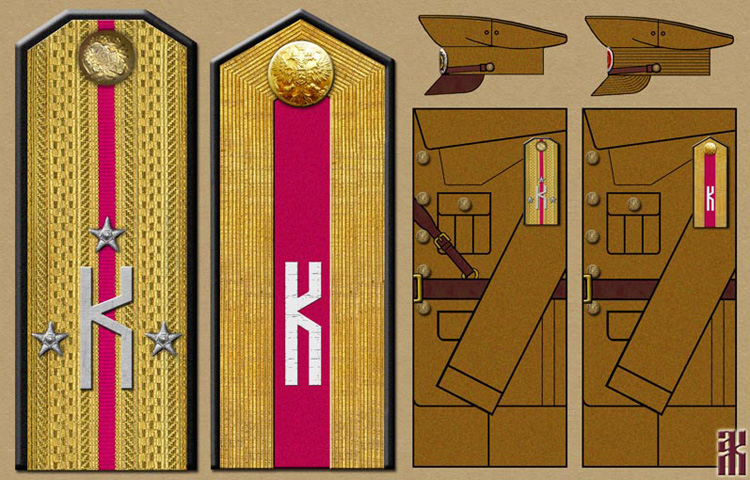
Shoulder-boards and uniforms for the staff and students of the Kornilov Military School in Vladivostok – infantry units
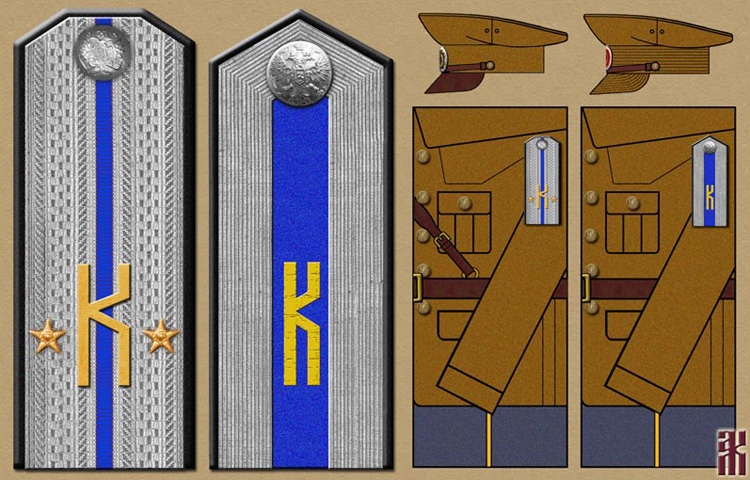
Shoulder-boards and uniforms for the staff and students of the Kornilov Military School in Vladivostok – cavalry units
October 1921
The cadets were dressed in English uniforms and Russian greatcoats. At first, the school was simply a military school, but later, during a parade at a school celebration, General Verzhbitskiy awarded the school the name "Kornilov" in memory of General Kornilov, who had served on Russkiy Island.
Elenevskiy, A. in "Military Schools in Siberia (1918-1922) // Cadets and Junkers in the White Struggle and Abroad", Moscow, 2003, p.443.
6. Irkutsk Military School
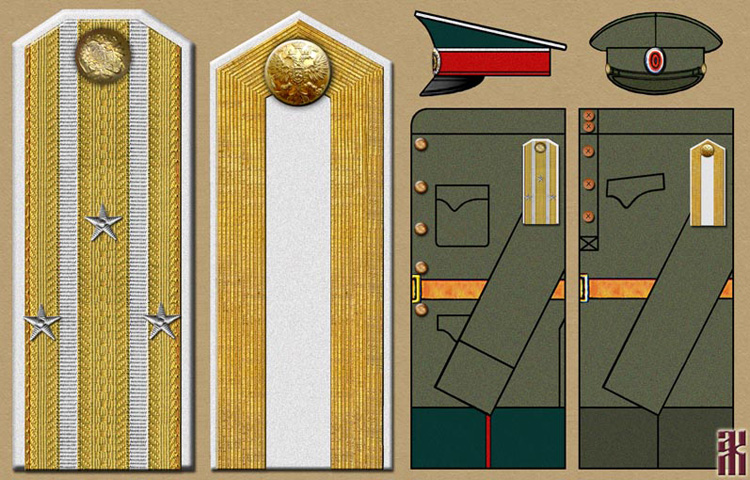
Shoulder-boards and uniforms of the staff and students of the Irkutsk Military School
The reconstruction of the staff is based on the uniform tables of V.K. Shenk. The reconstruction of the cadet is based on the "White Russia Photoalbum".
"White Russia Photoalbum", Moscow, 2003, p.235.
7. 1st Artillery School, Omsk
By Order No. 862 of the Chief of Staff of the Supreme Commander-in-Chief of 21 August 1919, cadets of the Artillery School were issued with "scarlet broadcloth shoulder-boards with black piping, with cadet braid and a stencilled insignia – two crossed cannons in the middle".
Material from the old version of the forum on the website www.bergenschild.narod.ru [link dead].
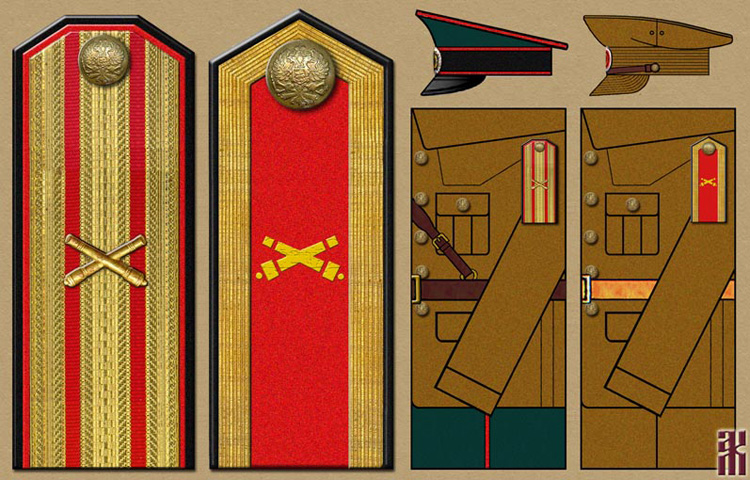
Shoulder-boards and uniforms of the staff and students of the 1st Artillery School in Omsk
June 1919
Cadets were dressed in English uniforms with Russian cadet shoulder-boards – red with black piping.
Elenevskiy, A. in "Military Schools in Siberia (1918-1922) // Cadets and Cadets in the White Struggle and Abroad", Moscow, 2003, p.441.
8. Chelyabinsk Cavalry School
1919
The school uniform was blue shoulder-boards, khaki blouse, scarlet breeches and field equipment.
Elenevskiy, A. in "Military Schools in Siberia (1918-1922) // Cadets and Junkers in the White Struggle and Abroad", Moscow, 2003, p.452.
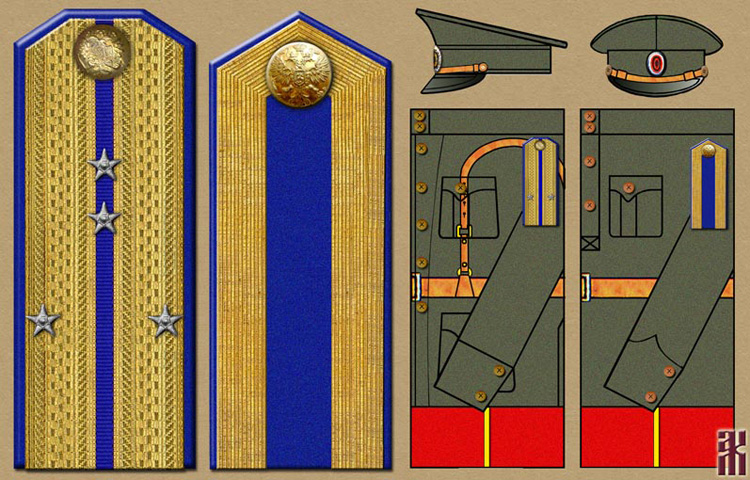
Shoulder-boards and uniforms of the staff and students of the Chelyabinsk Cavalry School
9. Military Topographical School (Novonikolaevsk)
Cadets wore black shoulder-boards with light blue piping and yellow lettering in the form of the letter "М".
Dolgov, E. I. and Sergeev, S. V. in "The History of the Service Topographical Units", Moscow, 2012, cited at www.regiment.ru/reg/VI/C/30/1.htm
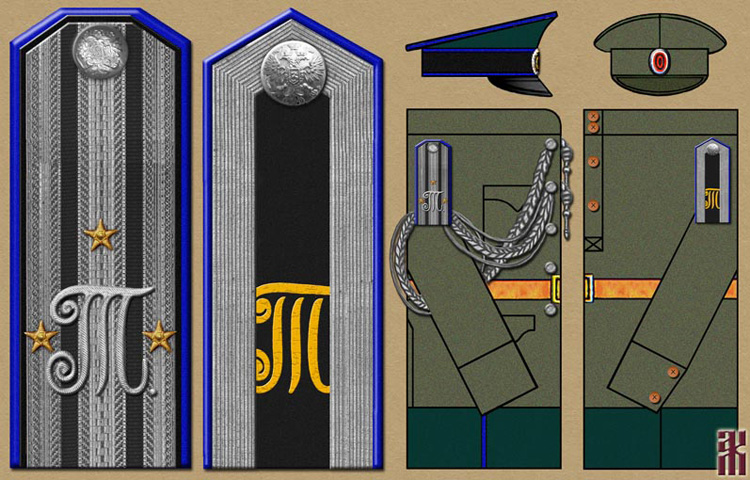
Shoulder-boards and uniforms of the staff and students of the Military Topographical School
Home — State Symbols — Flags — Uniforms — Badges & Medals — Money — Other
Pygmy Wars Notes
The original for this page is at kolchakiya.ru/uniformology/militaty_school.htm.
The original direct links in the midshipmen naval sections no longer work. However the photos cited can still be found by going to www.photo-war.com/ru/archives/album3366.htm.
The junior military cadets were called egeri, but as that is the same name as the "jaeger" rifle units it is very confusing and I have avoided the term. The "senior cadets" (yunkera) noted above were correctly "sword-belt cadets", that is they got to wear an officer sword knot on their uniform. It appears to be the same rank as sub-ensign.
While the cipher for the Topographical school looks like an "M", it is in fact a Cyrillic italic "T".
Discussion on the translation choices I have made can be found here.