
Uniforms of Russian Military and Police Units in Japanese Manchukuo
All material and reconstructions are by A. Karevskiy unless noted otherwise.
The Asano Brigade (Detachment), 1938-1943
Initially the Asano soldiers wore Japanese uniforms, which were later replaced by Imperial Manchukuo Army uniforms with the appropriate insignia. Officers wore caps and peaked caps with a five-colour star (yellow, black, white, blue and red – the national colours of Manchukuo), uniforms of the 1930 (Type 90) or 1938 (Type 98) Models, tight trousers, and officer's boots. For privates, there was a simplified uniform consisting of a cap, a tunic and trousers with puttees. Transverse shoulder-markings and collar tabs were used as insignia. The military ranks were the same as in the Manchukuo army, but with a Russian interpretation.
The weapons of the Asano detachment were Japanese. The officers and NCOs were armed with Type 14 8-mm Nambu pistols. Ranks from sergeant-major to colonel were armed with sabres, although, as researcher S. V. Smirnov notes, many Japanese officers carried samurai swords – katanas – which were of great importance in preserving samurai traditions. According to some sources, Russian officers also carried katanas. Russian émigré Viktor Sannikov recalled this in his memoirs: "Some of those who served often came home for a few days' leave each year. They made an impression with their bearing and military uniforms with Japanese sabres at their sides."
Yakovkin, E. V. in "Russian Soldiers of the Kwantung Army", Moscow, 2014, pp.122-124.
The Hailar mounted police detachment of Captain I. A. Peshkov
The rank and file were dressed in Japanese army uniforms, but the shoulder-boards and cockades were Cossack. The officers wore Cossack uniforms. They were armed with Czechoslovakian and Japanese rifles.
Yakovkin, E. V. in "Russian Soldiers of the Kwantung Army", Moscow, 2014, p.159.
Russian military detachments (Sungari, Hendaohezi and Hailar) of the Imperial Manchurian Army, 1943-1945
As for the uniforms of the RMD [Russian Military Detachments] officers, they remained the same – the uniforms of the Manchukuo army. The cockade was a five-pointed star in the colours of Manchukuo. The RMD officers also had a special badge, which was attached above the right pocket of their tunic. This badge was a small circle with a stylised, convex white cross (the so-called militia cross) in the centre, in the middle of which was an image of St. George slaying the dragon. This badge was mainly worn by the Sungari detachment of the RMD. Each RMD detachment received its own banner: it is known that the Sungari detachment had a white banner with an image of St. George the Victorious.
Yakovkin, E. V. in "Russian Soldiers of the Kwantung Army", Moscow, 2014, pp.164-165.
Interesting information about the Hendaohezi RMD is provided by historian A. V. Okorokov. Thus, each soldier of the HRMD received a greatcoat, two pairs of outer clothing, two pairs of underwear, and in winter – woollen underwear, woollen socks, winter boots with rubber soles, a fur coat, a hat, woollen gloves and mittens.
Yakovkin, E. V. in "Russian Soldiers of the Kwantung Army", Moscow, 2014, p.166.
Sakhalin Partisan Detachment
On ordinary days, the detachment personnel wore Japanese uniforms without insignia.
Balmassov S.S. in "White Émigrés in military service in China", Moscow, 2007, p.425.
Russian police in Japanese service
The police themselves ridiculed the black Japanese uniform: "A tunic with slits on the sides along the seam, trousers tucked into boots, silver piping on the cuffs and collar, and raspberry trim. A black cap with a raspberry visor and piping, a clumsy sabre with an incredible hilt without a guard, which rests under the armpit. Instead of a guard, there is a yellow leather lanyard. Instead of a cockade, there is a copper chrysanthemum petal on the cap. Old commanders, commanders and others are distinguished by gold stripes, and their sabres have handles. The uniforms look terrible on almost everyone, especially the wide and large boots – and this was a parade uniform!
Balmassov S.S. in "White Émigrés in military service in China", Moscow, 2007, p.427-428.
The Asano Brigade
Initially, the Asano cadets were dressed in Japanese uniforms, but later they began to wear the uniforms of Soviet military units. These were usually issued during training exercises and when parachuting into Soviet territory. Later, the Asano cadets were issued uniforms of the Manchukuo military and border guard units.
Balmassov S.S. in "White Émigrés in military service in China", Moscow, 2007, p.465.
On 15 March 1938 a group of candidates for junior commanders, accompanied by a Japanese officer, arrived at Sungari-2 Station. Many of those who arrived did not expect to find themselves serving in the "Japanese army", but it was too late to change anything. The next day, the cadets were issued military uniforms, but without shoulder-boards, and immediately began grueling training sessions accompanied by commands in Japanese. ...
The cadets not only had to learn Japanese on the fly, but also had to learn to get along with each other, putting aside their previous "party" differences. Yesterday's fascists, "musketeers", and legitimists now marched in unison under the commands of Japanese officers.
After a month of training, the cadets received their first ranks – junior and senior NCOs with the official duties of platoon commanders.
The system of military ranks in the detachment, formally part of the Manchukuo Army (later Imperial Manchukuo Army), fully corresponded to the system adopted in the Japanese army. The enlisted ranks included private 2nd class (nitto-hei), private 1st class (itto-hei), and senior private (lance-corporal – joto-hei). The NCOs included corporals (go-cho), junior and senior sergeants (gun-so, so-sho). Next came the sergeant-major (yun-i), officer candidate (sub-ensign – yunshi-kan) and ensign (i-kan) – second lieutenant (sho-i), first lieutenant (chu-i), captain (tai-i). The officer ranks were rounded off by the category of staff-captain (sa-kan): major (sho-sa), lieutenant-colonel (chu-sa) and colonel (vtai-sa). ...
The uniforms of the detachment's soldiers corresponded to the models adopted by the Manchukuo Army, which in turn copied the 1930 Model (Type 90) Japanese military uniform. The uniform consisted of a tunic, trousers and canvas (woollen) puttees in khaki with a mustard tint. The summer version of the uniform was made of light cotton fabric, while the winter version was made of thick woollen fabric. The tunic had a stiff stand-up collar, five copper or brass buttons at the front, two breast pockets and two side slit or patch pockets. The trousers were knee-length breeches with a fastening at the bottom. The trousers were tucked into the puttees. The uniform was complemented by a field cloth or wool cap (as the photographs show, Russian servicemen also wore peaked caps), a wide leather belt and brown pigskin ankle boots. Cloth shoes with rubber soles were also worn.
In the early 1940s, Russian units began to introduce new uniforms based on the Japanese 1938 Model (Type 98), which differed from Type 90 mainly in the collar, which was stand and fall.
The outer clothing of military personnel consisted of a greatcoat and a winter coat. The Type 90 greatcoat was made of thick woollen fabric and was double-breasted with two vertical rows of buttons. A large hood could be attached to the collar. The Type 98 greatcoat was single-breasted. Canvas raincoats were also used. In winter, double-breasted coats lined with sheepskin or fur and winter hats made of hare fur with ear flaps were issued. Winter ankle boots were complemented by gaiters and fur-lined leggings. Winter gloves were quilted, with separate thumbs and index fingers.
According to the regulations on clothing allowances, privates were to receive two pairs of regular and warm underwear per year, as well as two pairs of summer and winter uniforms. Footwear was used until it was completely worn out. The uniforms of the detachment's officers were of much better quality than those of the rank and file and were usually made to order from material issued to officers.
The insignia of Asano's detachment, initially the same as those of the Manchukuo Army, were replaced by Japanese ones in the summer of 1938. Raspberry cloth shoulder-markings in the form of transverse strips were placed at the junction of the shoulder and the upper part of the uniform sleeve, with rank indicated by gold-coloured stars and stripes. The stars on the insignia of soldiers and corporals were made of cloth, while those of all other ranks were metal. The shoulder-markings of ensigns and officers were trimmed with gold braid. Button tabs were sewn onto the collar of the tunic, the colour of which corresponded to the branch of the military (infantry in red, cavalry in green, artillery in yellow, engineers in brown). On their field caps, the detachment members wore a five-pointed, five-coloured star (corresponding to the colours of the Manchukuo national flag), which had been adopted by the Manchukuo Army.
Smirnov, S. V. and Buyakov, A. M. in "The Asano Detachment: Russian Emigrants in the Armed Forces of Manchukuo (1938-1945)", Moscow, 2015.
Reconstructions
Photographs published in the following sources were used in the reconstruction of the uniforms:
Balsamov, S. S. "White émigrés in Military Service in China", Moscow, 2007.
Yakovkin, E. V. "Russian soldiers of the Kwantung Army", Moscow, 2014.
Okorokov, A. V. "In the battles for the Celestial Empire: Russian Traces in China", Moscow, 2013.
Okorokov, A. V. "Russian Volunteers", Moscow, 2007.
Jowett, P. S. "Rays of the Rising Sun: Armed Forces of Japan's Asian Allies 1931-1945" Lancaster, 2004.
Jowett, P. S. "Chinese Civil War Armies 1911-49 // Men-at-Arms", Oxford, 1997.
Jowett, P. S. "Japanese Army, 1931-1942 // Men-at-Arms", Oxford, 2002.
Jowett, P. S. "The Chinese Army 1937-49: World War II and Civil War // Men-at-Arms", Oxford, 2005.
Photographs freely available on the Internet.
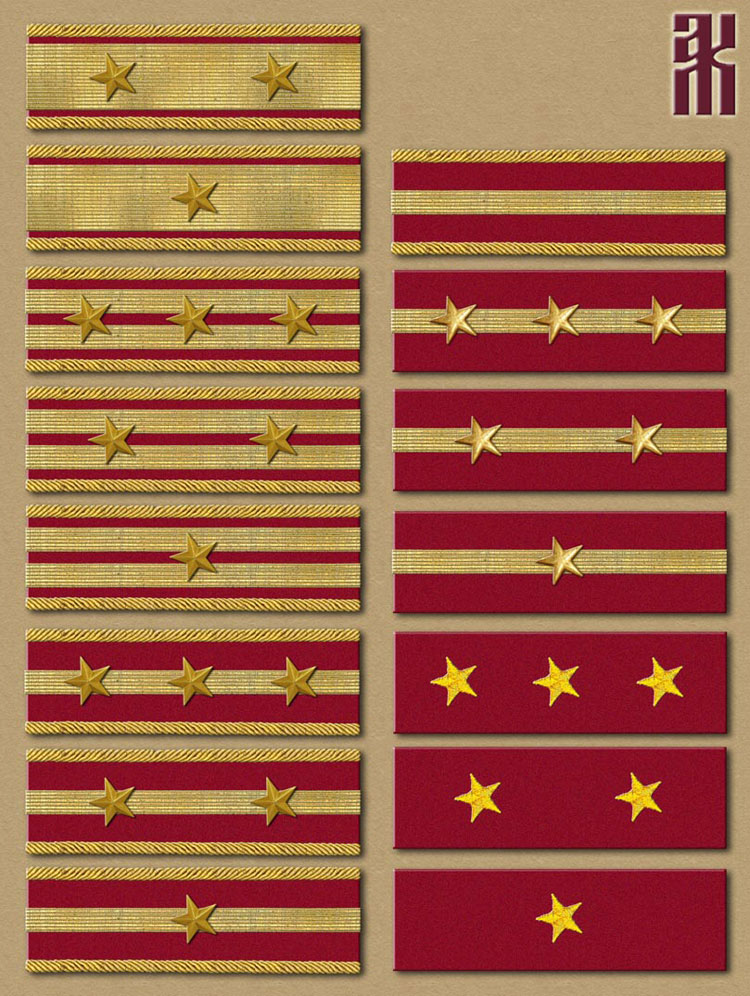
Insignia of the Imperial Manchukuo Army:
1 – Lieutenant-General; 2 – Major-General; 3 – Colonel; 4 – Lieutenant-Colonel;
5 – Major; 6 – Captain; 7 – First Lieutenant; 8 – Second Lieutenant;
9 – Officer Candidate/Ensign; 10 – Senior Sergeant; 11 – Sergeant; 12 – Corporal;
13 – Senior Private; 14 – Private 1st Class; 15 – Private 2nd Class
The insignia were the same for all branches of the armed forces including the Russian military detachments.
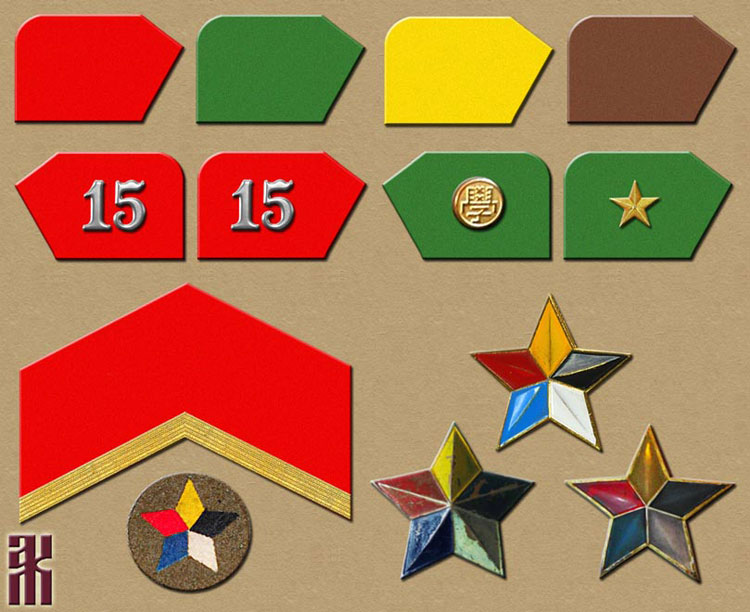
Insignia of the Imperial Manchukuo Army, including the Russian military detachments;
Collar tabs: 1 – infantry; 2 –cavalry; 3 – artillery; 4 – engineers;
5 to 8 – collar tabs with insignia and ciphers;
9 – sleeve chevron of a corporal acting as sergeant; 10 to 13 – cockades
It is unclear if Russian units of the Manchukuo army wore insignia on their collar tabs. The star under the chevron is a sewn version for the cap of lower ranks.
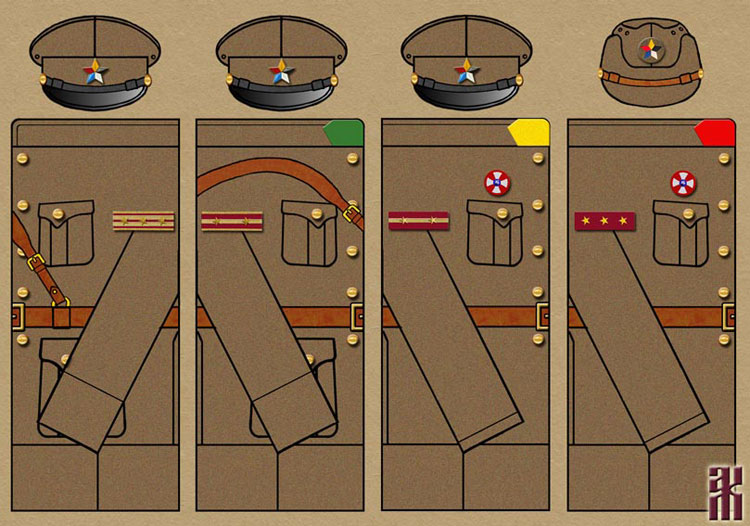
Uniform of the Imperial Manchukuo Army:
1 and 2 – officers; 3 and 4 – NCO and private 1st class with RMD breast badges
From 1943 the uniform of the Imperial Manchukuo Army was also used by the Asano Detachment.
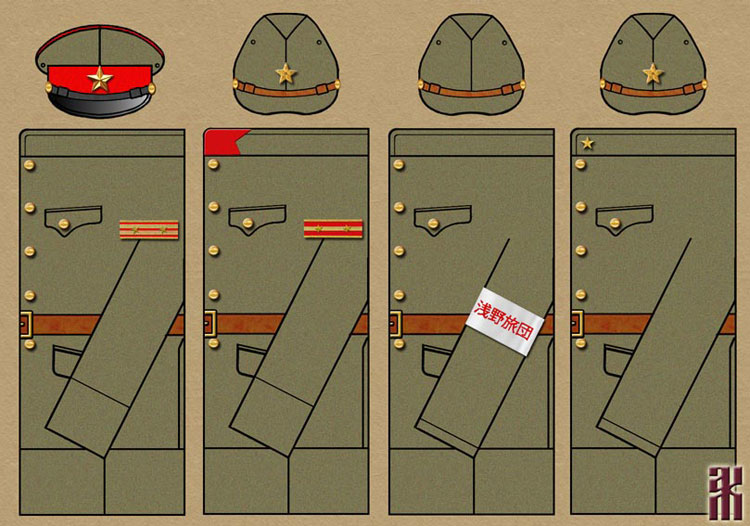
Uniform of the Asano Detachment (initial version):
1 and 2 – officers in 1930 model uniforms; 3 and 4 – privates in 1930 model uniforms (variants with arm-band and uniform without rank markings, but with insignia and cockades).
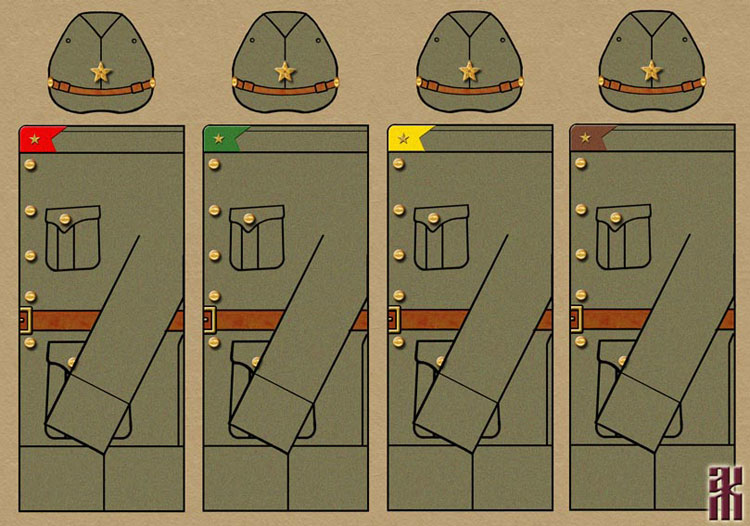
Uniform of the Asano Detachment (interim version):
1 – Vasio unit (infantry); 2 – cavalry units; 3 – Kushiada unit (artillery);
4 – Asakura and Omura units (engineers and radio telegraph)
The detachment was divided into units (effectively companies), named after their commanders, but the cavalry did not have a unified command.
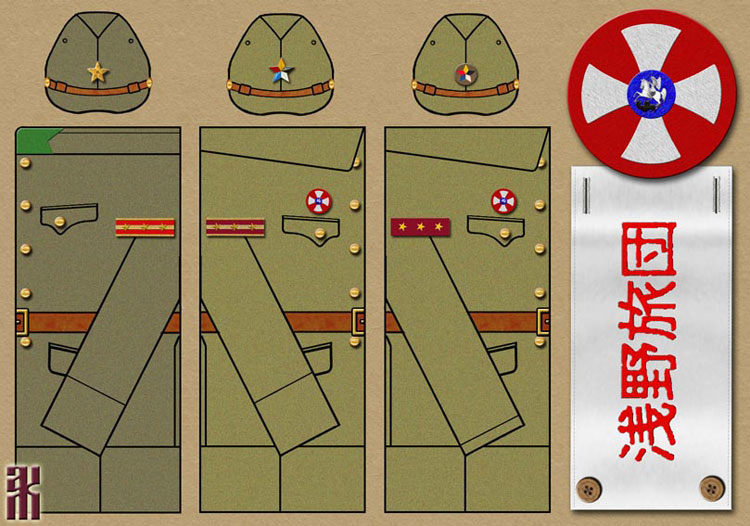
Uniform of the Asano detachment (final version):
1 – 1930 Model NCO uniform with cavalry markings;
2 and 3 – officer and private in Japanese 1938 Model uniforms with insignia of the
Imperial Manchukuo Army and RMD breast badges;
5 – arm-band with "Asano Detachment" and the RMD breast badge (from 1943)
In 1939, the detachment was finally reorganised as a cavalry unit.
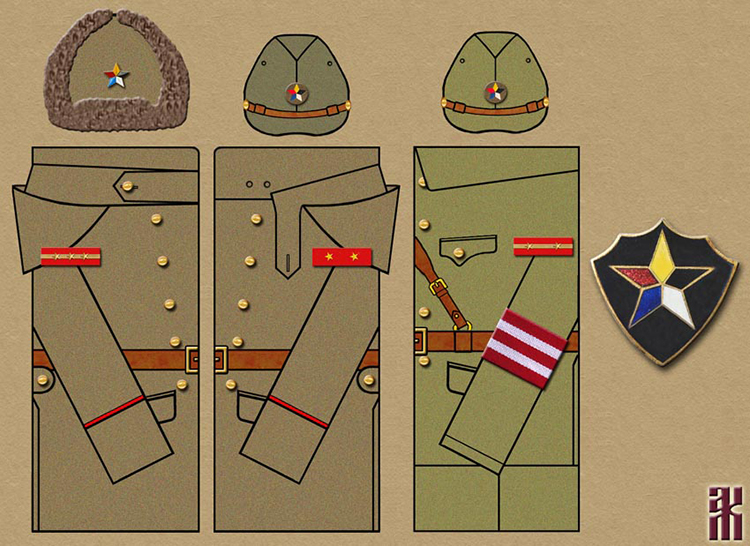
Uniforms of the Asano Detachment (final version):
1 and 2 – in greatcoats with attached hoods;
3 – in summer cotton uniforms with the arm-band of a duty NCO;
4 – cockade of the Military Reserve of the Imperial Manchukuo Army
From 1938, the unit switched to wearing uniforms with shoulder-boards of the Imperial Japanese Army, but with cockades of the Imperial Manchukuo Army (five-coloured stars). Some of the Russian military detachments wore the cockade in Figure 4.
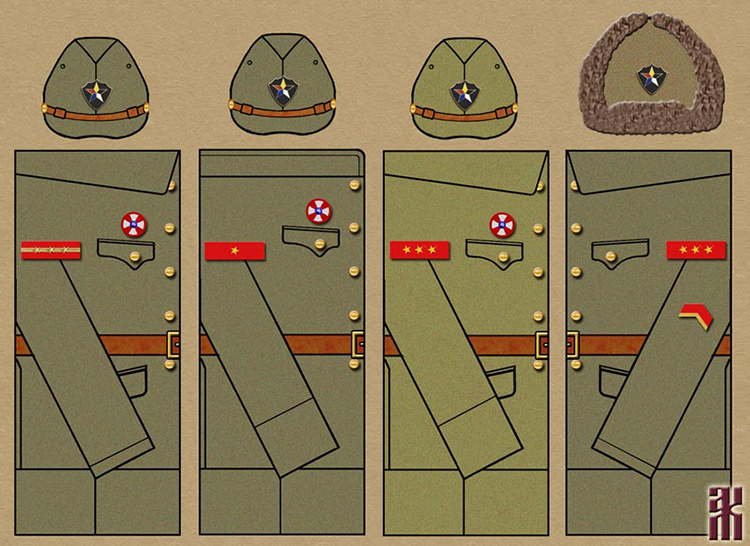
Uniforms of the Asano detachment (final version)
The headgear features cockades of the Imperial Manchukuo Army's Military Reserve, and the right side of their chest above the pocket flap there is the RMD insignia.
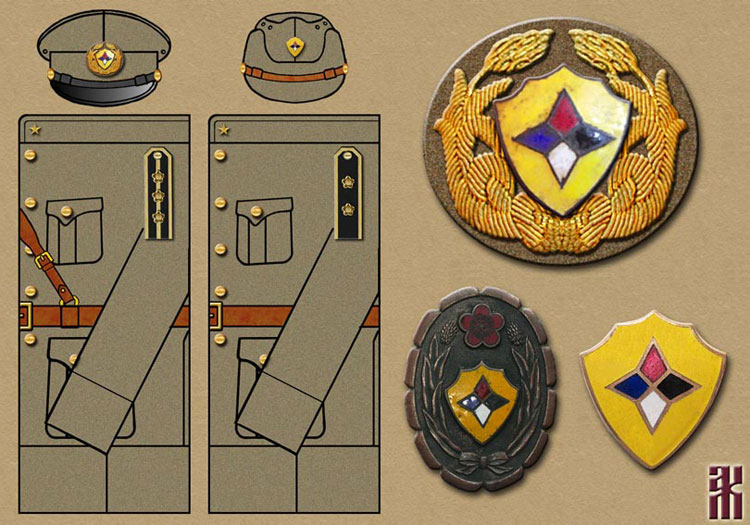
1 and 2 – Uniforms of an officer and enlisted personnel in the Manchukuo police
3 and 4 – officer and enlisted personnel police cockades; 5 – Manchukuo police badge.
The Manchukuo Police recruited former White Army servicemen.
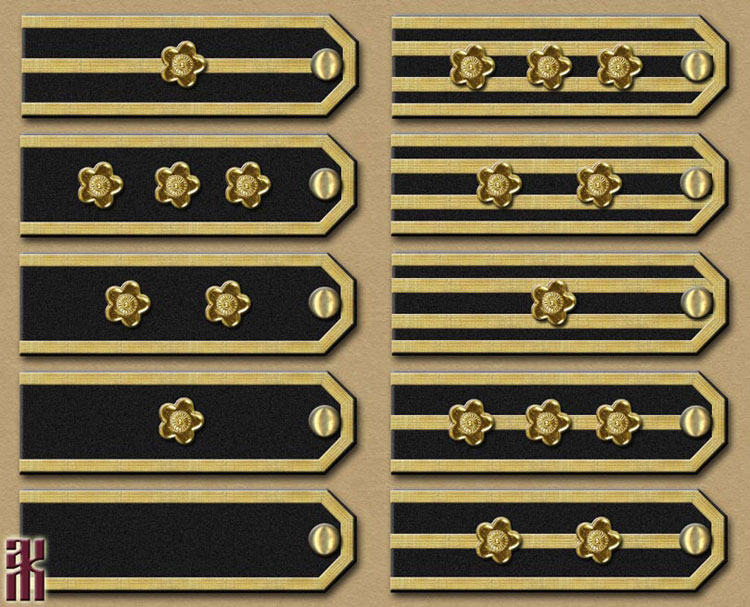
Rank markings of the Manchukuo Police
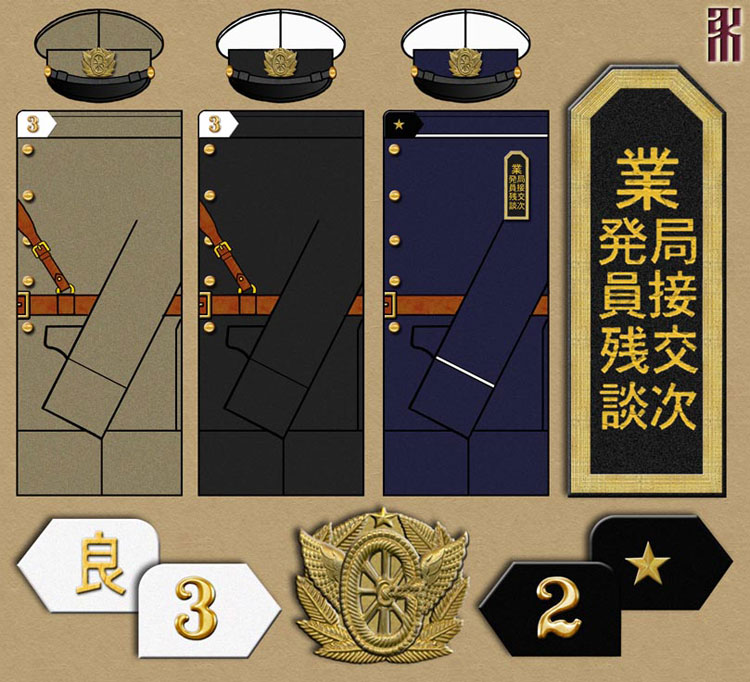
Uniform of the Manchukuo railway police, based on photographs
forum.vgd.ru/post/614/31743/p1494452.htm?hlt=%D0%B1%D1%80%D1%8D%D0%BC
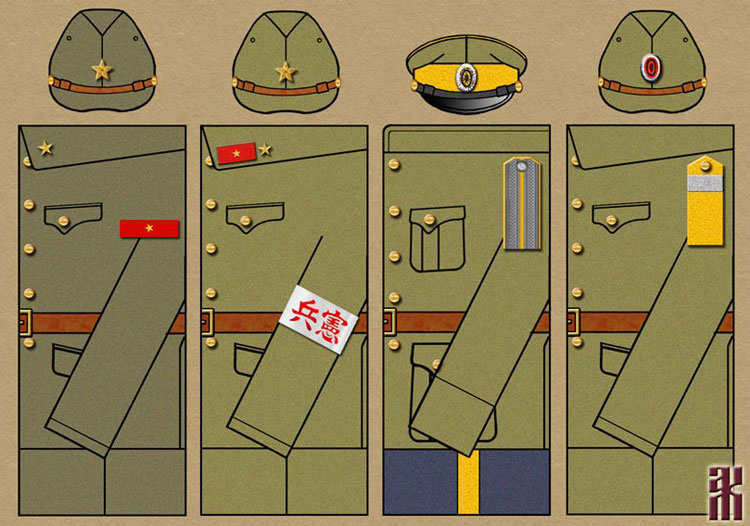
Uniforms of Russian officers of Japanese military police units in Manchuria:
1 – military police; 2 – Kempetai military gendarmerie with matching arm-band;
3 and 4 – Hailar mounted police detachment
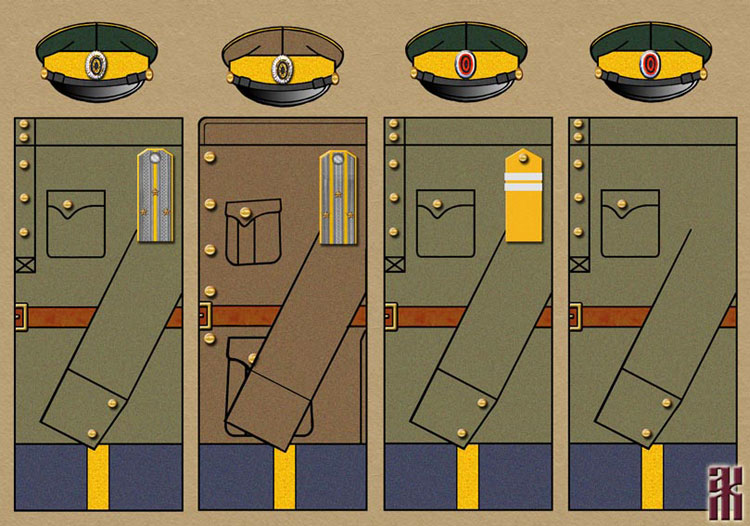
Uniform of servicemen of the Independent Trans-Hinggan Corps (Transbaikal Cossacks)
The corps included a Manchurian Composite Volunteer Detachment, Independent North Hinggan Brigade (formerly the Trekhrechensk Regiment), the Composite Hailar Regiment, the Yakessinsk Composite Cossack Regiment, and the Bukhedussk Composite Volunteer Detachment. Russian insignia was used, but the presence of any ciphers is unknown.
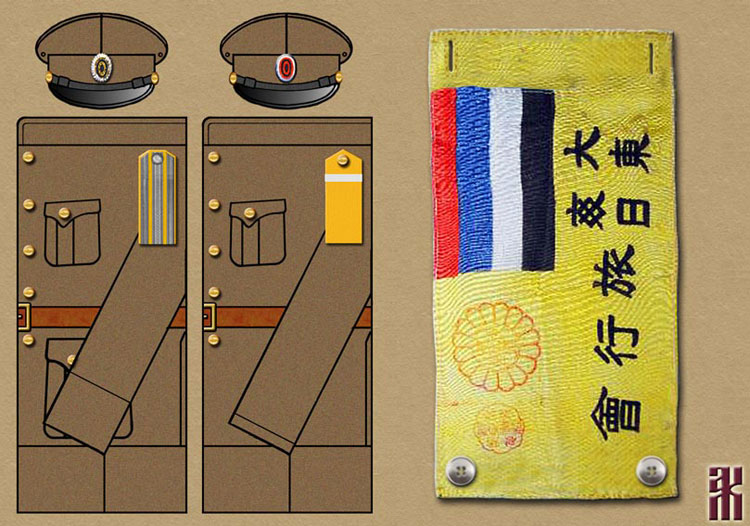
Uniform of servicemen of the Independent Trans-Hinggan Corps
and arm-band in the form of the national flag of Manchukuo
The corps mainly used Russian-style uniforms, made from materials supplied by either the Japanese or the Manchus, which resulted in a variety of colours. From 1943 uniforms of the Imperial Manchukuo Army with Russian cockades and insignia were used.
Home — State Symbols — Flags — Uniforms — Badges & Medals — Money — Other
Pygmy Wars Notes:
The original for this page is at kolchakiya.ru/uniformology/Manchukuo_formations.htm.
The "musketeers" were members of the "Union of Musketeers", a White Émigré youth organisation in China. Some information on them.
I have left place names in the transliterated Russian versions. For example, Hendaohezi is modern Hengdaohezixiang. Discussion on other translation choices I have made can be found here.