
Uniforms of the Independent "Vytautas the Great" Lithuanian Battalion,
5th Polish Rifle Division
All material and reconstructions are by A. Karevskiy unless noted otherwise.
Literature:
Tinchenko, Ya. "Armed Forces of the Belarusian People's Republic on the territory of Lithuania, 1919-1923 // Tseykhgauz, No. 6 (38)", 2010, p.50.
Khvostov, M. "The Russian Civil War (2), The White Armies // Men-at-Arms No. 305", 1997, p.33.
Table of insignia of the Lithuanian period of the War of Independence 1918-1920 at forum.axishistory.com/viewtopic.php?f=53&t=181977
The Polish forces in the east of Russia included an Independent Lithuanian Battalion, named for Vytautas the Great. This unit was formed from one of the companies of the 1st Rifle Regiment and consisted of soldiers of Lithuanian ethnicity. Its formation began in July 1919 near Novonikolaevsk. Captain Petras Linkevicius was appointed commander of the battalion. The soldiers of the battalion wore the same uniform as the rest of the division, but with distinctive insignia. Instead of an eagle, their caps bore the Vytis.
Institute of Slavic Studies of the Russian Academy of Sciences "Revolutionary Russia in 1917 and the Polish Question, New Sources, New Perspectives // A collection of works by Polish and Russian researchers", Moscow, 2009, p.240.
Presumably the battalion introduced the insignia adopted by the Lithuanian Army and established by Order No. 35 of the Minister of Defence on 21 February 1919. These consisted of: for NCOs, braid of the appropriate colour sewn onto the collar; for officers and generals, triangular cloth collar tabs of the appropriate colour – trimmed with narrow gold braid for generals, with narrow silver braid for senior officers and plain for junior officers. Military ranks were indicated for NCOs with braid in the branch of service colour and for officers and generals, by stars of yellow metal (Tinchenko and Lithuanian publications indicate eight-pointed stars for junior officers and four-pointed stars for senior and higher officers, whereas Khvostov indicates five-pointed stars). NCO braid the field of officers' tabs were meant to be in the branch of service colour; for the Independent Lithuanian Battalion that was most likely yellow-orange, the colour for infantry.
In addition, for a stronger visual distinction from Polish formations there was a sleeve insignia of a triangle in the national colours (yellow-green-red, 73 mm high and 63 mm wide) and a special cap introduced in 1919. Known as the "Kaunas" cap, it was soft and round, with a 2 cm wide hat-band and a white chin strap. A cockade was worn on the crown, and the hat-band and piping on the crown were in the branch of service colour.
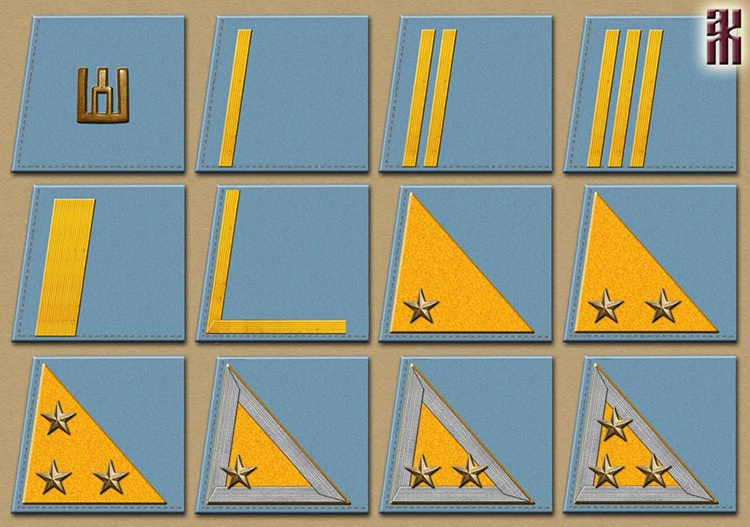
Rank insignia of the Independent "Vytautas the Great" Lithuanian Battalion:
1 – private (eilinis), 2 – corporal (grandinis), 3 – junior sergeant (jaunesnysis serzantas);
4 – sergeant (serzantas), 5 – senior sergeant (virsila); 6 – cadet (kariuunas);
7 – lieutenant (leitenantas); 8 – senior lieutenant (vyresnysis leitenantas); 9 – captain (kapitonas); 10 – major (majoras); 11 – lieutenant colonel (pulkininkas leitenantas);
12 – colonel (pulkininkas)
The Lithuanian Army branch of service colour for artillery was black, for engineers was red, and for cavalry was white, but the Vytautas the Great Battalion only had infantry units in yellow.
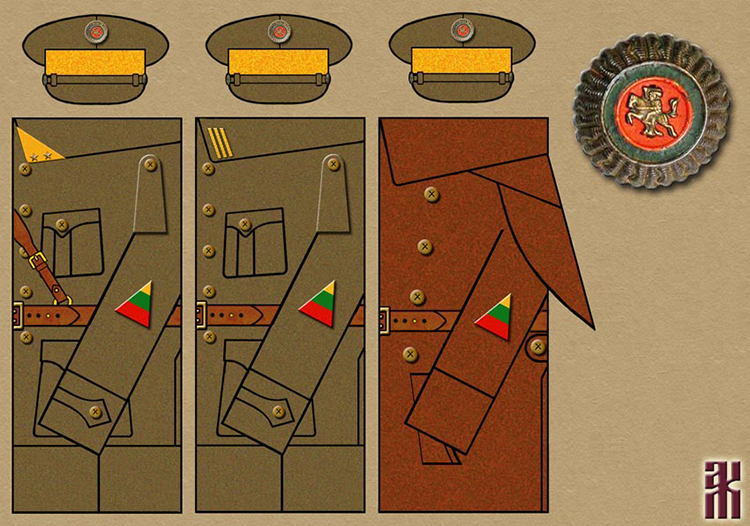
Initial uniforms of the Independent "Vytautas the Great" Lithuanian Battalion:
1 and 2 – uniforms supplied by the Poles; 3 – with American greatcoat; 4 – cockade
The battalion was formed and then supplied by the 1st Rifle Regiment of the 5th Polish Rifle Division in the summer of 1919. Initially it received the 1918-Model uniform, established for Polish units in the east of Russia in the autumn of 1918 (tunic, trousers and cap in dark olive colour). However the amaranth piping and stripes [of the Poles] were not worn by the battalion, and instead the cap had a yellow fabric hatband. An isosceles triangle in the Lithuanian national colours (yellow, green and red) was sewn onto the left sleeve.
The US Army had phased out its late 19th century greatcoat with hood by this time, but there is evidence that such overcoats were supplied to the 5th Polish Rifle Division. They were widely used but were not popular due to their insufficient warmth (and were sometimes even referred to as "brown raincoats").
The cockade has the Lithuanian state coat of arms (the Vytis or Pogon) in the centre.
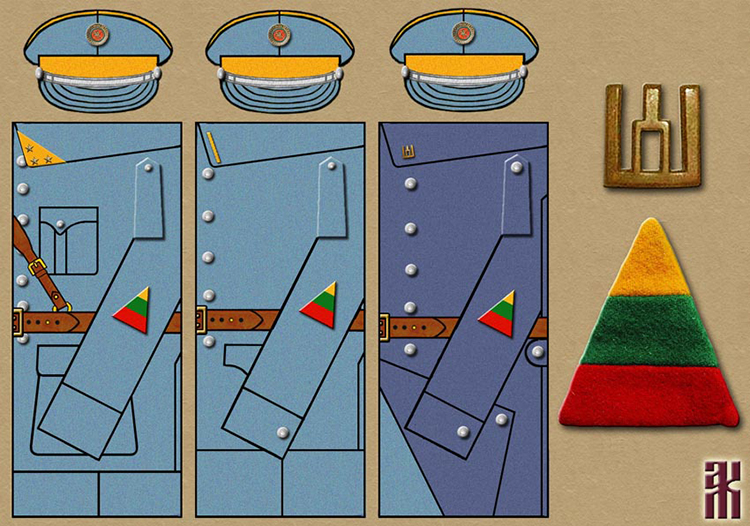
Final uniforms of the Independent "Vytautas the Great" Lithuanian Battalion:
1 to 3 – horizon-blue uniforms; 4 – collar badge; 5 – sleeve badge
After the 5th Polish Rifle Division was formally subordinated to the command of the Polish Army in France, it was gradually supplied with French horizon-blue uniforms. Such uniforms were also supplied to the Lithuanian Battalion, which retained its previous national insignia and rank markings on the new uniforms.
Badges like Figure 4 were sometimes worn on the collar by enlisted personnel. Figure 5 is the sleeve badge in the national colours of Lithuania (yellow, green and red).
Home — State Symbols — Flags — Uniforms — Badges & Medals — Money — Other
Pygmy Wars Notes:
The original for this page is at kolchakiya.ru/uniformology/Lithuanian_battalion.htm.
The badge worn by privates with the three prongs is called the "Columns of Gediminas" or variations on that, such as the "Pillars of the Gediminids". Vytautas the Great is often called Witold or Witowt, from the German version of his name.
The ranks and their translations have been left as in the original, but other sources differ on the Lithuanian names for the NCOs and their translations (e.g. Boltowsky, T. and Thomas, N. "Armies of the Baltic Independence Wars 1918-1920 // Elite No. 227, Oxford, 2019").
Discussion on the translation choices I have made can be found here.