
Uniforms of White Latvian Armed Forces in the East of Russia, 1918-1920
All material and reconstructions are by A. Karevskiy unless noted otherwise.
These reconstructions are based on several published photographs of Latvian military personnel in the east of Russia, as well as on contemporary drawings The following resources were used:
http://latvjustrelnieki.lv/ru/kuljtura--muzei-99947/latvijskij-voennyj-muzej-112169/latvijskie-voiny-na-grazhdanskoj-vojne-v-rossii-1918--1921-belye-359781
voencomuezd.livejournal.com/664765.html?thread=3420605
voencomuezd.dreamwidth.org/411491.html
vesture.eu/index.php/Troickas_bataljons
wap.siberia.forum24.ru/?1-5-0-00000004-000-20-0 [exact link dead]
history-lv.livejournal.com/15010.html
Troitsk Battalion (1st Latvian Liberation Battalion)
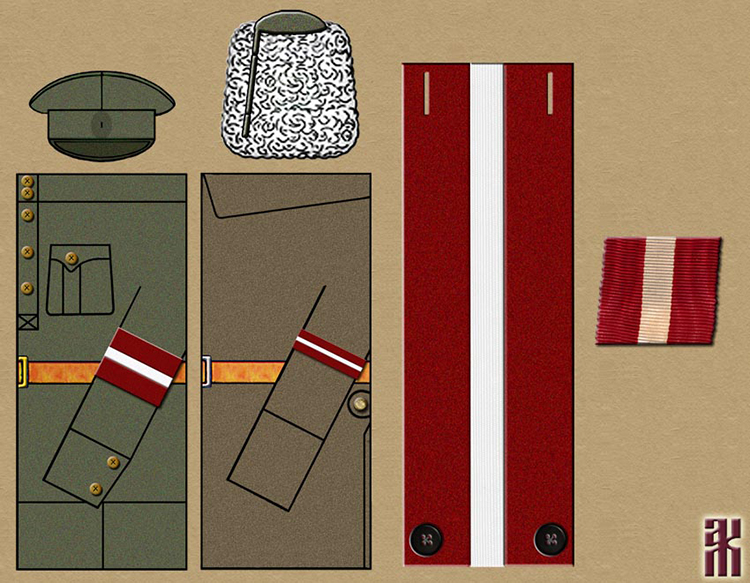
The initial version of the national insignia of the Troitsk Battalion
The first Latvian soldiers wore arm-bands or ribbon cockades in the Latvian national colours on their Russian uniforms. The Republic of Latvia was proclaimed on 18 November 1918, and its armed forces were established on 7 December.
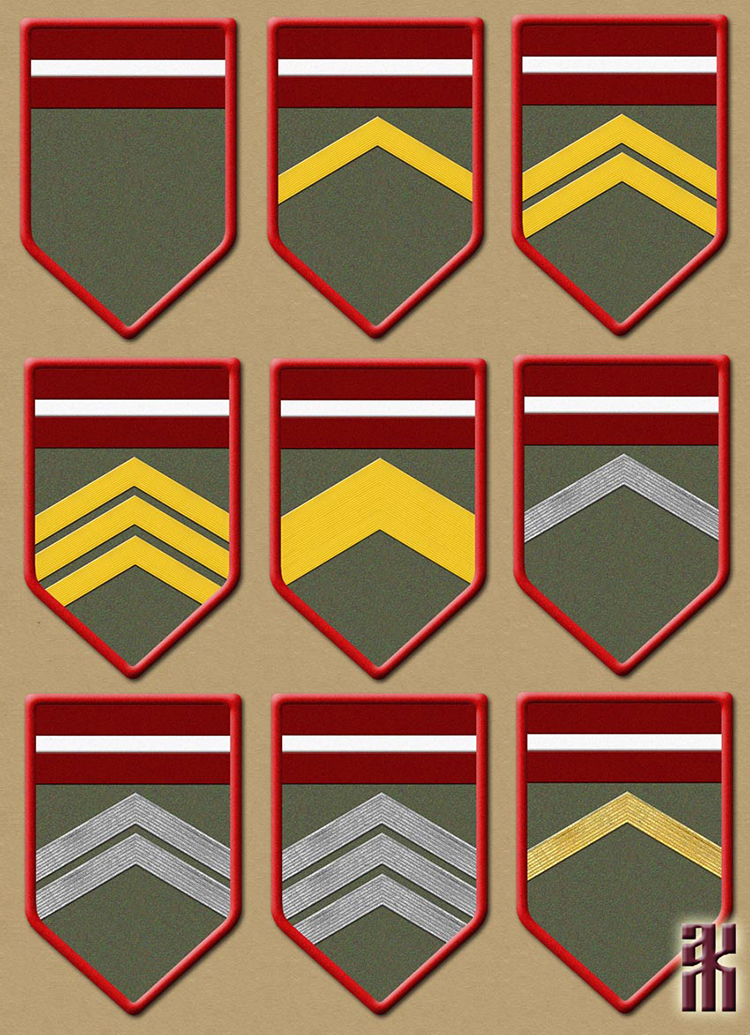
Rank markings adopted by the Troitsk Battalion in 1918-1920:
1 – private (kareivis); 2 – private first class (dižkareivis); 3 – corporal (kaprālis);
4 – sergeant (seržants); 5 – sergeant-major (virsseržants); 6 – second lieutenant (leitnants);
7 – lieutenant (virslietnants); 8 – captain (kapteinis); 9 – major (majors)
As the Troitsk Battalion was formed and supplied under the auspices of the Czechoslovak Corps, in November-December 1918 a system of insignia the same as the Czechoslovakian system was established. This was sleeve shields with red piping, on which military ranks were indicated by means of braid or ribbon chevrons. The difference was a strip of cloth in the colours of the national flag sewn across the top of the shield. The highest rank in the battalion was major.
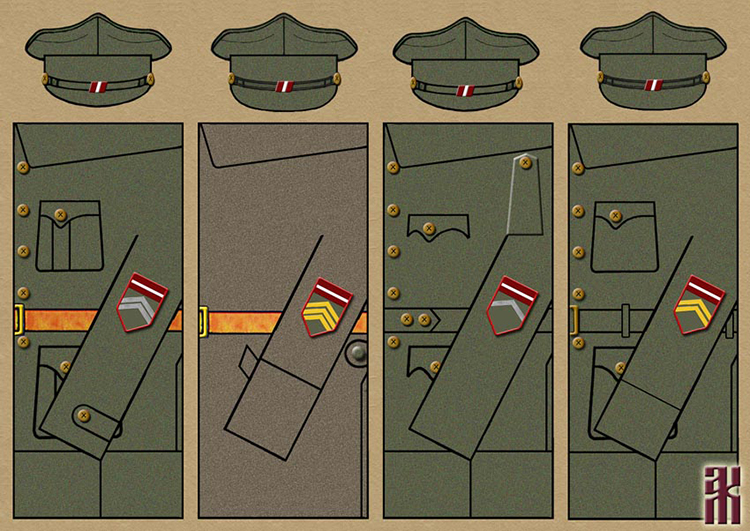
Uniform of the Troitsk Battalion in the period 1918-1920
The Czechoslovak influence was also noticeable in the uniforms throughout the period 1918-1920, which were dominated by tunics with patch breast and side pockets, as well as caps with fabric-covered visors and shaped crowns. The battalion wore ribbons in the colours of the national flag as cockades, wound around the centre of the chin strap.
In addition to the Czechoslovakian model, for a certain period of time the battalion also used long tunics with soft cloth belts held by specially sewn loops on the sides.
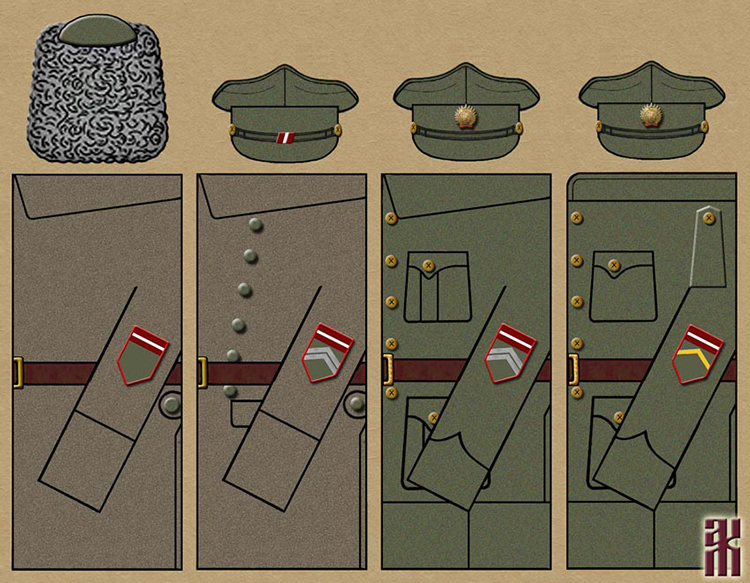
Uniforms of the Troitsk Battalion, 1918-1920
Judging by photographs, the battalion used Russian-style greatcoats – with either no buttons or with two rows of buttons covered with khaki fabric. A distinctive feature was the absence of buttonhole tabs on the collars. By the beginning of 1920 tunics of various cuts appeared, with cuffs cut in a "pointed" style.
Balay Station near Kansk, January 1920
The station was guarded by soldiers from the Latvian battalion that was leaving. Strong, well-fed men sat in the control room, dressed in uniforms we had never seen before.
Ivanov, V. in "In the Civil War (From the notes of an Omsk journalist)", Moscow, 2017, p.90.
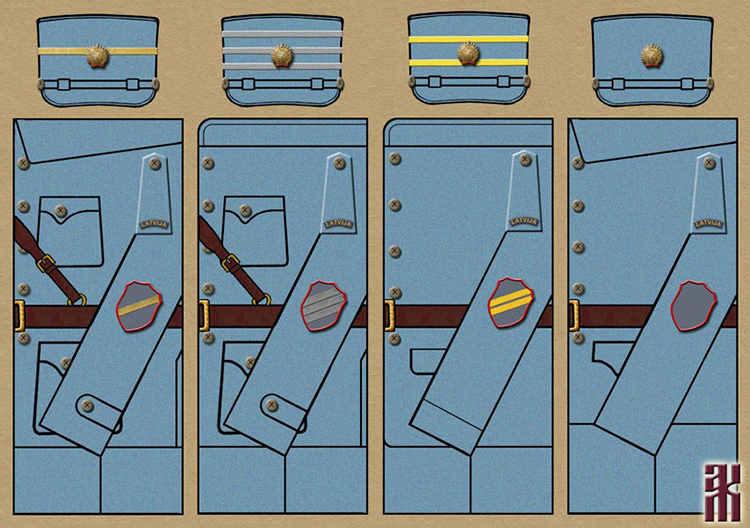
The final version of the uniforms of the Troitsk Battalion, from 1920
After evacuation to the Far East, from the summer of 1920 the battalion switched to wearing French uniforms in "horizon blue", with both officers and privates wearing tunics with either stand-up or turn down collars. The officers' tunics were distinguished by the presence of patch breast and side pockets, they were worn with a belt and French-style shoulder-straps, as well as breeches with high lace-up boots. The tunics of the other ranks had only side slit pockets with flaps. At the base of the soft sewn-in shoulder-straps were was the inscription "Latvija" (as with the Imanta Regiment). The insignia also changed to that used by the Imanta Regiment.
A cap of a special Latvian style (with a slightly widened crown towards the top and a wide flat visor covered in the same fabric) had braid sewn onto the crown (photographs show caps with one, two and three rows of braid, apparently duplicating the insignia on the sleeve patches). A specifically Latvian military cockade was introduced in February 1919, as used in the Imanta Regiment.
Imanta Regiment
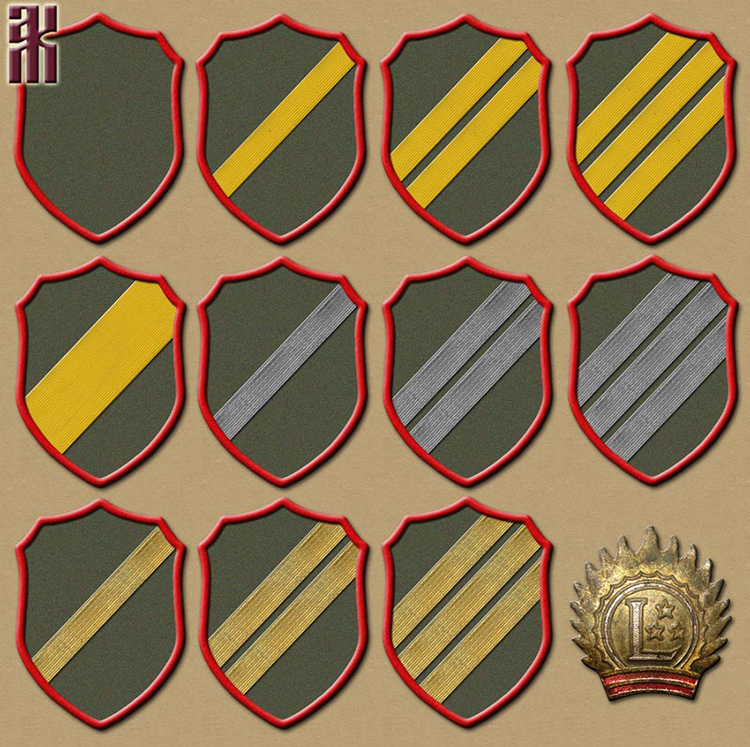
Rank markings of the Imanta Regiment:
1 – private; 2 – private 1st class; 3 – corporal; 4 – sergeant; 5 – sergeant-major;
6 – second-lieutenant; 7 – lieutenant; 8 – captain; 9 – major;
10 – lieutenant-colonel (pulkvezleitnants); 11 – colonel (pulkvedis); 12 – cockade
From the summer of 1920, this system was also introduced into the Troitsk Battalion.
The first Latvian military cockade was approved in February 1919. It had three stars with a large letter "L" on top of a rising sun, with a strip in the national colours along the bottom.
As of 1920, the highest military rank in the regiment was captain.
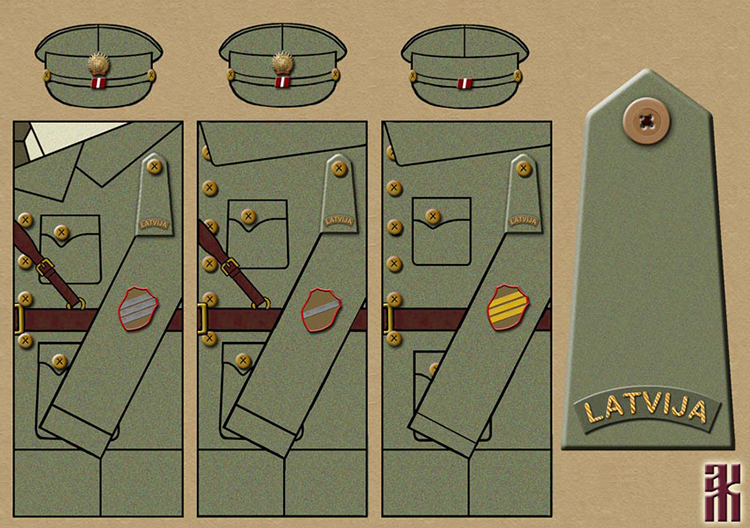
Uniforms of the Imanta Regiment, 1919-1920
Judging by photographs, the Imanta Regiment initially wore loose-fitting tunics, sewn open (British style) for some officers. At the very edge of the soft sewn-in shoulder-straps was the inscription "Latvija". The headgear was caps with a small soft crown and a fabric-covered visor. The Latvian military cockade, introduced in February 1919, was attached to band.
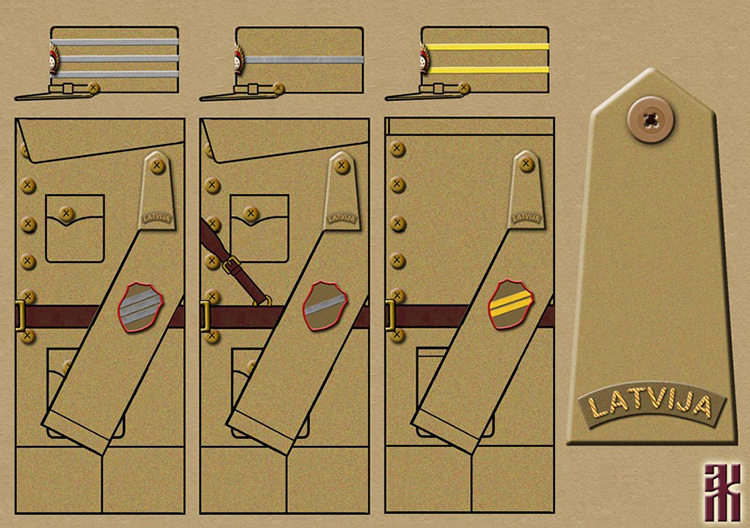
Uniforms of the Imanta Latvian Regiment in the 1920s
At the bottom of the soft sewn-in shoulder-boards on the tunics were stripes was the inscription "Latvija". A cap of a special Latvian style was used (with a slight widening of the crown towards the top and a wide flat visor covered with the same fabric) with a Latvian cockade. The crown had braid was sewn on (photographs show caps with one, two and three rows of braid, apparently duplicating the insignia on the sleeve patches).
From the summer of 1920, the personnel of the Imanta Regiment began to receive French colonial uniforms. A military contingent from French Indochina and China had arrived in Vladivostok in August 1918 wearing similar uniforms. In 1920 that uniform was also issued to the Latvian Regiment in the Far East. The uniform included a loose-fitting tunic with a low stand-up collar and wide sewn-in shoulder-straps, fastened with six large plastic buttons, two large hip pockets without flaps (there were no breast pockets), and straight trousers, also loose-fitting. Sometimes the trousers were replaced by dark khaki breeches. The tunic of sergeant-majors (also worn by regimental officers) differed in that it had a turn-down collar and breast pockets.
Kapustin, L. G. in "Uniforms and uniform differences of the Serbo-Yugoslav units in Eastern Russia, 1918-1920 // White Army, White Cause No. 24", Ekaterinburg, 2017, pp.74-75.
Latvian Contingent of the International Military Police in Vladivostok
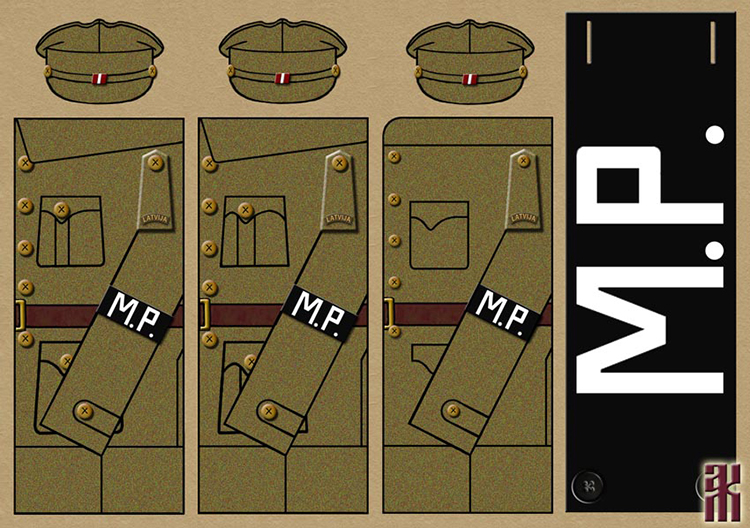
Uniforms of the Latvian contingent of the International Military Police in Vladivostok, 1920
In a group photo of the International Military Police forces in Vladivostok, the Latvian contingent is dressed in closed "French" tunics with stand-up collars and caps with soft small crowns and fabric-covered visors. The only national distinction is the ribbon of the national colours on the chin straps. A black arm-band with the abbreviation "M.P." served as a distinctive sign of belonging to the military police.
In the Army of the Republic of Latvia
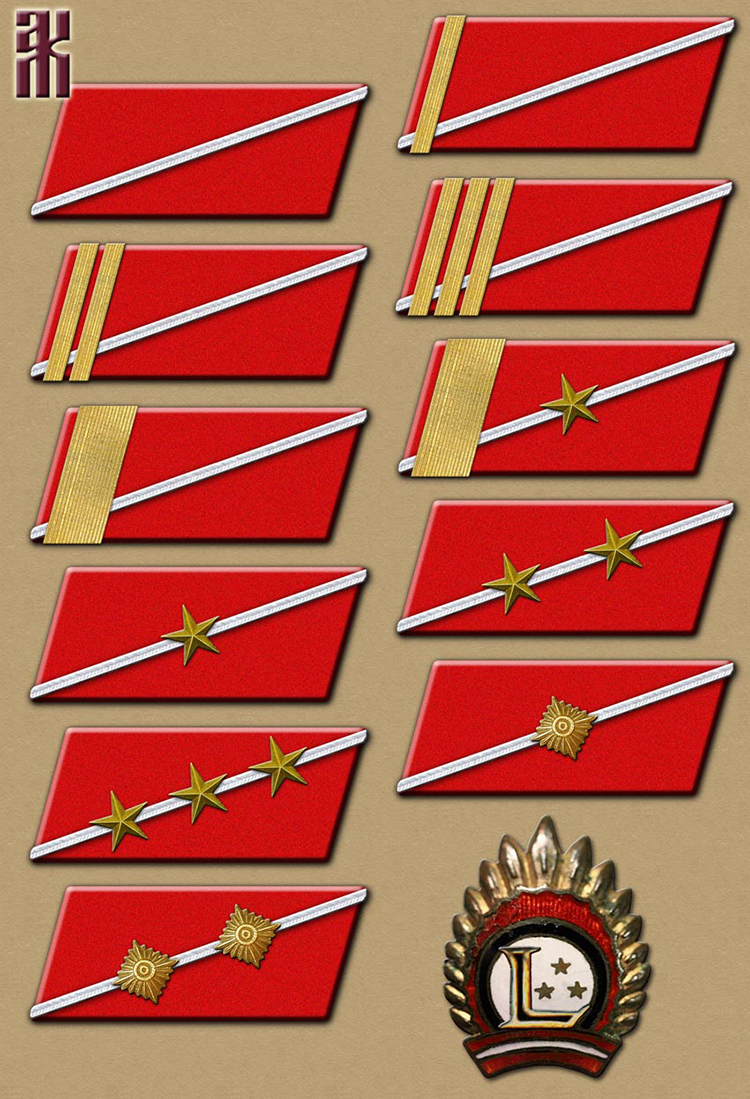
Rank markings of the army of the Republic of Latvia, introduced into the
Troitsk Battalion and Imanta Regiment after their return to their homeland:
1 – private; 2 – private first class; 3 – corporal; 4 – sergeant; 5 – sergeant-major;
6 – senior sergeant-major (virsniekvietnieks); 7 – second lieutenant; 8 – lieutenant;
9 – captain; 10 – lieutenant-colonel; 11 – colonel; 12 – general (generālis);
Latvian military cockade, second model, 1920
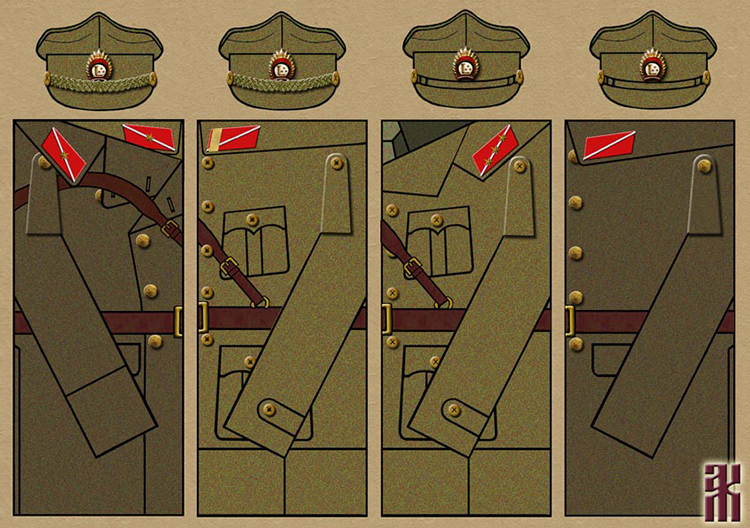
Uniforms of the army of the Republic of Latvia, introduced into the
Troitsk Battalion and Imanta Regiment after their return to their homeland:
1 and 2 – Troitsk Battalion; 3 and 4 – Imanta Regiment
The new uniform was developed on the basis of British uniforms and consisted of a British-style khaki tunic with a stand-up collar (officers sometimes wore an open collar with a shirt and tie), four patch pockets (with flap pockets and bow folds) and soft sewn-in shoulder-straps, and trousers in the same material. The cap was characteristic of the Latvian army, with a wide band and a low, small crown, a wide fabric-covered visor and a chin strap.
Home — State Symbols — Flags — Uniforms — Badges & Medals — Money — Other
Pygmy Wars Notes:
The original for this page is at kolchakiya.ru/uniformology/Latvian_regiments.htm.
The Russian text refers to the "1st Independent Troitsk Latvian Battalion" throughout, but the Latvians seem to have called it either the "Troitsk Battalion" or the "1st Latvian Liberation Battalion", not combining the two names.
The original page has some paragraphs on medals and badges, but I am not doing those at this time.
Discussion on the translation choices I have made can be found here.