
Official Uniform of the People's Army
of the Committee of Members of the Constituent Assembly (KOMUCH)
June-October 1918
All reconstructions are by A. Karevskiy unless noted otherwise.
Orders No. 1, 11 and 17 of the People's Army, 8 June 1918
On establishing the St. George cockade and St. George banners for the troops.
Ezeev, A. B. in "On the question of "admissibility", "legitimacy" and "authority" ... // Military Reality, No. 4", Moscow, 1993, p.15.
Provisional rules on the organisation and service of the People's Army, approved 17 June 1918
III. Distinctive sign of the People's Army. All those serving in the People's Army will wear a cockade made of St. George ribbon on their caps as a symbol of special courage.
RGVA. F.39551 Op.1 D.16 L.3.
Order No. 16 of the People's Army, 4 July 1918
To supply uniforms and footwear to the People's Army soldiers, commanding officers, and officials serving in the army, the following items are to be issued free of charge by the quartermaster's department for the following periods:
Seasonal clothing
| Quantity | For the period | |
| Summer uniform | 1 | 1 year |
| Blouse | 1 | 1 year |
| Summer trousers | 1 | 1 year |
| Autumn and Spring items | 1 | 2 years |
| Field cap | 1 | 1 year |
| Greatcoat | 1 | 1 year |
| Cloth blouse | 1 | 3 seasons |
| Cloth trousers | 1 | 3 seasons |
| Winter clothing | 1 | 3 seasons without coat |
| Papakha | 1 | 1 year with coat |
| Short sheepskin coat | ||
| Quilted jacket | ||
| Winter trousers |
RGVA F.39551 Op.1 D.16. L.17.
Order No. 20 of the People's Army, 25 July 1918
Appendix No. 1 – description.
§ 8. At the same time, rules on uniforms for all military units, headquarters and departments of the People's Army are announced.
§ 9. A uniform is a visible sign of a citizen's affiliation with a military unit, which also serves as a connecting link between military personnel, demonstrating their belonging to a common group, internal cohesion, and a high sense of duty and responsibility to the Motherland.
§ 10. Every soldier must firmly remember that his behaviour will be judged not only by the unit whose uniform he wears, but also by the entire People's Army, which is the bulwark of law and order in the Motherland.
§ 11. Persons who are not serving in the People's Army, as well as those serving in it on a voluntary basis and females, are not entitled to wear the prescribed uniform.
§ 12. Compliance with the established rules for wearing uniforms is mandatory for all military personnel. Mixing civilian and military uniforms is not permitted.
§ 13. All military personnel are permitted to wear all orders and medals received for combat distinctions.
§ 14. Outside the premises of military units, service and training, all military personnel are permitted to wear civilian clothing.
§ 15. In view of the established uniform for the People's Army, military personnel are strictly prohibited from wearing any insignia of the former military uniform, such as cockades, shoulder-boards, etc., except for those Cossack formations where this is permitted.
§ 16. Former military personnel who are not members of the People's Army are permitted to continue wearing their former uniforms, but without any insignia: cockades, shoulder-boards, weapons, or other military rank accessories. Those guilty of violating these rules shall be punished in accordance with military law.
§ 17. Those guilty of deviating from and failing to comply with the established rules for wearing uniforms, as well as those guilty of mixing them, shall be subject to strict liability, the degree of which shall be determined in accordance with rank and position. The garrison commander and the commandant shall be responsible for monitoring the wearing of the established uniform and order in each city and settlement.
RGVA F.39551 Op.1 D.16 L.29-29ob.
Order No. 34 on the formation of the People's Army in the Ufa Province, 2 August 1918.
Regarding economic matters.
I hereby announce, for information and guidance, a list of prices for items brought in by conscripts during mobilisation. This list has been drawn up by representatives of the War Office and public organisations, as well as the State Control Committee.
| New | Good for 3 months. | Good for 6 months | |
| Greatcoat | 28 r | 14 r | 17.50 r |
| Summer blouse | 7 r | 2.80 r | 4.20 r |
| Winter blouse | 18 r | 7.20 r | 10.80 r |
| Summer trousers | 5 r | 2 r | 3 r |
| Winter trousers | 13 r | 5.20 r | 7.80 r |
| Infantry boots | 49.25 r | 19.70 r | 28.35 r |
| Cavalry boots | 48 r | 19.20 r | 28.80 r |
| Low boots | 39.10 r | 15.64 r | 23.46 r |
| Field cap | 2.25 r | 0.50 r | 1 r |
| Papakha | 4 r | 4.50 r | 2.50 r |
| Ammunition pouch | 0.70 r | 0.30 r | 0.50 r |
| Duffle bag | 1 r | 0.40 r | 0.80 r |
| Belt | 1.5 r | 0.60 r | 0.80 r |
Order No. 92 for the Orenburg Military District, 6 August 1918
(From district headquarters)
§ 1. I hereby announce, for guidance and strict implementation, an excerpt from Order No. 20 of the People's Army of 25 July of this year.
§ 2. I forbid military personnel from wearing mixed clothing (military and civilian), especially clothing of a "fancy" nature.
RGVA F.39477 Op.1 D.1 L.80-81.
Order No. 94 for the Orenburg Military District, 8 August 1918
In addition to my order No. 92 of 6 August of this year, I hereby declare that the above order on the uniform of military personnel also applies to employees and students of educational institutions of the Military Department.
RGVA F.39477 Op.1 D.1 L.84.
Order No. 15 of the Military Department of the People's Army, 11 August 1918
Knights of St. George serving in units of the People's Army, in the uniform announced by Order No. 20 of the General Staff of the People's Army, shall be issued with a special distinguishing mark: a St. George ribbon to be sewn along the opening of the blouse.
Head of the Military Department, Maj-Gen. Galkin
RGVA F.39477 Op.1 D.1 L.164 ob.
Order No. 29 to the troops of the People's Army, 11 August 1918
§ 2. In addition to Appendix No. 1 to Order No. 20 of 25 July 1918, the field uniform for military personnel in transport and transit units and those serving in troop movements is hereby announced.
The uniform is in accordance with Appendix No. 1 to Order No. 20 of the People's Army dated 25 July 1918, but with the following differences in the sleeve insignia:
- for transport units – yellow,
- for transport battalions and transports – blue,
- for troop movement officers and railway commandants – blue, and the shield field – red.
Head of the Transport Department of the Main Administration
Chief of Military Communications of the People's Army
Colonel Arondt
RGVA F.39551 Op.1 D.16 L.45-45ob.
Order No. 25 to the People's Army Units in the Simbirsk Region, 18 August 1918
Appendix No. 1. Description of the uniforms of the People's Army.
The field uniform for units, headquarters, administrations and institutions of the People's Army is established as follows:
a) A khaki-coloured blouse with narrow shoulder-straps of the same colour (the shoulder-straps are 44 mm wide at the base/sleeve and 33 mm wide at the top), the same for all ranks and branches of the army, with plain metal numbers for the army units.
b) Trousers are khaki for infantry and engineering units, black or grey-blue for artillery and cavalry.
c) Head wear is a khaki-coloured field cap, temporarily, until the establishment of a cockade, with a St. George ribbon on the brim diagonally (from right to left).
d) Greatcoat is grey greatcoat broadcloth with narrow shoulder-straps of the same cloth and a plain metal unit number.
e) Belt is yellow leather with a white metal buckle.
f) Boots or low boots with puttees.
g) Spurs, for those who are required to be in formation on horseback.
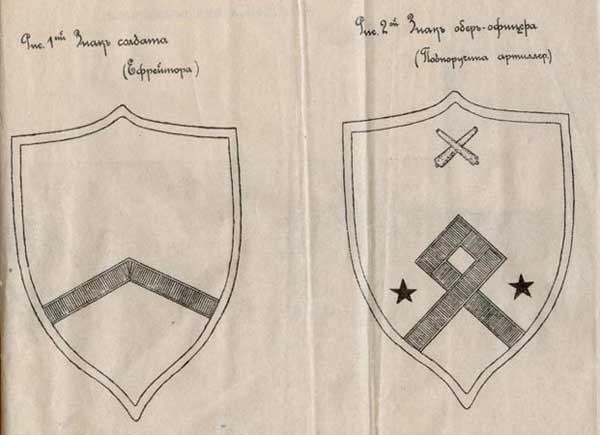
h) To distinguish military personnel by their rank, we establish a sleeve insignia on the left sleeve, the full-size drawings of which are attached. Lance-corporals,, corporals, sergeants, bombardiers, and armourers wear one, two or three chevrons of braid in the colour of their equipment on their sleeve insignia; sergeant-majors wear one wide stripe.
Sub-ensigns, in addition to the sergeant-major's stripe, have a vertical strip of braid from the inner corner of the chevron to the bottom point of the shield.
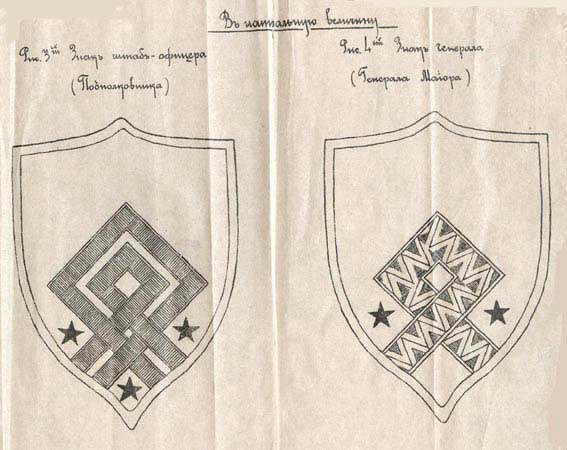
Officers have the same braid as the soldiers. Ensigns have one star above the braid; second-lieutenants have two stars, as shown on the drawing; lieutenants have three stars (two stars as shown on the drawing, one above the braid); staff-captains have four stars (two as shown on the drawing, one above the braid, one below); captains have no stars but below the braid is an additional chevron made of the same braid.
Staff officers: lieutenant-colonels have three stars according to the drawing; colonels have no stars.
Generals: major-generals have two stars as shown on the drawing; lieutenant-generals have three stars (two as shown on the drawing and one below the braid; full generals have no stars.
A distinction is made for the branch of service above the rank markings on the sleeve insignia:
Riflemen have two crossed rifles,
Artillery have two crossed cannons,
Engineers (aviation, motorised infantry) and all other special units have their [previously?] assigned external distinction.
The sleeve insignia is on a shield, the actual size of which is indicated on the attached drawing, with a border. The shield is in khaki.
The edge is piped red for all combat units except cavalry, who have orange piping.
For combat headquarters, at division or above, [the piping] is white; for other institutions and establishments of the Military Department and for non-combat komands and companies, it is black.
The uniforms for doctors and military officials will be announced separately.
Lanyards on sabres are leather for soldiers, braid with silver tips for officers and ensigns.
Aiguilettes are according to rank, for officers of the General Staff and topographers of the Staff.
RGVA F.39551 Op.1 D.16 L.111-111 ob.
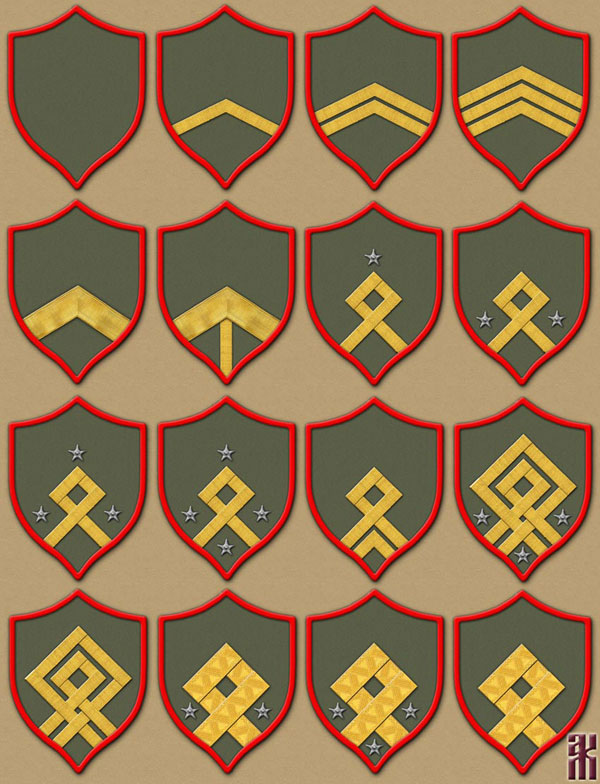
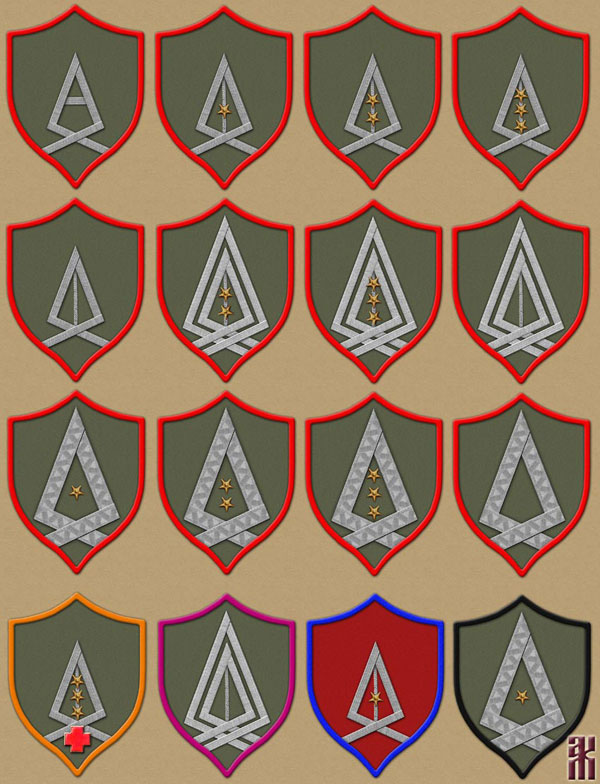
Sleeve insignia of the People's Army, base scheme:
1 – private; 2 – lance-corporal; 3 – corporal; 4 – sergeant;
5 – sergeant-major; 6 – sub-ensign; 7 – ensign; 8 – second-lieutenant;
9 – lieutenant; 10 – staff-captain; 11 – captain; 12 – lieutenant-colonel;
13 – colonel; 14 – major-general; 15 – lieutenant-general; 16 – general of infantry.
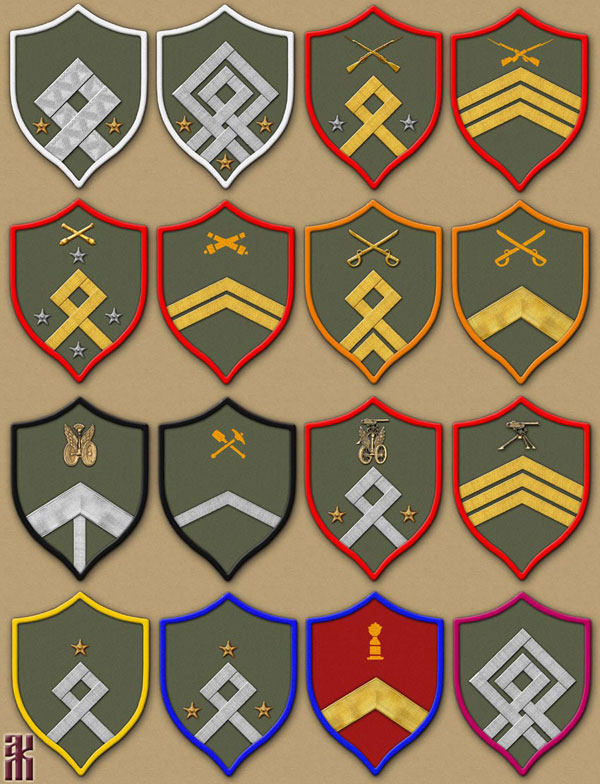
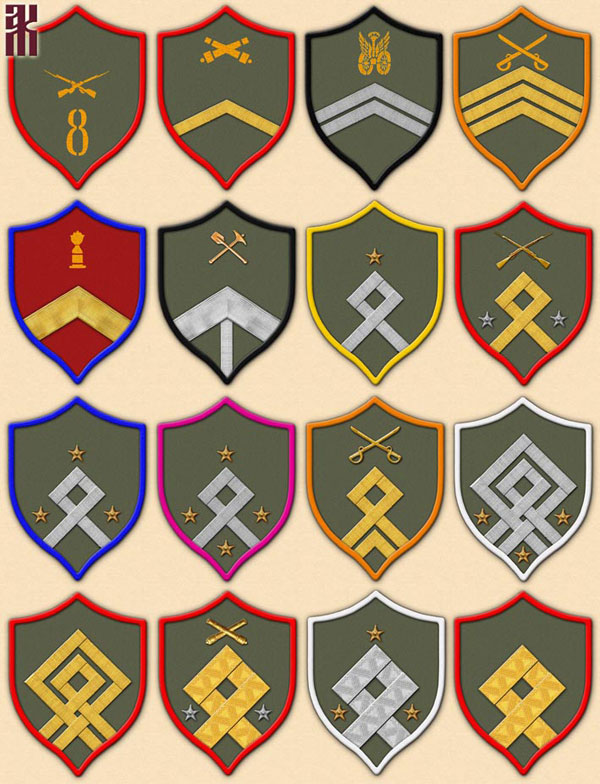
Sleeve insignia of the People's Army, with branch of service and rank:
1 – major-general (staff); 2 – lieutenant-colonel (staff); 3 – second-lieutenant (rifles);
4 – sergeant (rifles); 5 – staff-captain (artillery); 6 – corporal (artillery);
7 – captain (cavalry); 8 – sergeant-major (cavalry); 9 – sub-ensign (motorised units);
10 – lance-corporal (sappers); 11 – second lieutenant (armour);
12 – sergeant (machine gun komand); 13 – ensign (transport);
14 – lieutenant (transport); 15 – sergeant-major (artillery park);
16 – colonel (military courts).
Sleeve insignia of civil servants of the War Department and the People's Army:
1 – civil servant without rank; 2 – district secretary; 3 – province secretary;
4 – collegiate secretary; 5 – titular councillor; 6 – collegiate assessor; 7 – court councillor;
8 – collegiate councillor; 9 – civil councillor; 10 – active civil councillor; 11 – privy councillor;
12 – active privy councillor; 13 – collegiate secretary (cavalry, military doctor);
14 – collegiate councillor (military courts); 15 – district secretary (military transport);
16 – civil councillor (quartermaster services).
Insignia of the People's Army in accordance with the orders of 25 July and 11 August 1918:
1 – private (rifles, numbered version); 2 – lance-corporal (artillery); 3 – corporal (motorised);
4 – sergeant (cavalry); 5 – sergeant-major (artillery park); 6 – sub-ensign (sapper);
7 – ensign (transport); 8 – second lieutenant (rifles); 9 – lieutenant (transport);
10 – staff-captain (courts); 11 – captain (cavalry); 12 – lieutenant-colonel (HQ);
13 – colonel (rifles); 14 – major-general (artillery);
15 – lieutenant-general (HQ, General Staff); 16 – general of infantry.
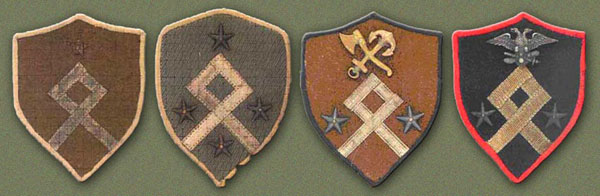
Authentic sleeve insignia of the People's Army
1 – ensign of army headquarters. Fabric, 90 by 70 mm;
2 – staff-captain of army headquarters. Fabric, 100 by 75 mm;
3 – second lieutenant of the Ufa Railway Battalion. Fabric, 95 by 70 mm;
4 – second lieutenant, pilot of the 1st Samara Air Squadron. Fabric, 95 by 70 mm.
Selivanov, M. in "Insignia and distinctions of the Civil War era" at http://www.mirnagrad.ru.
Order No. 27 to the People's Army units in the Simbirsk district, 20 August 1918.
§ 1. Unit commanders shall pay the utmost attention to ensuring that officers of regiments, batteries, cavalry and engineers – both those on leave and especially those on guard duty and dress duty to render honours – are always neatly and strictly dressed in uniform.
It is common to see military officers wearing caps of various shapes without St. George ribbons, in long civilian trousers or, even if in service trousers, without puttees. This is reminiscent of the Red Army and people dressed so carelessly do not inspire respect. There are many People's Army officers, especially commanders, in mixed uniforms (for example, a silk shirt, cap with St. George ribbon and spurs) which is also unacceptable. Anything that resembles the Red Army must be banished once and for all.
RGVA F.39551 Op.1 D.16 L.114.
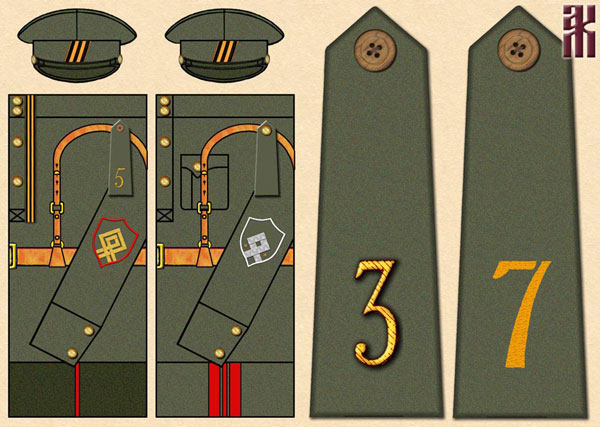
Uniforms of the People's Army
in accordance with Order No. 20 of 25 July 1918
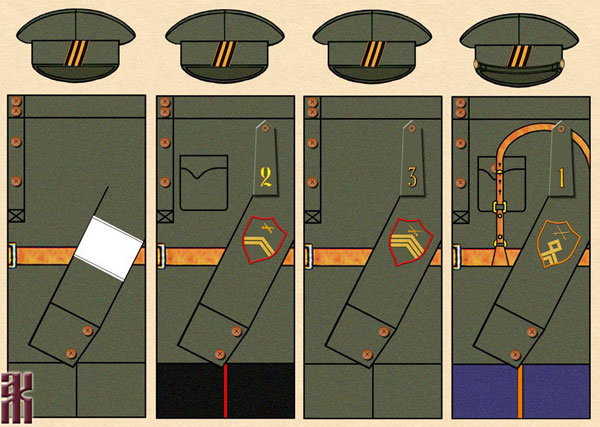
1 – volunteer (as per Order No. 17 of 8 June 1918); 2 – artillery corporal;
3 – infantry (rifles) sergeant; 4 – cavalry captain
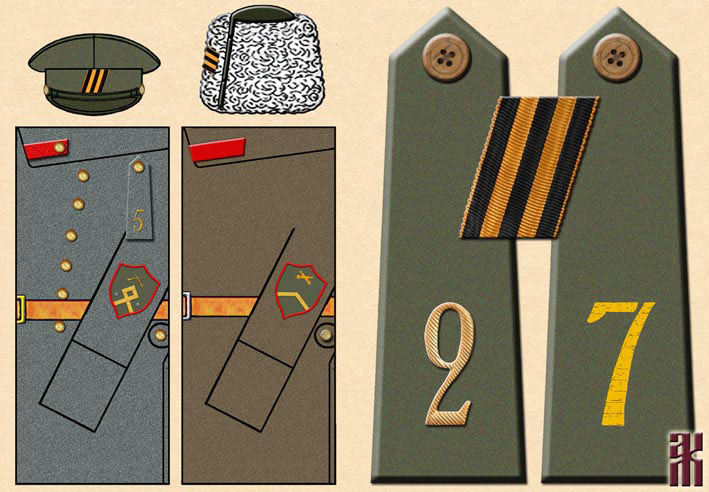
1 – a recipient of the Order of St. George (as per Order No. 15 of 11 August 1918):
2 – General Staff; 3 and 4 – shoulder-straps, with metal and stencil ciphers
1 – rifleman; 2 – artilleryman, 3 (above) – cockade,
4 (below) – shoulder-straps, with metal and stencil ciphers
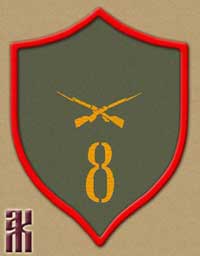
Sleeve insignia of a private in a rifle unit. Initially, before shoulder-straps were introduced, the unit number was placed on the sleeve insignia.
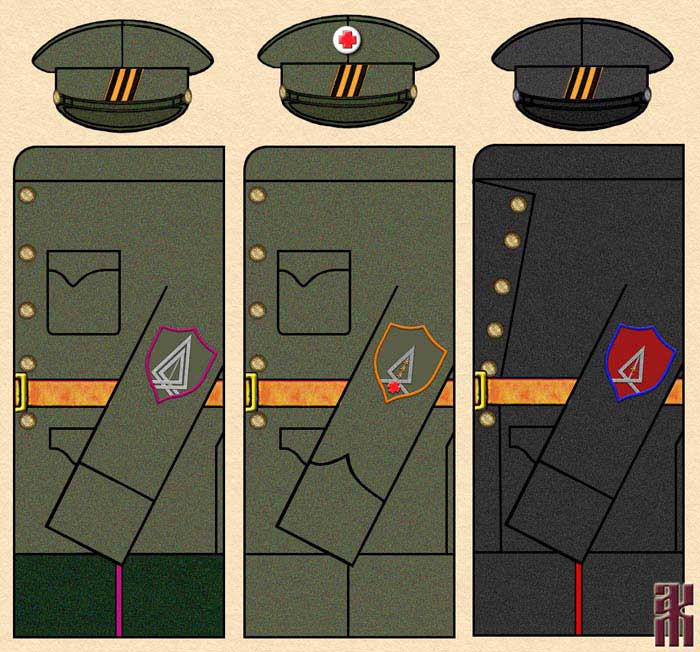
Uniforms of civilian officials of the War Department. 1 – military courts;
2 – military doctor (cavalry); 3 – military transport services.
Order No. 31 of the 2nd Rifle Division, 5 September 1918, Syzran
§5. In view of the fact that insignia indicating soldiers' ranks must now be placed on shields rather than on shoulder-straps, unit numbers on the latter must be stenciled in the middle of the shoulder-straps ensuring strict uniformity. On greatcoat shoulder-straps, the stencil must be placed so that the edges of the collar do not cover the number. Crossed swords or rifles should be stenciled as shown on the shield illustration; such insignia are not to be placed on the shoulder-straps. Buttons for the shoulder-straps may be obtained from the Quartermaster's Department upon request.
RGVA F. 39844 Op.1 D.1 L.21.
Order No. 26 for the 2nd Rifle Division, 28 August 1918
§2. Units of the division may obtain from the divisional quartermaster's office, for money, grey-blue cloth at 20 rubles per arshin [=71 cm], greatcoat cloth at 11 rubles per arshin, and cheviot at 16 rubles per arshin. Units should submit to the quartermaster's office a list of officers wishing to receive materials, indicating the number of arshins of each material. Materials will be issued only according to actual need, such as for trousers, greatcoats, and blouses.
RGVA F.39844 Op.1 D.1 L.9.
Aviation
Order No. 44 of the People's Army to the troops, 31 August 1918.
§ 4. The field uniform for military personnel in the aviation units of the People's Army is hereby announced.
Appendix to Order No. 44.
Description
of the uniform for military personnel in the aviation units of the People's Army.
The field uniform for the People's Army aviation units is established as follows:
a) A dark blue or khaki coloured blouse with narrow shoulder-straps of the same colour, with metal aviation unit numbers.
b) Black or khaki trousers with red piping.
c) Headgear – an aviator's cap.
d) A light grey cloth greatcoat, or, for those who are entitled to it, a black leather jacket with a turn-down velvet collar, red piping, narrow shoulder-straps of the same material, and a metal number of the aviation unit on the shoulder-straps.
e) Leather belt with metal buckle.
e) Boots or low boots with puttees.
f) Spurs, for those who are required to be in formation on horseback and staff officers, and
g) To distinguish military personnel by rank, sleeve insignia shall be placed on the left sleeve. The sleeve insignia shall consist of a shield with braid, piping, and star distinctions, in accordance with the description attached to Order No. 20 of the People's Army dated 25 July 1918.
The shield is the same colour as the blouse. The piping for aviation specialists is red, and for other military personnel it is black.
2) Distinctions are established according to speciality: a) For military pilots, above the braid distinctions on the sleeve shield there is a black eagle, b) For observer pilots, a gold eagle, c) For other military personnel, a gold propeller.
RGVA F.39551 Op.1 D.16 L.64-64 ob.
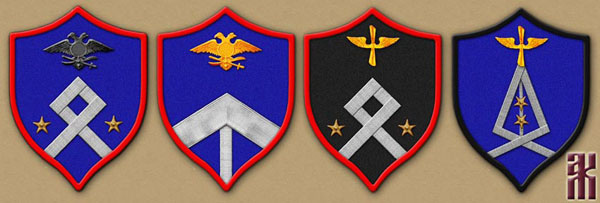
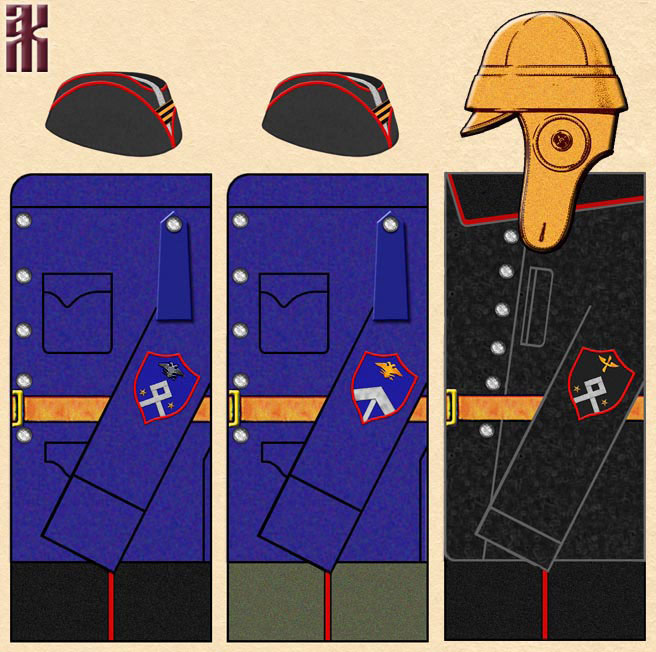
Uniforms of aviation troops of the People's Army
Home — State Symbols — Flags — Uniforms — Badges & Medals — Money — Other
Pygmy Wars Notes
The original for this page is at kolchakiya.ru/uniformology/komuch_orders.htm.
Discussion on the translation choices I have made can be found here.