
Actual Appearance of the People's Army in 1918
According to Memoirs and Historiography
The first days
At first the Socialist Revolutionaries really tried to create a democratic army. ... They redesigned the uniform and eliminated shoulder-boards. The symbol and emblem of the army was the St. George ribbon on the cap.
Spirin, L. M. in "Classes and Parties in the Civil War in Russia (1917-1920)", Moscow, 1968, p.258.
It was 1918 on the Volga, where revolutionary fervour was still far from over, and where a hastily written return to the old order could stir up talk and discord. ... One issue concerning shoulder-boards would play a major role, as it did, in my opinion, in the further struggle. "Shoulder-boards, gold shoulder-boards" was a powerful means of agitation for the Bolsheviks at the grassroots level.
Petrov, P. P. in "From the Volga to the Pacific Ocean in the ranks of the Whites (1918-1922)", Riga, 1930, pp.49-50.
In print, the Socialist Revolutionaries ... talked a lot about the democratic principles of building an army. ... even about the appearance of military personnel, which was to be simple, without much difference between the uniforms of soldiers and officers.
Garmiza, V. V. in "The collapse of the Socialist Revolutionary Governments", Moscow, 1970, p.33.
The St. George ribbon was adopted as the distinctive mark of the People's Army, as was specifically announced in the following flowery order: "A soldier who has voluntarily taken upon himself the obligation to defend freedom and the homeland from violence is the embodiment of the idea of selfless courage. Therefore, the Committee of Members of the Constituent Assembly resolves to establish a distinctive sign for the volunteers of the People's Army – the St. George ribbon worn diagonally."
Maisky, I. in "Democratic Counter-Revolution", Moscow-Petrograd, 1923, pp. 150-151.
... No one in the White Army on the Volga wore shoulder-boards at that time. The leaders of the Constituent Assembly Committee: Chernov, Volsky and Klimushkin, who were at the head of the government, were feared more than Lenin and his commander-in-chief Trotskiy.
Elenevsky, A. in "Summer on the Volga (1918) // 1918 in Eastern Russia", Moscow, 2003, p.149.
Samara, June 1918
I ran to the window and saw some men in helmets leading a worker ...
Gonya in "Constituentia: from the memoirs of a worker // Death Train", Kuibyshev, 1957, p.19.
16 June 1918
The first large detachment of Ural Cossacks, who continued to wear shoulder-boards, arrived in Samara, where KOMUCH organised an official welcome.
Popov, F. G. in "1918 in Samara Province: Chronicle of events", Kuibyshev, 1972, p.137.
On behalf of the government, the founders, through their official newspaper, recommended that citizens "not express dissatisfaction with the Cossacks wearing shoulder-boards".
Garmiza, V. V. in "The collapse of the Socialist Revolutionary Governments", Moscow, 1970, p.168, citing Samarskie Vedomosti [newspaper], 16 June 1918.
Syzran, 11 June 1918
From that day on, all the White Army units began to be called the People's Army. It should be added that at that time, army ranks did not yet wear shoulder-boards, but instead wore a white arm-band on their left sleeve as a distinguishing mark.
Fedorovich, A. A. in "General Kappel", Melbourne, 1967, p.25.
On that day Kappel' appeared before the public for the first time. ... Dressed in a khaki blouse and lancer breeches, wearing officer's cavalry boots ... without shoulder-boards and only with a white arm-band on his left sleeve.
Vorypaev, V. O. in "The Kappelevtsy // Vestnik Pervopokhodnika, No. 33", Los Angeles, 1964, p.34.
July 1918
The old military ranks and titles were restored and shoulder-boards reappeared on the shoulders of the officers, although here Galkin made a compromise, agreeing to limit it to inconspicuous soft shoulder-straps in khaki, with the differences in military ranks indicated on the sleeves.
Garmiza, V. V. in "The collapse of the Socialist Revolutionary Governments", Moscow, 1970, p.34.
The old ranks were restored, a disciplinary code was introduced. ... Galkin also badly wanted to adorn the officers with the old gold shoulder-boards, but he dared not do so for the time being and compromised: shoulder-straps were installed, but they were small and khaki. They were almost invisible, but Galkin was pleased that the Committee had recognised the very "principle of shoulder-boards" – the principle was naturally to be followed by braid and stars as well.
Maisky, I. in "Democratic Counter-Revolution", Moscow-Petrograd, 1923, p.155.
The Special Samara Brigade, Simbirsk, July 1918
People in soldiers' greatcoats marched along the main streets of the city, with white arm-bands and St. George ribbons instead of cockades. They carried rifles and knapsacks on their backs, dragging machine guns behind them. Their entire appearance spoke of deep tension and the discipline that prevailed among them.
Nikolaev, S. in "The People's Army in Simbirsk // The Will of Russia, No. 10-11", Prague, 1928, p.22.
V. O. Kappel'
Like all the officers in his unit, he looked almost the same as his soldiers.
Nikolaev, S. in "The People's Army in Simbirsk // The Will of Russia, No. 10-11", Prague, 1928, p.90.
On the outskirts of the city, we came across a truck driving towards us. When he saw us, he turned around, and the man sitting next to the driver shouted:
"Run for your lives, comrades, the Whites are coming!"
In an instant, he was dragged out of the truck:
"Ah, you're a Red? Against the wall!"
And the man was already in the hands of ten enraged workers. He was shouting something. I approached him:
"What's the matter? What Whites are you talking about? We're not Whites, we're the People's Army..."
The truth became clear immediately. The man and the driver had indeed been racing towards us and, seeing the diverse clothing of our chains [of riflemen], decided to deceive us with their cries of supposedly retreating Reds.
Lebedev, V. I. in "From Petrograd to Kazan // The Will of Russia, No. 8-9", Prague, 1928, pp.104-105.
The passengers in our carriage, soldiers of the People's Army and Czechoslovaks, exuded something completely new. Their appearance alone, after the disheveled, unkempt soldiers and "Red Army men" of the revolutionary and Bolshevik periods, seemed unusual. Cleanly dressed, fit, cheerful and friendly, they stood out favourably from the soldiers of the old regime and the praetorians of the new.
Lebedev, V. I. in "From Petrograd to Kazan // The Will of Russia, No. 8-9", Prague, 1928, p.94.
Bugulma, July 1918
Finally a detachment of Czechs appeared from the station and approached the city centre. The detachment marched in orderly fashion, singing songs, armed with rifles and hung with cartridges and grenades. St. George and white-red ribbons fluttered on their caps. Their faces were bold and tanned, all of them attractive with their healthy appearance.
Podolskiy, M. in "Days of the Czechs in Bugulma // The Struggle for Kazan. Collection of Materials on the Czech-Constituent Intervention in 1918", Kazan, 1924, p.202.
1st Independent Samara Artillery Division, Simbirsk area, July 1918
On the right side there were more and more soldiers wandering around the houses. This began to worry us greatly. "Isn't that a very large detachment?" At that moment, three peasants walking towards us, also in the middle of the road, caught up with us. One of them came up close to us, looked at us intently, and asked, "Guys, are you Whites?" We had St. George ribbons on our caps. "Yes, we are Whites," I replied. "So you know, everyone around here is a Red," he said, and all three of them went on their way without delay. Such pleasant news left me speechless, and I just looked around in confusion, while my companion gripped his rifle more tightly in his hands.
Elenevsky, A. in "Summer on the Volga (1918) // 1918 in Eastern Russia", Moscow, 2003, p.140.
Simbirsk, July 1918
Passing by the gate of the military supply depot, we noticed a group of people with white arm-bands ...
I had walked no more than 200 paces when I saw three people in school uniforms, with rifles in their hands and white arm-bands on their sleeves.
Gladkov, I. D. in "In White captivity // Simbirsk Province during the Civil War. Collection of memoirs", Ulyanovsk, 1958, pp.223-224.
Samara, August 1918
The city was unusually lively. It looked like a large military camp. Everywhere you looked, there were Czech legionnaires and volunteers of the People's Army, with St. George ribbons on the brims of their caps. There were no shoulder-boards any more, but the ranks remained.
Boldyrev, V. G. in "The Directory, Kolchak, the Interventionists: Memoirs", Novonikolaevsk, 1925, p.28.
Kazan, August 1918
By the evening of 6 August, the fate of Kazan had been decided. ... Battalions of the People's Army were entering the city from the Volga side. Almost simultaneously with the Committee's units, armed groups of young people with white arm-bands appeared on the streets of Kazan, rushing around the city in trucks, breaking into houses, arresting those suspected of Bolshevism.
Maisky, I. in "Democratic Counter-revolution", Moscow-Petrograd, 1923, p.24.
With what enthusiasm the entire population of Kazan greeted their liberators – their Czechoslovak and Serbian brothers and the detachment of the Russian People's Army, who arrived with white arm-bands on their sleeves.
Kotomkin, A. in "The Czechoslovak Legionnaires in Siberia. 1918-1920. Memoirs and documents", Antiquary, 1987, p.8.
After tidying ourselves up, we ... reported to Captain Stepanov, commander of the Northern Group of the People's Army. We did not receive our assignments immediately, but remained at headquarters. ... I spent the next day walking around shops to buy a uniform and necessary items.
Perkhurov, A.P. in "Confession of a Convict", Rybinsk, 1990, p.30.
The streets of Kazan were packed with people, the bells of all the churches announced our victory, we were showered with flowers, and you could clearly hear thousands of voices singing "Christ is risen!" I was also struck by the huge number of officers on the street, in uniforms, with medals.
Meybom, F. F. in "The Thorny Path // Pervopokhodnik, No. 24", Los Angeles, 1975, p.22.
Registration of officers
... we immediately went to the Military Academy. An officer on duty was standing at the entrance – a lieutenant with a white arm-band. He looked at us suspiciously: we looked terrible. We were dirty, unshaven, long-haired, dressed in semi-military clothing. We did not look like officers at all.
Meybom, F. F. in "The Thorny Path // Pervopokhodnik, No. 24", Los Angeles, 1975, p.22.
Ufa
The Ufa Menshevik newspaper Golos Rabochaya (Worker's Voice) wrote in its September article "The Truth About Kazan": "...The Czechoslovaks were hardly visible in the city: they were fighting, pursuing the Bolsheviks. Instead, there was a striking abundance of armed men with white arm-bands, dressed in military uniforms."
Lelevich, G. (Mogilevsky, L.) in "During the Days of the Samara Constituent Assembly", Moscow, 1921, p.19.
Kazan
In the minds of the workers, the memory of executions, arrests and other "delights" was still in their memories, in contrast with the unarmed couples walking around including discharged officers (wearing Tsarist medals, and some even had shoulder-boards).
Znamensky, N. in "The Days of the Czechs // The Struggle for Kazan. Collection of Materials on the Czech-Constituent Intervention in 1918", Kazan, 1924, p.148.
Kazan, August 1918
After capturing Kazan, KOMUCH representative Lebedev ordered the immediate removal of "white arm-bands as a sign of no relationship to the People's Army" and prohibited the use of the words "White Army" or "White Guard" in relation to the army of the Samara government.
from Litvin, A. L. in "The Peasantry of the Middle Volga Region during the Civil War", Kazan, 1972, p. 244, published in the Kazan Gazette on 24 August 1918.
Tatar rifle volunteer companies
I was called to the telephone. It was the quartermaster colonel, who informed me that the uniforms he had sent me belonged to the [163rd Infantry] Lenkoran-Nasheburg Regiment, but he "did not know how they had ended up with us!" I thanked him again and said that if it had been a uniform of His Majesty's Cuirassiers, I would still have put it on my Tatars ...
The officers were very busy. Everyone had to be put into uniform, but they accomplished their task with honour and fairly quickly. Then they led everyone out into the courtyard and lined them up. ... Seeing the Tatars lined up, I was amazed. Once in uniform they already looked like soldiers. The platoon officers walked through the ranks, adjusting their visor-less caps. ... My four NCOs were beyond praise. Three of them wore two stripes on their shoulder-boards, which meant a corporal, and one wore three stripes, which meant a sergeant.
We arrived at Colonel Nikolai Pavlovich Sakharov's command post. ... In the morning, he inspected our detachment and began to laugh.
"Captain, where did you get these uniforms and visor-less caps? Your soldiers look like regular peacetime infantrymen!"
Meybom F. F. in "The Thorny Path // Pervopokhodnik, No. 26", Los Angeles, 1975, pp.13-14.
Nikolaevsk area, August 1918
In the middle of the night, a column of peasant carts with armed men appeared. They all had white arm-bands on their sleeves. When they were stopped by Chapaev's sentries, it turned out that they were reinforcement officers on their way to the White "People's Army" HQ. Thus, 70 officers were captured and disarmed.
Khlibnikov, N. M., Evlampiev, P. S. and Volodikhin, Ya. A. in "The Legendary Chapaev", Moscow, 1968, p.48
Sviyazhsk, 6 August 1918
The entire male population of the city was ordered to appear in the square, where weapons were issued and white arm-bands were put on.
Puchkovsky and Tychkin, in "The Czech-SR Raid // The Struggle for Kazan: Collection of materials on the Czech-Constituent Intervention in 1918", Kazan, 1924, p.216.
1st Independent Samara Artillery Divizion, Khvalynsk, August 1918
The whole area where the cannons were firing was boiling with enemy shell explosions. My white cadet blouse, which I was wearing, completely changed colour, turning into a kind of yellow-brown.
As was customary for a more stylish look, I had spurs attached to my boots, which the regulations prohibited for artillery crews, but at that time everyone wore forbidden items. I was no worse than the others.
Elenevsky, A. in "Summer on the Volga (1918) // 1918 in Eastern Russia", Moscow, 2003, pp.152,153.
Tetyushi,10 August
The Whites marched in two tight rows, shoulder to shoulder, holding their rifles in their hands, with white arm-bands on their left sleeves. ... The Whites were close, their faces contorted with hatred and anger. The second row was sparse – many had been killed in action. They all had officer's shoulder-boards on, white arm-bands on their left sleeves, and cockades with a St. George ribbon diagonally across their caps.
From the lone individuals who were caught hiding in barns, we learned for certain that a St. George officer volunteer regiment was fighting against our detachment. The company commanders were colonels, and the rest served as privates. All were in officer's uniforms, some with medals on their chests.
Dolinsky, I. F. in "The Battle of Tetyushi // Simbirsk Province during the Civil War: a Collection of Memoirs", Ulyanovsk, 1958, pp.243,245.
Simbirsk, 12 August
My host reported that "White soldiers with St. George ribbons have just passed through the street and are now firing at the area near the church," where our Smolensk battery was stationed in the elm trees on an island between the rivers . ... It turned out that during the morning a St. George officer battalion had our-flanked us on the left.
Perkin, D. E. in "The Struggle for Simbirsk // Simbirsk Province during the Civil War: a Collection of Memoirs", Ulyanovsk, 1958, p.268.
Elabuga, August 1918
I had no uniform: no trousers, no boots, no blouse. We had no shoulder-boards, nothing, but then Czech "patches" appeared.
Molchanov, V. M. in "Interview recorded by B. Raymond (Bancroft Library, University of California, Berkeley, USA) in 1970 // Molchanov V. M.: The Last White General", Moscow, 2009, p.91.
Buzuluk, September 1918
I saw the first regiment of the People's Army in Buzuluk. Without shoulder-boards, with Czech-style shields on the sleeve, and for some reason with a St. George ribbon instead of a cockade on their caps. They half looked like comrades.
Sakharov, K. V. in "White Siberia (The Civil War of 1918-1920)", Munich, 1923, p.10.
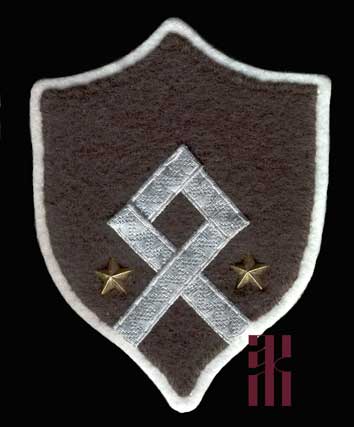
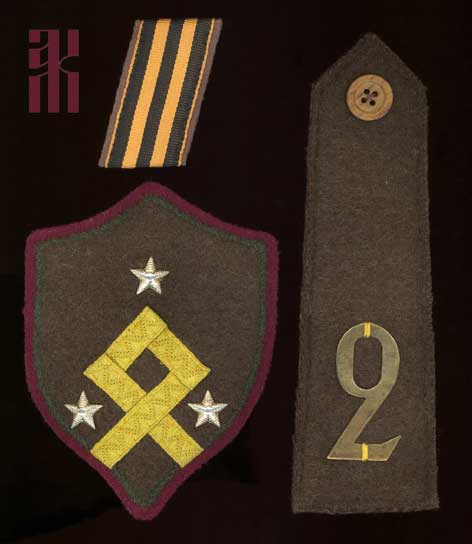
Reconstructions of KOMUCH People's Army Insignia:
1 – sleeve insignia of a second lieutenant of the Army Staff;
2 – shield, shoulder-strap and cockade for a lieutenant of the 2nd Samara Rifle Regiment
1st St. George Rifle Battalion, near Simbirsk, 14 September
As we approached, we noticed the silver shoulder-boards on the shoulders of one of the men ...
Lyudvik, Zh. In "The 3rd Moscow Regiment of the Iron Division // Simbirsk Province during the Civil War: a Collection of Memoirs", Ulyanovsk, 1958, p.293.
Syzran district, 19 September 1918
There were no guards either in the village on the Czech side, and it was only further on, about 25 kms beyond that village, that we came across two horsemen with white arm-bands, who belonged to the People's Army.
Lieutenant NN. in "Notes of a White Guard Soldier // Archive of the Russian Revolution, Vol. 10", Berlin, 1923, p.79.
Chelyabinsk, 16 October 1918
Most of the prisoners did not even have outer clothing. ... This was explained by the fact that a significant percentage of the prisoners were Red Army soldiers, who had taken from them anything that could be useful to the People's Army, and so they were brought to prison in their underwear. And since in those days almost all workers wore military clothing, they suffered the same fate.
Stefansky, E.S. in "On the Death Train // Death Train", Kuibyshev, 1957, p.38.
The prisoners watched two escort officers arguing. "I'm not some kind of scoundrel," shouted one, "I have shoulder-boards."
Zaltsman-Adelson, L. in "From Samara to Vladivostok // Death Train", Kuibyshev, 1957, p.96.
The People's Army units that entered Chistopol included a company of Serbs and Croats (there were no Czechs) under the command of Lieutenant Dibich, a battalion of St. George knights, a battery of three-inch guns (installed in the city centre near the town hall), a machine gun komand, and fifty cavalrymen. There were no insignia, only tricolour stripes on the sleeves. The officers searched for and sewed on shoulder-boards.
Published at metallgirl-rus.narod.ru/Chistopol.html
Simbirsk area, October 1918
It was at the end of 1918 near Simbirsk. At that time we had a habit that after fighting General Kappel's officer battalions, which were facing the 24th Iron Division under my command, we would collect officers' shoulder-boards and field caps with cockades. This time around my orderly, Comrade Titlev, collected several officers' caps and shoulder-boards and handed them to the driver, Shurka. Shurka hid them under the seat of the car.
Soon we ran into the Whites in Ivanovka. But on the outskirts of the village, right on the road that led to our rear, I saw Kappel's officers. We recognised them immediately – they were wearing officer's caps with cockades and white arm-bands on their left sleeves.
I stood up in the car and, frowning, shouted in a commanding voice:
"Gentlemen, we are on the same side. The artillery colonel is coming. Which battalion are you from, lads?"
Obviously my appearance – in an officer's cap and shoulder-boards – and bold tone stunned the Whites. One of the officers lowered his rifle and, saluting, replied:
"Samara Assault Battalion, Your Excellency."
Story by G.D. Gay in "Stages of the Long Road: Memories of the Civil War", Moscow, Voenizdat, 1962, pp.468-469.
Upon arriving in Biysk, I spent some time observing my surroundings and did not report to the garrison commander. I did not like the clearly Socialist spirit that prevailed in the White movement in Siberia at first: the officers had no shoulder-boards, and saluting was abolished. Only when all that was restored did I report to the commandant's office in early August 1918.
"War and Revolution: Memoirs of Colonel N. I. De-Lippe-Lipsk, 2nd Tsarskoye Selo Rifle Regiment // Memorable Days: From the Memoirs of a Guards Riflemen.", Tallinn, 1939, p.81.
Ufa, August 1918
The officers once again wore shoulder-boards and medals.
"Where there are no Bolsheviks // Northern Commune: Organ of the Central Executive Committee of the Union of Communes of the Northern Region and the Petrograd Soviet. No. 71", 4 August 1918.
In Samara I was struck above all by the abundance of officers walking the streets with shoulder-boards and spurs. They turned out to be adjutants to members of the Constituent Assembly. They could easily have formed a company. In addition, there were the famous "300 ensigns of Comrade Rogovskiy" – the Minister of Police of the Samara government, also known as the Fouché of the Russian Revolution. The purpose of these ensigns was to listen to the conversations of ordinary people in cafes and restaurants in order to identify those who were critical of the activities of the Constituent Assembly.
Litvin, A. L. (ed) in "Boris Savinkov in Lubyanka: Documents", Moscow, Rosspen, 2001, p.400.
Kazan, August 1918
The Commander-in-Chief of the Kazan Front, Comrade Vatsetis, held out until the last minute, confident that the city could be defended. He remained in the city with a small detachment of Latvian riflemen until the Czechoslovaks entered, and he had to fight his way out of the city. Incidentally, when the Latvian riflemen left the city they encountered a large group of armed people, among whom there were also many women with white arm-bands. The Latvians mistook them for Sisters and Brothers of Mercy, and so when asked who was coming, our detachment replied, "Our side." In the following minutes, it became clear that this was a White Guard detachment.
"What is happening at the front (conversation with Comrade Mekhonoshin) // Northern Commune: Organ of the Central Executive Committee of the Union of Communes of the Northern Region and the Petrograd Soviet, No. 94", 2 September 1918.
At the same time, we are informed that the Czechoslovaks have no strength in the city, that the recruitment of the "People's Army" is going slowly, and that the our grenade raids on the Kremlin are causing panic and forcing the "volunteers" of the "People's Army" to hastily throw off their white arm-bands.
"Political Commissar of the 5th Army, S. Gusev: Battles near Kazan // Northern Commune: Organ of the Central Executive Committee of the Union of Communes of the Northern Region and the Petrograd Soviet. No. 94", 2 September 1918.
General Staff Academy, August 1918
The headquarters of the People's Army Academy was also given the name "All-Russian," with the Russian national flag on velvet serving as a sleeve distinction.
During this period, officers did not wear shoulder-boards and, as in the Czech units, ranks were distinguished by sleeve insignia.
Ryabikov, P. F. in "In the Military Academy" quoted by Ganin, A. V. "The Fall of the Nikolaev Military Academy: 1914-1922", Moscow, 2014, p.755.
Battles near Samara
Fearing that the Czechoslovaks would do this themselves, the Samara Soviet of Workers' Deputies sent delegates to them, led by Comrade Trainin. The first person who met him in Ivashchenkovo was the well-known Right Socialist Revolutionary Petrov, who rudely asked what the delegates wanted. Comrade Trainin stated that he wished to speak with a representative of the Czechoslovaks, and Petrov undertook to take him to the Czechoslovak commandant of the city. On the way, Comrade Trainin saw the following scene: all the residents wore arm-bands with the inscription "Long live the Constituent Assembly," and Russian officers walked around in their uniforms.
... On the morning of 7 June, Samara fell as soon as the first detachment of Czechoslovaks appeared on the bridge – within half an hour the city was occupied by White Guards who appeared from various houses. The first to be arrested was the commander of the Samara Front, the Left Socialist Revolutionary Comrade Rybin, who was immediately shot by the White Guards. Groups of 40-50 people in grey greatcoats walked the streets, so at first it was difficult to tell whether they were friends or foes.
"Petrograd Pravda, No. 127", 18 June 1918. Material kindly provided by Voronezh researcher N. Zayats.
Battles near Kazan, 1918.
"Do they show off their shoulder-boards?"
"Of course. They surround themselves with comfort. Shoulder-boards, cockades, brand new greatcoats made of black cloth. Each of them who falls into our captivity has pockets full of silver and gold. And they don't go without their wives. At Krasnaya Gorka, their wives came with the officers.
"Usman Gazette, No. 112", 4 September (22 August 1918). Material kindly provided by Voronezh researcher N. Zayats.
"Morning of Siberia" reports that recently officers in uniform have begun to appear in public places in Chelyabinsk. How beneficial the power of the "Constituent" is for officers' uniforms!
"Usman Gazette, No. 93", 10 August (28 July) 1918. Material kindly provided by Voronezh researcher N. Zayats.
Ivaschenkovo, summer 1918
Around noon, we reached the station at Ivaschenkovo, which had already been abandoned by Soviet troops. A crowd of armed locals was guarding the station. Many wore red ribbons with slogans of the Constituent Assembly in their buttonholes, and it was immediately apparent that these were not simply residents guarding the factory and station, as they called themselves, but enemies of Soviet power.
Traikin, I. in "The June Coup // Krasnaya Byl: Collection of the Samara Provincial Bureau of the Istpart, October, No. 3", Samara, 1923, p.9.
Home — State Symbols — Flags — Uniforms — Badges & Medals — Money — Other
Pygmy Wars Notes
The original for this page is at kolchakiya.ru/uniformology/komuch_memoirs.htm.
Discussion on the translation choices I have made can be found here.
The following illustrations by A. Lebedeva were in an early version of this page.
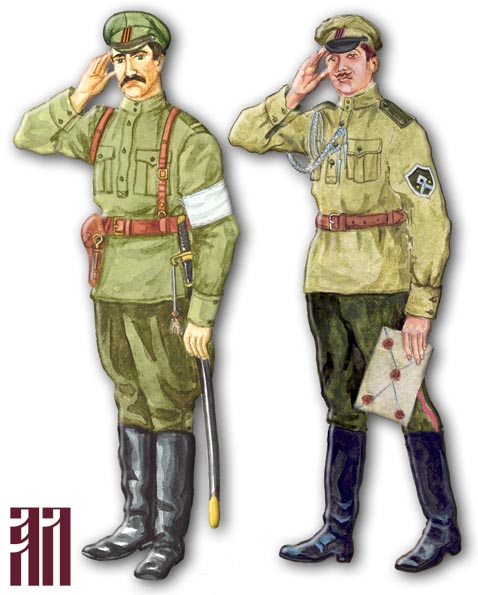
1 – officer of Kappel's Special Samara Rifle Brigade,
2 – officer of the Main Directorate of the General Staff of the People's Army
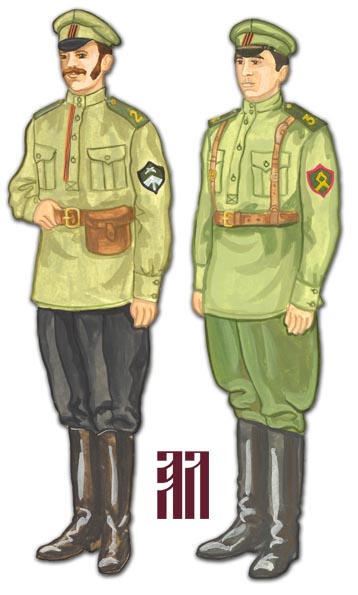
1 – sub-ensign and St George knight of the 2nd Syzran Artillery Brigade;
2 – second lieutenant of the 3rd Samara Rifle Regiment