
Uniforms of Independent Ussuri Units under Ataman Kalmykov
(Special Ussuri Cossack Detachment,
Independent "Ataman Kalmykov" Ussuri Brigade,
Independent "Ataman Kalmykov" Ussuri Division)
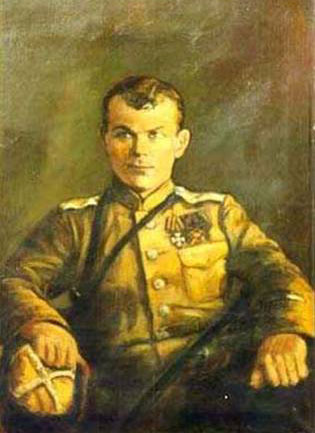
Ataman I. P. Kalmykov as a major-general of the Ussuri Cossack Host, by an unknown artist.
Taken from: www.fegi.ru/primopye/kazaki/hist8.htm [link dead]
The following material kindly provided by V. V. Romanov of Moscow. As the documents have not yet been entered into scientific circulation, at his request we are not posting any archival references.
All reconstructions are by A Karevskiy.
Order No. 1 to the Special Cossack Detachment, 1 January 1919, Khabarovsk
Ensign Leshchinskiy, duty officer at headquarters.
§6. The uniform of my detachment has a sleeve badge, but I note that not all officers consider it necessary to comply with the established uniform. I order all ranks of the detachment to strictly adhere to the uniform. Officers who are cannot wear the detachment insignia are requested to leave the detachment. Unit commanders are to immediately ensure that all Cossacks have uniform sleeve insignia.
§7. From this day forward, I categorically forbid members of the detachment from following fashion trends by wearing "French"coats, double or triple collars, etc. It is time to revive pride in the uniform of the Russian Army and put an end to debauchery. I order strict adherence to the Russian Army uniform:
1. The field uniform greatcoat, without any distortions in the form of flaps, shiny buttons on the back, and
2. The blouse.
Signed: Ataman Kalmykov
Order No. 3 to the Special Cossack Detachment, 3 January 1919, Khabarovsk
Duty officer at the Detachment Headquarters, Lieutenant Sidorov.
Regarding the unit.
§2. I consider the sleeve marking established in the Russian Army for wounds to be a source of pride for military officers and Cossacks, as visible proof of the honest fulfillment of a soldier's duty. However, many officers of the Detachment who have been wounded (that I know of) in battle, for some reason, do not consider it necessary (obviously out of false modesty) to observe the uniform. I order all officers of the Detachment who are entitled to the established insignia for wounds to sew them on immediately.
Signed: Ataman Kalmykov
Order No. 1 to the Special Ussuri Detachment, 25 March 1919, en route (Harbin)
§3. Due to the division of the Cossacks into independent units and the formation of the Special Ussuri Detachment from volunteers, I am establishing a special uniform for the officers of the detachment, the description of which will be announced separately based on the arm of service.
§4. The honour of wearing the Detachment insignia on the sleeve belongs only to the officers of the Special Ussuri Detachment – as volunteers who have devoted themselves of their own free will to the difficult and great cause – the cause of active struggle for the revival of Russia.
§6. On the basis of Paragraph 5 of this order, I order the officers of the Ussuri Cossack Regiment and the Independent Ussuri Cossack Sotnia to immediately remove the detachment badge.
Signed: Ataman Kalmykov
A Cossack of Kalmykov's detachment, Omsk prison, Autumn 1918
Once a cheeky, red-cheeked Cossack of about twenty-seven was brought to our cell. He was wearing a black sheepskin coat, black trousers with orange stripes, a military cap with an orange band, and a grey woollen blouse without shoulder-boards. A tuft of fluffy ash-coloured fringe stuck out from under his cap.
Berezovsky, F. in "In Captivity // Siberian Lights, No. 4", 1935, p.16
Instead of opening fire and stunning the enemy, Lebedev hesitated, watching the approaching unit. He was confused by the appearance of the White Guards, who were dressed in Japanese short coats and grey goatskin hats and resembled our soldiers. Moreover, they were infantrymen, and Lebedev had expected to encounter cavalry, since he had heard at the front headquarters that only White cavalry units were moving along the Ussuri River. All this made him wonder whether this was one of our units.
"Which unit are you from?" he asked the commander, whose officer's shoulder-boards he could not see under his sheepskin coat.
Instead of answering, the officer quickly drew his revolver and shot Lebedev dead.
www.biografia.ru/about/pohod17.html
Feeling neither restraint nor fear, the Ataman officers continued their atrocities. They differed from other officers in the insignia on their sleeves: the letters "А.С." or "А.К." were stamped in black paint on a yellow cloth shield. Chita, Khabarovsk and the Trans-Baikal Railway continued to remain under their arbitrary rule.
Andrushkevich, N. A. "The Last Russia // The White Cause: Chronicle of the White Struggle, Vol. 4", Berlin, 1928, p.130.
Vladivostok, 1 February 1919
Individuals with skulls painted on the front and back of their heads [sic] appeared in the city. A punitive detachment, obviously Kalmykovtsy, arrived and stopped at Pervaya Rechka (a suburb of Vladivostok). The carriages carrying the punitive forces bore large inscriptions: "God and the Ataman are with us".
Yaremenko, A. in "Diary of a Communist // Taiga Expeditions", Khabarovsk, 1972, p.61.
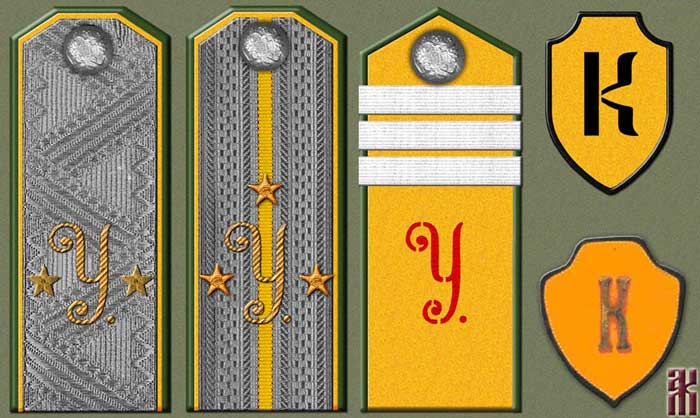
Insignia of the Ussuri (1st Ussuri) Cossack Regiment:
1 – shoulder-boards of Major-General Ataman I. P. Kalmykov;
2 and 3 – lieutenant-colonel and sergeant of the regiment;
4 – sleeve insignia of the Special Ussuri Cossack Detachment, based on a photograph:
5 – authentic insignia with an applied metal letter "К"
The photo in Figure 5 is taken from the Selivanov article. The same shield was used as a tactical marking for the Kalmykovets armoured train.
Selivanov, M. in "Distinguishing Marks and Insignia of the Civil War Era in Russia", at www.mirnagrad.ru [link dead]
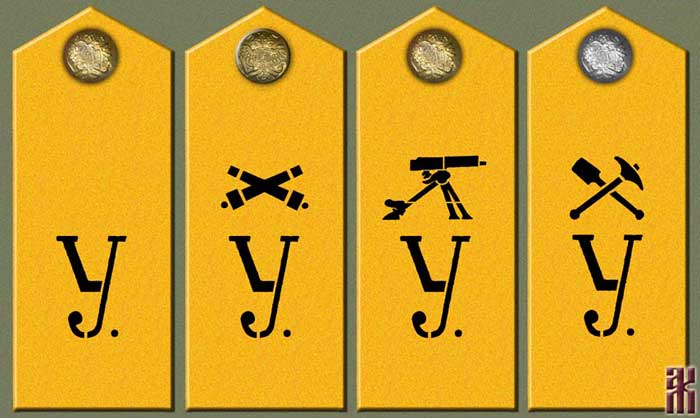
Shoulder-boards of privates of: 1 – the Independent Ussuri Horse Sotnia;
2 – the Ussuri Horse Artillery Divizion; 3 – the Machine Gun Company;
4 – the Engineer and Technical Company
The reconstruction of the shoulder-boards is based on the quartermaster's report for Kalmykov's unit, according to which "orange" cloth was purchased for the finishing of uniforms and the manufacture of insignia.
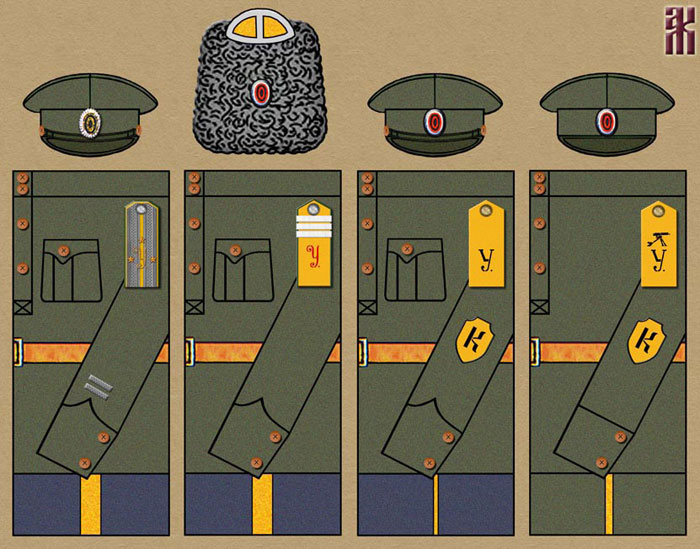
Uniforms of Ussuri Cossacks:
1 – staff-captain with sleeve markings for wounds, 2 – sergeant;
3 – cossack of the Independent Ussuri Cavalry Sotnia ;
4 – private of the Machine Gun komand
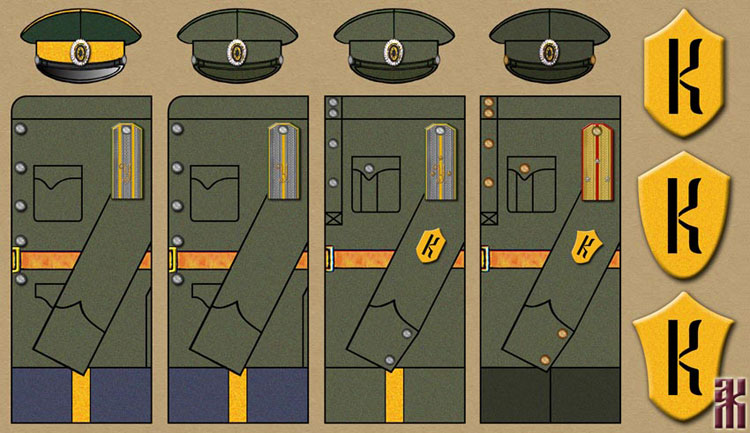
Uniforms of units under the command of Ataman Kalmykov
The reconstructions are based on a photograph in the "White Russia" photo album. The photograph clearly shows several varieties of sleeve insignia, indicating that the soldiers belonged to the ranks of the Special Cossack Detachment.
White Russia: Photo Album", Moscow, 2003.
Home — State Symbols — Flags — Uniforms — Badges & Medals — Money — Other
Pygmy Wars Notes
The original for this page is at kolchakiya.ru/uniformology/Kalmikov_units.htm.
Discussion on the translation choices I have made can be found here.
History of the Independent Ussuri Division of Ataman Kalmykov
Taken from Volkov:
Ataman Kalmykov of the Ussuri host formed a detachment, originally some 500 men, in March-April 1918 within the Chinese Eastern Railway's exclusion zone. It was one of the main anti-Bolshevik forces in the Primor'e. From 28 May it operated with the Orlov Detachment, around Grodekov. Between June and August it cleared the territory along the rail line from Nikolsk-Ussuriysk to Khabarovsk of Bolsheviks. By mid-July it numbered around 1,200 men and sabres. Following the overthrow of Bolshevik rule, it was based in Khabarovsk.
In March 1919, following a mobilisation of the Ussuri Cossacks, it was expanded to the Special Ussuri Ataman Kalmykov Detachment. In August 1919 it was merged into the Separate Ussuri Ataman Kalmykov Brigade, made up of the Ussuri Cossack Regiment, the Independent Ussuri Horse, a Volunteer Horse Detachment(Khabarovsk Volunteer Detachment), some infantry, some Native Cavalry sotnias, an engineer company, a horse-artillery divizion and an armoured train. On 1 January 1920 the brigade was expanded into Ataman Kalmykov's Independent Composite Ussuri Division.
In February 1920, under difficult conditions, it withdrew to Manchuria, where it was disarmed.
The Ussuri Cossack Host forces were very poor and never made it to the front lines fighting the Red Army proper, concerned only with suppressing local partisans. A bit more context can be found here.