
Uniforms of the Japanese Expeditionary Forces in the East of Russia, April 1918-October 1922
All material and reconstructions are by A. Karevskiy unless noted otherwise.
The following sources were used in the reconstruction of the Imperial Japanese Army uniforms:
North, D. "Soldiers of the First World War, 1914-1918: Uniforms, Insignia, Equipment and Weapons" Moscow, 2015, pp.186-187.
Funken, F. and Funken, L. The First World War 1914-1918. Part 1. Infantry – Armoured Vehicles – Aviation. Moscow, 2002.
Jowett, P. "The Japanese Army 1931-45 (1), 1931-42 // Men-at-Arms No. 362", Oxford, 2002.
"Uniforms of the Imperial Japanese Army" at zoldatik.mybb.ru/viewtopic.php?id=490 [link dead]
Deryabin, A. I. "Civil War in Russia 1917-1922: Interventionist Forces", Moscow, 1999, pp.43-45.
The Japanese expeditionary forces in the Far East and Transbaikalia included the 5th, 7th, 12th and 14th Infantry Divisions. The 12th landed earlier than the others, in April 1918.
The division was the highest tactical unit of the Imperial Japanese Army. Each included four infantry regiments (in two brigades), a cavalry regiment (of three squadrons), a field artillery regiment (of six batteries), an engineer battalion and transport battalion.
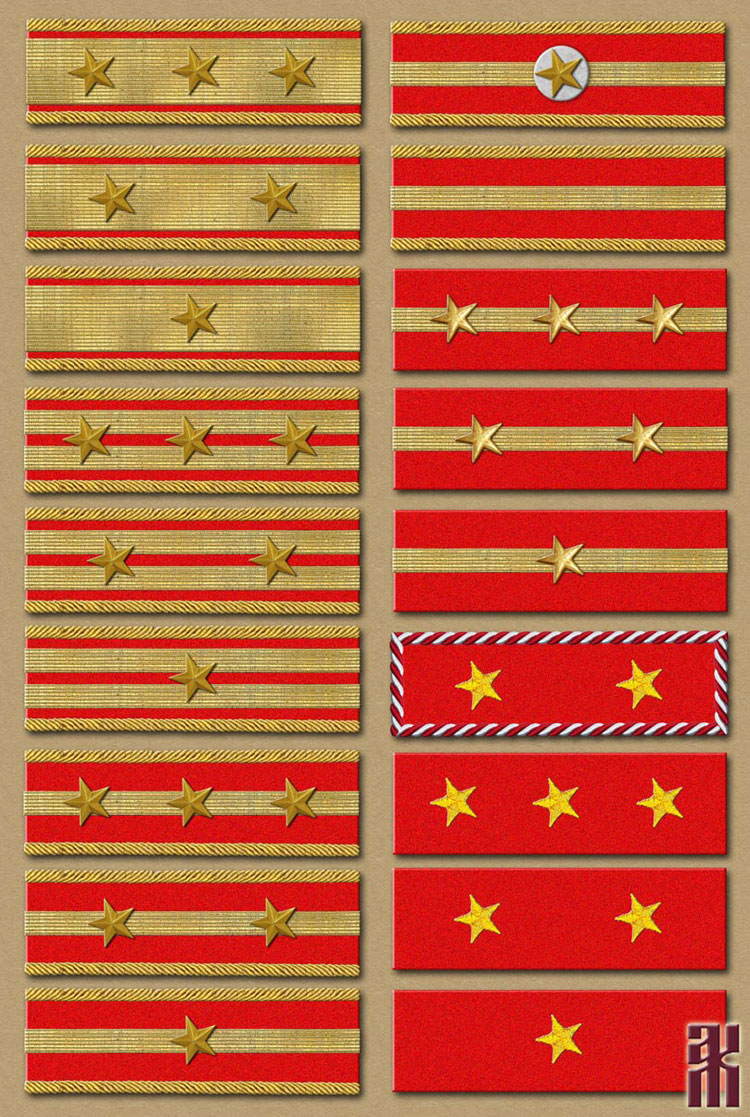
Rank markings of the Imperial Japanese Army:
1 – general; 2 – lieutenant-general; 3 – major-general; 4 – colonel; 5 – lieutenant-colonel;
6 – major; 7 – captain; 8 – lieutenant; 9 – second-lieutenant
10 – ensign; 11 – sergeant-major; 12 – sergeant; 13 – corporal;
14 – lance-corporal; 15 – volunteer; 16 – senior private; 17 – private 1st class; 18 – private
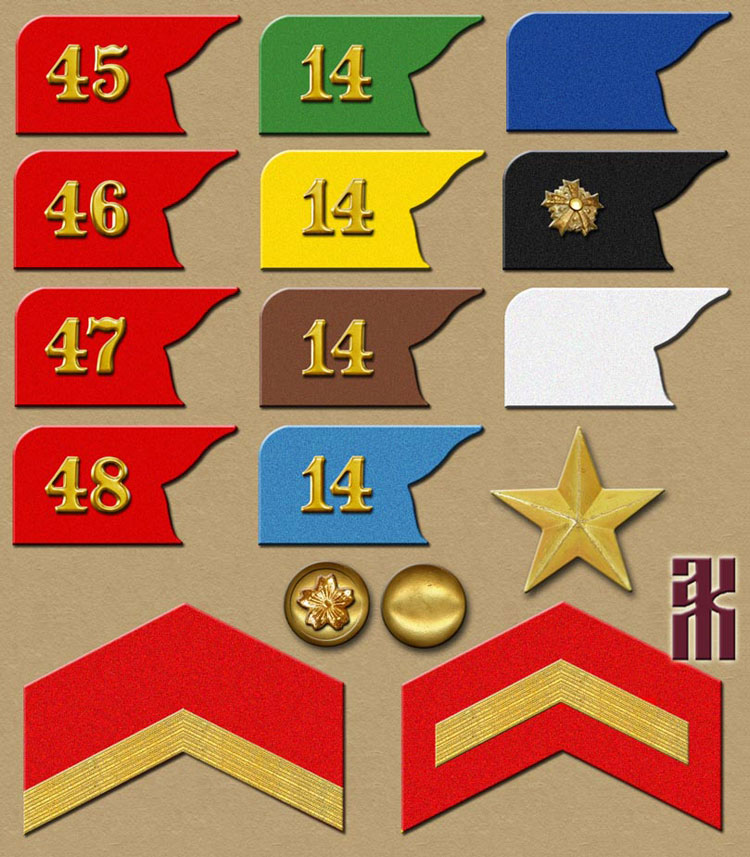
Insignia of Imperial Japanese Army combat units:
1 to 11 – collar tabs; 12 – cockade; 13 – officer button; 14 – other ranks buttons;
15 and 16 – sleeve chevrons for acting corporal and acting senior private
The branch of service colours were: red for infantry, green for cavalry, yellow for artillery, light brown for engineers, blue for transport and administration, black for field gendarmerie, and white for military judiciary.
Metal numbers were to be worn on the tabs: regimental numbers in the infantry, divisional numbers in the rest. In wartime they had to be worn on both sides. The examples are for the 14th Infantry Division – 45th to 48th Infantry Regiments, 14th Cavalry Regiment, 14th Field Artillery Regiment, 14th Engineer Battalion, and 14th Transport Battalion.
The button in Figure 13 has a sakura, cherry blossom, flower.
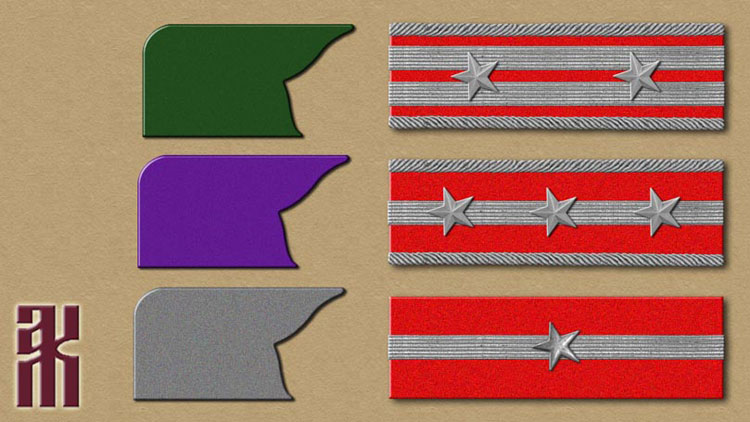
Insignia of non-combat units in the Imperial Japanese Army
Collar tabs were green for military medics, purple for veterinarians, grey for quartermasters. The rank markings of non-combat personnel had silver instead of gold.
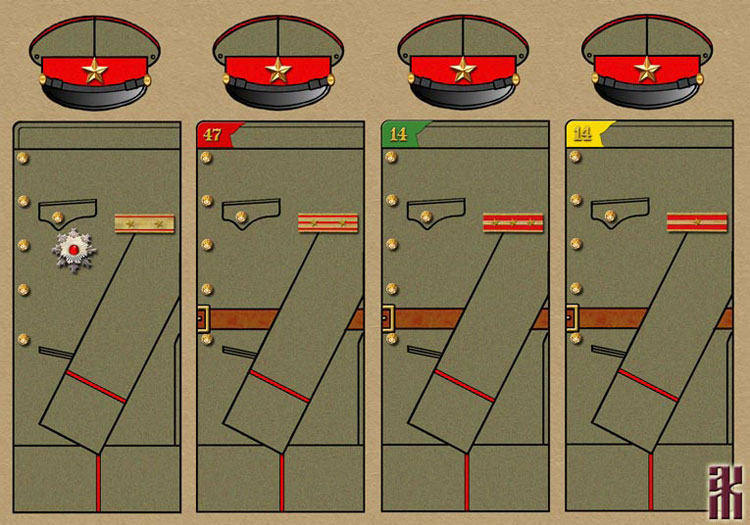
Uniforms of Imperial Japanese Army officers:
1 – general; 2 – infantry lieutenant-colonel; 3 – cavalry captain; 4 – artillery 2nd-lieutenant
The 1913-Model ("Type 45") uniforms of the officers and men of the Imperial Japanese Army the were identical in cut and colour, differing in the buttons and the quality of the material and tailoring. All branches of the armed forces wore a tunic with red piping on the cuffs and trouser seams, and a cap with a red hat-band and piping on the crown.
Judging by photographs, generals preferred not to wear coloured collar tabs.
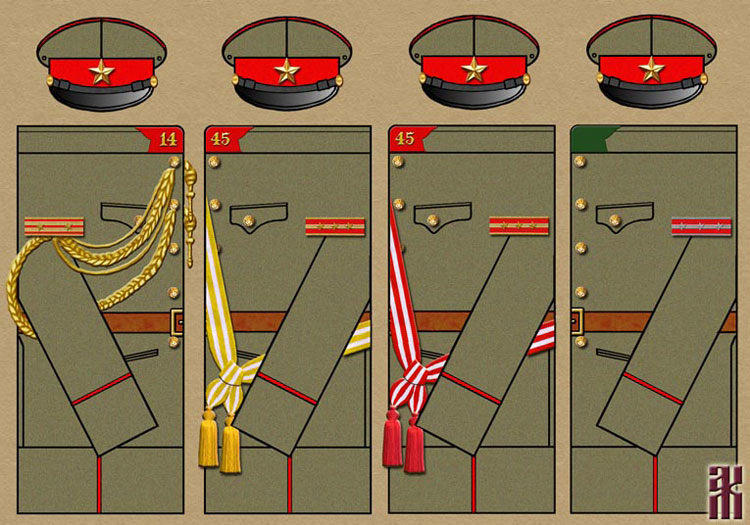
Uniforms of Imperial Japanese Army officers:
1 – general staff or division staff officer; 2 – adjutant officer; 3 – duty officer;
4 – military medic with officer rank.
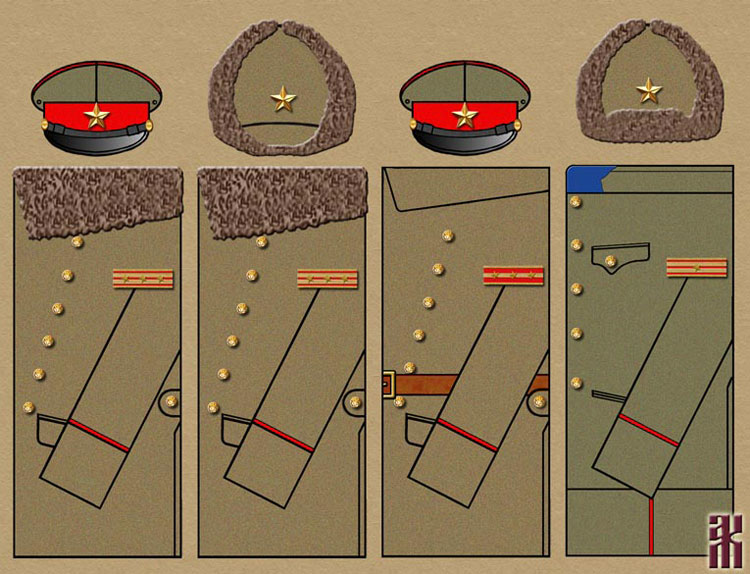
Winter uniforms of Imperial Japanese Army officers:
1 – greatcoat with fur collar; 2 – greatcoat with fur collar and fur hat (upturned brim);
3 – greatcoat with cap; 4 – tunic with fur hat (upturned brim)
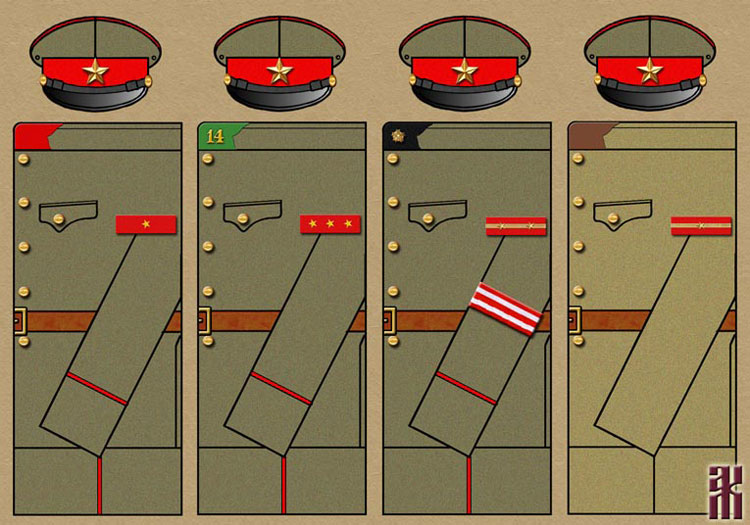
Uniforms of Imperial Japanese Army other ranks:
1 – infantryman (with no number on the collar); 2 – cavalryman;
3 – gendarme (with duty arm-band); 4 – engineer.
Figure 4 is in the summer uniform, made of yellowish cotton fabric.
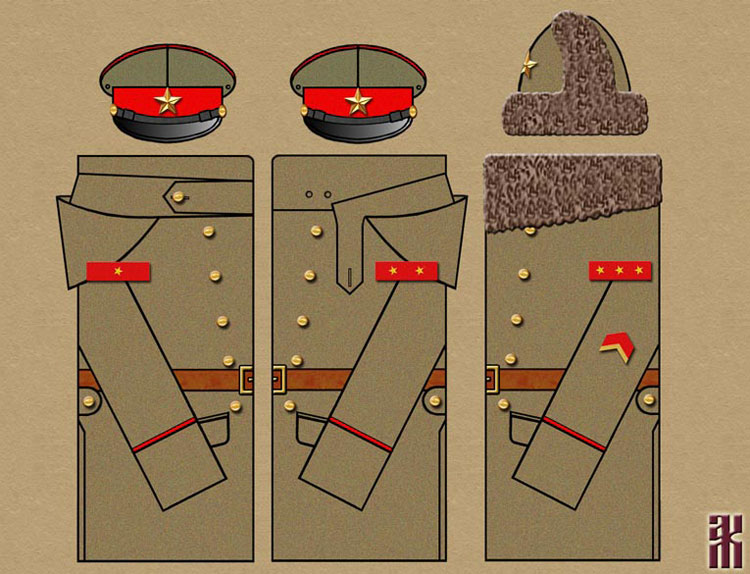
Winter uniforms of Imperial Japanese Army other ranks:
1 – greatcoat with the flaps of the attached hood fastened;
2 – greatcoat with the flaps of the attached hood unfastened;
3 – greatcoat with a fur collar and fur hat
Home — State Symbols — Flags — Uniforms — Badges & Medals — Money — Other
Pygmy Wars Notes
The original for this page is at kolchakiya.ru/uniformology/Japanese_expeditionary_force.htm.
The original has a brief section on medals, but I am not doing those at this time.
Discussion on the translation choices I have made can be found here.