
Uniforms of the Italian Corps and Siberian Salvation Legion
in the Far East, February 1918-November 1920
All material and reconstructions are by A. Karevskiy unless noted otherwise.
The following were used in the reconstruction of the uniforms of the Italian Expeditionary Force in the Far East of Russia:
Kapustin, L. G. "Italian armed formations in the East of Russia. 1918-1920 // White Army, White Cause No. 22", Ekaterinburg, 2015, p.46-65.
North, D. "Soldiers of World War I, 1914-1918: Uniforms, insignia, equipment and weapons", Moscow, 2015, p.176-179.
Funken, F. and Funken, L. "The First World War, 1914-1918, Part 1: Infantry – Armoured Vehicles – Aviation", Moscow, 2002.
Funken, F. and Funken, L. "The First World War 1914-1918, Part 2: Cavalry – Artillery – Engineers – Navy", Moscow, 2002.
Nicolle, D. "The Italian Army of World War I // Men-at-Arms, No. 387", Oxford, 2003.
Pirocchi, A. "Italian Arditi – Elite Assault Troops // Warrior, No. 87", Oxford, 2004.
Deryabin, A. A. "Interventionist Forces", Moscow, 1999
In February 1918 an Italian mission to repatriate prisoners of war, led by Major K. Manera, arrived in Vladivostok. The result of its work was the formation of two battalions and some small auxiliary units, the so-called "Black battalions" (based on the color of their collar tabs) from men captured by the Russians from the Austro-Hungarian Army. A "Savoy" battalion was also privately formed in Samara in September 1918, similarly from former prisoners of war, which was later reorganised into the "Red Battalions" (also based on the collar tabs). These formations were later united as part of the Siberian Salvation Legion (Legion Redenta di Siberia). Organisationally they became part of the Italian Expeditionary Force, but in reality only Manera's "Black Battalions" operated as part of the corps.
In October 1918 another Italian military mission was opened in Vladivostok, alongside the Italian Mission for Prisoners of War Affairs. From November 1918 the Italian Expeditionary Corps in the Far East (Corpo di Spedicione Italiano in Estremo Oriente, CSIEO) settled in Krasnoyarsk. The corps included an infantry battalion (made from men of the "Naples" and "Torino" brigades), a company of the 85th Infantry Regiment (of the "Verona" Brigade), a company of Alpine riflemen, a mountain artillery section from the 1st Mountain Artillery Regiment in Turin, the 159th section of the Royal Military Carabinieri, two machine gun sections (armed with Fiats) and a field hospital.
Uniforms and insignia of the Italian Units in Russia
Quoting Kapustin, pp.61-63.
There were two distinct periods of Italian uniforms in Eastern Russia: before and after the arrival of the CSIEO.
During the initial stage, the uniforms of the Italian units were quite varied: they mixed elements of Austro-Hungarian and Russian field uniforms, as well as civilian clothing. However, there were exceptions. In September 1918 Samara locals sewed a set of uniforms for A. Compatanangelo's Savoy Battalion, which resembled the uniform of the Royal Italian Army in general terms: a tunic, breeches and boots with puttees. Compatanangelo himself wore an Italian-style officer's uniform with shoulder-straps. Judging by the surviving photograph, "Captain" Compatanangelo wore an Italian-style cap and troops wore Austrian-style caps with visors, as well as fur hats of various designs. The soldiers of the battalion wore Italian-style insignia and collar stars, as well as national (green, white and red) ribbons.
The CSIEO arrived in Russia in standard Italian uniforms. Corps officers wore the grey-green uniforms which had been adopted by the Italian army in 1909. Individual army units differed mainly in the types of headgear, cockades and a few other specific elements. The soldier's uniform included a wide jacket without patch pockets with a hidden fastening, with shoulder-straps and pointed cuffs, trousers and boots with puttees.
However the Italian uniforms, designed for temperate and hot climates, were completely unsuitable for the harsh weather conditions of the Siberian winter. The double-breasted greatcoat with a large turn-down collar and turned-up cuffs and a short rain cape did not provide any protection from the cold. So on arrival in Siberia the troops received warm uniforms: coats with fur hoods, warm trousers, long gloves, woollen socks, and fur hats. Instead of short boots, they often wore felt and fur boots (whatever sort they could get locally). In addition, the soldiers received a significant amount of warm clothing from the "Italian women of Shanghai" (undershirts, gloves, long-johns, cummerbunds, socks, scarves, mittens) and from Italy itself (fur coats and sheepskin coats, "shoes with thick hob-nailed soles", soles, white scarves, handkerchiefs with the Italian coat of arms). All of this was stored in large quantities in Krasnoyarsk, directly at the units' quarters. Even folding bicycles were delivered from Italy. The Italians also set up a number of workshops in Russia for their own needs: with shoemakers, tailors, and carpenters.
Officers wore jackets with pleated breast and thigh pockets, trousers, low boots with puttees or high boots. The headgear was a stiff kepi with a black or grey-green visor and a chin strap for officers, and a soft cap with a grey-green visor and a narrow chin strap for other ranks. From 1916 the kepi was replaced by a round cap with a visor. All headgear had grey linen covers. Infantrymen wore crossed rifles under the crown of their headgear, with the regiment number in the centre for officers and NCOs, and a single regiment number under the crown for lower ranks. The colour of the infantry's shoulder-straps depended on the brigade number.
The Alpine units (Alpini) wore the same uniform, but were distinguished by a hat with short turned-up brim and a high crown, characteristic of the inhabitants of the Alpine regions of Italy. On the hat's left side was a coloured pompom (not always there), indicating the battalion number (...) and a feather. This element of the uniform was noted by some eyewitnesses:
We arrived at Chzhalaynor station (Manchuria). On the neighbouring track stood a train with some foreign soldiers – hats with long feathers in them. Someone found out that they were Italian Alpine riflemen.
The men of the mountain artillery section had special black collar badges with yellow edging in the shape of a flame with a single tongue, on which was a metal five-pointed star (the emblem of the ruling House of Savoy), as with all units of the Italian army. They also wore a cockade of crossed guns topped with an exploding grenade. The ranks of machine gun units operating in Russia had the emblem of their branch of service with a machine gun instead of the unit number or a five-pointed star with a machine gun in the centre; sometimes a single machine gun was embroidered on their headgear. The collars of the Fiat machine gun crews were red with three vertical white stripes.
In addition to the standard army field uniform, the Carabinieri (military police) wore a bicorn hat with a black flaming grenade cockade. The collar tabs were grey-green, with two "coils" on a black background. Photographs suggest that on certain ceremonial occasions the Carabinieri wore a dress uniform: a double-breasted tunic with silver collar tabs, shoulder straps and aiguillettes, flared trousers, and the black bicorn hat (without cover) with feather.
In the summer of 1918 the ranks of the "Black Battalions" received black collar tabs as a special uniform distinctions (similar to the Italian
The Italian units used old equipment: grey-green 1907-model cartridge pouches, 1891-model pouches, and 1897-model bandoliers.
Rank markings were located above the cuffs of both sleeves of the tunic and consisted of black braided chevrons (point upwards) for NCOs and five-pointed stars located vertically on the cuffs for officers (gold for artillery, silver for other branches). The stars could be embroidered or metal.
Reconstructions
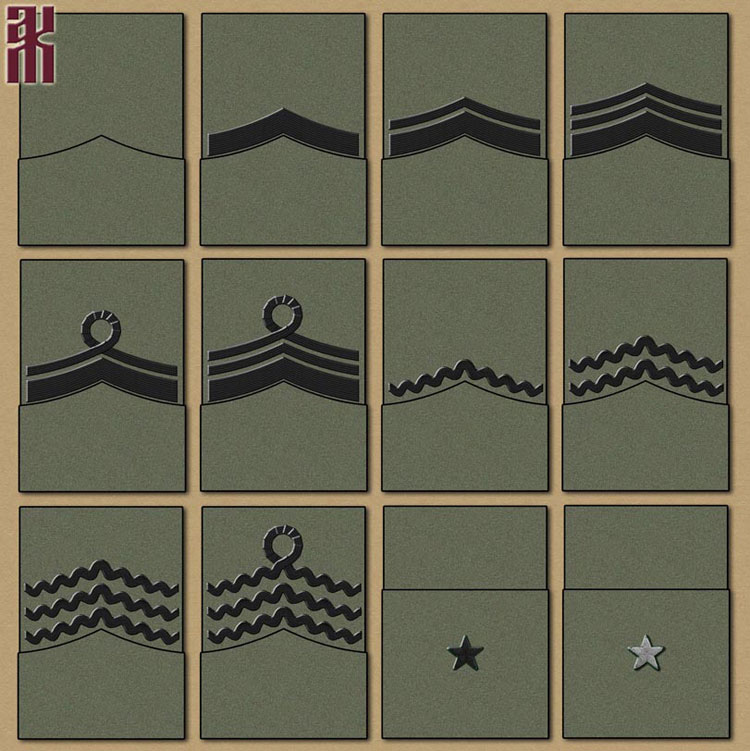
Rank markings of Royal Italian Army:
1 – soldier (soldato); 2 – senior soldier (soldato scelto); 3 – corporal (caporale);
4 – senior corporal (caporale maggiore); 5 – sergeant (sergente);
6 – senior sergeant (sergente maggiore);
7 – company sergeant major (maresciallo di compagnia);
8 – battalion sergeant major (maresciallo di battaglione);
9 – regimental sergeant major (maresciallo di reggimento);
10 – combat adjutant (Aiutante di battaglia);
11 – cadet (aspirante ufficiale); 12 – second lieutenant (sottotenente).
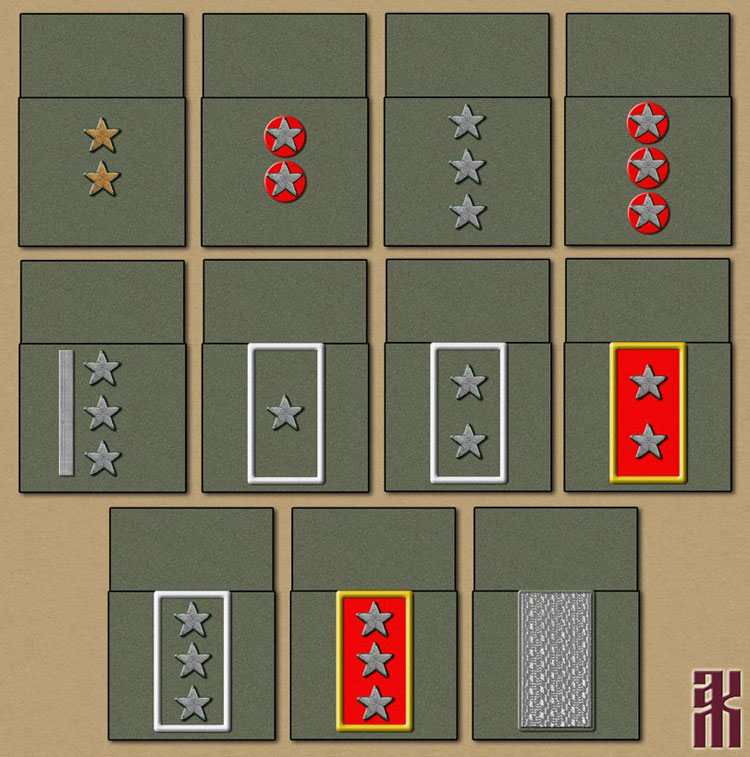
Rank markings of Royal Italian Army:
1 – lieutenant (tenente); 2 – lieutenant commanding a company (tenente igs);
3 – captain (capitano); 4 – captain commanding a battalion (capitano igs);
5 – senior captain (primo capitano); 6 – major (maggiore);
7 – lieutenant-colonel (tenente colonelo);
8 – lieutenant-colonel commanding a regiment (tenente colonelo igs);
9 – colonel (colonelo); 10 – colonel commanding a regiment (colonelo titulare);
11 – colonel commanding a brigade (colonelo igs).
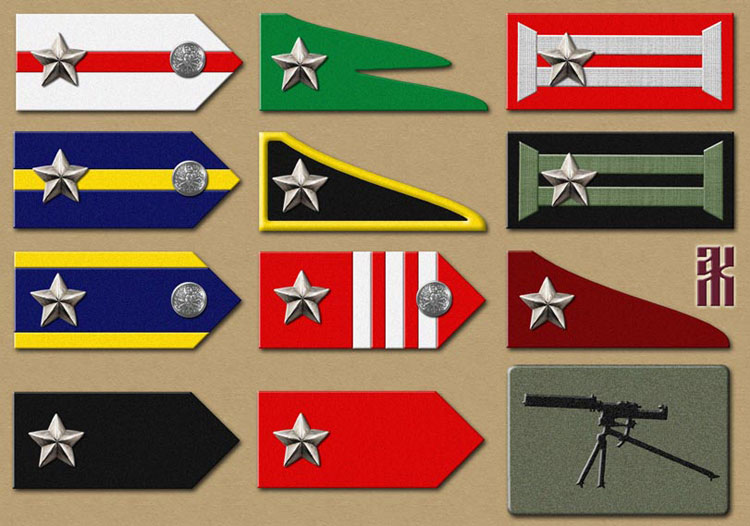
Collar tabs of the Royal Italian Army, units in Russia:
1 – "Naples" Brigade; 2 – Alpine riflemen; 3 – light infantry; 4 – "Turin" Brigade;
5 – artillery (including mountain artillery); 6 – military carabinieri ;
7 – 85th Infantry Regiment ("Verona" Brigade); 8 – MG teams; 9 – military medics;
10 – "Black Battalions" of the Italian Corps of Salvation;
11– "Red Battalions" of the Italian Salvation Corps (including the Savoy Battalion);
12 – sleeve insignia of machine gun teams (Fiat machine guns)
All collar tabs featured the white five-pointed star emblem of the ruling Savoy dynasty.
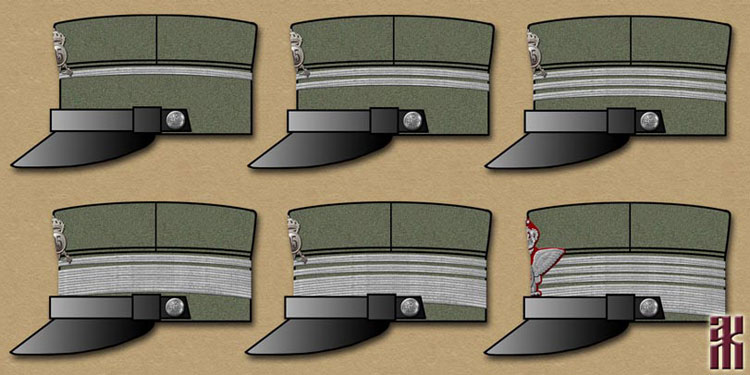
Officer headgear of the Royal Italian Army:
1 – second-lieutenant; 2 – lieutenant; 3 – captain and senior captain;
4 – major; 5 – lieutenant-colonel; 6 – colonel
The round cap with visor of 1916 replaced the stiff officer's kepi and quickly became popular among the troops due to its convenience and practicality. Judging by photographs, the Italians in Siberia used such caps, with a high round crown and the brim trimmed with silver or light grey braid 4 and 20 mm wide (kept from the previous kepi).
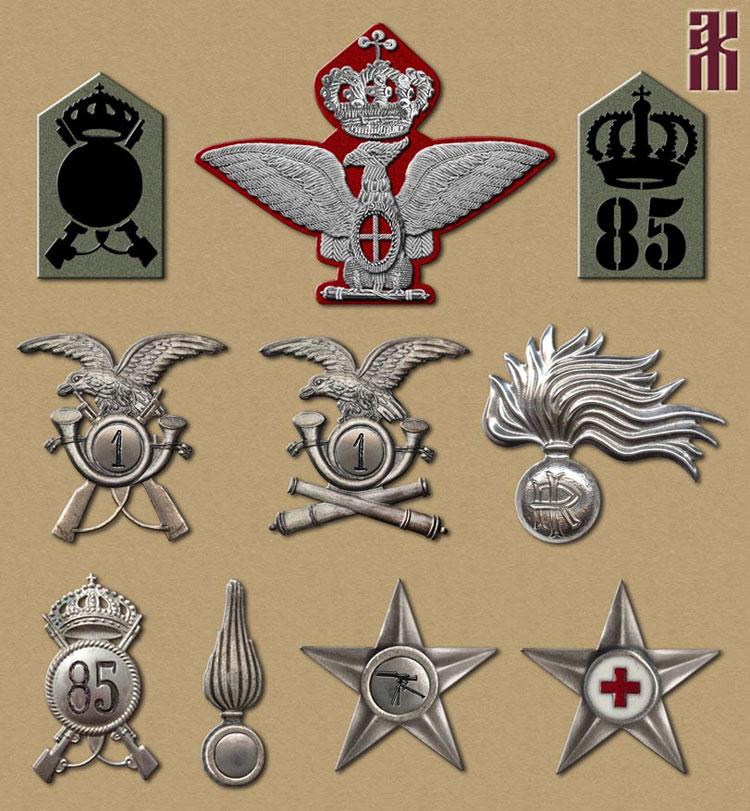
Cockades of the Royal Italian Army:
1 – infantry battalions of the ICS; 2 – senior officers; 3 – regular army (here, 85th IR);
4 – officer of Alpine infantry (here, 1st RR); 5 – mountain artillery (here, 1st MAR);
6 carabinieri ; 7 – infantry officer (here, 85th IR), 8 – officer of light infantry;
9 – officer of MG units; 10 – officer military medic
Figure 2 is the "Savoy Eagle", worn by generals, colonels and sometimes lieutenant colonels.
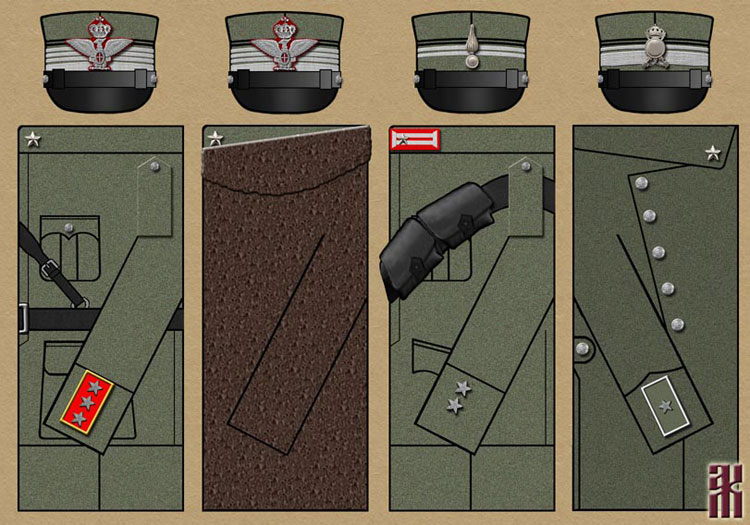
Uniforms of the Italian Expeditionary Corps in the Far East and the Siberian Salvation Legion:
1 – Corps Commander Colonel E. Fossini-Comossi in tunic; 2 – and in civilian fur coat;
3 – lieutenant of light infantry in the Italian military mission;
4 – major of the Siberian Legion of Salvation in an officer's greatcoat
Khaki uniforms were introduced into the Royal Italian Army in 1909. Greatcoats in the Italian army were worn without coloured collar tabs or shoulder-straps, but with the Savoyard white star on the collar.
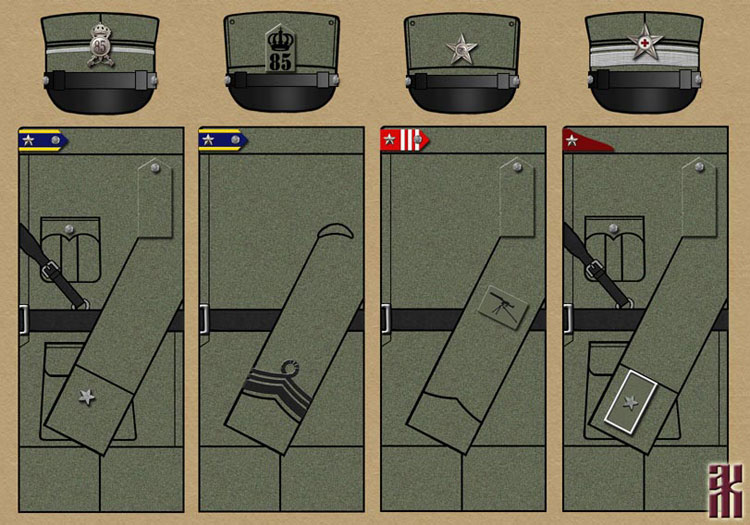
Uniforms of the Italian Expeditionary Corps in the Far East:
1 – officer of the 85th IR ("Verona" Brigade); 2 – senior corporal of the 85th IR;
3 – private in an MG team; 4 – medical officer
The corporal's tunic has a stiff pad sewn into the shoulder seam to support ammunition and equipment. Figure 3's tunic has soft sewn-in shoulder-straps, and his affiliation to a machine gun unit is indicated by the stripes on his collar tab, the sleeve patch and a cockade with the same image of a machine gun. Both lower ranks wear the 1915 model cap with a looser and softer crown.
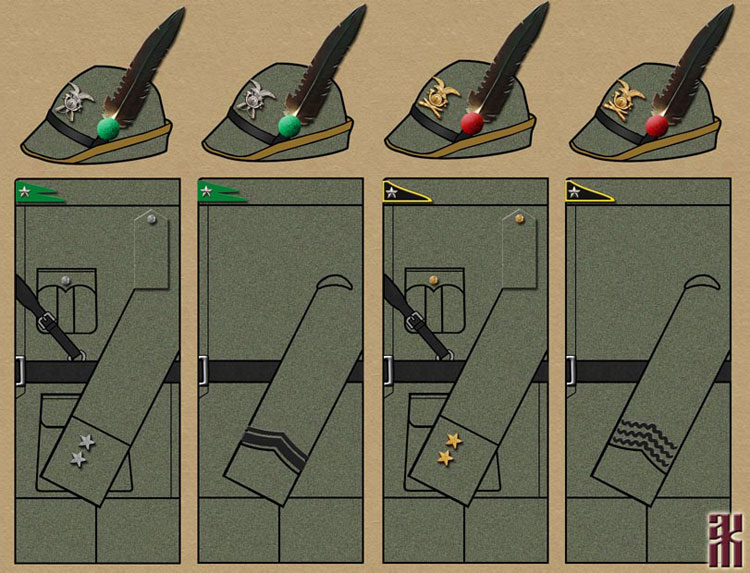
Uniforms of the Alpine units (Alpini ) in the Far East of Russia:
1 and 2 – alpine rifles; 3 and 4 – mountain artillery
Alpine rifles and mountain artillery units were distinguished by a special headdress – a felt hunting hat with turned-up brim and an eagle feather. The colour of the pom-poms was determined by the serial number of the battalion: white for 1st, red for 2nd, green for 3rd, blue for 4th, and yellow for reserve. Unlike infantry, the metal of artillery unit insignia in the Royal Italian Army was gold.
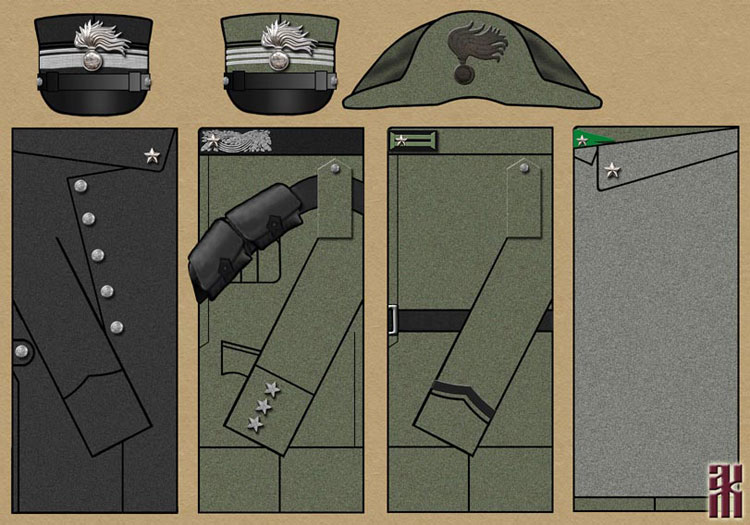
Uniforms of carabinieri in the Italian Expeditionary Corps:
1 – Major C. Manera; 2 – captain in field uniform;
3 – senior soldier in field uniform; 4 – soldier in cape
Figure 1 is from a photograph of Major C. Manera, deputy head of the Italian military repatriation mission. Judging by photographs, all military police officers had collars of black cloth with silver stitching, with a white metal star. Figure 3 has the stiff black bicorn hat with a khaki cover embroidered with black thread depicting a flaming grenade. Unlike the infantry, the uniforms of the Carabinieri soldiers had soft sewn-in shoulder-straps. Figure 4 shows the rain cape, which was very popular in the Italian army but proved unsuitable for the Siberian cold.
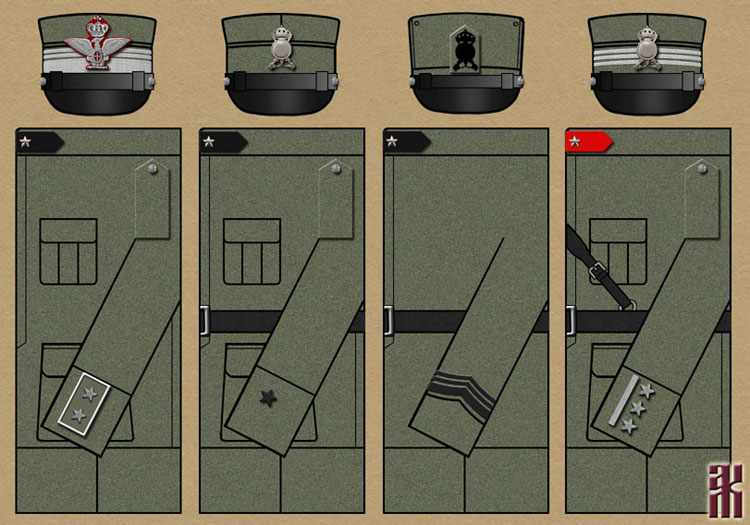
Uniforms of the Siberian Salvation Legion:
1, 2 and 3 – a lieutenant-colonel, cadet and senior corporal from the "Black Battalions";
4 – senior captain from the "Red Battalions" of the Italian Salvation Corps
Judging by photographs, the cut of the Legion officers' uniforms differed slightly from that adopted in the regular units of the Royal Italian Army (the breast pockets had a wide fold and a straight flap with no button). The uniforms of the lower ranks did not have shoulder pads sewn in to support equipment. The cockade was the same as in the infantry units, but without the regiment number (metal for officers, stencilled for the other ranks).
Home — State Symbols — Flags — Uniforms — Badges & Medals — Money — Other
Pygmy Wars Notes:
The original for this page is at kolchakiya.ru/uniformology/Italian_corp.htm.
I believe Chzhalaynor station in Manchuria is modern Jalainur, 49.47N, 117.72E.
Legion Redenta di Siberia properly translates as the "Redeemed Legion of Siberia", but the context is that the Irredenta was the Italian unification movement of the mid-1800s, so the Italian-speaking former Austro-Hungarian subjects were "redeemed" into a united Italy.
I have used "light infantry" where the original text has eger (so jaeger). The Italian light infantry were the Bersaglieri, but the uniform is wrong for them and none were sent. The only units I could find with red collar tabs with white bars and a grenade cockade were the Granatieri di Sardegna (Sardinian Grenadiers), but they are also not mentioned as being sent. Perhaps a few officers were in the military mission.
Discussion on other translation choices I have made can be found here.