
Uniforms of Senior Leaders of the Provincial Administration
in the Territories Controlled by the Supreme Ruler
All material and reconstructions are by A. Karevskiy unless noted otherwise.
On the introduction of uniforms
At the congress of district administrators held in Irkutsk the issue of introducing uniforms for provincial administrators, their assistants and district administrators was discussed, among other things. The congress decided to submit a request to the Ministry of Internal Affairs for approval of the following uniform design: a khaki cap and a greatcoat with shoulder-boards: for provincial governors, that of active state counsellor; for their assistants, that of state counsellor; and for district governors, that of collegiate counsellor.
"Mysl", Irkutsk, 5 March 1919.
The need for uniforms for provincial and district administrators is recognised by all administrators, and the congress approved the proposal of the provincial administrator to introduce khaki uniform caps and overcoats, with civilian-style shoulder-boards on the greatcoats, "French" tunics or short coats. For a provincial governor, that of 4th Class, active state councillor; for their assistant, that of 5th Class, state councillor; and for district administrators, that of 6th Class, collegiate councillor. This should be brought to the attention of the Ministry of Internal Affairs.
"Mysl", Irkutsk, 6 March 1919.
Governor's uniform
Governors of provinces and regions shall be assigned the same uniform that was assigned to former governors.
"Novonikolaevskie Vedomosti", April 1919.
Documents kindly provided by Voronezh researcher N. Zayats, in agreement with siberia.forum24.ru participant "Ratnik".
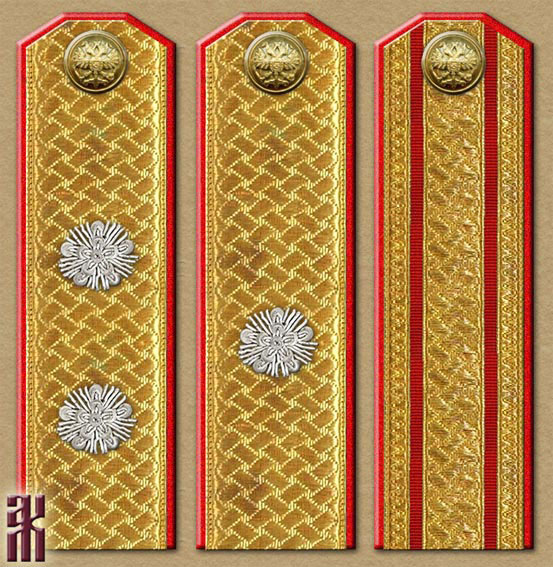
Shoulder-boards of provincial administration officials:
1 – provincial governor; 2 – assistant provincial governor; 3 – district governor
The red indicates affiliation with the Ministry of Internal Affairs.
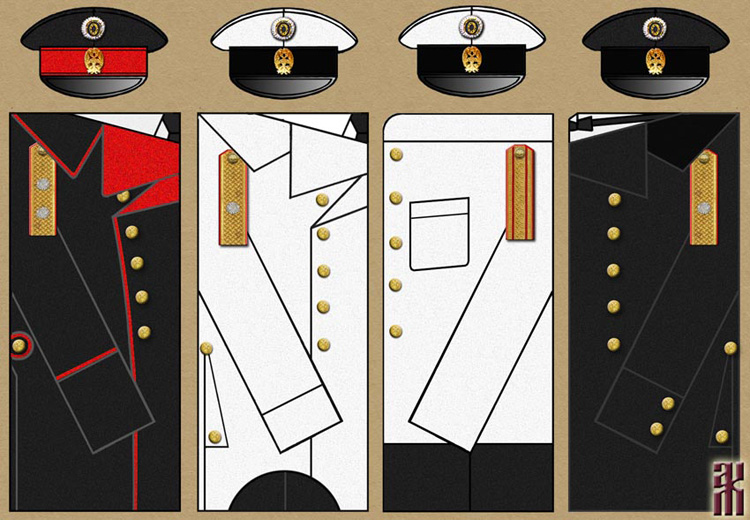
Uniforms of provincial administration officials:
1 – overcoat for officials of the first four classes: 2 – white frock coat; 3 – white tunic;
4 – dark green frock coat
The overcoats for lower ranks had no coloured lapels or piping. In practice the dark green frock coat was made of black broadcloth, to make it cheaper and more practical. Different types of shirts were permitted – including classic ones with stand-up collars with turned-down corners (for a bow tie) or the more fashionable turn-down collars with a long tie.
As mentioned earlier, the governor of Irkutsk was Yakovlev, a member of the Socialist-Revolutionary Party, and he remained irreplaceable until his last days. He knew how to appear in gold governor's shoulder-boards when necessary, in a black coat with red lining, standing at attention and often adding his title.
Sakharov, K. V. in "White Siberia: The Civil War of 1918-1920", Moscow, 2018, p.58.
Distinguishing marks of commissars
At a congress of district commissars held in Irkutsk, the question of special distinguishing marks for commissars was discussed. It was decided to petition for the introduction of the following distinguishing marks: 1) iron shields with a bright provincial coat of arms in the middle and narrow gold braid at the bottom; 2) gold cockades with the provincial coat of arms on headgear.
"Military Gazette, No. 27", 24 December 1918. Material kindly provided by Voronezh researcher N. Zayats.
Home — State Symbols — Flags — Uniforms — Badges & Medals — Money — Other
Pygmy Wars Notes
The original for this page is at kolchakiya.ru/uniformology/heads_provincial_administration.htm.
Discussion on the translation choices I have made can be found here.