
Siberian Grenadier Regiment
The "Green Grenadiers"
Personal Escort of General Pepelyaev, Commander of the 1st Army
Material and reconstructions by A. Karevskiy
Tomsk, 17 December 1919
The second report came as a complete surprise to us. A large group of officers entered the room where the Military Revolutionary Committee was working. Despite the severe cold, they were all wearing pilotka caps. On the sleeves of their greatcoats were badges of the shock troops: a skull with two crossed bones. Our hands involuntarily reached for our revolvers: these were our most bitter enemies.
A few steps away from the table where we were sitting, a young captain commanded:
"At ease, gentlemen officers!"
The officers froze dramatically. Turning to us, the captain reported:
"The grenadier battalion intercepted the Jaeger regiment on its way out of the city and fired on it. The enemy retreated without engaging in battle. What are your orders for further action?"
After quickly consulting with us, Yanson replied:
"Remain in your current position until further instructions are received from our headquarters."
But the captain did not leave. Looking back at the officers, frozen and motionless like statues, he continued:
"Please note that the grenadiers were the first to engage in combat against the Pepeliaevtsy. We request that we be given the title of the 1st Soviet Assault Regiment."
A barely noticeable smile touched Yanson's golden moustache.
"Very well, I will forward your request to the Red Army command. Only they have the authority to decide this matter.
Once again, the captain gave an amusing command, and the group of officers, marching in guard-like step, withdrew.
As soon as the door closed behind them, we jumped up from our seats and burst into uncontrollable laughter:
"What can I say, they're lively young lads: from Kolchak's "death squads" directly into Soviet shock troops!
Elkovich, Y. R. in "Stories of Unforgettable Years", Barnaul, 1964, pp.119-120 at voencomuezd.livejournal.com/579305.html
The situation was such that General Pepelyaev's army, which had previously been withdrawn to the Tomsk-Taiga-Achinsk area, was essentially the last hope. All the more reason for the brothers to talk this way, as General Pepelyaev's brilliant white-and-green grenadier battalion stood for a long time at the station, displaying machine guns on the station platform, together with the 6th Mariinsk Regiment.
Ivanov, V. in "In the Civil War (From the notes of an Omsk journalist)", Moscow, 2017, pp.71-72.
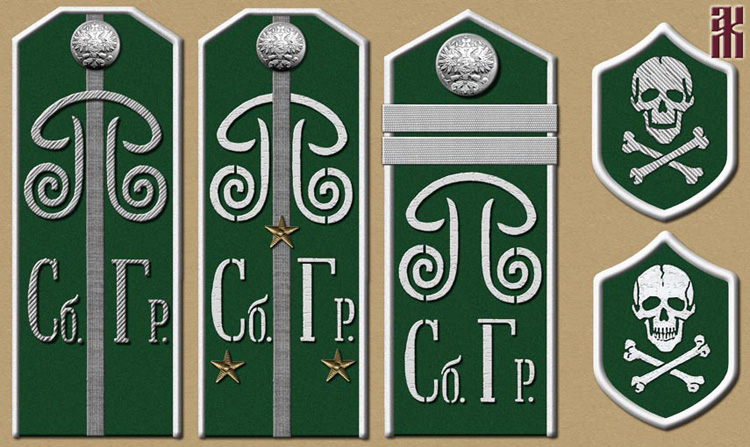
Shoulder-boards and sleeve devices of the Siberian Grenadier Regiment
(approximate reconstruction)
According to researcher S. V. Volkov, the main cadre of the Grenadier Regiment was selected from the 1st Siberian Assault Brigade. The reconstruction is based on the fact that the new regiment was created on the basis of continuity with the traditions of the assault troops. The colour of the shoulder-boards is determined by the regiment's nick-name of "Green Grenadiers", i.e. the black colour of the 1st Siberian Assault Brigade was replaced by green. Acting as Pepelyaev's personal escort, the regiment was also to inherit his monogram in the form of a stylised "П".
Volkov S.V. "The White Movement: Encyclopedia of the Civil War", Moscow, 2003.
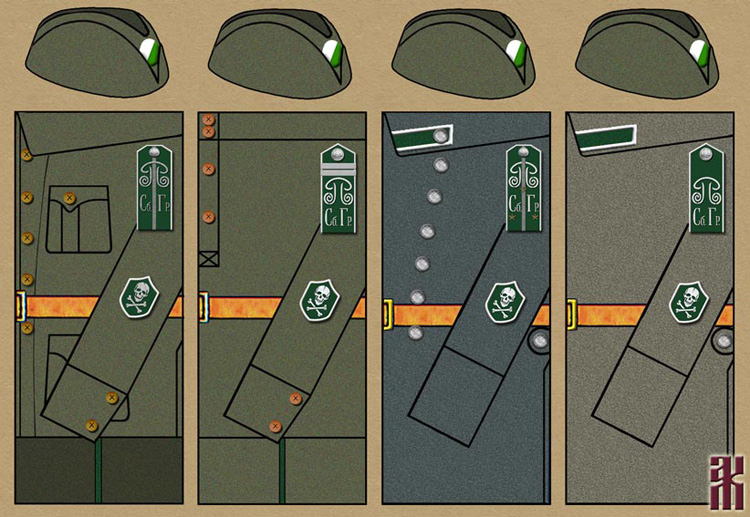
Uniform of the Siberian Grenadier Regiment (approximate reconstruction)
In the above description by Elkovich, a characteristic detail of the uniform is mentioned – the pilotka caps, which were also used as a distinctive detail of the uniform of the 1st Siberian Assault Brigade (which once again confirms the idea of continuity).
Home — State Symbols — Flags — Uniforms — Badges & Medals — Money — Other
Pygmy Wars Notes
The original for this page is at kolchakiya.ru/uniformology/Green grenadiers.htm.
The word pilotka (literally "pilot's cap" but more commonly a "side cap" in English) is a variant word for what is called zaletka in the page at Kolchakiya for the 1st Siberian Assault Brigade, from which this unit descended (although for some reason they have lost their piping).
Discussion on the translation choices I have made can be found here.