
Uniforms of the French Expeditionary Forces in the East of Russia
August 1918-February 1920
All material and reconstructions are by A. Karevskiy unless noted otherwise.
The following were used in the reconstruction of the uniforms of the French Expeditionary Forces in Eastern Russia
Jouineau, A. "The French army during the Great War, Vol. II: 1915-1918", Paris, 2009.
Sumner, I. "French Poilu, 1914-1918 // Warrior, No. 134", Oxford, 2009.
Sumner, I. "The French Army 1914-18 // Men-at-Arms No. 286", Oxford, 1995.
North, D. "Soldiers of World War I, 1914-1918: Uniforms, insignia, equipment and weapons", Moscow, 2015, p.82-119.
Funken, F. and Funken, L. "The First World War, 1914-1918, Part 1: Infantry – Armoured Vehicles – Aviation", Moscow, 2002.
Funken, F. and Funken, L. "The First World War 1914-1918, Part 2: Cavalry – Artillery – Engineers – Navy", Moscow, 2002.
Polonskiy, I. "Tonkin Rifles: Vietnamese soldiers in the colonial forces of French Indochina at topwar.ru/54141-tonkinskie-strelki-vetnamskie-soldaty-v-kolonialnyh-voyskah-francuzskogo-indokitaya.html
Dadian-Zhagat, S. "French Siberian Colonial Battalion: Le Bataillon Colonial Francais de Sibérie, BCFS" at zhagat-dadian.livejournal.com/2013/02/03/
Khairulin, M. "Military pilots of the lost empire: Aviation in the Civil War", Moscow, 2008.
Deryabin, A. A. "Interventionist Forces", Moscow, 1999
The French expeditionary forces in eastern Russia included:
A Siberian Colonial Battalion (Bataillon colonial sibérien, BCS), made up of the 1st and 8th Companies of the 9th Colonial Infantry Regiment, 1st and 11th Companies of the 16th Colonial Infantry Regiment, 5th Company of the 3rd Zouave Regiment, and a Tonkin Rifles Company. It had two machine gun platoons and two military doctors;
A Siberian Colonial Battery: crewed by men of the 4th and 5th Colonial Artillery Regiments;
A French aviation detachment (at the French Military Mission).
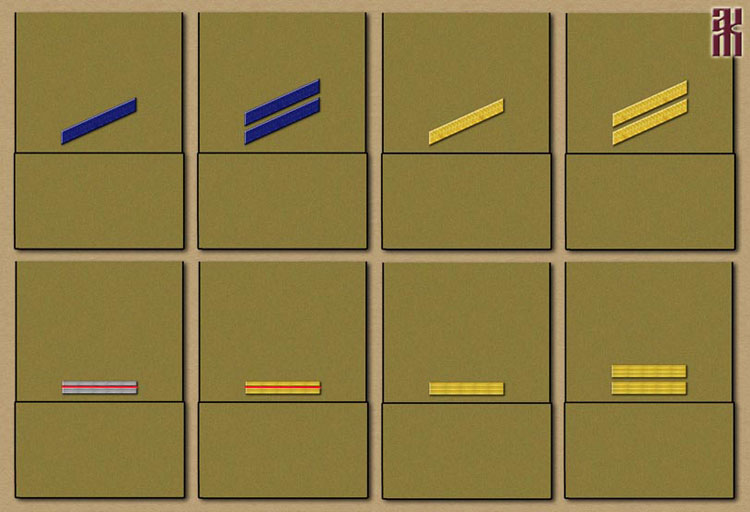
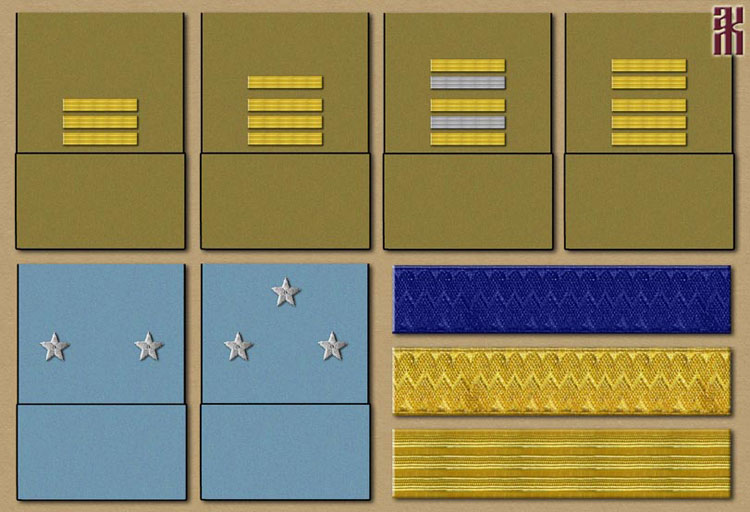
Lower sleeve insignia of the French Army:
1 – private first class (soldat 1ere classe); 2 – corporal (caporale);
3 – sergeant (sergent ); 4 – staff sergeant (sergent chef );
5 – warrant officer (adjutant ); 6 – senior adjutant (adjudant chef );
7 – second lieutenant (sous-lieutenant ); 8 – lieutenant (lieutenant );
9 – captain (capitaine); 10 – major (chef de bataillon);
11 – lieutenant colonel (lieutenant-colonel ); 12 – colonel (colonel );
13 – brigadier general (general de brigade); 14 – major general (general de division);
15 to 17 – examples of braid for infantry NCO, sergeant and officer, respectively
Artillery and engineer NCOs had red braid. Their length was set at 35 mm for field uniforms.
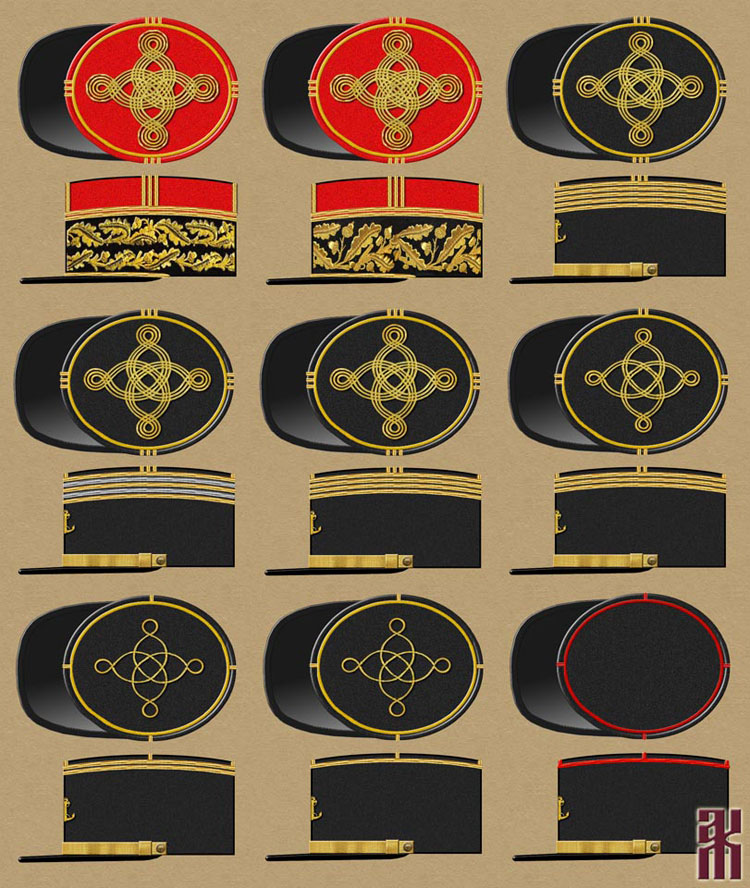
Dress kepi ("Saumur" model):
1 – major-general; 2 – brigadier-general; 3 – colonel; 4 – lieutenant colonel;
5 – major; 6 – captain; 7 – lieutenant; 8 – second lieutenants; 9 – lower ranks
The caps shown here are for officers of colonial infantry regiments, with a black top and an anchor emblem. The stitching on the crowns is that approved for enlisted personnel; non-enlisted personnel did not have the curls. The field cap could be horizon-blue or khaki, depending on the territorial affiliation of the unit, without embroidery, but with the emblem and rank insignia on the front.
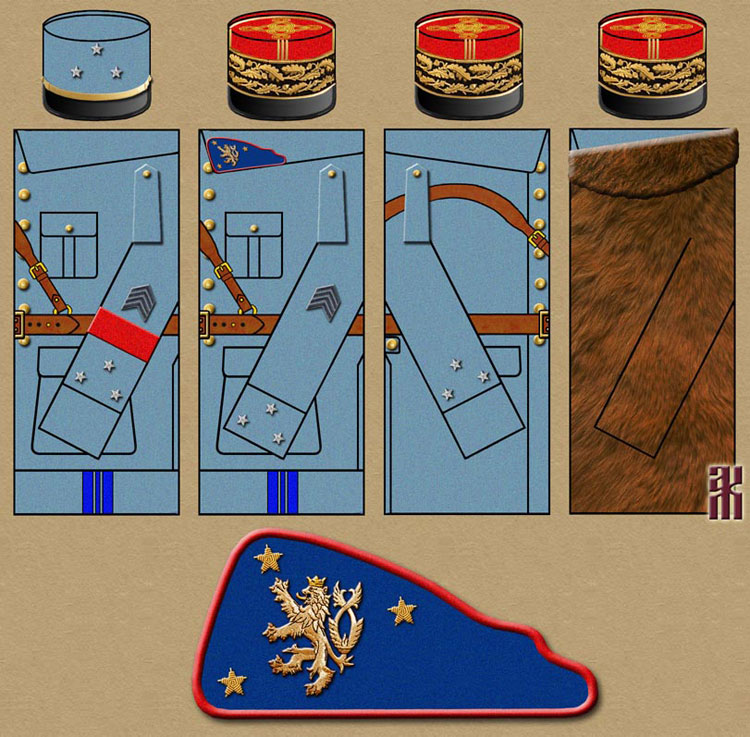
Uniforms of General M. Janin:
1 – major-general's field uniform; 2 – everyday uniform; 3 – in greatcoat;
4 – in winter fur coat
Janin was the representative of the Supreme Allied Command and commander-in-chief of the Allied forces in Siberia. Figure 1 has the insignia of a divisional general and a red arm-band, as prescribed for division commanders. On the sleeve are service chevrons (1 for each year of service in the war). Figure 2 shows the everyday uniform worn by Janin in Siberia. The collar has patches with an erect white lion and three five-pointed stars, which was adopted by Czechoslovak units in France. It is believed that these patches were presented to the general in his role as commander-in-chief of the Czechoslovak army units in Russia. Janin was photographed wearing a fur coat at numerous parades in Omsk.
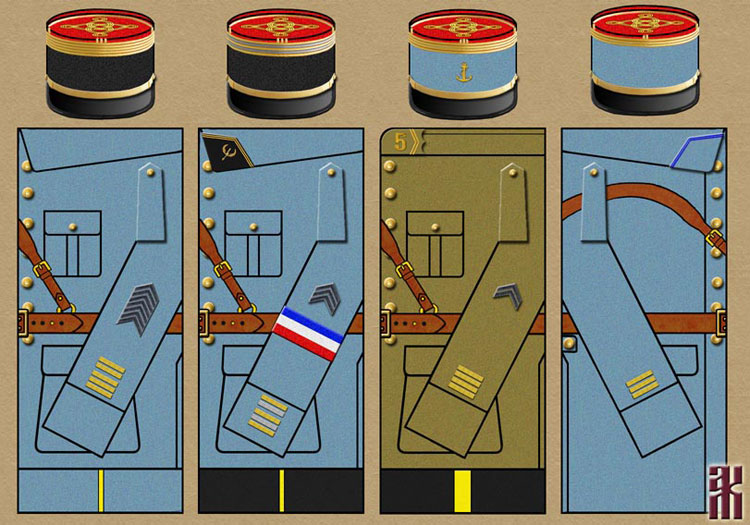
Uniforms of members of the French military mission in Siberia:
1 – infantry colonel: 2 – lieutenant-colonel of the general staff;
3 – major; 4 – captain in greatcoat
The cut of the tunics is established in 1913, although they only became camouflage coloured in 1915. Coloured kepis continued to be used frequently even after the army changed to "horizon blue". Figure 2 has the black collar tabs trimmed with double gold braid assigned to infantry staff officers. The arm-band in the national colours indicates that the officer belongs to the General Staff or has been sent on a special mission by the French Ministry of Defence. Figure 3 is a battalion commander of the 5th Colonial Infantry Regiment, reconstructed from a photograph. Note the black trousers with wide yellow stripes and the horizon-blue kepi, kept after the colonial infantry changed from horizon-blue to khaki uniforms in 1918. Figure 4 shows a 1913-model winter greatcoat and a horizon-blue kepi which has retained its coloured top. The collar tabs are trimmed with double dark blue piping, assigned to metropolitan infantry units.
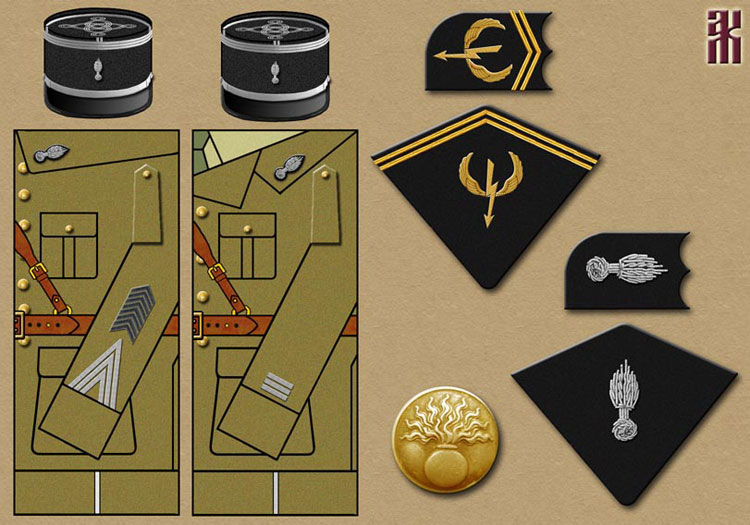
Uniforms of the French military mission in Siberia:
1 and 2 – field gendarmerie officers;
3 and 4 – tunic and greatcoat collar tabs of the French General Staff;
5 and 7 – tunic and greatcoat tabs of the field gendarmerie; 8 – button
Figures 1 and 2 are reconstructed from a photograph. The different ways of wearing the insignia are characteristic. The tabs of the General Staff had a winged lightning bolt and were trimmed with double gold braid. The tabs of the military field gendarmerie had a flaming grenade with edging, and from 1916 onwards only the embroidered emblem with no field was worn (as shown in Figures 1 and 2).
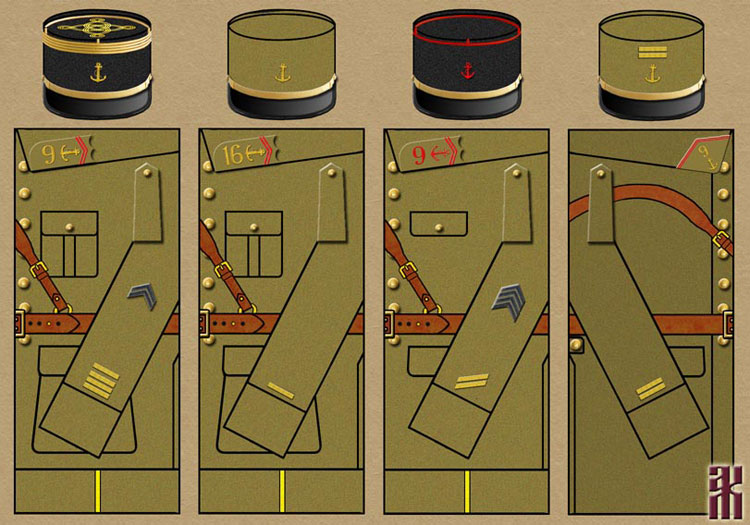
Uniforms of the 9th and 16th Colonial Infantry Regiments of the BCS:
1 and 2 – officers in summer uniform; 3 – sergeant in summer uniform; 4 – winter uniform.
Shown here are the khaki uniforms with various types of headgear established for the colonial units of the French Army from 1918 (from 1916 the colonial units had gradually been issued with horizon-blue uniforms). The trousers have yellow piping, as prescribed for the infantry. A characteristic detail is that sergeants in the army usually wore officer-style uniforms, with the exception of headgear: this one's kepi has the gold chin strap and one red band, being a remnant of the horizon-blue period. The sleeve has dark blue chevrons introduced in 1916 for service abroad: one chevron was awarded for the first year of service, with additional chevrons added for every subsequent six months. Unlike the soldier's greatcoat, the officer's greatcoat was single-breasted and fastened with seven buttons.
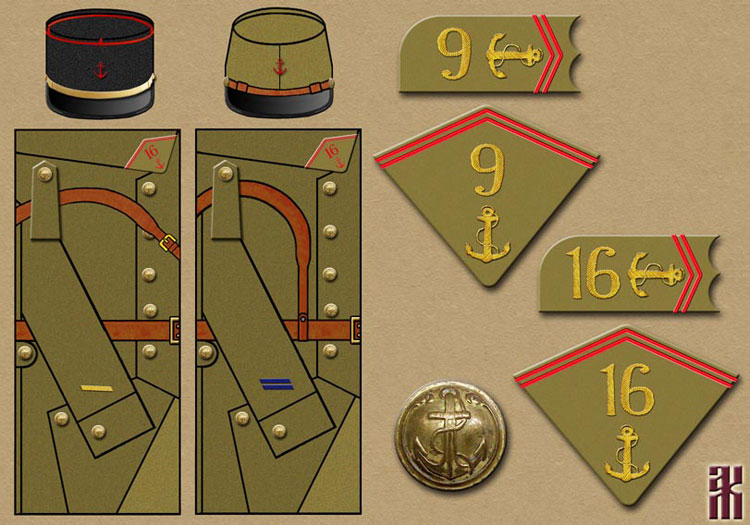
Uniforms of the 9th and 16th Colonial Infantry Regiments of the BCS:
1 and 2 – NCOs in winter uniform; 3, 4, 5, and 7 – officer tunic and greatcoat collar tabs
Both uniforms show a 1915 model greatcoat (double-breasted, with five buttons, simplified compared to the previous model and with a turn-down instead of a stand-up collar). However, the sergeant in Figure 1 can be distinguished by his kepi and officer's equipment. Both wear other ranks collar tabs for the 16th Colonial Infantry Regiment in plain red. The emblem of the colonial units was an anchor, which was worn on headgear and buttons, and from 1917 on collar tabs. The anchor served as a reminder that these units had previously been subordinate to the Ministry of the Navy and Colonies. The colonial infantry were assigned khaki-coloured tabs (until 1915 they had been the standard infantry colour, i.e. yellow), trimmed with double red piping. Officers preferred to embroider the emblems and ciphers with gold braid.
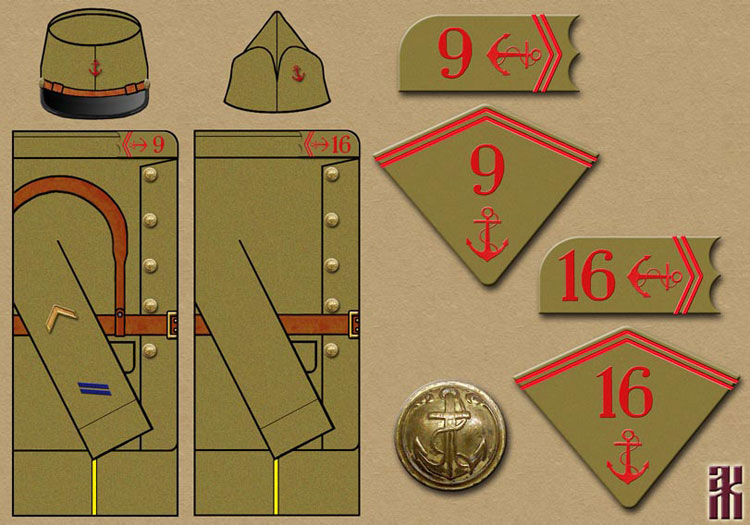
Uniforms of the 9th and 16th Colonial Infantry Regiments of the BCS:
1 and 2 – corporal and private in summer uniform;
3, 4, 5, and 7 – other ranks tunic and greatcoat collar tabs; 6 – button
Both Figures 1 and 2 are in colonial infantry summer uniforms of the special 1914 design which, unlike the single-breasted uniforms of the metropolitan infantry, were double-breasted, with two rows of five buttons. The headgear shown is a soldier's kepi and the sidecap introduced during the war. On the corporal's sleeve is a wound chevron, introduced in 1916 (it was gold or dark blue, depending on the proximity to the front line). Unlike the officer collar tabs, the emblems and ciphers were embroidered with just red silk thread or cut out of cloth.
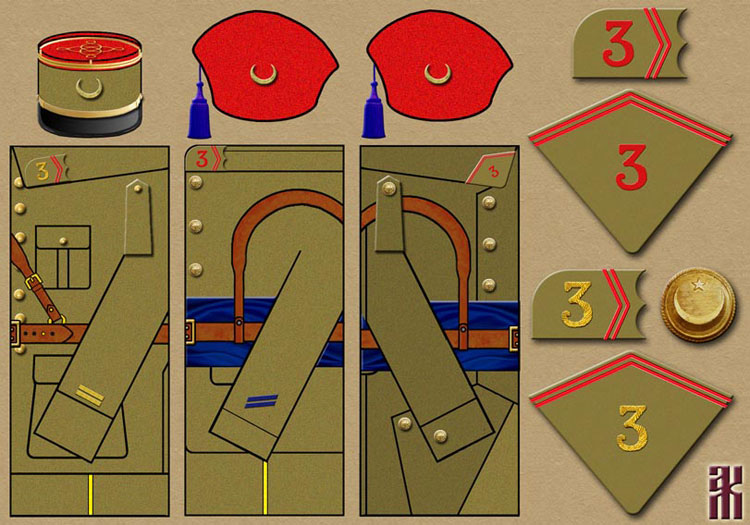
Uniforms of the 3rd Zouave Regiment:
1 – officer; 2 – corporal in summer uniform; 3 – private in winter uniform; 3 and 4 – other ranks tunic and greatcoat collar tabs; 5 and 6 – officer tunic and greatcoat collar tabs
Unlike the colonial infantry, the Zouave uniform, introduced in 1915, matched the cut of the metropolitan infantry uniforms (single-breasted with five buttons). Distinctive details of the Zouaves' uniform, retained from the previous coloured uniform, were the red fez with a blue tassel (a "sheshia") and a wide blue sash worn under the leather equipment. A khaki cover was provided for the fez in field conditions (and the tassels were removed), but it was often not worn, as was the case in Siberia. The emblem of the Zouaves was a golden crescent. The buttons had the crescent with a five-pointed star above. The Zouaves had khaki collar tabs with double red piping: officers' insignia were embroidered with gold thread, while those of lower ranks were embroidered with red silk thread (or cut out of broadcloth).
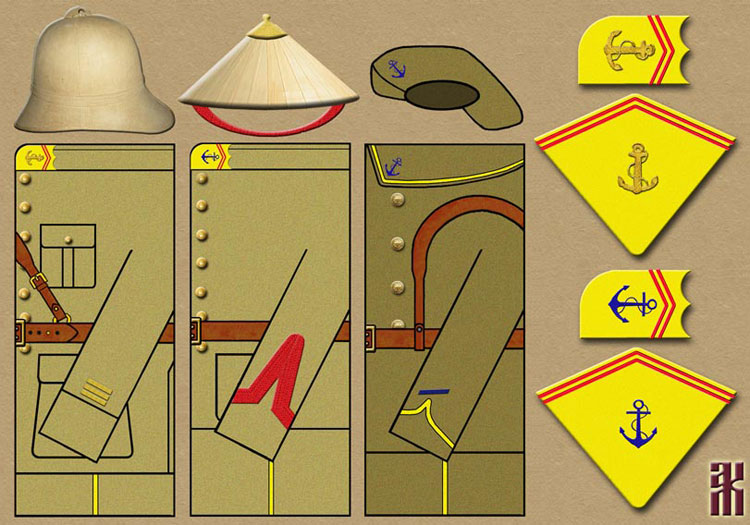
Uniforms of the Tonkin Rifles:
1 – officer in summer tropical uniform; 2 – rifleman in summer tropical uniform;
3 – rifleman in winter uniform; 4 and 5 – officer collar tabs; 6 and 7 – other ranks collar tabs
Figure 1 wears a cork helmet. Figure 2 is a tirailleur, as the colonial riflemen were called. The red braid on the sleeve indicates his rank of corporal. He wears the national conical bamboo hat, called a "Non", which was part of the uniform. Photographs show this is how the Tonkin Riflemen appeared in Vladivostok and Ufa in the summer of 1919. Figure 3 has the winter double-breasted khaki uniform with turn-down collar. Yellow piping on the collar, cuffs and trouser seams were introduced in 1916. The collar and beret featured a blue colonial anchor emblems. The Tonkin Rifles were assigned yellow collar tabs with double red piping and the anchor emblem, embroidered with blue silk thread for other ranks and gold thread for officers.
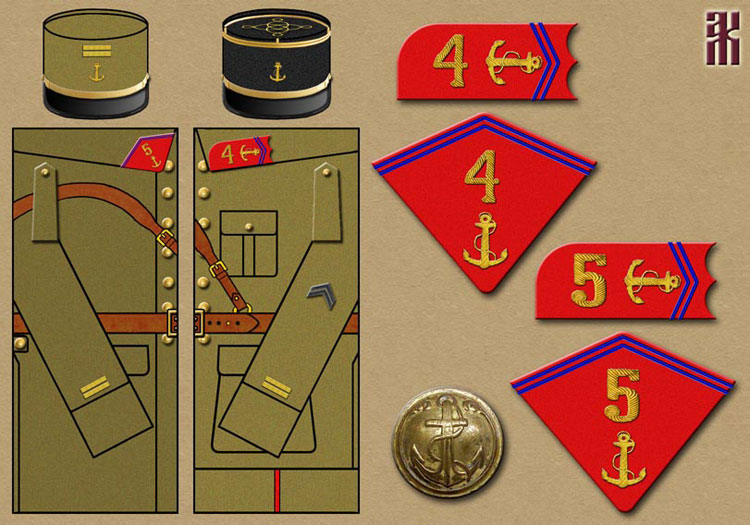
Uniforms of officers of the Siberian Colonial Battery:
1 – officer in greatcoat; 2 – officer in tunic; 3, 4, 5 and 7 – officer collar tabs
The French artillery's colour was red, used on the trouser piping and for the field of the greatcoat and tunic collar tabs. Officers had the regiment's number embroidered in gold, adding the colonial anchor from 1918.
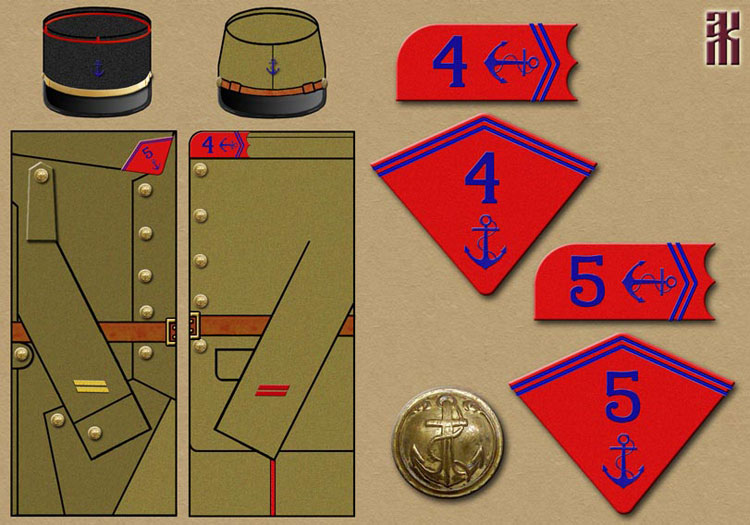
Uniforms of other ranks of the Siberian Colonial Battery:
1 – sergeant in greatcoat; 2 – corporal in tunic; 3, 4 6 and 7 – officer collar tabs
The tunic is the 1914 model, with a stand-up collar and no outside pockets. Judging by photographs, both field and everyday headgear were used, the latter being black with an embroidered anchor in blue for lower ranks (gold for officers).
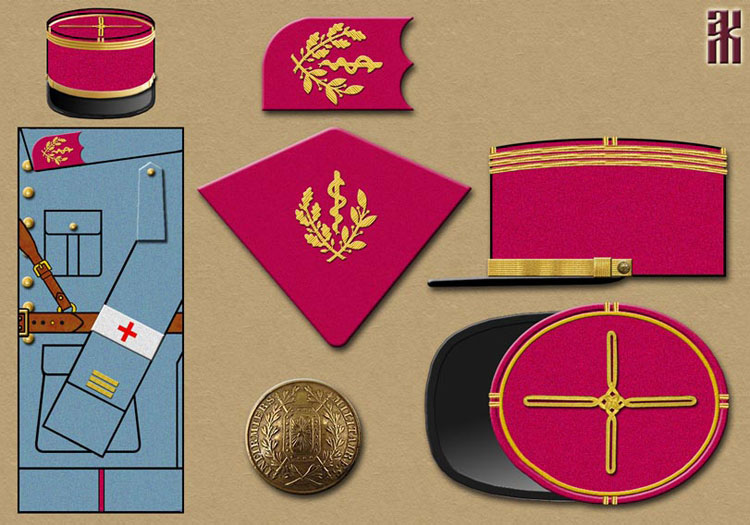
Uniform of French military medical officers:
1 – captain of the medical service; 2 and 3 – tunic and greatcoat collar tabs;
4 – button; 5 and 6 – kepi for a doctor
The insignia colour of French military medics was raspberry. The collar emblem was an embroidered image of the Rod of Asclepius, framed by a wreath of oak and laurel branches. The pattern on the top of the kepi is that for non-combatant personnel.
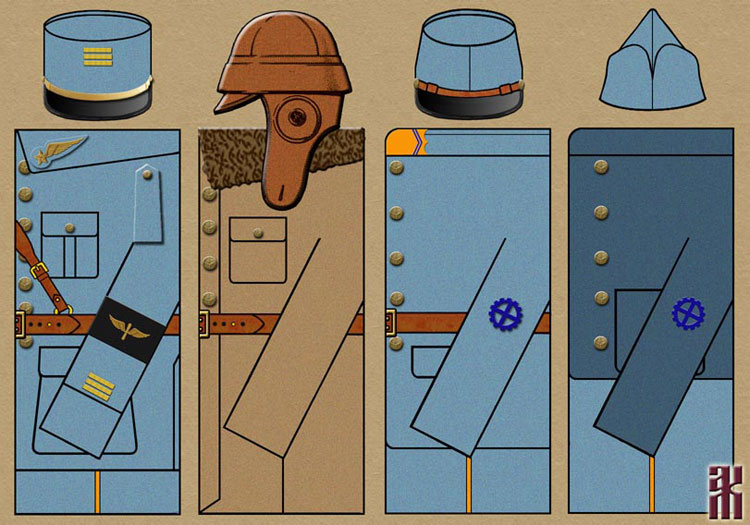
Uniforms of the French Aviation Detachment attached to the French Military Mission:
1 – officer in everyday uniform; 2 – officer in flight suit and leather flight helmet;
3 – technical personnel in tunic; 4 – technical personnel in work jacket and sidecap.
The standardisation of uniforms in aviation began in 1915: prior to that pilots wore the uniforms of the units from which they were seconded.
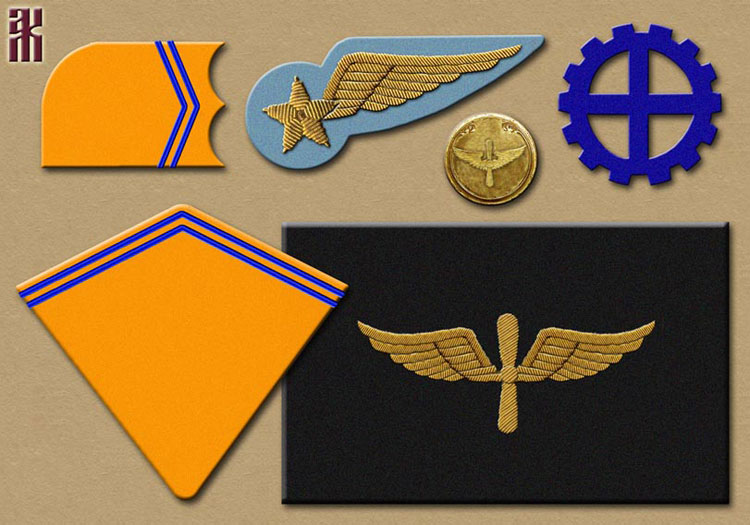
Details of the uniforms of the French Aviation Detachment:
1 – early tunic collar tab; 2 – later tunic collar marking; 3 – button;
4 – insignia of ground technical personnel; 5 – greatcoat collar tab; 6 – pilots' arm-band
The original aviation service collar insignia, introduced in 1915, was orange with double dark blue piping. In 1916 that was replaced by a winged star, embroidered on a horizon-blue field. However, both systems coexisted for some time. Technical staff wore insignia cut from blue broadcloth on their sleeves. Mechanics had gear wheels, gunners had crossed gun barrels under a flaming grenade, and electricians wore two circles with eight lightning bolts emanating out.
In early August 1919 one of the units of this detachment, consisting of three aircraft, arrived at the front. The planes were flown by experienced pilots, veterans of the First World War. The French aviators flew reconnaissance and aerial photography missions for about a month, delivering valuable information about the enemy and arousing the envy of Kolchak's pilots with their brand-new planes, reliable engines and smart uniforms.
Khairulin, M. in "Military Aircraft of a Fallen Empire: Aviation in the Civil War", Moscow, 2008.
Arrival of French troops in Ufa Headquarters, 6 December 1918
At 9 o'clock in the morning, representatives of the French consulate's administrative council, the garrison commander and representatives of the city arrived at the station. A large crowd gathered there. Finally, the Czechoslovak honour guard and the Samara Group's normal guard arrived, and at 10 o'clock they lined up. By this time, General Wojciechowski, commander of the Samara Group, had arrived with his staff. A little later, a train with the French national flag appeared at the end of the platform. Finally, soldiers in colonial uniforms began to appear, with the fez hats of the Zouaves standing out particularly sharply. The orchestra played a march to welcome them, and then the train stopped. The commander of the French units got out of the first-class carriage and, after introducing himself to the commander of the White troops, began to introduce his officers. At that moment, the second train arrived. The Zouaves lined up at the command of their officers. Honours were given to Commander General Wojciechowski. The latter greeted the valiant Allied troops and, turning to the guard of honour, proclaimed "hurrah" in honour of the arrival of the Allies. Amidst incessant cries of "Long live" and "Hurrah", the orchestra played "La Marseillaise".
Politkom Sorokin, "Northern Commune. No. 175", 10 December 1918 at zhagat-dadian.livejournal.com/26891.html
Home — State Symbols — Flags — Uniforms — Badges & Medals — Money — Other
Pygmy Wars Notes:
The original for this page is at kolchakiya.ru/uniformology/French_expeditionary_force.htm.
A couple of the unit numbers in the original page are different from French sources, and in particular French Wikipedia. I have indicated my changes with red font in the text. The topwar.ru page cited also states that three companies of Tonkin Rifles served in Siberia, which appears to be incorrect.
"Metropolitan" units were those from mainland France, as opposed to "Colonial" units and zouaves.
Discussion on the translation choices I have made can be found here.