
Uniforms of the Russian Army of the Supreme Ruler,
based on documents, memoirs and historiography
Material compiled and edited by A. Karevskiy.
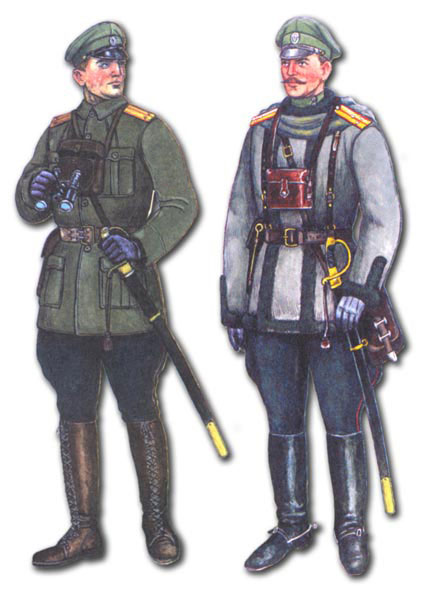
A popular view of the appearance of officers of Kolchak's Army
Illustration by Yu. Kashtanov
Kashtanov, Yu. in "Russian Military Costume", Moscow, 2005 and "Civil War in Russia", Moscow, 2006.
Insignia
Cockades were replaced by a tricolour national ribbon...
Konstantinov, S. I. in "Issues of Logistical Support for A. V. Kolchak's Russian army // History of White Siberia: Abstracts of the 3rd scientific conference, 2-3 February 1999", Kemerovo, 1999, citing GAPO F.656 Op.1 D.4 L.88.
The Ekaterinburg Art and Industrial School, commissioned by the Ministry of War, produced two samples of officer's cockades and one of a soldier's cockade.
Rudichenko, A. I. and Durov, V. A. in "Awards and insignia of the White Armies and governments", Moscow, 2005, p.130.
Order of the War Department No. 84 of 20 March 1919, Omsk.
The Supreme Ruler and Supreme Commander-in-Chief has ordered:
All distinctive insignia and badges introduced by various commanders for their units shall be abolished, retaining only, as special exceptions:
a) the insignia on the right sleeve of their tricolour national ribbon, established by the Volunteer Army of General Alekseev, now General Denikin, and
b) the blue insignia with a design on the left sleeve for the ranks of the regiment named after General Kornilov.
The right to wear these distinctions must be certified by special certificates obtained either from the Headquarters of General Denikin's Army or from the Chief of Staff of the Supreme Commander-in-Chief, Major General Lebedev.
Military units that have distinguished themselves in the struggle for the restoration of the Russian state, as at the time of the awarding of those distinctions had badges or stripes, should submit a request for the awarding of these distinctions to the Supreme Ruler for his consideration. When submitting such petitions, evidence from senior combat commanders must be provided confirming that the ranks of these units actually wore the insignia and that they performed heroic deeds.
Minister of War Major General Stepanov.
This document was kindly provided by Moscow researcher V. V. Romanov.
It became fashionable in the White armies to form sabotage units and assign them insignia in the form of skulls and other symbols appropriate for the most brutal and fanatical soldiers. However, these distinctive attributes, which undoubtedly raised the morale of soldiers in the days of victory, had the opposite effect when the other side prevailed, because if such a soldier was taken prisoner, his insignia and special equipment identified him as a particularly fierce enemy of the Soviet regime, and he was treated with particular cruelty. The surest way to avoid such a fate was to desert and flee, and select units did not shy away from this. One such unit was called the Immortal Regiment. "If this regiment", mused one war correspondent, "did not achieve immortality by emerging from battle without losses, it is not the fault of the officers and soldiers; they did everything humanly possible to achieve that."
Fleming, P. in "The Fate of Admiral Kolchak: 1917-1920", Moscow, 2007, pp.165-166
Chelyabinsk, January 1919
While adjusting my greatcoat, the tailor, with a sly smile, drew my attention to the shoulder-boards, which were sewn on with tightly. He hinted that if they "loosened", the shoulder-boards could easily be torn off. I pretended not to understand his hint. Who knows what kind of person he is. The fact is that Red Army soldiers did not wear shoulder-boards at that time. Kolchak introduced shoulder-boards in the White Army units as a sign of a return to the past. Among the White Army officers, it was considered particularly stylish to sew shoulder-boards on tightly. This meant: "Even if things get really tough, I won't tear off my shoulder-boards."
Lebedinsky, D. E. in "Shevchenko's Kurin: Lenin's Regiment // Combat Past: Memoirs", Kuibyshev, 1958, pp.202-222. Also at scepsis.ru/library/id_1673.html
Lack of greatcoats
Western Army, May 1919
Incidentally, despite all our efforts, we were unable to obtain and prepare greatcoats for all the march companies, and the men went to the front with blankets instead of greatcoats. Those blankets were carried rolled up during the day and used as raincoats at night. The men did not look like warriors at all.
Petrov, P. P. in "From the Volga to the Pacific Ocean in the ranks of the Whites, 1918-1922 // Admiral Kolchak's Eastern Front", Moscow, 2004. p.45.
Many reinforcements arrived at the front in brand new English uniforms, but... summer ones. There was only one broadcloth factory in the whole of Siberia, so greatcoats were in short supply. Starting in the summer of 1919, marching companies arrived at their positions with blankets instead of greatcoats. During the day, these blankets were worn rolled up over the shoulder, and at night they were used as raincoats.
Konstantinov, S. I. in "Issues of Logistical Support for A. V. Kolchak's Russian army // History of White Siberia: Abstracts of the 3rd scientific conference, 2-3 February 1999", Kemerovo, 1999, p.31.
There was another circumstance that gave the appearance of the White soldiers in Siberia a special diversity. The fact is that there, throughout the territory controlled by the Whites, there were absolutely no factories producing cloth, nor were there any significant stocks of it. Therefore, all uniforms, except for those taken as trophies from the Reds, had to be either sewn from imported materials or purchased ready-made abroad. Of course, there was a shortage of both, and the White troops, like the entire population of Siberia, existed in a state of constant "manufacturing famine". The worst situation was with greatcoats, which they tried to obtain from wherever possible. At the same time, ready-made uniforms were mainly supplied from England, while cloth, as far as can be judged, was primarily purchased in Japan. However, these two countries were not the only ones involved. ... There is evidence from B. B. Filimonov that during the Khabarovsk Campaign in the winter of 1921-1922, some of the soldiers of the 1st Rifle (Gludkinsk) Brigade and the overwhelming majority of the officers of the 3rd Plastun Brigade still continued to wear "cloaks (red-brown in colour, used by Admiral Kolchak's army and also worn by the 5th Polish Division)". Those were too thin and proved completely unsuitable for the Siberian winter. It can be assumed that these "red-brown cloaks" were in fact nothing more than old US Army greatcoats from 1883 or 1904, which were indeed reddish-brown in colour.
Petrov, A. A. in "Uniforms of the Jaegers and Cadets of Admiral Kolchak's Army Training and Instructor Schools: an Attempt at Reconstruction // Dobrovolets, No. 2 (4)", Moscow, 2004, pp.52-53.
Excerpts from a report at the 1919 Economic Conference:
As for greatcoats, woollen blouses and trousers, the January-April target was not met by the following amounts: 132,000 greatcoats, 157,000 blouses and 157,000 trousers were not delivered. It is not yet possible to supply all military units with both summer and winter uniforms. Therefore, some units are supplied with English uniforms, while others receive either khaki or cloth uniforms. ...
The issue of greatcoats, woollen blouses and trousers will encounter difficulties due to insufficient production of woollen cloth on the domestic market, its shortage on the Far Eastern market and the small amount of currency at our disposal. The British are providing 100,000 sets. The rest will have to be obtained by ourselves, and in this case, public organisations should be given the widest possible assistance. The task of providing summer uniforms in the first third of May will not be fully accomplished. It will be necessary to resort to combined uniforms. Units receiving British uniforms will not receive summer uniforms.
Gins, G. K. in "Siberia, the Allies and Kolchak: A turning point in Russian history, 1918-1920, Vol. 2", Beijing, 1921, pp.218-219.
Short coats for the army
The Ministry of Supply is concerned with the issue of providing Russian soldiers with warm clothing. There is a particular need for short coats. In the absence of sheepskin, the Ministry has decided to use hare skins. Contrary to the opinion that hare skins are unsuitable for this purpose, the Ministry of Supply has decided that they can be, changing only the design of the coats. The skins will not be fur outwards but fastened inside a lining. The order for coats has been forwarded to the Novo-Nikolaevsk District Representative of the Ministry. Currently, over 200,000 skins have already been procured. Offers to sell new batches of skins continue to come in, but for now it is assumed that the existing quantity will suffice. On 2 January, a meeting was held with tailors who wished to take on the production of the coats. It was decided to meet on the third day of Christmas for detailed discussions.
"Russian Speech, No. 4 (77)", 7 January 1919. Material kindly provided by Voronezh researcher N. Zayats.
Requisitioning
Decree of the Supreme Ruler of 18 March 1919
On the requisition of linen from the population in cities east of the Ekaterinburg-Chelyabinsk-Troitsk line, including those cities.
On the basis of Part 2 of Article 3 of the "Provisions on the Provisional Organisation of State Power in Russia" for the supply of underwear to the active army, I order:
1. Requisition linen from the population in cities east of the Ekaterinburg-Chelyabinsk-Troitsk line, including those cities.
2. That requisition shall be carried out by the civil authorities; in the theatre of war – by order of the army commanders and the commander of the 2nd Steppe Corps; in the rear, in areas declared to be under martial law – by order of the district commanders; and in all other areas – by order of the provincial governors.
3. The male population of the specified cities, employed in state, public or private service, is obliged to provide:
Those receiving a monthly salary:
| From 600 to 1000 rubles | 1 set of linen |
| 1001 to 1500 | 2 sets |
| 1501 to 2000 | 3 sets | Over 2000 | 4 sets |
5. On the same basis as the persons specified in paragraphs 3-4, linen shall be provided by all other persons liable to pay income tax for 1918.
6. The requisition shall be carried out as soon as possible, to be determined in their respective areas by the commanders of armies and districts and the governors of provinces (regions).
7. Receipts shall be issued for the receipt of linen requisitioned on the basis of this Decree.
8. The linen must be completely suitable for wear and presented in good condition. Each set of linen shall consist of au undershirt, underpants and a pair of socks or a pair of footcloths.
9. Requisitioned linen shall be sent to army warehouses in the theatre of war, and to the Omsk and Irkutsk clothing warehouses in the rear.
10. Persons in active military service shall be exempt from requisition.
(...)
12. Persons who have supplied fewer sets of underwear than required by this Decree shall, upon discovery, be subject to a fine of not more than 3,000 rubles or imprisonment for a term of not more than three months. The same punishment shall be imposed on those who have evaded the delivery of linen or who have been late in handing it over without valid reasons by the appointed deadline.
This Decree shall be enforced by telegraph.
Supreme Ruler, Admiral Kolchak
Chairman of the Council of Ministers, P. Vologodskiy
"Collection of Laws and Regulations of the Government // Published by the Governing Senate, No. 4", 30 April 1919.
Among the factors that irritated the peasantry was the government's ill-considered decision to collect uniforms for the army from the population. The government had neither the means nor the trained personnel to carry out this task, but the negative consequences were more than enough. "How many people did the government turn against itself by taking away their greatcoats, and how many did they take away? Only 5-10%, while 90% are still wearing them and boasting that we must not give in to the bourgeoisie, that they will leave us all naked," wrote a peasant from the Enisei province to P. V. Vologodskiy. "In the end, the same thing may happen with taxes ..." concluded the author of the letter.
Myshanskiy, A. A. The attitude of the Siberian population towards the "white" regime during the Kolchak period, citing GARF, F.176 Op.3 D.14 L.48-50. at www.zaimka.ru/02_2002/myshansky_whiteregime/
We seemed to be approaching Chulym. It was getting dark. We saw a peasant trudging along the road with a huge sack on his shoulders. When he saw us on horseback, he begged:
"Comrades, let me ride with you, I just need to put my things down."
"What are the things?"
"The Kolchakevtsy took me away with my cart. My horse died, so I'm walking home, carrying a harness, a saddle, some household items."
"Go ahead, put them down." We reached the village and, knowing the man, stopped at his place to rest. The owner dragged his bag into the hut.
"Well, tell me, owner, what kind of harness is that? It seems very heavy."
The owner took a bundle out of the bag: it looked like warm underwear. He untied it – soldiers' waist bands – quilted pieces of flannel with ties that Kolchak gave to his soldiers so that they would not catch a cold in the snow while lying in their rifle chains. He pulled out a second bundle – waist bands. The third – also waist bands. Only at the very bottom did he find a single pair of brand new American soldier's boots. The Red Army soldiers laughed so hard that the flame of the fat man's lamp flickered, and the owner swore desperately:
"Damn those Kolchakevtsy, I dragged this junk ten kilometres, I'm exhausted..."
Krasnopolsky, L. A. in "The Liberation of Novonikolaevsk from the Whites, End of 1919" at akmnsk.su/Raznoe/RevNovonik.doc [link dead]
Kainsk, 2 January 1919
In order to avoid misunderstandings and the appearance of persons not authorised to have military uniforms, I hereby declare:
1). The right to seize and detain items of military uniform in the city of Kainsk, as well as in its district, is granted to the head of the district police and his subordinate officers, but the latter only with the written certification of the head of the police.
2). Military uniforms are considered to be: grey soldier's cloth greatcoats or khaki Japanese greatcoats; blouses or tunics made only of khaki Japanese cloth or tent material; trousers made of the same material; quilted jackets and padded trousers of the same design; papakhi made only of grey imitation sheepskin of the quartermaster's design; boots, belts, felt boots and short coats with quartermaster stamps. Sewing non-military clothing from grey soldier's cloth, khaki Japanese cloth or tent material is strictly prohibited.
Head of the Kainsk Military District, Major-General Samaryanin
On the return of military uniforms
In response to a telegraph inquiry from the heads of the administrative department of the garrison command, regarding tunics, "French" coats, etc. The chief quartermaster of the district replied by telegram that tunics, "French" coats and other items not included in the list of uniforms and military clothing are not subject to surrender.
"Military Reports, No. 34", 3 January 1919. Material kindly provided by Voronezh researcher N. Zayats.
Corruption
The appalling planning, professional incompetence of officials and dilapidation of the railways would have been enough to disrupt the supply of the front-line Omsk armies, but widespread corruption exacerbated these insurmountable weaknesses and deprived the front-line units of the most essential supplies. A Russian naval officer, commander of a gunboat defending the bridgehead on the Kama River in the spring of 1919, paints the following picture:
The soldiers are dressed horribly, some literally in rags. Only a few have boots – most wear bast shoes or wrap their feet in burlap. Some wear sacks sewn together instead of military uniforms. The officers' uniforms are faded and worn out.
Another reliable witness spoke of an army corps in which the only equipment issued to officers in six months was a thousand pairs of suspenders.
Fleming, P. in "The Fate of Admiral Kolchak: 1917-1920", Moscow, 2007, p.145.
Allied supply
Our primary task was to supply the units with uniforms. Everyone without exception, from generals to privates, received a full set of "Tommy" uniforms, underwear, equipment, etc. In the Transcaucasus, our first task was to make sure that everyone was fed: there was enough food [in Siberia], but there was an extreme need for clothing. Only God knows how many millions of pounds were spent on Siberia by the British government. We always received what we considered necessary for our units. ...
Another case: we issued a complete set of British equipment to one unit, and a few days later we were surprised to hear that Chinese shopkeepers were selling some of that equipment. The unit commander was asked about it, and he admitted that he had "moved" certain items. His naive justification for this action was that "people were used to having one undershirt, one blouse, etc., so giving them two was pointless, and the money earned was necessary for the needs of the regiment." What can you say to that?
Latchford, E. U. in "With the White Army in Siberia", 1933
The intervention, as seen from Omsk, was already largely British. Seeing a parade of 10,000 troops in Ekaterinburg in early May 1919, Captain Hogreave-Graham of the Hampshire Regiment wrote in his diary:
As a Briton, I was most struck by the evidence of strong British influence and assistance. Ekaterinburg is just one of several dozen training centres, and the Siberian Army is just one of several Russian armies. However, when you watch platoon after platoon, company after company, battalion after battalion march past for an hour, all with British rifles and equipment, in British uniforms, boots and gaiters, you feel deeply shaken. The British band played British tunes.
Fleming, P. in "The Fate of Admiral Kolchak: 1917-1920", Moscow, 2007, p.161
We noticed that in the last days of June, many prisoners were dressed in green British uniforms. Now it became clear to us why there were rumours that British troops had come to Kolchak's aid.
"An Essay on the History of the 1st Peasant Communist Regiment // Under the Banner of the All-Russian Central Executive Committee", Moscow, 1963, p.114
In June 1919 the Omsk newspaper Herald of Finance, Trade and Industry "delighted" its readers with the news that:
Siberia is temporarily forced to supply itself with large quantities of low-quality Japanese cotton fabrics, both for the needs of the impoverished population and for the army.
General Budberg reports the same in his memoirs:
Our canvas and our village cloth are beyond comparison with the rubbish and rot that, under the guise of cloth, drill and various counterfeits of the most disgusting quality, are flooding in from abroad and are paid for with gold rubles; now, instead of broadcloth, we receive a disgusting Japanese substitute, consisting of various scraps rolled onto a cotton base, which falls apart after three weeks."
Livshits, S. G. in "Japan's Policy in Siberia in 1918-1920", Barnaul, 1991, p.68.
Omsk, August-September 1919
Trains began to arrive more and more often with typical English grey-green uniforms: with wide civilian-style caps, shoulder straps supporting cartridge pouches, short greatcoats, and low boots with gaiters or puttees ... And these worn-out clothes from someone else's shoulders were so offensive to the eye that the Siberians began to mistake Kolchak's soldiers for foreigners.
Ivanov, V. N. in "Exodus: A story about time and about myself // Far East, No. 12", 1994, pp.15-16.
Western Army, March 1919
When I got into the reserve unit's train, which was going to reinforce the front, I saw a completely different picture. Firstly, these units were completely undressed: they were not wearing grey soldier's greatcoats, as the regulars did, but their own, almost homemade tunics and coats, a wide variety of hats, and, worst of all, instead of boots, they wore felt boots, which became soggy from the onset of the thaw and wetness.
Lieutenant N. Notes of a White Guard // Admiral Kolchak's Eastern Front. Moscow, 2004, p.343.
Spring 1919
When I returned to the third battery two or three days later, I noticed that Grozovoy had undergone a major makeover. Instead of the old soldier's greatcoat that he wore in all weathers, he was now sporting a new khaki officer's tunic, and most remarkably, the tunic had buttons with the image of the English lion. It turned out that the night before, Grozovoy had gone behind enemy lines to the Whites. It was a completely unnecessary and dangerous raid. But Grozovoy achieved his goal: he captured a Kappel' officer and now flaunted his uniform.
Grozovoy's trophies attracted the attention of the entire regiment for several days. However, the glory was short-lived. After the first battles with Kappel's forces, English bags, tunics and greatcoats appeared on many commanders and soldiers of our division. The English lion did not help Kolchak's White Guards. Its image on buttons served as a good illustration for our commissars in their conversations about who the corrupt Omsk "supreme ruler" was working for. And Kappel' uniforms became something of a badge of honour for the Red Army soldiers. The further east our troops advanced, the more of these trophies we acquired.
A. Blagonravov. Comrade Grozovoy // Artillerymen. Published: http://militera.lib.ru/h/sb_artilleristy/11.html
September 1919
In September 2,500 from Siberia appeared in Tashkent. They said they had deserted from Kolchak's army, killed their officers, and gone over to the Bolsheviks. Many of them were dressed in British military uniforms with Royal Army insignia on their buttons and English belts. Some were in Chinese clothing. At first glance, these uniforms reminded me of home, but upon closer inspection, there was a noticeable difference between those wearing them, mostly in favour of our soldiers. I was annoyed by the sight of these undisciplined and unwarrior-like idlers in our uniforms on the streets of the city. The appearance of those people was not enhanced by the uniforms issued to them without any consideration for the sizes of the clothes or their owners. The newspapers were full of jokes about Tommy from Tomsk and similar witticisms. It was annoying to realise that we had given these ragged Red Army soldiers such excellent uniforms.
Bailey, F. M. in "Mission to Tashkent", Moscow, 2013, pp.202-203.
Kolchakovka caps
The most interesting thing is undoubtedly the White soldiers' headgear. It is made entirely of khaki-coloured cloth. Hats of this style were very widespread in Admiral Kolchak's troops from the spring and summer of 1919.
... From the summer of 1919, a "summer" version of a similar hat became widespread in White Siberia, which could rightly be called the "Kolchakovka" hat. It differed from the "classic" Nansen cap in that, firstly, it was made entirely of cloth (i.e., its neck flap with ears and front flap were not trimmed with fur), and, secondly, in addition to the vertical front flap, it also had a visor (apparently also covered with cloth). ... By the autumn of 1919 , the "Kolchak cap", which would probably be more accurately called the "summer version of the Nansen cap", had become very widespread among Admiral Kolchak's troops. It did not completely replace the papakha and peaked cap, but in many photographs, white soldiers can be seen wearing both peaked and these hats, and some units (again, judging by the photographs) were equipped exclusively with this new version of headgear. ... Incidentally, there is another interesting detail: while officers' caps typically had a cockade attached to the vertical front flap (which was sometimes replaced by a white and green "Siberian" ribbon sewn on at an angle), in the vast majority of photographs, the cockades were simply absent from the caps of ordinary soldiers. This may be due to a shortage of cockades, but it is also possible that the unusual appearance of this headgear was a distinctive feature of the White soldiers.
Petrov, A. A. in "Uniforms of the Jaegers and Cadets of Admiral Kolchak's Army Training and Instructor Schools: an Attempt at Reconstruction // Dobrovolets, No. 2 (4)", Moscow, 2004, p.52.
Omsk, November 1919
Some of the Omsk Army retreated in the cold in greatcoats, leather boots, without warm felt boots or ushanka hats ("Kolchakovkas"), a creation of the Siberian cooperative during the Civil War.
Ivanov, V. N. in "Exodus: A story about time and about myself // Far East, No. 12", 1994, p.35.
Poor Appearance
2nd Ufa Corps, May 1919
But the appearance of these Russian regiments was completely different from what they had always been before. It was as if they were not military units, but thousands of beggars gathered from church porches. Their clothing was very diverse, mostly their own peasant clothes, which they wore at home, but everything was worn out and tattered from continuous fighting and looked like rags. Almost all of them had torn boots, sometimes without soles at all; some still wore felt boots, while others had their feet wrapped in rags and tied with string; most of the Tatars wore bast shoes. Almost all of them had trousers with holes, through which their bare bodies could be seen. On top, they were dressed in whatever they could find: caftans, Tatar coats, peasant blouse, and only occasionally a soldier's uniform or blouse. The officers did not differ in appearance from the soldiers. They stood in formation, hung with bags and knapsacks with ammunition.
Sakharov, K. V. in "White Siberia // Admiral Kolchak's Eastern Front", Moscow, 2004, p.150.
How were we dressed? Variedly, but everyone except Kappel' wore felt boots with warm, ordinary socks inside; the socks were warm and reached to the knees. Over a regular pair of military trousers and a tunic, we wore a quilted coat. And over that, a sheepskin coat. On our heads, we wore fur hats. Gloves. The collar of the sheepskin coat was so high that it covered the entire head. Some people tied a scarf around their necks to keep it from opening. ... We sat down and our legs were covered with fur up to the knees. ... Still, if there was a breeze or in the morning, it would penetrate through the seams.
From the unpublished memoirs of General A. S. Shchepikhin at GARF F.6605 Op.1 D.10 L.43. Based on materials by V.Zh. Tsvetkov at http://1918.borda.ru/?1-5-0-00000010-000-0-0-1277650534
The arrival of the Kappelevtsy in Chita, early March 1920
And so the day came when the city was literally flooded with sleds and horsemen. All the gates were wide open, the courtyards were teeming with sleds and horses; people stood in rows along the streets – and wept. Because it was impossible not to weep at the sight of that beaten-up army, wrapped up in rags such as I had never before imagined. A short greatcoat (once an "English uniform"), wrapped in a blanket, tied at the waist with a belt. Around the neck was a piece of sheepskin, also tied with a rag, the head covered with a patched cap pulled down over the face, overgrown with a beard. On his feet were broken felt boots , the soles tied with wire, and a straw insole dragging behind. ... Sleds, sleds, sleds... In them lie patients tied with ropes, mainly typhoid sufferers, also wrapped in dirty, lice-infested rags. And here and there, half a dozen children, also tied to the sled, sticking out of the straw.
Kotomkin, A. in "The Czechoslovak Legionnaires in Siberia, 1918-1920: Memoirs and Documents", Paris, 1930, p.219
Order for the garrison of the Usolye district, 11 March 1919
On 9 March I attended a performance held in the dining room of the Soda Plant. I thought I had ended up in a Soviet area: many officers were unarmed; during the intermissions, officers and riflemen sat in the auditorium; soldiers entered the auditorium not only in greatcoats, but sometimes in headgear; and the police looked like bandits – in unbuttoned greatcoats, in papakhi and with rifles over their shoulders, they entered the auditorium and sat in that manner with cigarettes in their teeth in the buffet room.
Freedom and equality do not mean licentiousness and filth. The police should serve as an example to citizens. I instruct the Chief of Police to pay attention to the disgraceful appearance of the police officers. The commandant of the Usolye district shall appoint, in agreement with the regimental adjutant, a duty officer for all performances, soirés and public entertainments, who will be responsible for ensuring that military personnel comply with military regulations. Officers, military officials and riflemen may not sit during intermissions. Those who find this embarrassing are given the right by law to wear civilian clothes. It is permissible to sit in the buffet room, but one must stand up when a senior officer passes by for the first time. The police must ensure that citizens do not enter the auditorium and buffet room in formal dress and headgear. It is time to forget the ways of the Soviet Union: the salvation of the Motherland demands it.
This order is to be read in all companies and komands of the Usolye, Lenva and Dedyukhin garrisons.
Garrison Commander, Acting Commander of the 25th Tobolsk Siberian Rifle Regiment, Lieutenant-Colonel Bordzilovskiy
Regimental Adjutant, Second-Lieutenant Feofilov
"Siberian Rifleman, No. 15", Usolye, 15(2) March 1919, published by the user "Voiskovoy Starina" at siberia.forum24.ru/?1-9-0-00000127-000-0-1-1341505997
Omutninsk District, Vyatka Province, 30 April 1919
In the last days of April, between approximately the 26th and 29th, there was intense movement of the Whites one morning, with soldiers running around like madmen. Peskovka was declared under martial law. On the 30th the Whites moved all their forces to Kirs. The soldiers marched in bast shoes and caps, without greatcoats or rifles, their heads bowed. It was clear that they had no life, no spirit, the spirit with which they had taken Peskovka.
Fofanov, V. in "Thirty-five days under White rule // Solonitsyn, N. October and the Civil War in the Vyatka Province", 1927, p.161.
Order No. 4 of Lieutenant-General Diterikhs, Commander-in-Chief of the Eastern Front
Having travelled around the front, I was struck by the reports I received from the commanders of the Siberian army. The troops are starving, the troops are undressed: the central authorities give out nothing and do not care about the army; hence the discontent of the soldiers, officers and everyone else. The army commander reported the same to me. Meeting the troops, I really saw it. The guard of honour was in winter fur hats; bare bodies peeking out from under summer blouses; feet in low boots, but without puttees; greatcoats were the exception. But in the army rear, everyone was dressed.
"On Guard for Freedom, No. 10", 25 August 1919
Between 26 March and 5 April, Colonel Bordzilovskiy inspected the 3rd, 5th, 6th, 7th, 8th, 11th and 12th Companies and the trench artillery komand at the front. The companies had grown two to three times in size compared to Usolye. The 3rd Company was particularly powerful (500 bayonets, including 30 horsemen and 100 skiers). The men are well-trained and look good. They are armed with three lines captured in battle. They are poorly dressed and shod. Many are wearing felt boots, even though it is already spring. Some riflemen are wearing bast shoes. The regiment's services can provide boots for less than half of them.
"Tobolsk People's Word", 20 April 1919, quoted in Sitnikov, M. G. and Veber, M. I. in "In military affairs, if I ever knew anything, I forgot it long ago: Lieutenant A. M. Smirnov's report on Major General A. V. Bordzilovsky // Idnakar: Methods of Historical and Cultural Reconstruction: Scientific and Practical Journal: Izhevtsy and Votkintsy in the civil war, No. 1 (30)", 2016, p.205.
From a Soviet newspaper
We reproduce in full (with the exception of details of a purely personal nature) a letter from a comrade-artilleryman on the eastern front:
We marched through forests and fields, along the banks of the Kama. We are now in the foothills of the Urals. A harsh but beautiful area.
Our regiment has already dealt with twelve enemy regiments. The White regiments consist of people of different ages, dressed in rags and bast shoes or fur coats and rubber gaiters (which we happened to pick up during their retreat), armed with rifles of various models, under the command of officers wearing shoulder-boards, which we take as trophies. Only the last regiments of the Whites to arrive at the front are uniformly armed with Russian 3-line rifles of American and English manufacture (Remington and Westinghouse). The cartridges are of English and American manufacture, the machine guns are mostly of American manufacture, the shells are French, etc. In short, they are dependent on the Allies.
The regiments, at least those we dealt with, consist of Russians and Russian-foreigners; we did not encounter any Czechs or anyone else. Everyone wears shoulder-boards, even those who do not have a uniform greatcoat, but many of the conscripts wear shoulder-boards in their pockets. All the officers have gold shoulder-boards. There are officer assault companies.
"The Red North, No. 39", 18 June 1919. Material kindly provided by Voronezh researcher N. Zayats
Soviet underground intelligence report on the state of the White rear, November 1918
Uniforms. The lack of uniforms for the troops is striking. Other than the Czechs, until the beginning of November their troops had no greatcoats and wore only blouses. In some places, with few exceptions, the conscripts wore their own clothes until they were sent to the front. Due to the shortage of greatcoats, they resorted to forcibly confiscating them from peasants who had come to the city from the front, as well as from the city's residents. In general, all government-issued uniforms were taken from the population. At one time, the source of the influx of uniforms (greatcoats, boots, blouses, etc.) was prisoners of war returning from Austria-Germany and receiving uniforms here. Upon arrival, they were literally stripped naked, without being given anything in return. Our [captured] Red Army soldiers are stripped bare and sent to the camps almost naked. They are not issued with government-issued footwear.
As bad as the uniforms of the conscripts are, the Czechs, Cossacks and officers are well-supplied; the latter three categories literally want for nothing – they have everything they need in sufficient quantities.
"On the work of underground Bolshevik organisations in Siberia (1918-1919) // Historical Archive, No. 2", 1962, p.105.
Discipline
In one of his last orders to the Tomsk garrison troops, the garrison commander announced: "Despite my repeated orders to the garrison, military personnel are still being seen on the streets of the city dressed out of uniform, without shoulder-boards or cockades, and completely unable to salute. I reiterate and order the commanders of military units, institutions and establishments of the garrison to exercise the strictest supervision so that only military personnel who are properly trained and able to perform military honours in a dignified manner and who are dressed in uniform are allowed to leave the city; in the absence of cockades on their caps, they must wear national tricolour ribbons.
"Siberian Life, No. 193", 13 September 1919
Army supplies
N. I. Mashinsky and several other members of the army supply bureau of the Council of Trade and Industry visited the largest industrial areas in order to assess the possibility of using these areas for army procurement, such as Shadrinsk and Tyumen, where the production of felt boots and sheepskin coats is highly developed.
N.I. Mashinsky recently returned from his trip and shared his impressions with our colleague.
According to Mashinsky, the main obstacle to the rapid and productive supply of the army is the existence of several organisations working in parallel for the same purpose, which in fact have to compete with each other. In addition, procurement suffers greatly from the fact that the authorised representatives themselves are not specialists in the items they purchase. As a consequence of the latter circumstance, Mashinsky recounts the following fact: during his trip, accompanied by his companion, an old, experienced boot manufacturer, he visited one of the representatives of the Ministry of Supply. The manufacturer was interested in the quality of the boots, which were mainly being purchased by the representative at that time. They went to the warehouse where the boots were stored. The manufacturer took one of them, crumpled it in his hands, looked at it critically and shook his head, but said nothing to the representative. He called over a soldier standing nearby, asked him to put on the same fur boots and walk to the station and back, which was 6 kilometres. The soldier returned after a while. And what happened? Those fur boots, which at first glance looked quite decent, after walking 6 kilometres in them, were almost completely worn out.
It turned out that the batch of fur boots had been made by artisans who, knowing the representative's expertise in the manufacture of them, had slipped him this product. The artisans were not mistaken: the goods were accepted.
N.I. Mashinsky will submit a report to the Supreme Ruler. The report will mainly point out the need to create a supreme body for supplying the army, which would unite and direct all the activities of organisations working to supply the army.
"Military Gazette, No. 66", 15 February 1919. Material kindly provided by Voronezh researcher N. Zayats.
The most important thing in a soldier's life is footwear, and I can say that our soldiers are provided with footwear. There is a shortage of autumn uniforms for soldiers. Instead of greatcoats, they have begun to issue, albeit prematurely, sheepskin coats. At the moment, soldiers are dressed in a motley fashion, and many do not have greatcoats. This is due to the low productivity of our cloth factories and the fact that, for some reason, we did not receive the cloth that we expected to receive from abroad in a timely manner. Soldiers are replacing greatcoats with short coats. Winter uniforms are being energetically prepared by the Ministry and some have even been transported; all that remains is to transport the rest and distribute them. Then the army's most pressing need will be met.
"Our Newspaper, No. 38", Omsk, 27 September 1919. Material kindly provided by Voronezh researcher N. Zayats.
Cadets of the Vladivostok Naval Academy, Summer 1919
During these expeditions, I remember our boots. One of the Vladivostok port quartermasters made a fortune on those boots. The boots looked decent on the outside (made by the Japanese government), but they lasted no more than a month. That's why there was a huge box with those boots in the armoury: you could take as many as you wanted. So on expeditions to catch bulls we had to change up to two pairs of boots, as they were completely torn by the stones.
Sokolovsky, S. I. in "Northern Voyage on the Diomede in 1919 // Bulletin of the Naval Academy", Lakewood, 1971, p.30
18th Tobolsk Siberian Rifle Regiment
"On 17 December 1918, a letter from Colonel Kiselev, commander of the 18th Tobolsk Regiment, was published. In it he claimed that the warm clothes sent by the residents of Tobolsk to the regiment had not arrived. According to his information, they were being held by the local city command. The regiment's doctor, Belavin, wrote that 11 warm blankets had arrived on 15 December. Finally, a letter arrived stating that the warm clothes from Tobolsk had arrived at the Tobolsk regiment on the front line and had been distributed between 12 and 16 December 1918. The quartermaster of the regiment, O. Toporkov, ensigns Khomyakov and Utkin, and Cadet Zorin confirmed (letter No. 99) that a shipment of warm clothing had arrived at the regiment – 100 sheepskin coats, 50 pairs of felt boots, 135 warm footcloths, and 11 fur blankets for transporting the wounded. Colonel Kiselev did not apologise to the townspeople, although three months earlier, when the regiment had 150-200 bayonets, he claimed that the regiment had received several pairs of underwear, a small amount of tobacco, etc., when in fact the regiment had received 325 pairs of underwear, 90 kg of tobacco, 5 feet of smoking paper, 20 pouches, 20 pairs of hospital linen, pillowcases, sheets, bandages, and robes for medical personnel.
"Tobolsk People's Word, No. 164", 21 March 1919, quoted in Sitnikov, M. G. and Veber, M. I. in "In military affairs, if I ever knew anything, I forgot it long ago: Lieutenant A. M. Smirnov's report on Major General A. V. Bordzilovsky // Idnakar: Methods of Historical and Cultural Reconstruction: Scientific and Practical Journal: Izhevtsy and Votkintsy in the civil war, No. 1 (30)", 2016, p.199.
Dear Sir, Editor!
Issue No. 100 of your respected newspaper contains an article entitled "Gifts to the front". In this article, the author calls on the population of Irbit not to forget the front. I consider it my duty on behalf of the entire regiment to declare that the good citizens of Irbit and its district have not forgotten the regiment. Despite the fact that Irbit helps four regiments, we very often receive valuable and necessary items. How pleasant it is to receive gifts, albeit few in number but valuable, in the deep snows of the Urals in the far north. With love and deep gratitude to the dear people of Irbit, officers and soldiers wear fur stockings and sheepskin coats sent from Irbit.
Commander of the 18th Tobolsk Siberian Regiment, Colonel Kiselev, 25 December 1918
"Irbitsky Vestnik", 4 January 1919, quoted in Sitnikov, M. G. and Veber, M. I. in "In military affairs, if I ever knew anything, I forgot it long ago: Lieutenant A. M. Smirnov's report on Major General A. V. Bordzilovsky // Idnakar: Methods of Historical and Cultural Reconstruction: Scientific and Practical Journal: Izhevtsy and Votkintsy in the civil war, No. 1 (30)", 2016, p.344.
Other
Blagoveshchensk, March 1919
Even officers are not immune to insults from Japanese troops. The station commander at Blagoveshchensk Station, an elderly lieutenant-colonel wounded in the leg during the war, was unceremoniously pushed by Japanese soldiers before my very eyes. They almost beat him up to stop him from passing through the station. Even though the commandant wore a white arm-band with an inscription in Japanese indicating his position. ... Such is the attitude of the Japanese here in the Amur region, where they already present themselves to the population as conquerors, and even our officer and Cossack detachments do not dare to fly their national flag, but always wear Japanese insignia and obey Japanese commands, which must be very offensive to our national pride.
"Report on the business trip of Captain Muravyov, an employee of the military statistics department of the district headquarters of the Amur Military District, to Blagoveshchensk from 4 to 31 March 1919 // RGVA F.39507 Op.1 D.47 L.31-36.
Retreat of Kappel's forces from Krasnoyarsk, December 1919
In Atamanovo, Sukhobuzimsky District, a militia was formed, led by St. George Knight Pavel Kochergin and former front-line soldiers Daniil Kulikov from Atamanovo and Efim Belyaev from B. Balchug. We were informed from the city that Kolchak's troops were coming. We decided not to let them into the village. On the morning of 25 December, Christmas Day, we disarmed a detachment of Cossacks – 40 men – which turned out to be a reconnaissance platoon. And practically all the men, about 150 of them, rode out on horseback and in carts towards Shivery with their guns. Halfway there – and it is 12 kilometres from Shivery to Atamanovo – they saw many thousands of soldiers advancing. Of course, they turned back, but the Cossacks caught up with three peasants and hacked them to death. Many residents abandoned their homes and crossed the Enisei River to their huts in the forest. Cavalrymen in fur hats with black ribbons diagonally across them rode up to the gathering place where the headman Ivan Tyumentsev was sitting. ... One of them grabbed a revolver and shouted, "What are you doing spreading the red plague here?!" and shot the headman, wounding him in the arm.
Chernyaev, F. F. and Guzhevsky, V. E. in a 1967 recording "Atamanovo" by Aferenko, V. A., local historian and member of the Union of Journalists of Russia. Also at www.siberia.forum24.ru/?1-11-0-00000005-000-10001-0-1262800058
Kadchina, 21 February 1919
A stocky, short man in an officer's greatcoat stuck his rifle into the snow and slowly approached me. I don't know why, perhaps out of confusion, he pushed his fur hat back from his broad forehead, shook my hand, and said softly:
"Ah. So you're the one in charge here?"
I recognised him: he was my namesake. Ivan Trofimovich Kopytov, a fellow countryman from my district. His shoulder-boards bore the distinctive insignia of a lieutenant, drawn with a chemical pencil.
Kopytov ,F. in "In the battles of the Northern Urals", Sverdlovsk, 1965, pp.18-19
"Barabinskaya Steppe [newspaper], No. 95", 7 January 1919. Material published "Barabash" at siberia.forum24.ru/? 1-8-0-00000044-000-0-1-1345318925
In Perm, as already reported, a performance is being prepared or was being prepared. Everyone has their own uniforms, and only the boots are ready.
"Among Kolchak's troops // News of the Petrograd Council of Workers' and Red Army Deputies, No. 110", 19 May 1919.
March reinforcements for the Krasnoyarsk garrison
The prisoner-of-war camp, located seven kilometres from Krasnoyarsk, was part of a military town – a typical military town of the Tsarist era. One half of it was never completed, while the other consisted of barracks dug into the ground. When I arrived at the camp, Russian units of Kolchak's White Army were being formed in the town. They were mainly recruiting privates, who, after a short period of training, were sent to infantry units. The NCO needed to train the soldiers were also selected here. The training took place right before my eyes. The composition of the NCO instructors remained almost unchanged – every day I watched them take turns on guard duty. The soldiers' military uniforms with blue and red braid resembled Chinese uniforms. The soldiers were trained on the training ground, right under our windows, and they did it thoroughly. The drill lasted a month, and then the march companies were sent to the front.
Mate Zalk, "Krasnoyarsk Memories // About the October Revolution: Memories of participants and eyewitnesses", Moscow, 1968, p.82.
Omsk
In our city, there is a special profession of people engaged in dyeing fabric, cloth, clothing, and dresses, mainly in black, but often in brown. During August and September of this year, the dyers had so much work that they could barely keep up with customer demand. They dyed exclusively brand new overcoats of various types and styles, blouses, trousers, army cloth, tents and, in general, all items of soldiers' uniforms.
"Russian Speech, No. 214 (287)", 4 October 1919. Material kindly provided by Voronezh researcher N. Zayats.
Home — State Symbols — Flags — Uniforms — Badges & Medals — Money — Other
Pygmy Wars Notes
The original for this page is at kolchakiya.ru/uniformology/features_regimentals.htm. It has been edited to remove duplicated material and to group it more into themes.
"Russian-foreigners" is russki inorodtsy, which refers to Kazakhs, Altai, Mongols etc, who were Russian citizens but with a different legal status. Discussion on the other translation choices I have made can be found here.