
Draft Uniform Design for NCOs and Other Ranks of the Navy in Eastern Russia, 1919
All material and reconstructions are by A. Karevskiy unless noted otherwise.
On 25 December 1918 Perm was liberated by the Siberian Army, and among the trophies was a large number of steamboats suitable for arming. Perm thus became a natural base for the creation of a new powerful river flotilla, which, with the start of navigation, was to move down the Kama, defeat the Red flotilla and reach the Volga.
It was decided to urgently replenish the experienced personnel of the former Volga combat flotilla with new recruits and to try to train them professionally over the winter. It should be noted that although Admiral Kolchak attracted many naval officers to Siberia, the bulk of the White Fleet's officer corps consisted of wartime officers, including land forces. The rank and file was made up partly of civilian sailors and river men, and for the most part of mobilised students and high school pupils. Former sailors of the Imperial Russian Navy were not recruited into naval units and subunits because of their unreliability. Due to the constant shortage of personnel, attempts were made to recruit volunteers, but there was no significant influx of new recruits into the fleet.
The personnel of the future flotilla needed to be supplied with uniforms, but there were no necessary supplies of naval uniforms in Siberia. It was necessary to urgently organise their mass production or purchase them abroad. On 31 January 1919, Rear Admiral V. V. Kovalevskiy sent a request from Omsk to Vladivostok:
Please make urgent inquiries with local firms, or, as a last resort, with foreign firms. It is necessary to find out how and within what time frame it is possible to supply the Navy with 8,000 sets of land uniforms and 2,000 sets of naval uniforms in finished form. If it is not possible to supply them in finished form, is there enough material to sew these uniforms in the port sewing workshop?
On 14 February Captain P. I. Krasheninnikov replied. He reported that at that time, several companies had submitted proposals to supply all sets of sailor and soldier uniforms made of good materials and at a relatively favourable price within 50 days according to "our samples", with only the linen canvas being replaced with another material. As for the procurement of materials and the subsequent sewing of uniforms in sewing workshops, this would undoubtedly be more expensive and take longer due to the lack of a sufficient number of experienced tailors. Krasheninnikov requested a prompt response and, in the event of a positive decision, the immediate transfer of funds.
Kovalevskiy immediately demanded that a contract be concluded, only changing the order to 7,000 sets of soldiers' uniforms and 3,000 sets of sailors' uniforms, adding 7,000 sets of underwear to this. He specified that the sailors' uniforms should be sewn according to the model brought to Omsk by Senior Lieutenant N. S. Kharin, and promised that the approved designs would be sent in two weeks.
On 1 March Rear Admiral Timirev telegraphed from Vladivostok that the urgent procurement of uniforms had begun, but that the process was being slowed down by the lack of samples and descriptions of naval uniforms. The next day, the Minister of the Navy, Rear Admiral Smirnov, in Omsk, added the following resolution to this telegram: 'Establish the uniform as brought in the samples by Senior Lieutenant Kharin, work out the details on site.'
Description of the Uniform from Cadets, Conductors and Volunteer Sailors
Cap without a visor. Made of dark blue (almost black) cloth; brim width 4 cm, crown height 6 cm without a frame and with an elastic band to hold it in place in windy conditions.
Cap ribbon. Black silk ribbon with the name of the ship or unit; letters embossed in gold, Slavonic script. Ribbon width approx. 3.5 cm; ribbon runs around the brim, has short ends tied in a bow on the right side of the cap.
Cockade on cap. Model for lower army ranks.
Cap with visor and chin strap. Made of dark blue cloth: large visor made of lacquered hard leather, almost straight, with a slight downward slope; chin strap made of lacquered soft leather, fastened to the cap with two small copper buttons with anchors.
Cockade on the cap. For midshipmen and conductors the officer's model, and for boatswains the model for lower army ranks.
Covers for caps. Made of white cotton fabric, fits over the bottom and crown of the cap up to the brim.
Tunic for midshipmen. Made of dark blue broadcloth, single-breasted, fastened with four gilded copper buttons with anchors; pockets with flaps are sewn on both sides of the chest; straight pockets are cut on the sides of the tunic. Shoulder-boards are made of the same material, with narrow gold braid sewn along the edges and a gold anchor in the middle of the shoulder-board. The jacket with a turn-down collar and lapels is worn with a white shirt with a starched collar and a long silk tie.
Trousers for midshipmen. Made of dark blue cloth of the standard type.
Boots for midshipmen. Black leather lace-up boots with straight toes.
Tunic for conductors. Made of dark blue broadcloth or cheviot, double-breasted, with three copper buttons with anchors on each side, straight pockets cut on the left side of the chest and at the bottom on both sides. Shoulder-boards made of the same material with a wide gold braid sewn in the middle; worn with a white shirt with a starched collar and a long black silk tie.
Trousers for conductors. Made of dark blue broadcloth of the standard pattern.
Boots for conductors. Black leather lace-ups with straight toes.
Uniform for boatswains. Made of dark blue broadcloth or cheviot, single-breasted, fastened with four copper buttons with anchors; on the left side at the front there is a patch pocket with a flap, with the insignia of the speciality and rank stripes sewn on it. Shoulder-boards of the same material with rank stripes sewn on them [in a chevron], pointing downwards.
Flannel blouse. Made of dark blue broadcloth or smooth flannel with a large turn-down collar of the same material, straight sleeves without cuffs; on the left side there is a pocket with speciality insignia, for boatswains there are insignia on both sleeves at the forearm and on the pocket above the speciality insignia; seven small black buttons are sewn near the neck of the collar to fasten the cotton collar. The entire blouse should have a loose fit, tapering towards the hips, with a length reaching the leg slit.
Blue detachable collar. Made of blue cotton with three white stripes woven on three sides (side and bottom). There are 7 loops sewn onto the upper edge of the collar for attaching it to the cotton collar. Knitted, made of cotton with long sleeves, all white, with one narrow blue border at the collar.
Trousers made of dark blue broadcloth with a flap at the front and stats under the flap. The flap has two black buttons on each side for fastening the trousers. A black leather belt with a black metal buckle is sewn on the back to tighten the trousers. Pockets are cut into the longitudinal seams on both sides with fasteners made of small triangular pieces of black leather at the bottom of the pockets. The trousers are flared at the bottom.
Formal tie. Long, made of black silk, worn under the turn-down collar of a flannel blouse or work dress, with the long ends tied in a knot at the bottom of the front slit of the blouse.
Pea coat. Made of thick dark blue broadcloth or drape, double-breasted, with six copper buttons with anchors on each side. Lined with black beaver or other warm fabric. The pea coat should fit loosely (it is designed to be worn over a flannel blouse or work dress), but without excessive fabric. Turn-down collar with hook and loop fastening. Shoulder-boards made of the same fabric. A speciality badge is sewn onto the left sleeve above the elbow. Insignia are sewn onto both shoulder-boards with the chevrons pointing downwards, and onto the left sleeve above the speciality badge.
The work top is white. Made of white canvas or other suitable fabric, straight at the sides, tapering towards the bottom. A pocket is sewn on the left side of the chest. The collar is low, with 7 small black buttons sewn to it for fastening a blue collar made of cotton. The length and width of the blouse are the same as those of a flannel blouse. The insignia and stripes are sewn onto separate patches of the same material and, by means of laces sewn onto these patches, are tied to the left sleeve above the elbow, for which purpose eyelets are sewn onto the sleeve in the appropriate place.
Trousers for work clothes. Made of the same material as the blouse, sewn according to the pattern of black cloth trousers.
Three-quarter boots. Made of black leather, smooth, with laces, with wide toes.
Boots with long uppers. Made of black leather, with wide toes.
Canvas shoes for summer. Made of grey or yellow canvas with leather soles and heels. The shoes have three eyelets for lacing and laces in the same colour as the shoes.
Coat (greatcoat). Made of dark blue broadcloth or drape. Double-breasted, with 5 copper buttons with anchors on each side. Lined with dark flannel or cotton. Sleeves with cuffs. The collar is wide and can be turned up in cold weather to cover the entire neck; the collar has a small flap of the same material with two loops for fastening when turned up, and two black buttons are sewn onto the corresponding place on the back of the collar to fasten the flap. The coat is completely loose, flared at the bottom, and has a wide flap made of the same fabric at the back for tightening, fastened with two copper buttons with anchors. The pockets are cut diagonally. The shoulder-boards are made of the same fabric. A speciality badge is sewn onto the left sleeve above the elbow, and above the speciality badge there are striped in a chevron with the corners pointing upwards and the same stripes in a chevron with the corners pointing downwards on the shoulder-boards of the coat.
Gaiters for boots. Made of brown canvas with leather straps. Black lacing on the outer sides. The gaiters should be of such a height that the trousers are not visible when the coat is worn.
Belt with a belt buckle. Wide, black leather. Copper buckle with a double-headed eagle.
This version differed significantly from the uniform of the Imperial Russian Navy and in many features copied the uniform of the British Royal Navy. For example, the ribbon on the sailor's cap had short ends in the form of a bow above the right ear. It is also worth noting the chevrons on the shoulder-boards of NCOs instead of the Russian straight stripes, which were also duplicated on the outer clothing. In addition, an English-style dress tie was introduced for sailors, the blouse lost its blue stripes, and, finally, lace-up boots and canvas gaiters appeared.
In general, of the traditional uniform details unique to the Imperial Russian Navy, only the shoulder-boards of conductors, midshipmen, and Russian cockades remained in this project. In addition, the drawings themselves are sloppy, bear traces of haste, and there are many discrepancies between the approved colour drawings and the accompanying description. Thus, in the original version of the drawings, the colour of the jackets, uniform blouses, trousers and caps was light blue, and that of the overcoats was dark grey, almost black; in the approved drawings, the jackets, trousers and caps are depicted as grey-blue, even with a slight purple tint, while the overcoats are still grey-black; finally, in the text, all these items are described as dark blue. But what is even more interesting is that in the approved drawings, the colour of the shoulder-boards and cap bands for conductors and midshipmen is shown as black (with grey-blue tunics and cap crowns), while in the description it is dark blue (the same colour as the tunic and cap crown).
Incidentally, it was here that the famous flared trousers, which became widely fashionable after February 1917, were officially approved for the first time for sailors of the Russian fleet. ...
No order introducing this uniform has been found, but the available documents allow us to conclude that the order for the sewing of the naval uniform was placed by the Ministry of the Navy, and money was sent to Vladivostok to pay for the first batch. However, it remains unclear whether the order was fulfilled, whether the White sailors received this uniform, and whether the crews of the White river flotillas wore naval uniforms. Everything here depended on the specific circumstances that arose during the formation of new river flotillas in the spring of 1919 – on the Kama, Enisei and Ob-Irtysh.
Kuznetsov, N. A. and Petrov, A. A. in "Admiral Kolchak's White Sailors: The history of the White fleets in Eastern Russia in 1918-1919 and the uniforms of their ship's crews // Serzhant, No. 24", Moscow, 2002, pp.44-45.
Reconstructions
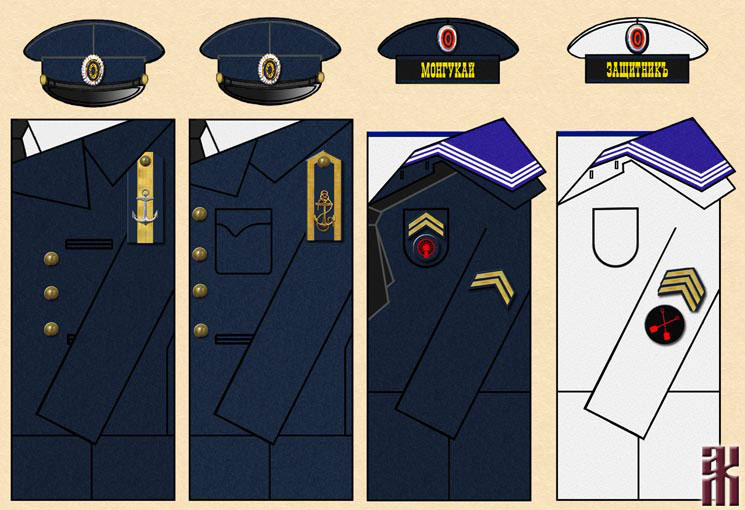
Draft clothing designs for naval NCOs and lower ranks in Eastern Russia:
1 – for fleet conductors; 2 – for fleet midshipmen;
3 – for lower ranks (ship's uniform with blue flannel shirt and dress tie);
4 – for lower ranks (work dress)
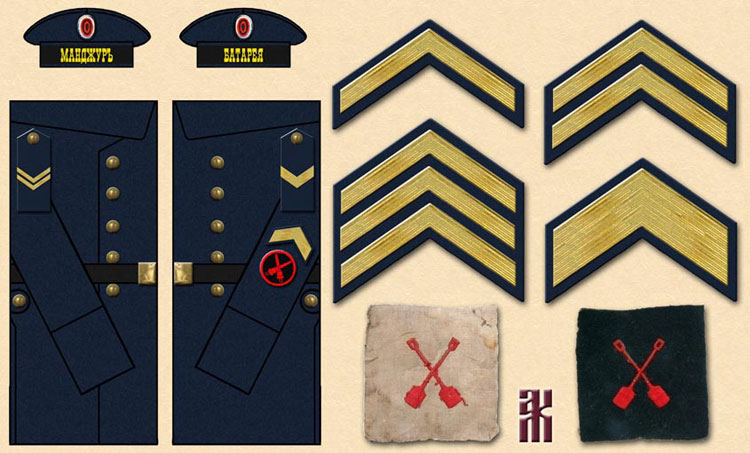
Draft clothing designs for NCOs and lower ranks in Eastern Russia:
1 and 2 – coat (greatcoat); 3 to 6 – sleeve insignia for shoulder-boards and sleeves;
7 and 8 – speciality insignia (here, stokers) for work dress (white linen base)
and greatcoats and blue flannel blouses (dark blue cloth base)
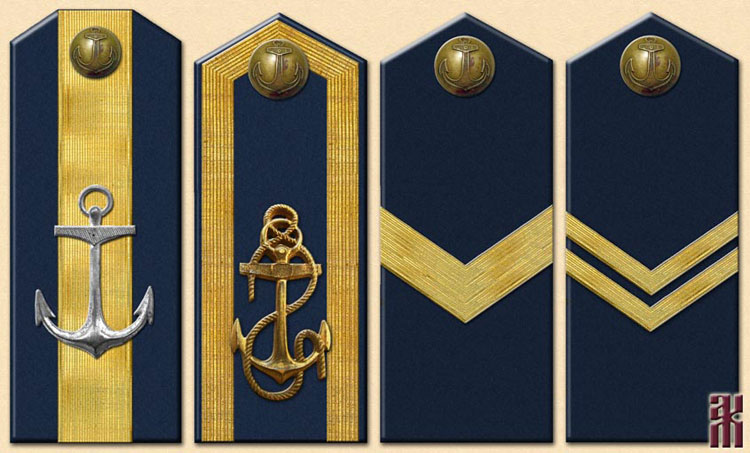
Shoulder-boards for the proposed uniform for overcoats and uniforms:
1 – conductors (here, senior boatswain); 2 – midshipman; 3 – boatswain; 4 – unter-ofitser
Home — State Symbols — Flags — Uniforms — Badges & Medals — Money — Other
Pygmy Wars Notes
The original for this page is at kolchakiya.ru/uniformology/Ekb_garrison.htm.
Discussion on the translation choices I have made can be found here.