
Uniforms of the Independent Transport Company of the Czecho-Slovak Corps, 1918-1920
All material and reconstructions are by A. Karevskiy.
The main sources for this material are:
Tatarov, B. "Czechoslovak Military Formations in Russia: Part 1, 1917-1918 // Staryi Tseykhgauz, No. 5-6", Moscow, 2015. pp. 54-76; and " ... Part 2, 1919-1920 // Staryi Tseykhgauz, No. 3", Moscow, 2016, pp.73-83.
Orian, E., Panus, B., Stechlik, E. and Steidler, F. "Ceskoslovenska Legie v Rusku, 1914-1920", Prague, 2014.
Bullock, D. "The Czech Legion // Men-at-Arms No. 447", Oxford, 2007.
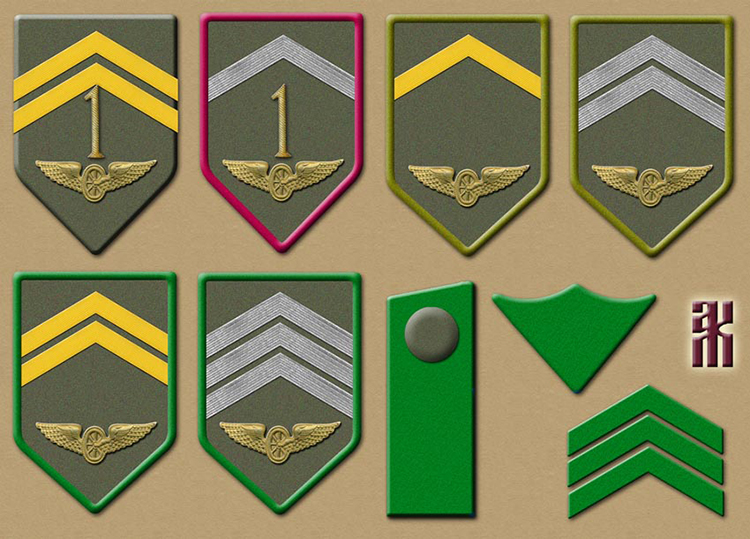
Insignia of the Independent Transport Company:
1 and 2 – sleeve badges as per the 30 December 1917 order;
3 and 4 sleeve badges as per the 27 October 1919 order;
5 and 6 – badges from the mid-1919 to 1920; 7 – greatcoat collar tab;
8 – collar patches for the tunics of the "Vladivostok uniform"; 9 – service stripes
Order No. 15 of 30 December 1917 gave the first instructions on the sleeve badges. That was amended by Order No. 117 of 27 October 1919:
§7. The types of troops and services are distinguished by the colour of the piping on the uniform shields and the tabs on the coat collars. The following are established: ... technical units are olive green ...
§8. The designation of the unit and speciality is placed in the lower half of the shield, with the unit number above the designation of the individual's speciality. The following are established: for the transport (railway) department, a winged wheel.
From mid-1919 the olive colour for technical units was gradually replaced by green.
The so-called "Vladivostok uniform" was introduced in June 1919. At the same time chevrons for service (one for each full year served, counting from the founding of the Czechoslovak Druzhina in 1914 were brought in.
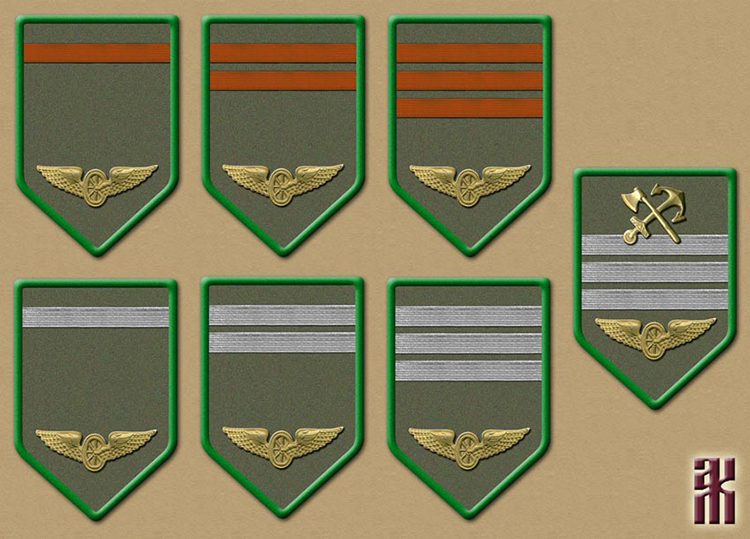
Sleeve badges of the officers of the Independent Transport Company:
First row: 3rd Class, 2nd Class and 1st Class military technicians respectively;
Second row: 3rd Class, 2nd Class and 1st Class military technical instructors respectively:
Far right: variant sleeve badge.
Order No. 49 of 13 July 1919 established classes of engineering and technical specialists for the administrative personnel of the technical units, including three classes for both military-technicians and military-technical-instructors.
The variant sleeve badge of a member of the Independent Transport Company includes, in addition to the regulated speciality insignia, also features the Russian insignia of the former Ministry of Transport.
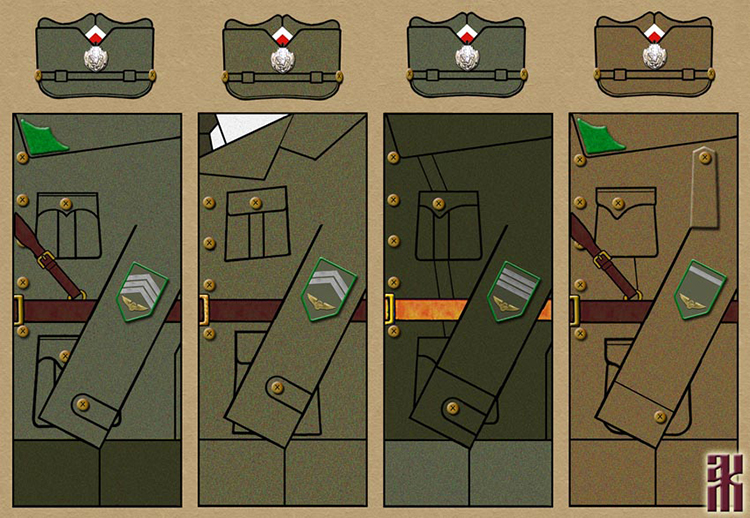
Uniforms of officers of the Independent Transport Company
Figures 1 to 3 show the most common version of the uniform from the summer of 1919, after the introduction in June 1919 of the vydumka, which became a characteristic feature of the Czechoslovak troops, even while retaining the blouses and tunics of the former Russian army. Figure 4 shows a set of the so-called "Vladivostok uniform", introduced in June 1919, initially for officers, and then extended to lower ranks. From July 1919, items of clothing that varied in quality and cut began to be gradually replaced by clothing of this new style, which was the same for all Czechoslovak units. In Figure 1 the collar tabs of the "Vladivostok uniform" are sewn onto the collars of a previous Russian model tunic.
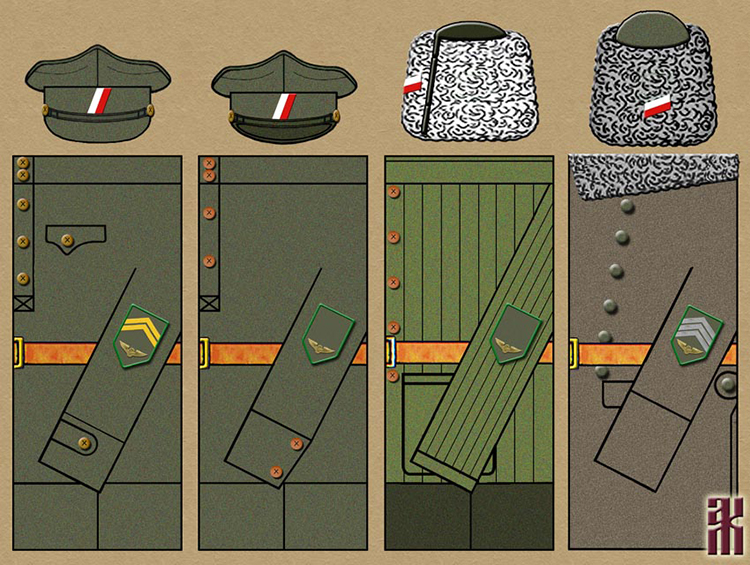
Uniforms of the Independent Transport Company
The uniforms have been reconstructed on the basis of numerous surviving photographs. It can be concluded that officers most commonly wore various styles of tunic with patch pockets, while lower ranks wore various styles of blouse. Until July 1919, the main headgear was a shaped Russian cap. Quilted cotton jackets were noted as winter uniforms for railway workers.
Home — State Symbols — Flags — Uniforms — Badges & Medals — Money — Other
Pygmy Wars Notes
The original for this page is at kolchakiya.ru/uniformology/czech/transport.htm.
Discussion on the translation choices I have made can be found here.