
Uniforms of the Czechoslovak Independent Shock Battalion
All material and reconstructions are by A. Karevskiy unless noted otherwise.
The main sources for this material are:
Tatarov, B. "Czechoslovak Military Formations in Russia: Part 1, 1917-1918 // Staryi Tseykhgauz, No. 5-6", Moscow, 2015. pp. 54-76; and " ... Part 2, 1919-1920 // Staryi Tseykhgauz, No. 3", Moscow, 2016, pp.73-83.
Orian, E., Panus, B., Stechlik, E. and Steidler, F. "Ceskoslovenska Legie v Rusku, 1914-1920", Prague, 2014.
Bullock, D. "The Czech Legion // Men-at-Arms No. 447", Oxford, 2007.
Insignia
A red cloth triangle with an image of a skull and crossbones originally served as a sign of completion of shock troop training in the Czechoslovak Corps. Subsequently, it became the distinctive insignia of the shock companies of the corps' 2nd Rifle Division. After Order No. 15 of 30 December 1917 "on the introduction of sleeve insignia in Czechoslovak units", it was to be sewn above the sleeve badge, but some photographs show that for some time the rank and file of the shock troops often only had the triangle.
Battalion Order No. 184 of 28 July 1918 abolished the red triangle and it was replaced by the image of the skull and crossbones, moved to the lower part of the sleeve badge.
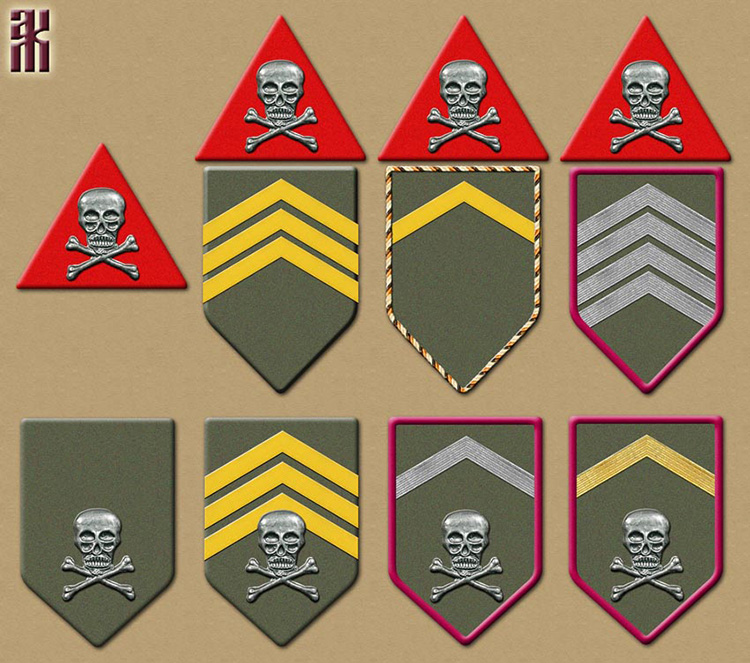
Official insignia of the Shock Battalion from December 1917 to October 1918:
1 to 4 – shock insignia as per the 30 December 1917 order
(respectively, private, sergeant, gentleman volunteer lance-corporal, and staff-captain);
5 to 8 – shock insignia as per the 28 July 1918 order
(respectively, private shock soldier, sergeant, ensign, and captain)
Note that at this time only officer sleeve badges had raspberry piping. On 20 August 1918 the ranks of gentleman volunteer and sub-ensign were abolished in the Czechoslovak army.
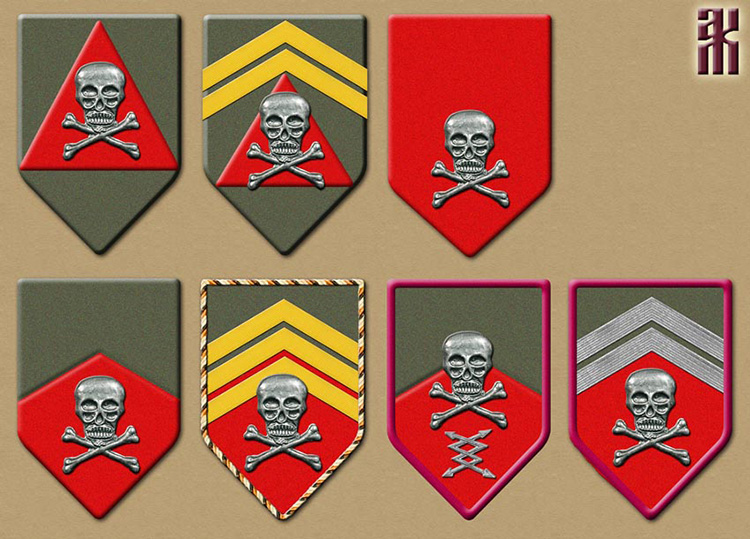
Variant insignia of the Shock Battalion in summer-autumn of 1918
(respectively, private, corporal, private, private, gentleman volunteer sergeant, communications private but with officer piping, second-lieutenant)
Judging by photographs, the Shock Battalion used arbitrary designs for sleeve insignia between July and October 1918, which differed greatly in appearance from those specified in the orders. Two characteristic trends can be identified. The first was to preserve the memory of the original red triangle insignia by moving it to the sleeve badge. The second was to make the shield two-coloured, red and green, with the field divided with an upwards angle.
Order No. 117 of the Czechoslovak Corps of 27 October 1918, gave new insignia. The Shock Battalion was assigned, in Paragraph 9: "a special scarlet shield with raspberry piping and a shock insignia – a skull with crossed bones".
At the same time, the rank of staff captain was replaced by captain, and the rank of captain by major.
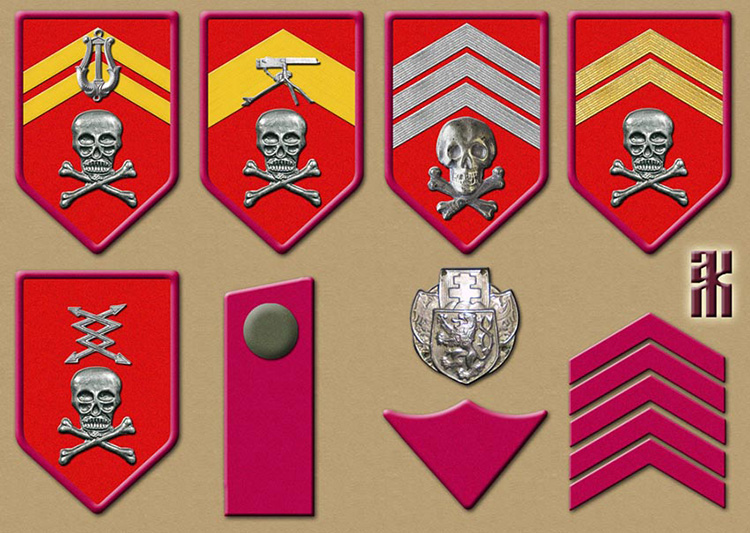
Distinguishing marks of the Shock Battalion from October 1918 to 1920:
1 – corporal musician; 2 – sergeant-major of a machine gun komand ;
3 – lieutenant; 4 – lieutenant-colonel;
5 – private of communications komand ; 6 – overcoat collar tab;
7 – cockade (21 June 1919 order); 8 – tunic collar tab; 9 – service chevrons
Based on surviving authentic items and photographs, it can be traced that from 1919 there were two varieties of the "skull and bones", as shown.
Figure 6 has the button covered with khaki cloth, which was instructed for buttons bearing the image of the Imperial Russian coat of arms.
The cockade in Figure 7 is that for the vydumka cap.
Uniforms
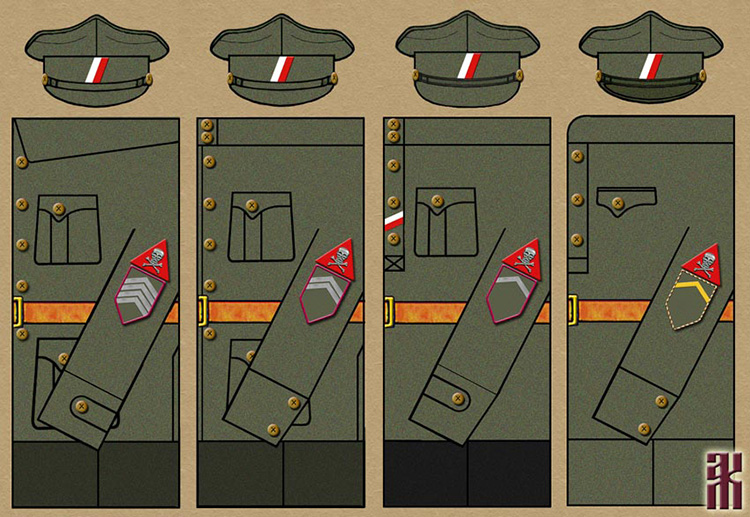
Uniforms of the Shock Battalion from December 1917 to October 1918
This uniform has been reconstructed on the basis of the many surviving photographs of Shock Battalion soldiers. It can be concluded that the most common type of uniform among officers was various types of tunics with patch pockets, while lower-ranking soldiers wore various styles of blouses. Until July 1919 the main headgear was a Russian cap crumpled in a distinct way (with both leather and cloth visors and chin straps).
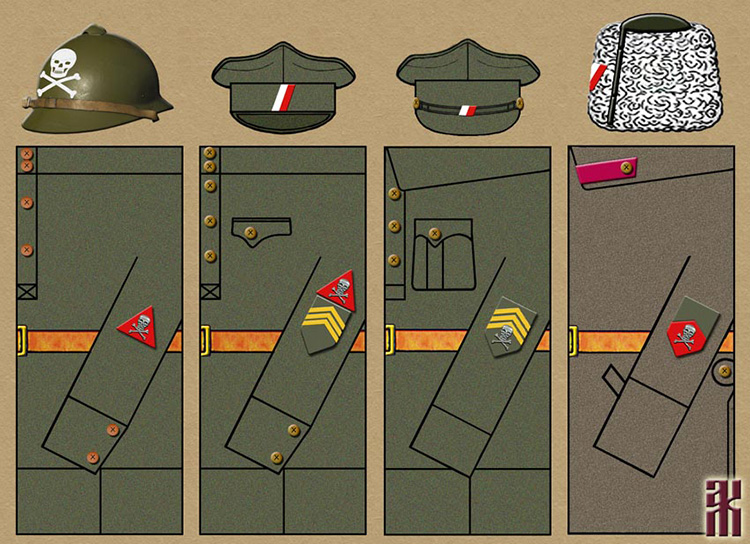
Uniforms of the Shock Battalion soldiers from December 1917 to October 1918
Until autumn 1918 it was common for privates to wear only a shock badge red cloth triangle with a skull and crossbones. Judging by photographs, both helmet types of the former Russian army were actively used: the Adrian M-1916 (with riveted crest and visor) and the Solberg M-1917 (solid stamped). There are few images before autumn 1918, but one of the photographs shows a shock trooper with a white skull and crossbones painted on his helmet (modelled on the shock troops of the Russian army in 1917).
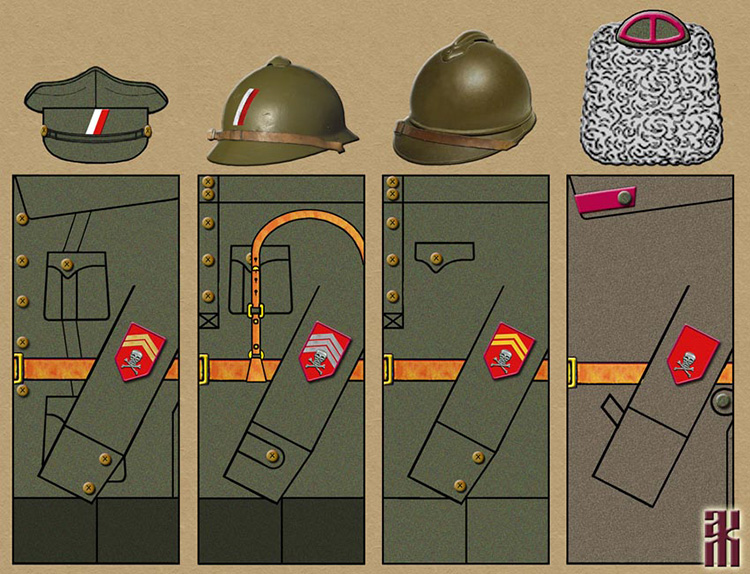
Uniforms of the Shock Battalion soldiers from October 1918 to June 1919
After the introduction of the new sleeve insignia in Order No. 117 of 27 October 1918, the variety of non-standard badges gradually disappeared. At the same time, a white and red stripe sloping from left to right began to be applied to helmets, serving as a cockade for all Czechoslovak units. Various types of tunics and blouses continued to be worn until the summer of 1919.
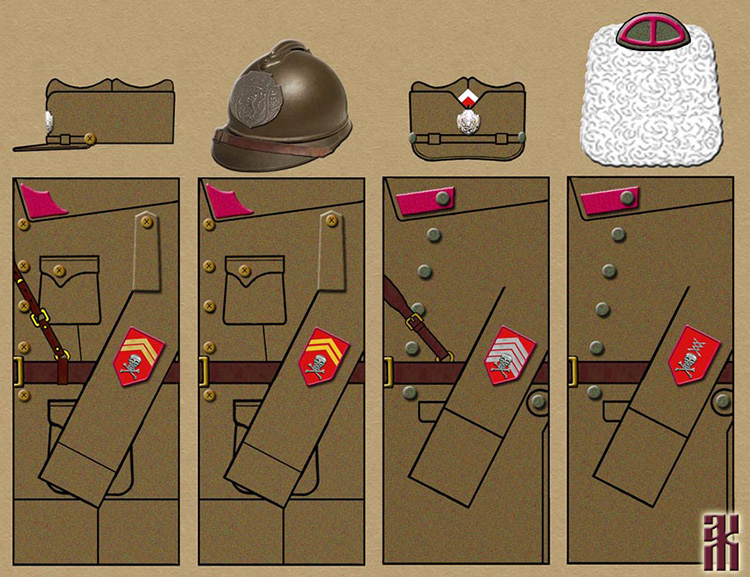
Uniforms of the Shock Battalion from June 1919
The so-called "Vladivostok uniform" was introduced to the Czechoslovak units by Order No. 41 of 21 June 1919. That order also introduced a new headgear – the vydumka – and prohibited the wearing of all others. At first the new uniform was only distributed to officers (with permission to continue wearing the old uniform until the end of 1919, provided that the new uniform was worn during all official events). Subsequently, that uniform was distributed to lower ranks, most of whom received it only in Vladivostok shortly before being sent back to their homeland. The introduction of a new model of overcoat, replacing the Russian one, common to all branches, followed in August 1919.
Towards the end of 1919 a metal emblem was stamped on the helmets, reproducing the cockade introduced for the Czechoslovak troops in Russia. Judging by photographs, in winter it was customary in the Shock Battalion to wear tall Russian papakhi made of white fur, and, according to Order No. 117, the bag of these papakhi was to be trimmed with raspberry braid.
<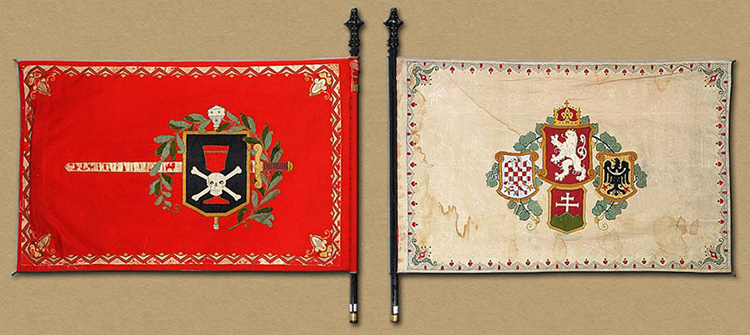
Banner of the Shock Battalion
Home — State Symbols — Flags — Uniforms — Badges & Medals — Money — Other
Pygmy Wars Notes:
The original for this page is at kolchakiya.ru/uniformology/czech/shock_troops.htm.
I have translated the word udarndyy as "shock", but it is common to see it as "storm" or "assault" as well. Discussion on other translation choices I have made can be found here.