
Uniforms of the Naval Detachment of the Czecho-Slovak Legion
All material and reconstructions are by A. Karevskiy.
The main source for this material was:
Tatarov B. "Czechoslovak Military Formations in Russia. Part 3. Naval detachment in the Far East // Staryi Tseykhgauz, No. 4 (80)", Moscow, 2018, p.56-63.
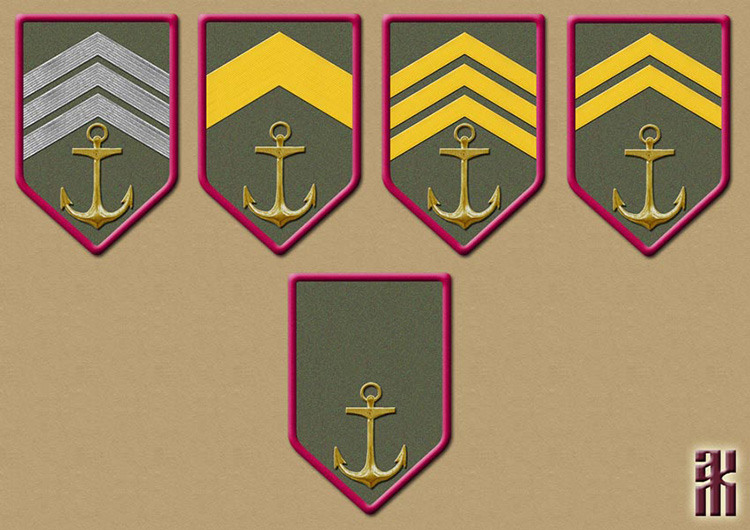
Initial sleeve shields of the Naval Detachment:
1 – lieutenant (detachment commander); 2 – 1st and 2nd class mechanic (sergeant-major);
3 – 1st and 2nd class helmsman (sergeant); 3 – 1st and 2nd class boatswain, electro-mechanic (corporal); 4 – stoker and deck sailor (private).
The 8th Regiment provided the personnel for the Naval Detachment, which is why it inherited infantry sleeve insignia, with raspberry piping. At first, with no special colours, the uniform distinction was an anchor, which was worn on an ad hoc basis.
On 10 March 1919 the Staff of the Czechoslovak Forces in the Far East, Order No. 2, introduced the naval ranks shown above (with their land equivalents alongside).
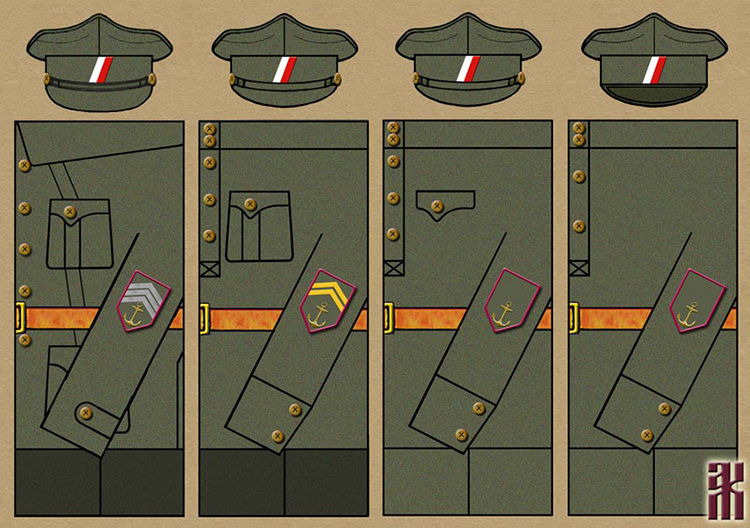
Uniforms of the Naval Detachment, 1918-1919
Throughout almost the entire period of the Naval Detachment's existence, the men generally wore standard khaki uniforms, like those in the infantry units of the Czechoslovak Corps. Officers wore "French" tunics with patch pockets and stand-up collars, while the lower ranks wore blouses.
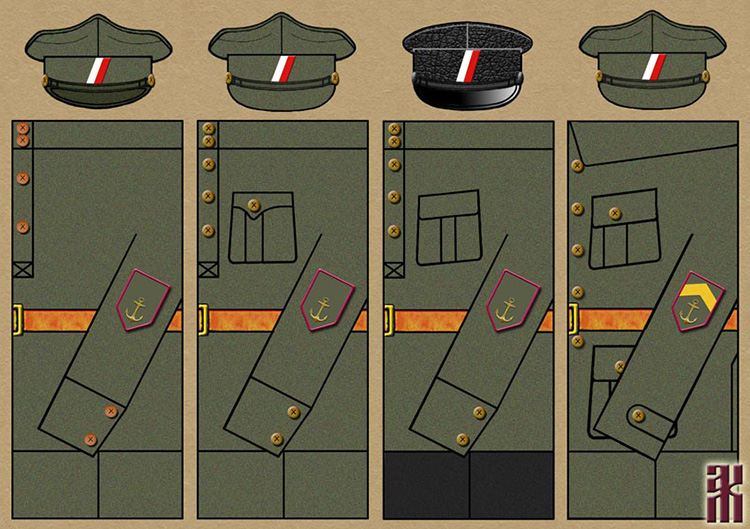
Uniforms of the Naval Detachment, 1918-1919
Examples of the variety of uniforms worn by lower ranks. The detachment commander required them to maintain a neat appearance and wear insignia (sleeve shields) that strictly corresponded to their rank. As in the infantry regiments, from which they were seconded to the detachment, various types of khaki clothing were used, including blouses and "French" tunics.
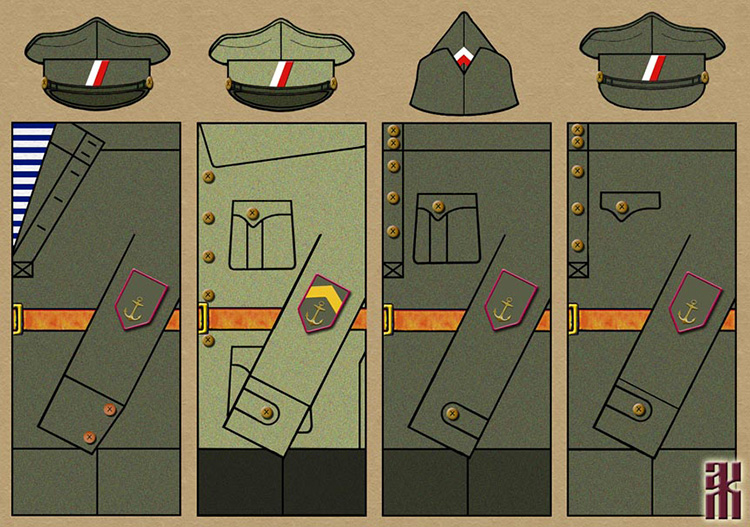
Uniforms of the Naval Detachment, 1918-1919
Despite the requirement to strictly adhere to infantry uniforms, elements of the naval uniform gradually found their way into the everyday life of the detachment. Figure 1 shows the most common violation – wearing a naval undershirt with an unbuttoned blouse.
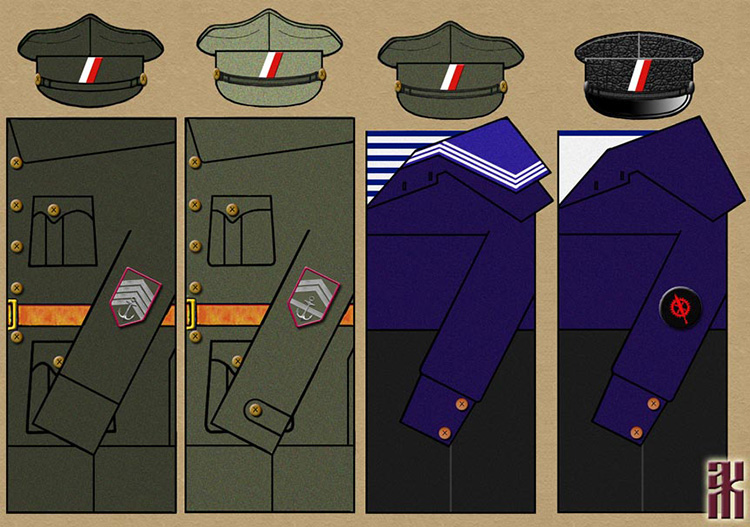
Uniforms of the Naval Detachment, 1918-1919
That process continued to develop, and the borrowing of naval uniforms by lower ranks continued. Figures 3 and 4 show naval uniform trousers and blue tops. Figure 4 even has the insignia of a mine engineer sewn on. Meanwhile the detachment's officers continued to strictly adhere to infantry uniforms (Figures 1 and 2).
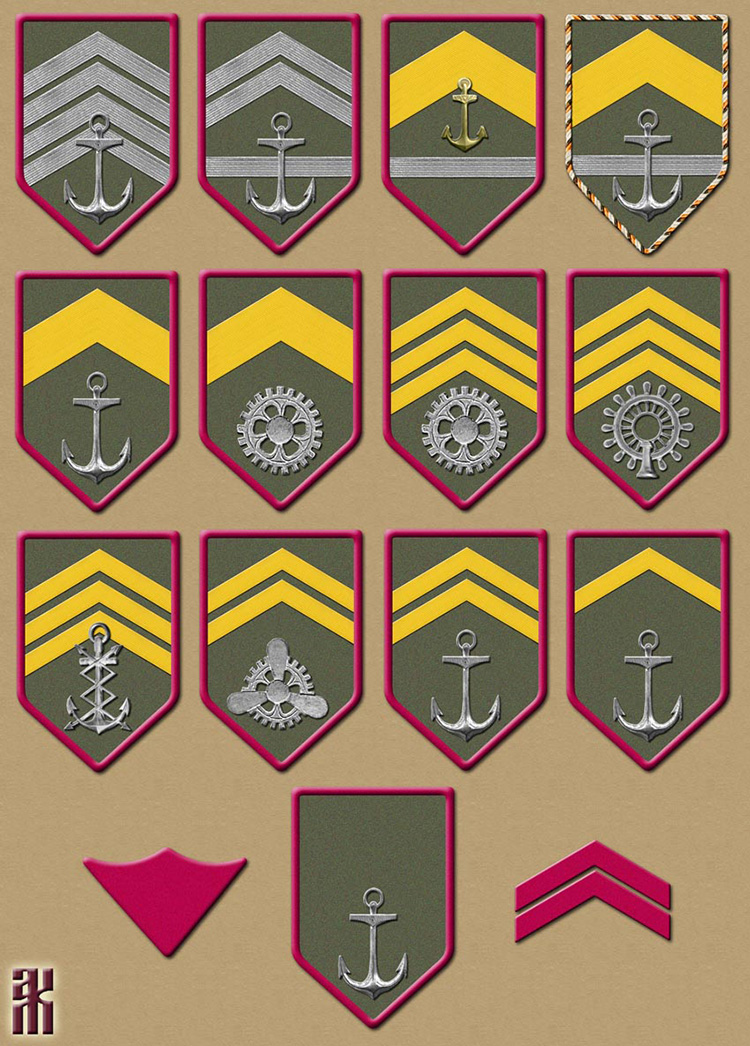
Insignia of the Naval Detachment, based on the 6 May 1920 Order:
1 – captain (detachment commander); 2 – second lieutenant (ship's captain);
3 – sergeant-major (ship's captain); 4 – volunteer sergeant-major (ship's captain);
5 – boatswain (sergeant-major); 6 – first class mechanic (sergeant-major):
7 – second class mechanic (sergeant); 8 – helmsman (sergeant);
9 – electrical engineer (sergeant); 10 – stoker (corporal);
11 – senior deck sailor (corporal); 12 – deck seaman (lance-corporal);
13 – tunic collar tab of "Vladivostok uniform"; 14 – ship's boy (private);
15 – service stripes
Order No. 13 of the Naval Detachment, dated 6 May 1920, specified that the position of ship's captain was indicated by horizontal silver braid at the bottom of the sleeve shield and an anchor emblem. Photographs show that various shapes of anchor were used.
The Naval Detachment generally used the emblems of specialist boatswains and conductors from the former Russian fleet: in their absence, the order allowed the use of analogues cut from yellow cloth. The mechanics shown here have gear emblems, the helmsman has a steering wheel, the electrical engineer an anchor with lightening bolts, and the stoker has a propeller on a gear.
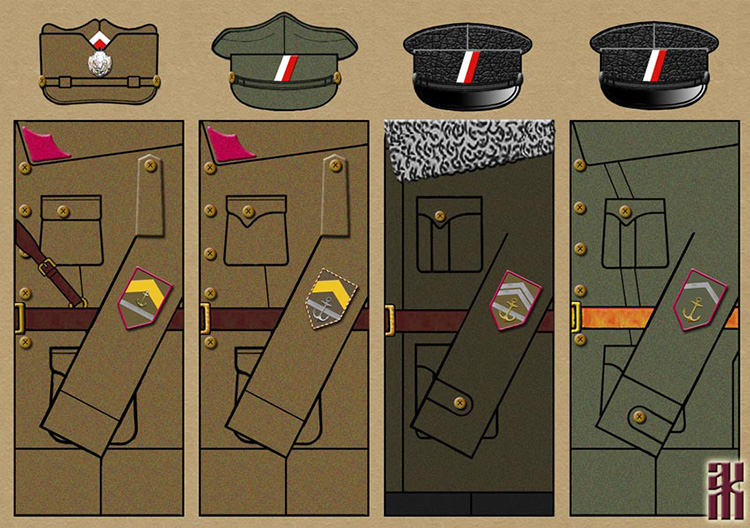
Uniforms of the Naval Detachment, 1919-1920
From June 1919 the detachment's personnel switched to wearing the so-called "Vladivostok uniform" (Figures 1 and 2). The distinguishing colour remained raspberry. A detachment order of July 1920 prohibited the wearing of all other types of uniforms. No specific naval officer uniform was ever introduced; throughout its entire existence the Naval Detachment officers wore khaki uniforms of various designs. Figures 3 and 4 show the fashion for leather caps.
The detachment had a total of four ships: the Russian Smĕlčak, Nadĕžny and Střelec, while the Dobrovolec was purchased in Japan.
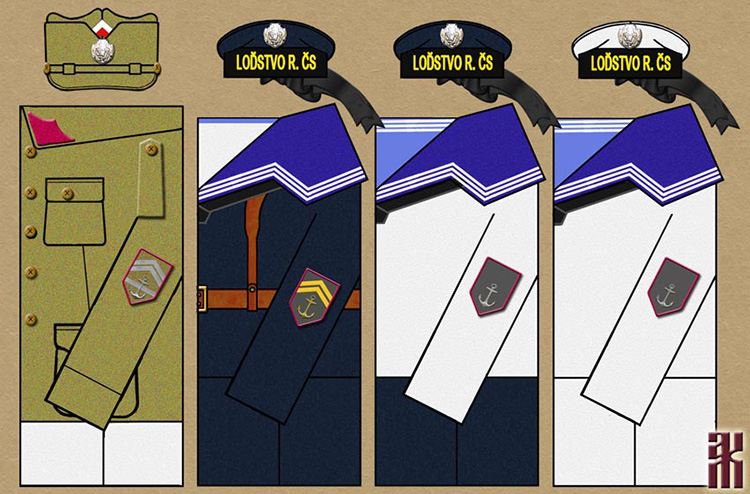
Uniforms of the Naval Detachment, 1919-1920
From autumn 1919 the Naval Detachment began to introduce a naval uniform for lower ranks, which copied the uniform of the Austro-Hungarian Navy. It consisted of a dark blue flannel blouse and matching trousers, as well as white linen blouses and trousers (with detachable linen collars and black silk ties). Undergarments were blue with three white stripes and white with one blue stripe at the throat. The visorless cap with a small soft crown was complemented by a white linen cover: the silk ribbon bore the inscription: "LOĎSTVO R. ČS" ("Navy of the Czechoslovak Republic"). The cockade attached to the crown was a coat of arms, as introduced for all Czechoslovak troops in June 1919.
From May 1920 off duty officers were allowed to wear white trousers, a linen tunic and the vydumka in summer (Figure 1).
Home — State Symbols — Flags — Uniforms — Badges & Medals — Money — Other
Pygmy Wars Notes:
The original for this page is at kolchakiya.ru/uniformology/czech/navy.htm.
I have translated the unit throughout as the "Naval Detachment", but its name changed on 6 May 1920, from one variety of "Naval" meaning more like "ships" to another word meaning more like "sea". Discussion on other translation choices I have made can be found here.