
Uniforms of the Czecho-Slovak Legion Rifle Units, 1917-1920
All material and reconstructions are by A. Karevskiy.
The main sources for this page are:
Tatarov, B. "Czechoslovak Military Formations in Russia: Part 1, 1917-1918 // Staryi Tseykhgauz, No. 5-6", Moscow, 2015. pp. 54-76; and " ... Part 2, 1919-1920 // Staryi Tseykhgauz, No. 3", Moscow, 2016, pp.73-83.
Tatarov, B. and Panush, B. "Czechoslovak Units in Russia, 1914-1917 // Tseykhgauz, No. 4", Moscow, 2001, pp.28-35.
Orian, E., Panus, B., Stechlik, E. and Steidler, F. "Ceskoslovenska Legie v Rusku, 1914-1920", Prague, 2014.
Bullock, D. "The Czech Legion // Men-at-Arms No. 447", Oxford, 2007.
Sleeve badges
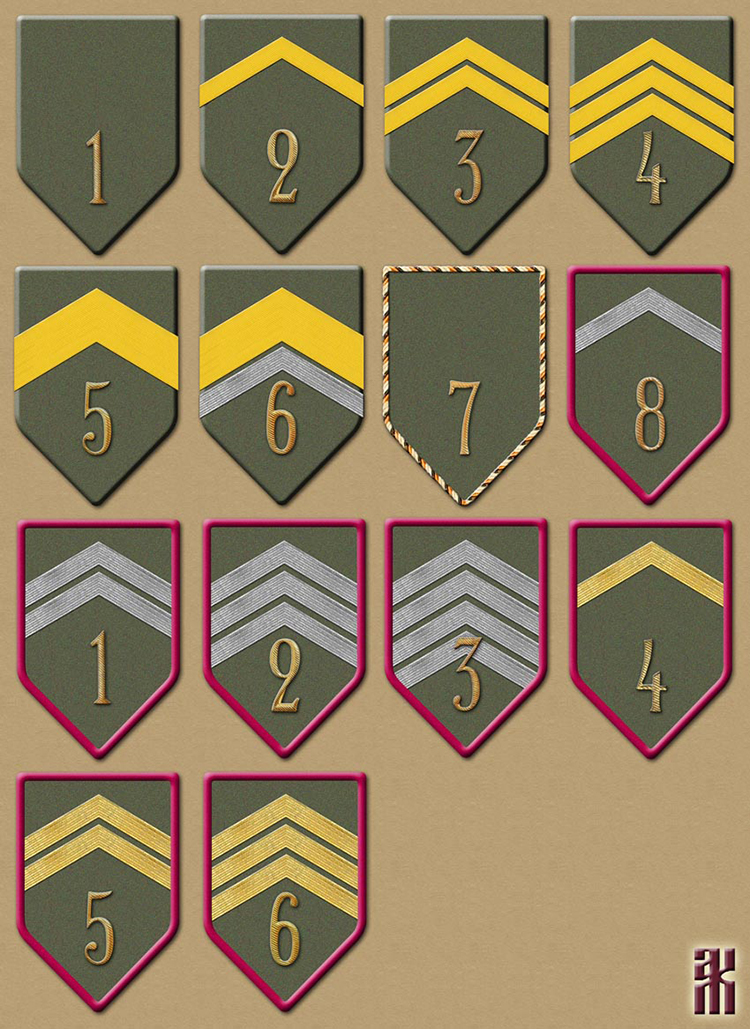
Sleeve badges of rifle regiments
in accordance with Corps Order No. 15 of 30 December 1917
1 – volunteer (private); 2 – lance-corporal; 3 – corporal; 4 – sergeant;
5 – sergeant-major; 6 – sub-ensign; 7 – gentleman volunteer; 8 – ensign;
9 – second-lieutenant; 10 – lieutenant; 11 – staff-captain; 12 – captain
13 – lieutenant-colonel; 14 – colonel
By order No. 91-D of 20 August 1918, the ranks of gentleman volunteer and sub-ensign were abolished in the Czechoslovak units.
The regimental numbers are all shown as metal, as in practice stencils were rarely used for sleeve badges – preference was given to metal ones, either of the officer model or homemade. The codes denoted:
As part of the 1st Czechoslovak Hussite Rifle Division:
1st "Jan Hus" Rifle Regiment
2nd "George of Poděbrady" Rifle Regiment
3rd "Jan Žižka of Trocnov" Rifle Regiment
4th "Prokop the Great" Rifle Regiment
As part of the 2nd Czechoslovak Rifle Division:
5th "Prague Tomáš Masaryk" Rifle Regiment
6th "Hanácký" Rifle Regiment
7th "Tatran" Rifle Regiment
8th "Silesian" Rifle Regiment
As part of the Czechoslovak Reserve Rifle Brigade:
1st and 2nd Reserve Regiments
Description of the insignia for the Czechoslovak Corps, approved by Order No. 15 of 30 December 1917
1. Ranks and titles are distinguished by the colour of the stripes and braid sewn onto the shield, in accordance with the attached samples.
2. For all ranks and titles, the shield is made of khaki cloth: for the greatcoat made of greatcoat broadcloth and for the field tunic or blouse made of the same material from which those items of clothing are made. Old khaki shoulder-boards may be used to make the shields. The size of the shield is exactly according to the attached sample: for officers they are 104 by 72 mm – taking into account a 4 mm border – and for lower ranks 96 by 64 mm, without a border.
3. For volunteers, the shield shall be without piping. For gentleman volunteers, the shield shall be piped with tricolour cord. For officers ... the shield shall be trimmed with raspberry piping.
4. The [regiment] number is placed in Arabic numerals in the acute corner of the shield, as shown in the samples, with specialist insignia placed under the number in special purpose units and komands: for artillery units – cannons, for engineer companies – the engineer symbol, for machine gun komands – a machine gun, etc...
5. Braid:
a) to distinguish the lower ranks of volunteers, narrow yellow braid is to be used, as shown in the samples; for sergeant majors, wide yellow braid; for sub-ensigns, wide yellow braid with silver braid underneath.
b) for officers, narrow silver braid up to the rank of staff captain, then gold ...
8. Regiment numbers (digits):
a) for lower ranks – yellow (stencil);
b) for officers, medical officers and officials – metal insignia of a yellow colour.
Letters and insignia for particular branches of the armed forces and komands:
a) for lower ranks – yellow (stencil);
b) for officers and medical officers and officials – metal insignia of a yellow colour.
9. The shield with insignia is worn on the left sleeve (outer side) midway between the elbow and shoulder.
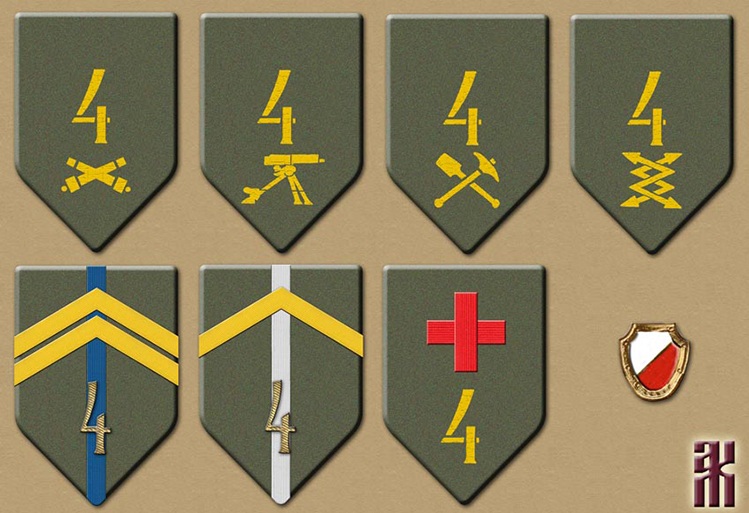
Sleeve badges of specialities and komands of rifle regiments in accordance with Corps Order No. 15 of 30 December 1917, using the example of the 4th Prokop the Great Rifle Regiment
1 – artillery komand (rapid-fire guns); 2 – machine gun komand ;
3 – engineer komand ; 4 – communications komand ;
5 – mounted scout komand ; 6 – foot scout komand ;
7 – medical komand and paramedics; 8 – 4th Regiment cockade
These badges are shown with stencilled numbers and speciality insignia, but in reality that was extremely rare. The scout insignia was unregulated, but was based on the form used on the shoulder-boards of the former Russian army.
The cockade in Figure 8 is a metal shield with a diagonal white and red field, which served as a cockade on the "Chechenka" caps that were common in the 4th "Prokop the Great" Regiment, designed by the regiment's commander, S. Chechek.
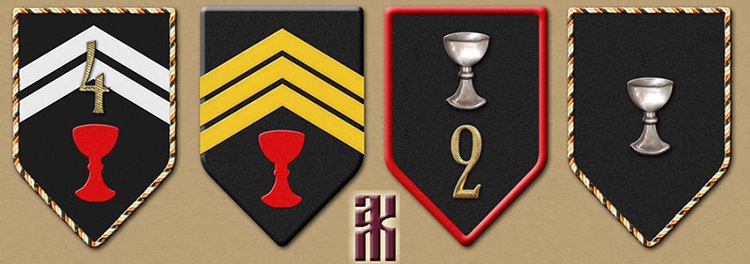
Non-standard insignia used in units of the 1st Division.
These shields were made from black shoulder-boards with the Hussite symbol in the form of a chalice, awarded for bravery in battle in the summer of 1917, which were widespread in the regiments of the division. The combination of black and red colours was symbolic of the national-religious Hussite movement of 15th Century Bohemia. The shoulder-boards, and later the sleeve badges, featured both metal and cloth appliqué images of the Chalice.
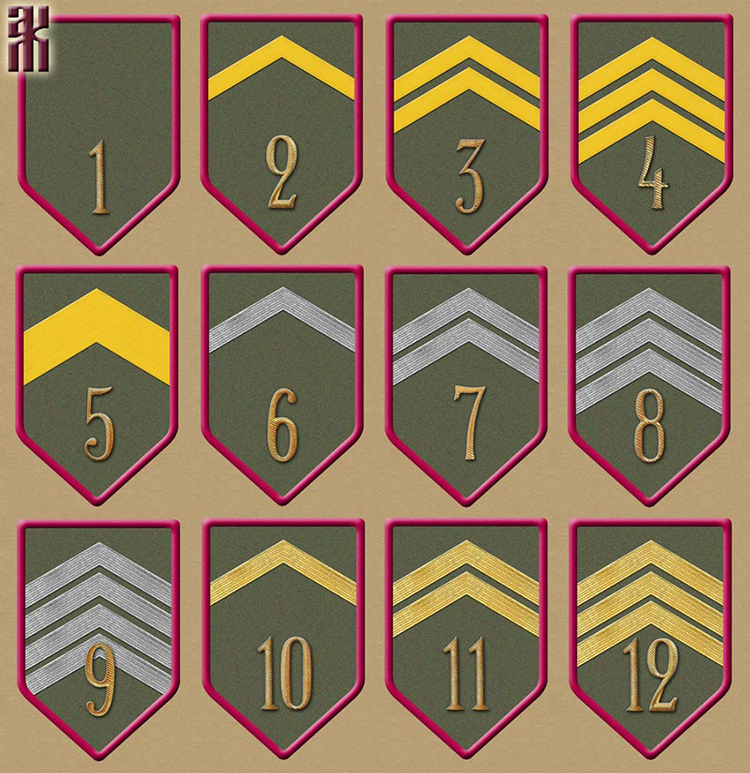
Sleeve badges of rifle regiments
in accordance with Order No. 117 of 27 October 1918.
1 – rifleman; 2 – lance-corporal; 3 – corporal; 4 – sergeant;
5 – sergeant-major; 6 – ensign; 7 – second-lieutenant; 8 – lieutenant;
9 – captain; 10 – major; 11 – lieutenant-colonel; 12 – colonel
In Czech: 1 – strelec; 2 – svobodnik; 3 – desátnik; 4 – četař;
5 – šikovatel; 6 – praporčik;7 – podporučik; 8 – poručik;
9 – kapitán; 10 – major; 11 – podplukovnik; 12 – plukovnik.
The ranks of sub-ensign (podpraporčik) and gentleman volunteer (důstojnický zástupce) were abolished on 20 August 1918, and the rank of ensign was abolished on 7 June 1919. On 27 October 1918, the rank of staff captain (stabskapitan/podkapitan) was renamed captain, and the rank of captain was renamed major.
The table shows only Russian officer metal numbers, but from the summer of 1919 the Czechoslovak regiments began to use their own metal insignia, which were smaller in size and had a different font.
In addition to the regiments mentioned above, the ciphers also refer to the regiments of the 3rd Czechoslovak Division, formed in January 1919:
As part of the 3rd Czechoslovak Rifle Division:
9th "Karel Havlíček Borovský" Rifle Regiment
10th "Jan Sladký-Kozina" Rifle Regiment
11th "František Palacký" Rifle Regiment
12th "Milan Rastislav Štefánik" Rifle Regiment
Description of the insignia of the Czechoslovak Corps, approved by Order No. 117 of 27 October 1918
§3. The following changes are made to the system of officer ranks: ensign – 1 narrow silver stripe; second lieutenant – 2 narrow stripes; lieutenant – 3; captain – 4; major – 1 narrow gold stripe; lieutenant colonel – 2 narrow stripes; colonel – 3; ...
§5. A distinctive feature of all units of the Czechoslovak Corps in Russia is a shield introduced by Order No. 15 of the army corps, 30 December 1917, on the left sleeve. The shield is made of the same fabric as the part of the uniform on which it is worn and has a border regardless of rank.
The shield bears the [soldier's] rank and designation of the unit.
§6. The designation of rank is uniform for all branches of the armed forces ...: chevron stripes on the shield, introduced for rifle regiments ... Non-commissioned officers' stripes (including sergeant-majors) are yellow (silk).
§7. The branches of the armed forces and services are indicated by the colour of the piping on the uniform shields and the buttonhole tabs on the collars of the greatcoats. The following are established: raspberry for rifle regiments ...
§8. The designation of the unit and speciality is placed in the lower half of the shield, with the unit number above the designation of the individual's speciality. The following are established:... Arabic numerals for rifle regiments..., reserve regiment – "1Z". Designation of speciality: for machine gunners – a machine gun; for telephone operators – crossed lightning bolts; for sapper and engineer companies – crossed pickaxe and shovel; ... for scouts – light green horizontal stripe connecting the two middle corners of the shield, so forming a triangle in the lower half, and stripes on the sleeves 1 cm from the edge, of the same colour ...
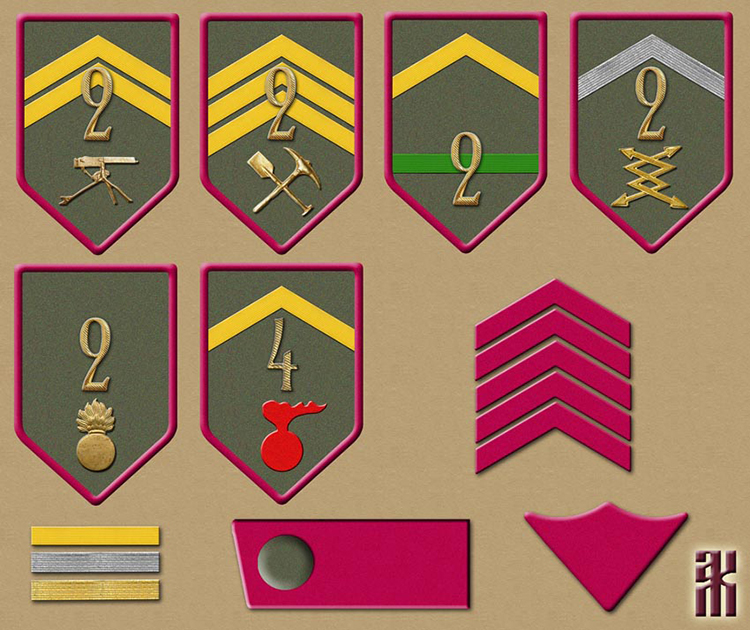
Insignia of specialists in the rifle regiments
in accordance with Order No. 117 of 27 October 1918.
1 – machine gun companies and komands ; 2 – sapper komands ;
3 – reconnaissance komands ; 4 – communications komands ;
5 and 6 – grenade launcher (mortar) komands: 7 – service stripes
8 – wound stripes; 9 – greatcoat collar tab; 10 – tunic collar tab
Figure 5 is the official version (as of Order No. 64 of the Czechoslovak Military Council of 30 September 1919), and Figure 6 the unofficial version in red cloth appliqué. Wound bars were worn on the lower left sleeve, horizontally along the edge of the cuff, 5-6 cm long, in the same colour as the rank bars when the wound was received.
The collar tabs are for the coat and tunic of the "Vladivostok uniform" introduced in June 1919, along with the service stripes:
"§11. On the right sleeve (level with the shield on the left sleeve) a designation of years of service is to be worn – chevrons of the same shape and size as those on the shield, in the colour of the branch of service. Each stripe indicates a completed calendar year voluntarily served in the Czechoslovak army. Volunteers who joined the Czechoslovak units in 1914 have 4 stripes (as of 1918), those who joined in 1915 have 3 stripes, those who joined in 1916 have 2 stripes, those who joined in 1917 have 1 stripe ...".
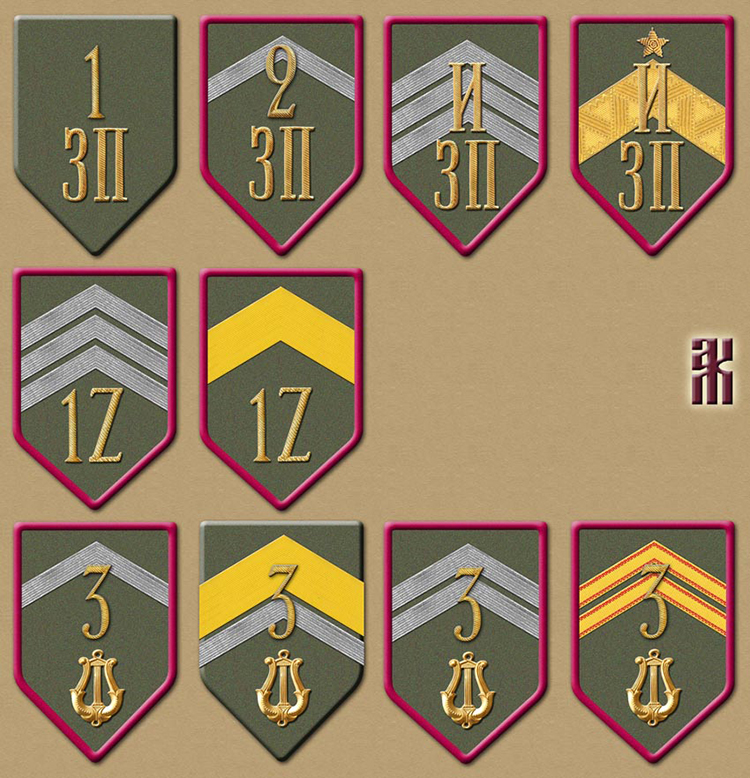
Sleeve badges of the reserve rifle regiments and regimental bands
1 and 2 – 1st and 2nd Reserve Regiment, as per Order No. 15 of December 30, 1917;
3 and 4 – Inspectorate of Reserve Units, as per Order No. 15 of December 30, 1917;;
5 and 6 – 1st Czechoslovak Reserve Regiment, as per Order No. 117 of 27 October 1918;
7 to 10 – personnel of regimental bands and orchestras (here, 3rd Rifle Regiment)
Figure 4 is the badge of Major-General J. V. Chervinki – Chief Inspector of Czechoslovak Reserve Units. The first order read:
4. ... For the Inspectorate of Reserve Forces, the letter "И" is placed on top of the chevron, with "ЗП" below it. For reserve regiments, an Arabic numeral is placed on top [of the chevron], followed by the regiment number and the letters "ЗП" (for reserve regiment) below.
The newer order read:
The designation of the unit and speciality is placed in the lower half of the shield, the unit number above the designation of the speciality of the individual. The following are established:... reserve regiment – "1Z".
The sleeve insignia of musicians was as per both orders No.s 15 and 117. The leaders of the bands were considered administrative officers and had the same rights as company commanders.
Uniforms
Until July 1918 the Czechoslovak units used various models of uniforms from the former Russian army. Numerous photographs reveal a certain pattern: among the lower ranks, the most common items of clothing were blouses of various styles (without breast pockets, with slit pockets and flaps, with patch pockets with bow folds); among the officers, "French" tunics of various styles, but those with four patch pockets with bow folds (two breast pockets and two lower pockets) dominated. Decorative tabs were most often placed on the collars and cuffs of both. Officers sometimes (but not often) wore a single shoulder strap (over the right shoulder) as well as a waist belt, taken from Russian officer equipment. Judging by photographs, two shoulder straps were very rare.
The first attempt to standardise the appearance of military personnel was made in the 2nd Division in November 1917, when Order No. 21 of 10 November 1917 established the following:
§3. shoulder-boards – khaki in the infantry and the previous ones remain in other branches. Greatcoats – if it is possible to obtain buttons from the Quartermaster's Department, it is desirable to have greatcoats with two rows of buttons; if this is not possible, then without buttons at all... The buttons are painted in a camouflage colour. Soldiers' trousers shall have no piping, while officers' trousers shall have piping according to the uniform.
Despite this, the inconsistency continued here as well: both khaki and raspberry shoulder-boards were sewn onto the collars of the greatcoats of rifle units; There were greatcoats with two rows of buttons arranged in different ways (straight lines converging at the bottom, curved lines in the Russian style), and the majority of servicemen wore greatcoats without buttons at all (fastened with hooks). Russian papakhi were used as winter headgear.
The main summer headgear in the Czechoslovak units was Russian caps with specially shaped crowns (sharp peak at the front with two deep folds on the sides). The most common type of cap was the one that became widely popular in the Russian army in 1917, with a soft crown, a wide square visor covered with khaki fabric, and a cloth chin strap. There were other variants, including those with fabric semi-circular visors and with khaki leather visors and chin straps, etc.
From the spring of 1918 the distinctive headgear of the 4th Rifle Regiment was a specially designed cap, developed personally by the regimental commander, S. Chechek, and named a "Chechenka" in honour of its author. It was worn with white and red ribbons or special metal shields with a diagonally divided white and red field.
From the end of the summer of 1918 a number of regiments (1st, 2nd, 3rd, 5th, 7th, 8th) introduced a new headdress in the form of a 1918 French-style pilotka sidecap, with a white and red ribbon sewn as an upward chevron in the front cutout.
Order No. 47 of 16 April 1918 abolished the wearing of Russian cockades in Czechoslovak units (Order No. 15 stated that they were to be replaced with narrow white and red ribbon worn diagonally across the cap). A white and red ribbon, the Czechoslovak national colours, was introduced for all military personnel,:
1-2 cm wide; the length of the ribbon, depending on the height of the band, should be sewn at a 60-degree angle from the top left to the bottom right; the length of the ribbon on winter papakhi is 4 cm.
Despite attempts at regulation, there were many variations in the ribbons, including being placed on papakhi and sidecaps horizontally rather than vertically, as well as attaching to the chin strap rather than the band. Despite that, white and red ribbon became the main visual distinction of Czechoslovak soldiers until the introduction of their national uniform.
The Czechoslovak command did not succeed in achieving uniformity in the manufacturing technology, sizes and materials of the sleeve badges. Throughout the spring and summer of 1918 many of the lower ranks did not wear the official insignia, merely having the ribbon of national colours on their headgear. Among the officers there developed a practice of wearing braid with the chevron pointing upwards directly on the sleeves of their outer clothing. Very often the badges differed from the official model in both shape and size, and the lack of precise specifications for the width and weave of the braid (metal) used to denote rank gave wide scope for creativity. The same was true of the numerical codes and specialist insignia – both old Russian and homemade ones were used, including those made in the corps's craft workshops, which differed in size and quality and did not have clasps, so were sewn onto the shields with thread.
In August 1918 the Czechoslovak National Council proposed a standardisation of its units, whereby "each branch of the armed forces will be distinguished by its own colour, which was placed around the shield, [down] the trouser seams, [on] the headgear and [around] the buttonhole tabs". For the infantry, the proposed colours were raspberry for the blouse or tunic, khaki trousers, and French-style hat (pilotka); in the rear, a Russian cap; and in winter, a Russian papakha with raspberry piping on a bag made of khaki cloth. It was planned to introduce red trim for the artillery, blue for the cavalry, yellow for the supply, green for the technical troops, and black for the medical staff. However, Order No. 117 of 27 October 1918 regarding uniforms stated only the following:
§4. Until the introduction of our own uniform, as far as possible, adhere to uniformity and avoid improvisation.
...
§12. All buttons bearing foreign state symbols must be covered with cloth.
Order No. 41 of 21 June 1919 introduced a new headgear for Czechoslovak units – the "vydumka". This was a cap sewn from four wedges, round, of equal height, turned up around the sides, and a wide square visor covered with fabric. A metal cockade in the form of the Czechoslovakian coat of arms was attached to the front, but it was not to cover either the upper cutout or the cloth chin strap. A white and red ribbon sewn as an upwards chevron was placed in a triangular cutout of the turn-ups. An order dated 1 July 1919 stipulated that only headgear issued by the quartermaster's department (1919 model) was to be worn, and it was forbidden to sew them from non-khaki fabric or to decorate them with coloured piping or ribbon under the cockade. For a long time, this cap coexisted with the old Russian-style uniforms (numerous models of tunics and blouses), becoming from that time on the main distinguishing feature of Czechoslovak soldiers.
A new, specifically Czechoslovakian uniform was introduced by the same order. It included a set of short breeches and a "French" tunic with four patch pockets (without folds), fastened with five large plastic or metal buttons (with four holes for sewing onto clothing), straight cuffs, soft sewn-in shoulder-boards tapering towards the collar (4 cm at the shoulder and 3 cm at the collar), and a stand-up collar decorated with diamond-shaped buttonhole tabs. Officers wore tunics with waist belt and a sword belt over their right shoulder. At first, the new uniform was only distributed to officers (with permission to continue wearing the old uniform until the end of 1919, provided that the new uniform was worn during all official events). Later the same uniform was distributed to lower ranks, most of whom received it only in Vladivostok shortly before being sent home. The introduction of a new model of greatcoat common to all branches of the army, replacing the Russian model, followed in August 1919. It was double-breasted (with two rows of five buttons), had side slit pockets with straight flaps, straight cuffs and a collar decorated with trapezoidal collar tabs with a button. Russian papakhi continued to be used as winter headgear.
When sewing the uniforms, each officer was required to follow the approved patterns without any deviations. However, there were some peculiarities here as well: the established cut of the tunic called for horizontal pockets with pointed flaps, but judging by numerous photographs, straight flaps, slanted breast pockets, sleeves without cuffs and sleeves with additional buttons sewn on them all became widespread. The diamond-shaped buttonholes established for the "Vladivostok" style could also be sewn onto the stand-up collars of "French" jackets of the old Russian cut. There was a mixing of individual items: for example, a "Vladivostok" tunic could be worn with Russian baggy trousers and a previously sewn vydumka of a different shade (matching the colour of Russian "pea" cloth). However, by the end of 1920, the Czechoslovakian units had acquired a completely distinctive appearance, different from the armies of other states and, moreover, uniform in appearance.
Reconstructions of the "Vladivostok" Uniform
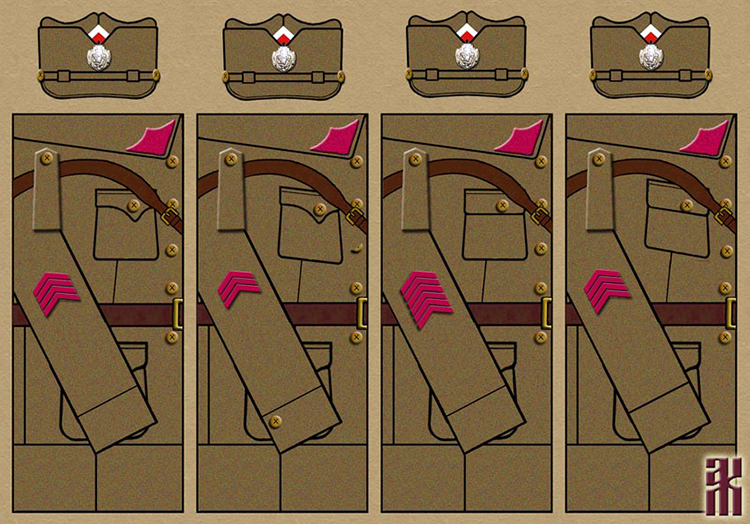
1 – approved model of tunic; 2 – slanted pockets and button on the cuff;
3 – straight pocket flaps; 4 – slanted pockets and straight flaps
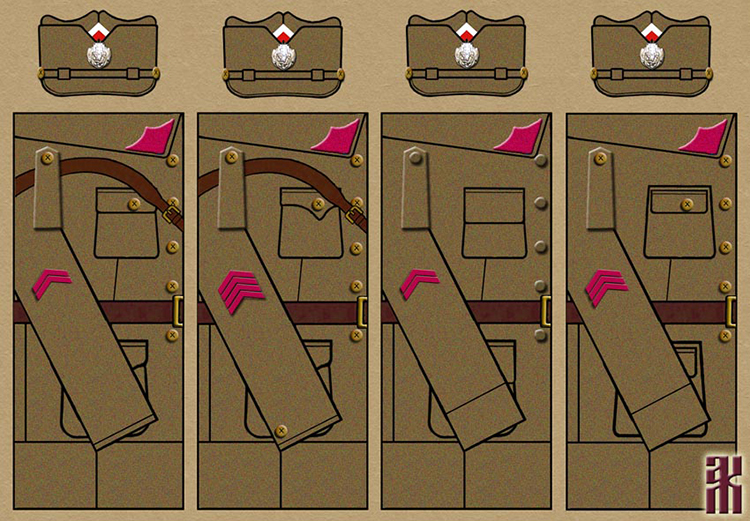
1 – straight sleeves without cuffs; 2 – button on the sleeve, no cuffs;
3 – large square pocket flaps and covered buttons; 4 – double patch pockets
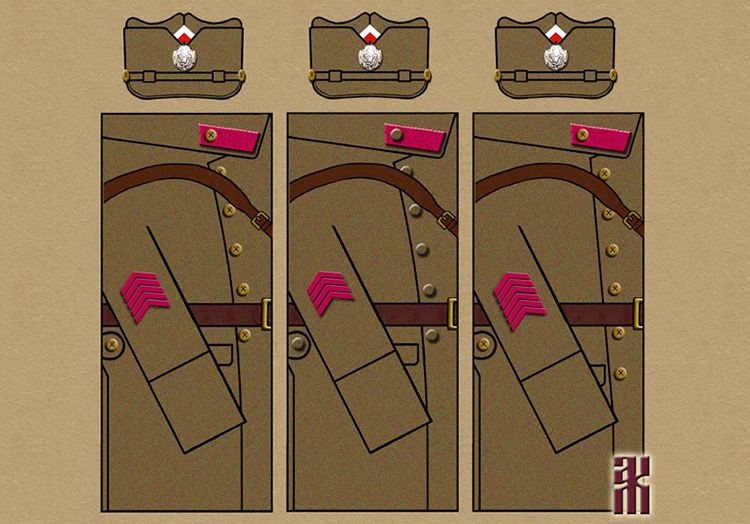
1 – approved version of greatcoat; 2 – covered buttons;
3 – rows of six buttons instead of five
Rifle Regiment Uniforms before the Introduction of the June 1919 Uniform
The reconstructions below are based on photographs, and apply to the uniforms before the change to the June 1919 version.
1st Czechoslovak "Hussite" Rifle Division
2nd "George of Poděbrady" Rifle Regiment
3rd "Jan Žižka of Trocnov" Rifle Regiment
4th "Prokop the Great" Rifle Regiment
2nd Czechoslovak Rifle Division
5th "Prague Tomáš Masaryk" Rifle Regiment
3rd Czechoslovak Rifle Division
9th "Karel Havlíček Borovský" Rifle Regiment
10th "Jan Sladký-Kozina" Rifle Regiment
11th "František Palacký" Rifle Regiment
12th "Milan Rastislav Štefánik" Rifle Regiment
Home — State Symbols — Flags — Uniforms — Badges & Medals — Money — Other
Pygmy Wars Notes
The original for this page is at kolchakiya.ru/uniformology/czech/infantry.htm.
The Czechs used the word "volunteer" as a synonym for "other ranks".
Vydumka means "invention".
The 1st Division were all named for famous Hussites of the early 15th Century, and were a reference prviously successful wars for an independent Greater Bohemia (including Bohemia proper, Moravia, Silesia and Sorbia/Lusatia, but not Slovakia). The 5th Regiment was named for the first president of an independent Czechoslovakia (usually regarded as that country's founding father). The other three regiments of the 2nd Division were named for regions of the country. The 3rd Division's patrons were famous Czech and Slovak patriots of the 17th to 20th Centuries.
Discussion on the translation choices I have made can be found here.