
Uniforms of the Czecho-Slovak Legion Cavalry Units, 1917-1920
All material and reconstructions are by A. Karevskiy unless noted otherwise.
The main sources for this material are:
Tatarov, B. "Czechoslovak Military Formations in Russia: Part 1, 1917-1918 // Staryi Tseykhgauz, No. 5-6", Moscow, 2015. pp. 54-76; and " ... Part 2, 1919-1920 // Staryi Tseykhgauz, No. 3", Moscow, 2016, pp.73-83.
Orian, E., Panus, B., Stechlik, E. and Steidler, F. "Ceskoslovenska Legie v Rusku, 1914-1920", Prague, 2014.
Bullock, D. "The Czech Legion // Men-at-Arms No. 447", Oxford, 2007.
1st "John Jiskra of Brandýs" Czechoslovak Cavalry Regiment
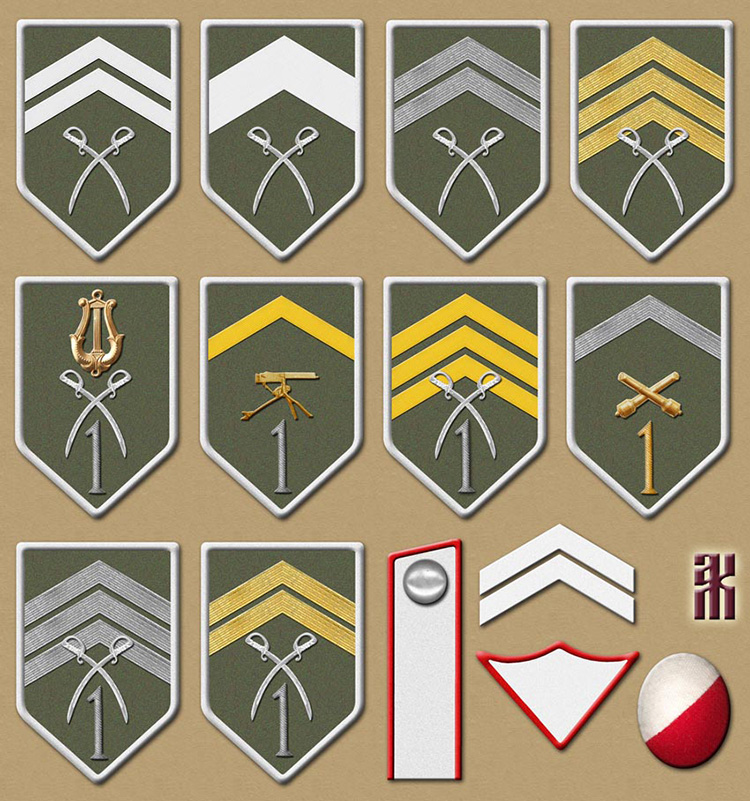
Original sleeve insignia of the 1st Cavalry Regiment;
1 – corporal; 2 – sergeant-major; 3 – second-lieutenant; 4 – colonel;
5 – private in the regimental orchestra; 6 – corporal of the machine-gun squadron;
7 – sergeant; 8 – ensign of the artillery platoon (rapid-fire guns)
9 – lieutenant; 10 – lieutenant-colonel; 11 – greatcoat buttonhole tab;
12 – service chevrons; 13 – tunic collar tab (Vladivostok uniform);
14 – original cockade for the "podebradka " headgear
Figures 1 and 2 have white rank braid for NCOs, as was originally used in accordance with regiment Order No. 41 of 21 August 1918. However a military department order of 5 January 1919 strictly instructed the regiment to use yellow, as in all other formations of the corps. Order No. 117 of 27 October 1918, stated:
§7. The types of troops and specialities are distinguished by the colour of the piping on the sleeve shields and the buttonhole tabs on the overcoat collars. It is established that: ... the colour for the cavalry is white.
§8. The designation of the unit and speciality is placed in the lower half of the shield, with the unit number above the designation of the individual's speciality. It is established that ... the designation of speciality for cavalry is crossed sabres.
Figure 13 is the collar tab for tunics in the so-called "Vladivostok" style, introduced in the Czechoslovakian army by Order No. 41 of 21 June 1919, initially for officers, and then extended to lower ranks.
Chevrons for service were established by Order No. 11 of 27 October 1918. Each chevron corresponded to one year of service, with the count starting in 1914, i.e. from the moment the Czechoslovakian druzhina was formed.
§11. On the right sleeve (at the same height as the shield on the left sleeve) is worn a designation of years of service – a chevron of the same shape and size as the stripe on the shield, in the colour of the branch of service.
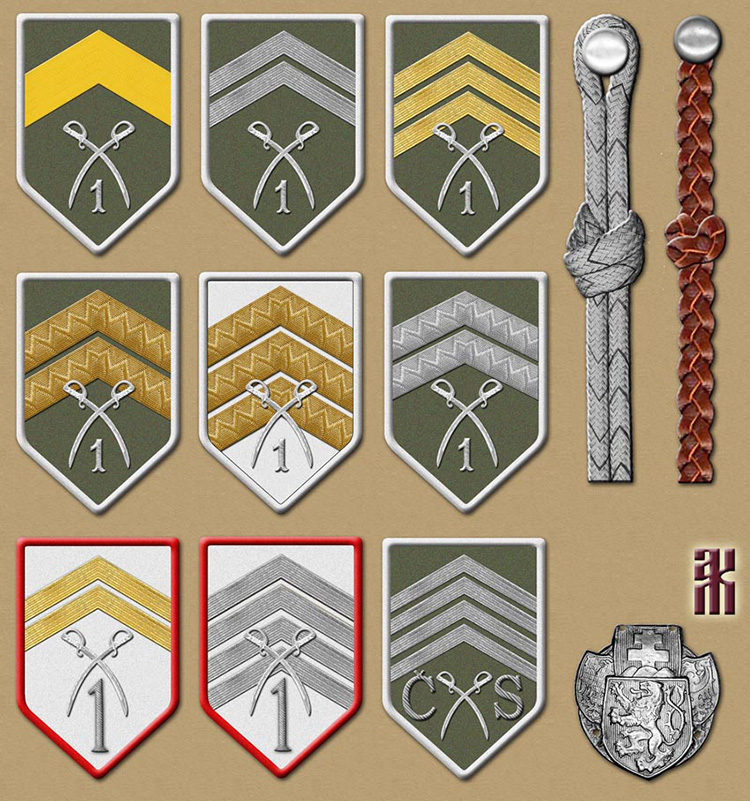
Variants on sleeve insignia of the 1st Cavalry Regiment:
first row – Russian style cipher numbers replaced by specifically Czech ones;
second row – using "hussar" braid instead of simple metal braid for rank chevrons;
third row – varieties seen at a parade in Vladivostok in the autumn of 1918;
right side – shoulder insignia in metal and leather and the cockade introduced in July 1918
The shoulder straps were worn on the left shoulder of the tunics, "French" coats and blouses. Initially all cavalrymen were issued with straps made of leather cord, but later officers switched to wearing ones made of silver metal cord.
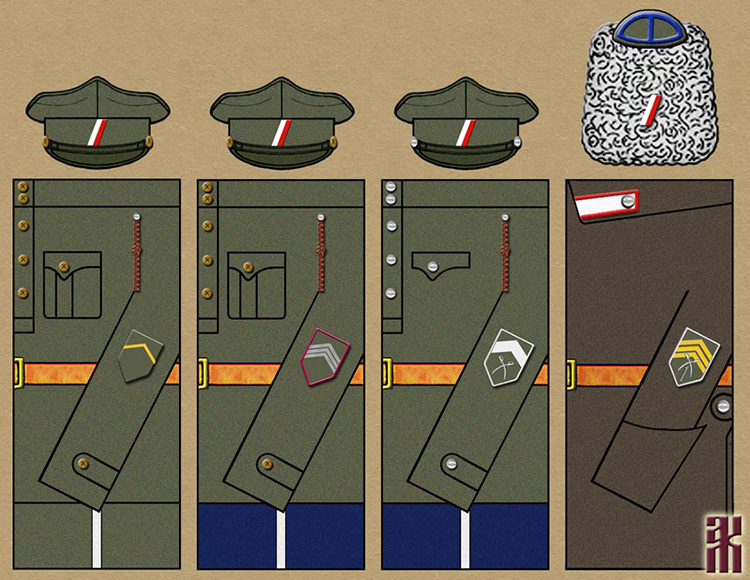
Uniform of the 1st Cavalry Regiment:
1 and 2 – initial version of the uniform, introduced on 12 August 1918;
3 and 4 – second version of the uniform, introduced on 21 August 1918
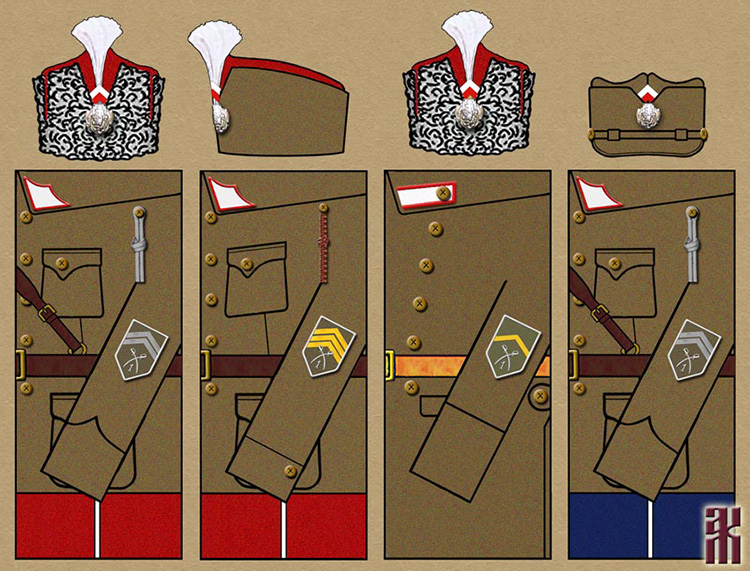
Regiment Order No. 32 of 12 August 1918 stated: "cavalry boots with spurs, blue trousers with white stripes, a blouse with leather shoulder-straps, and a cap with a chin strap". Since no special insignia were introduced, standard-issue [sleeve] shields were worn to indicate rank: for privates and NCOs without piping and using yellow for the stripes; for officers with raspberry piping and silver stripes (gold for staff officers). Due to a shortage of blue fabric, trousers could be made from khaki material but were to have the white stripe.
Regiment Order No. 41 of 21 August 1918, made a few amendments. The braid on the sleeve insignia of the lower ranks was replaced with white, and white cloth buttonhole tabs with red piping were introduced for the greatcoats:
Blue cavalry trousers with a 4 mm wide white stripe. On the khaki blouse, a shield of the same colour with a 4 mm white border on the left sleeve, bearing cavalry insignia of two crossed white sabres. Rank insignia on the patch is made of 8 mm wide white silk ribbon. On the left shoulder, a leather strap with a white metal button. A Cossack-style cap with a small ribbon in the Czech colours, 1½-2 cm wide, running the height of the brim, sewn diagonally at an angle of 60 degrees, from top right to bottom left. The cap has a 1 cm wide leather chin strap attached with two silver metal buttons. Sabre straps and belts are yellow, of normal width. The cavalry greatcoat is Russian style with white buttonhole tabs and red piping. Wearing non-regulation items is permitted only during internal service, i.e. in places where the public is not allowed, or on short walks. In all other cases, the uniform regulations must be observed. Note: due to a shortage of blue broadcloth, khaki trousers with the established stripe may be worn, until this order is revoked.
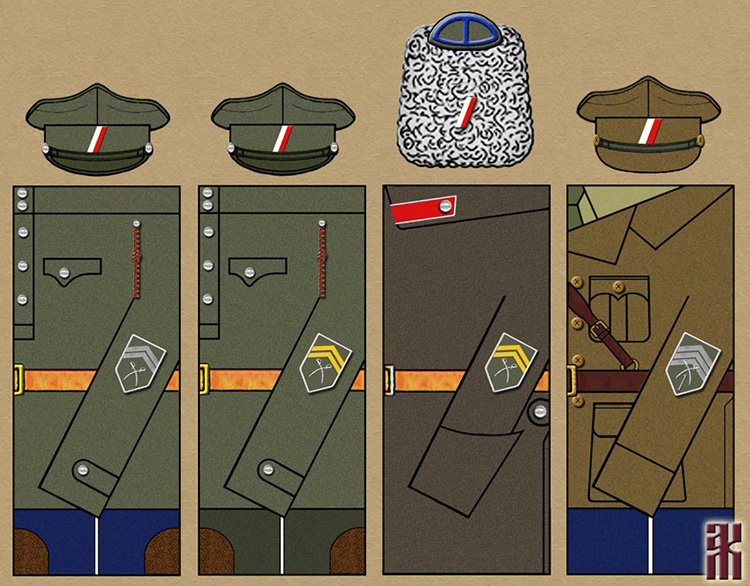
Uniform of the 1st Cavalry Regiment
1 to 3 – the "model" uniform of 18 August 1918; 4 – use of a British officer uniform
Corps Order No. 1-1p of 18 August 1918:
1. High cavalry boots with spurs on straps;
2. Blue cavalry breeches, trimmed with leather, with white piping along the seam, silver for officers. If blue trousers are not available, woollen trousers with white piping may be worn.
3. Green cloth blouse; sleeve shield of the same colour as the blouse, with braid, two crossed sabres made of metal or embroidered at the bottom. Distinguishing marks are silver for officers and yellow for lower ranks. On the left shoulder, a strap woven from thin leather, sewn on one side into the sleeve seam and fastened on the other side with a white metal button or an ordinary button.
4. The cap is green, with a strap at the front that is pulled under the chin when riding so that the cap does not fall off.
5. The greatcoat is long, cavalry style. The buttonhole tabs are red with white piping and white metal buttons. The insignia on the sleeve is the same as on the blouse.
6. Winter headgear – a papakha (Russian) with a red top and blue braid sewn on in the shape of a cross.
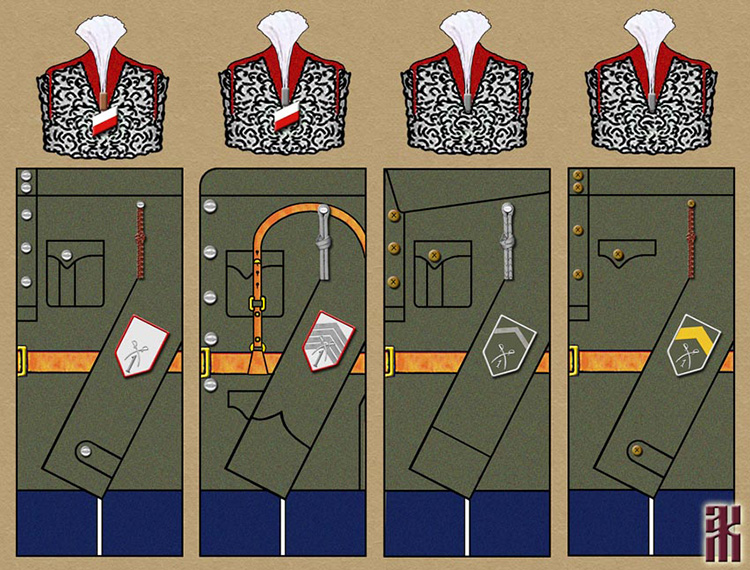
Dress uniforms of the 1st Cavalry Regiment, with podebradki
First developed and approved in the 2nd Czechoslovak Cavalry Regiment, the "podebradka" was introduced in the 1st Regiment by Regiment Order No. 238 of 6 March 1919, which stipulated that it should only be worn on Sundays and public holidays, or by order on special days. On other days, wearing it was strictly prohibited.
Figures 1 and 2 are reconstructed from photographs of a parade in Vladivostok in the autumn of 1918, when the podebradki were worn with a white and red ribbon instead of a cockade. Figures 3 and 4 are reconstructed from photographs of the regiment's officers from the first half of 1919, at which time there were no cockades on the podebradki at all.
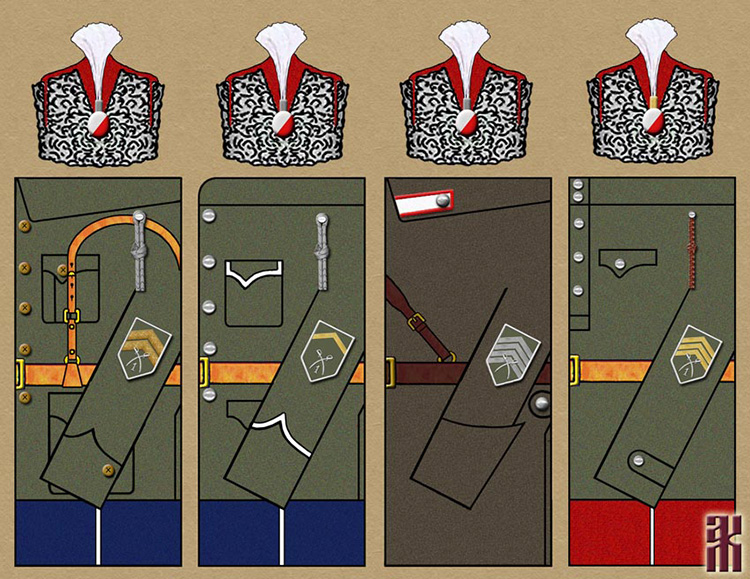
Uniform of officers of the 1st Cavalry Regiment
Judging by photographs, various types of "French" tunics were widely used in the regiment, as well as the old Russian-style tunic, with white piping on the cuffs, chest pocket flaps, and in some cases on the upper edge of the stand-up collar. By this time, the shoulder-strap on the left shoulder of the officer's uniform had finally been established as a silver-coloured metal cord with black silk threads woven in. The cockades for the podebradki were "repeyki", "burdock" cockades, covered with white and red cloth, borrowed from the 2nd Cavalry Regiment.
The red trousers of Figure 4 would later become a symbol of the Czechoslovak cavalry. They were first introduced into the regiment by Order No. 175 of 2 January 1919 as a dress item.
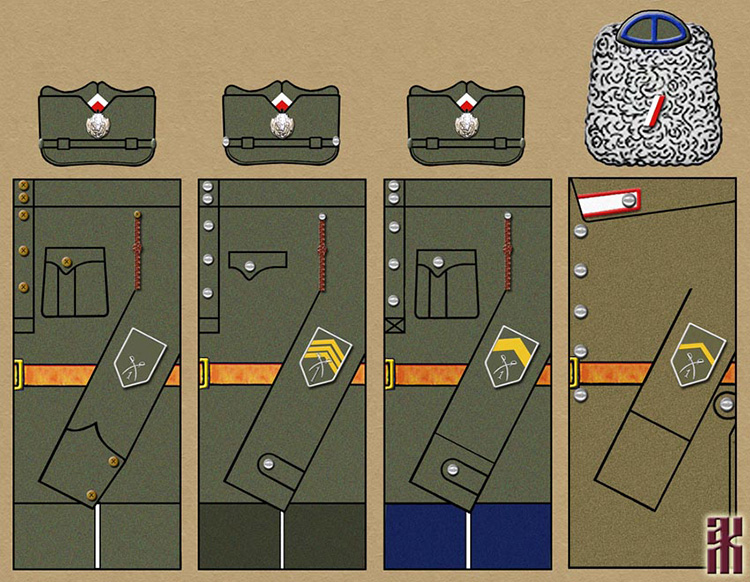
Field uniforms of the 1st Cavalry Regiment, 1 to 3 with vydumka
A "service" uniform was gradually established in the regiment for everyday wear and field work. Order No. 196 of 21 January 1919 regulated khaki trousers for the "service" uniform (to save the blue and then red trousers for dress, weekend-dress and parades). An order issued by the regiment on 26 May 1919 announced the introduction of a special headdress with the Czechoslovak coat of arms in metal. Order No. 41 of 21 June 1919 introduced a new type of headgear for the Czechoslovak units, shown in Figures 1 to 3. It was called a vydumka (literally, an invention). There followed a ban on the wearing of other types of headgear.
Figure 4 is an example of an unregulated model of a greatcoat – with straight cuffs and five metal buttons sewn onto the side. The papakha is shown in the "model" form of 1918.
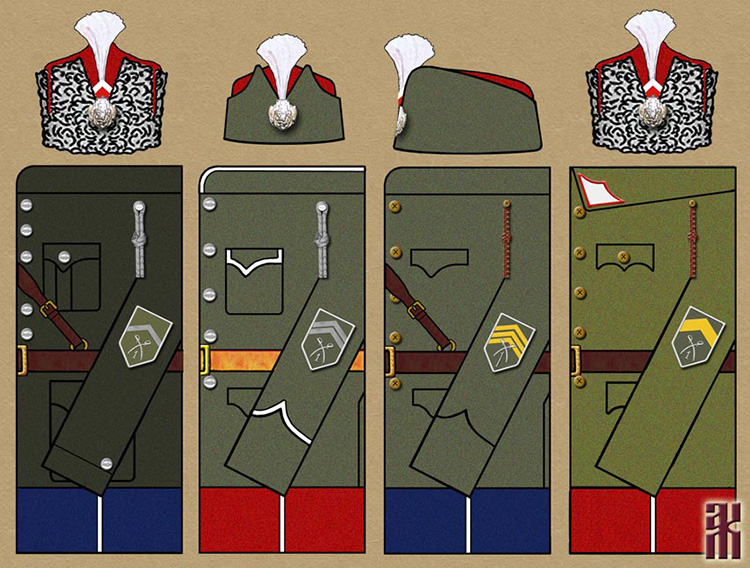
Dress uniforms of the 1st Cavalry Regiment, with podebradki
Figures 2 and 3 show the summer version of the podebradka, introduced in May 1919. In photographs its cut varies greatly: in some cases the front lapels are pointed, while in others they are rounded. On 27 August 1919 the Independent Czechoslovak National Council ordered that chevrons of the national colours (made of white and red ribbon) be sewn into all podebradki, in the cutout below the plume. From July 1919 the white and red repeyki began to be actively replaced by metal cockades bearing the coat of arms.
"Vladivostok" uniforms of the 1st Cavalry Regiment
Army Order No. 41 of 21 June 1919 introduced a new uniform for the Czechoslovak units (the "Vladivostok" uniform), and into the 1st Cavalry Regiment by Order No. 343 of 9 July 1919. Army Order No. 372 of 8 August 1919 introduced the new matching greatcoat. However, it proved extremely difficult to provide it to all personnel and initially was only distributed to officers (with permission to continue wearing the old uniform until the end of 1919, provided that the new uniform was worn for all official events). The tunic was modified for the cavalry: the soft shoulder-straps were removed and replaced with a single braided strap on the left shoulder, and in some cases, the straight cuffs were re-sewn with a point. Later this uniform was extended to the lower ranks.
Army Order No. 66 of 7 November 1919 brought in red trousers for all cavalry units as part of the parade uniform.
2nd Czechoslovak Cavalry Regiment
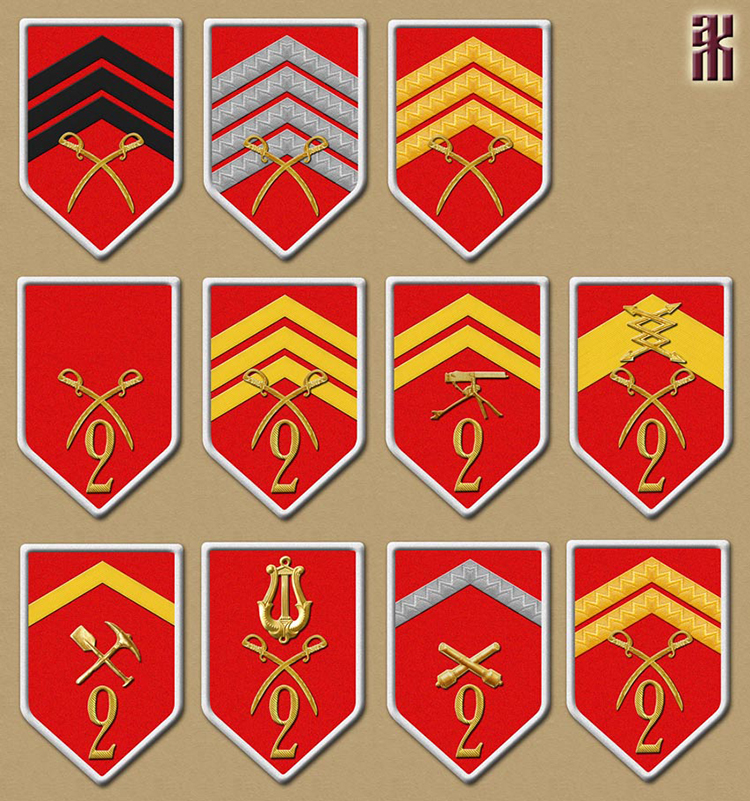
Original sleeve insignia of the 2nd Cavalry Regiment;
first row – sergeant, captain, colonel:
second row – private, sergeant, corporal of the machine gun squadron,
sergeant-major in the communications komand;
third row – lance-corporal of the engineer komand, private in the regimental orchestra,
ensign of the horse artillery platoon, lieutenant-colonel
The original version of the sleeve insignia, introduced by regiment Order No. 41 of 16 November 1918 had black stripes for NCOs and "hussar" braid for officers.
A revised format, with yellow braid for NCOs instead of the original white [officially ordered], was promulgated by Army Order No. 117 of 27 October 1918:
§7. The branches of the armed forces and services are distinguished by the colour of the piping on the uniform shields and the tabs on the collars of their coats. It is established that: ... the colour for the cavalry is white.
§8. The designation of the unit and speciality is placed in the lower half of the shield, with the unit number above the designation of the individual's speciality. It is established that ... the designation of speciality for the cavalry is crossed sabres.
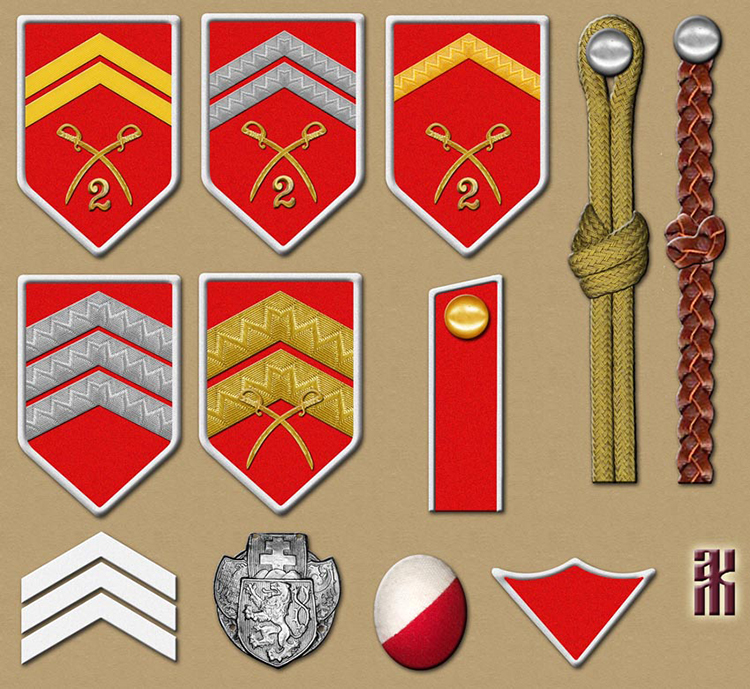
Variants of sleeve insignia of the 2nd Cavalry Regiment:
first row – Russian style cipher numbers replaced by specifically Czech ones;
second row – using varying widths of "hussar" braid instead of simple metal braid;
third row – service stripes, cockade introduced in July 1918, original cockade for the podebradka, tunic collar tab for the "Vladivostok" uniform;
right top – shoulder-straps
The shoulder straps were worn on the left shoulder of the tunics, "French" coats and blouses. Officers were entitled to straps made of gold metal cord and lower ranks of leather.
Chevrons for service were established by Order No. 11 of 27 October 1918. Each chevron corresponded to one year of service, with the count starting in 1914, i.e. from the moment the Czechoslovakian druzhina was formed.
§11. On the right sleeve (at the same height as the shield on the left sleeve) is worn a designation of years of service – a chevron of the same shape and size as the stripe on the shield, in the colour of the branch of service.
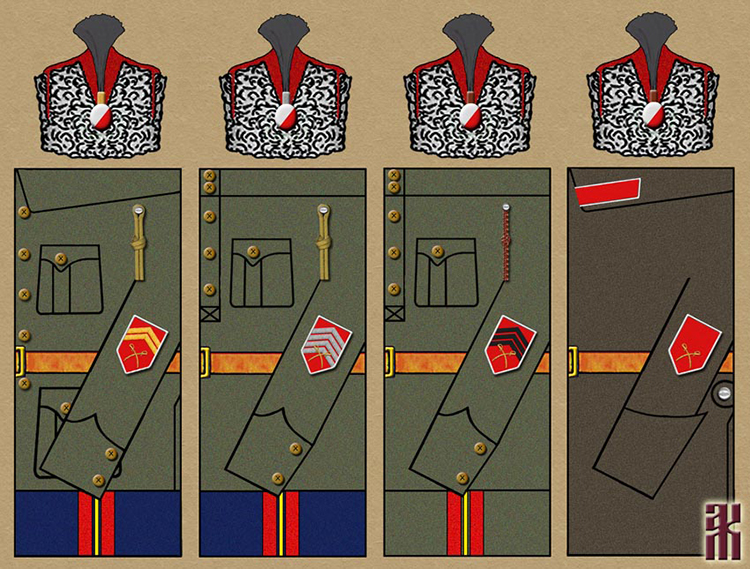
Dress uniforms of the 2nd Cavalry Regiment
This uniform was announced in Regiment Order No. 41 of 16 November 1918:
1. Headgear: podebradki made from grey papakhi (or grey sheepskin) with a dark red top; dimensions: height 10 cm, back 7 cm, front 16 cm, high plume made of black horsehair, placed straight and reinforced with an oval-shaped cloth rosette in the national colours. The plume is held in place by a leather ring for lower ranks and gold cords for officers;
2. Blouse: a field cloth shirt. The sleeves have red shields with white piping, with two crossed sabres on the shield and the regiment's number between them. Insignia denoting officer rank: up to captain – silver zigzags (this refers to hussar braid – A.K.); major and above – gold, NCOs – black. The cavalry shoulder strap on the left shoulder is (braided) leather for lower ranks and gold (with one knot) for officers. The blouses have two outer pockets.
3. Tunic, made of the same cloth as the blouse, but with four outer pockets;
4. Trousers. Cavalry style, dark blue, with two red stripes at a distance of ? cm from the seam; the seam is piped yellow for lower ranks and gold for officers. The width of the stripes is 4 cm each;
5. Greatcoat. Grey, simple style (Russian), without buttons, only officers have yellow buttons on the collar tabs. The collar tabs are red with white piping;
6. Russian-style short chamara coat, trimmed with sheepskin at the neck, sleeves and edges;
7. Footwear. High boots with spurs attached.
In the same order, the commander explained:
During my report in Ekaterinburg to Major-General Gaida of the 2nd Czech R.D., I presented the regimental uniform approved by your commission, and the general authorised its fabrication, namely: podebradki, cavalry overcoats, chamaras and trousers. The podebradki will be made from available papakhi in such a way that the sides can be lowered in severe cold. Stripes should be sewn onto the trousers from the fabric I brought with me. Black leather should be purchased for the manufacture of cords for the chamaras. Buttons, where appropriate, should be covered with uniform fabric.
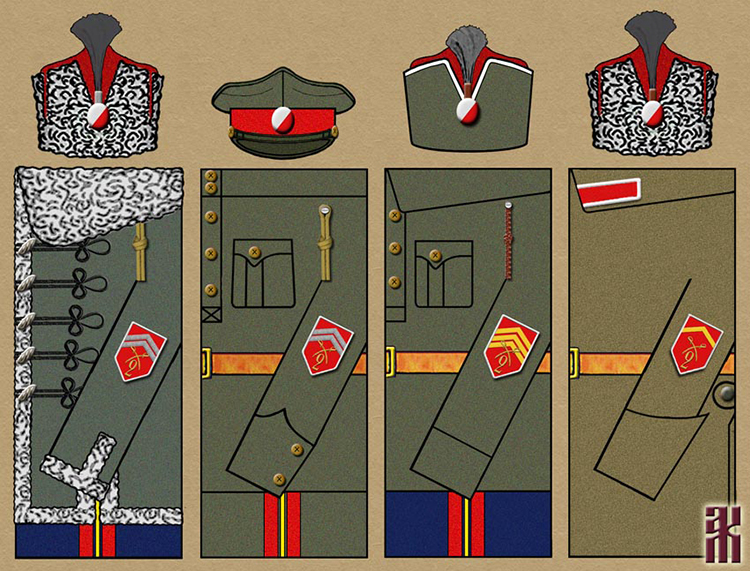
Uniforms of the 2nd Cavalry Regiment
Figure 1 is wearing a chamara, a short coat with cords, in the style of a hussar mentik, as set out in the 16 November 1918 order. Figure 2 has a Russian cap with a red hat-band, which was a non-statutory uniform, prohibited by regimental Order No. 90 of 31 March 1919. Figure 3 has the summer version of the podebradka, introduced by regiment Order No. 105 of 14 April 1919, in agreement with the commander, General Y. Syrov. It was made entirely of fabric, with white piping sewn along the edge of the turn-ups.
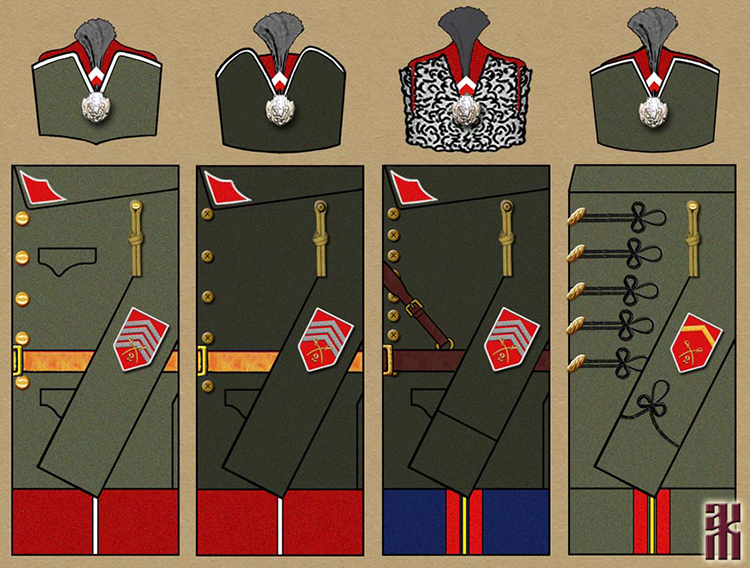
Uniforms of the 2nd Cavalry Regiment
On 27 August 1919, in accordance with an order from the Czechoslovak National Council, upwards pointing chevrons of national colours (made from white and red ribbon) were sewn into all podebradki, in the gap below the plume. By Order No. 116 of 27 April 1919, white and red repeyki cockades began to be replaced by a metal coat of arms.
Figures 1 to 3 show different styles of tunic with collar tabs, as established for the so-called "Vladivostok uniform", in accordance with Order No. 41 of 21 June 1919. Figure 4 is in a hussar "attila" used by officers of the 2nd Cavalry Regiment when not in formation. Red trousers were first introduced as a parade and dress item by regiment Order No. 143 of 24 May 1919. Their official introduction into the regiment was by Order No. 289 of 22 October 1919. Order No. 304 of 7 November 1919 stipulated that they were to be worn exclusively as parade items.
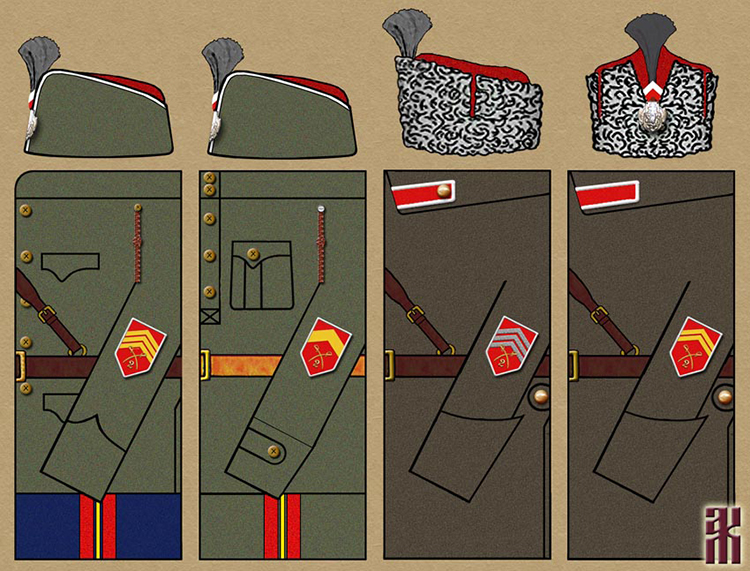
Uniforms of the 2nd Cavalry Regiment
Figures 1 and 2 show the summer version of the podebradki. The regiment's command was very careful to ensure that the official white piping was present. Photographs also show that the greatcoats in the regiment were worn exclusively without buttons.
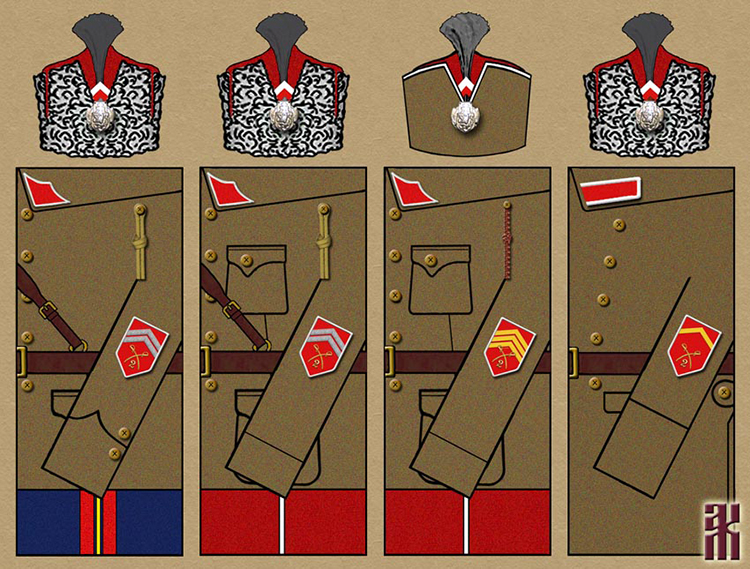
Uniforms of the 2nd Cavalry Regiment
Army Order No. 41 of 21 June 1919 introduced a new uniform for the Czechoslovak units (the "Vladivostok uniform"). However, it proved extremely difficult to provide it to all personnel and initially was only distributed to officers (with permission to continue wearing the old uniform until the end of 1919, provided that the new uniform was worn for all official events). Later this uniform was extended to the lower ranks. Army Order No. 372 of 8 August 1919 added the new greatcoat in the same style.
The tunic was modified for the cavalry: the soft shoulder-straps were removed and replaced with a single braided strap on the left shoulder, and in some cases, the straight cuffs were re-sewn with a point. When it was introduced by Order No. 236 of 27 August 1919 into the 2nd Regiment, there were also the following changes:
The tunic is short, without patch pockets, with internal pockets on the sides. ... It fastens at the front with five buttons. The shoulder-straps are gold for officers and leather for lower ranks. The collar is stand-up, folded, with [red] tabs with white piping.
In accordance with this description, officers' tunics were made to order, while those of lower ranks were altered in the regimental tailor's shop. However, the process was protracted, and most of the regiment's ranks used the previously approved model. The rest of the uniform (tunic, "French" coat and blouse) was kept to be worn during parades and exercises. On 7 November, in Order No. 300:
... until the rules for altering the received tunics are established, I order all ranks of the regiment to sew red tabs with white piping on the front of the collar, in accordance with §3 of Regimental Order No. 236 of 27 August of this year, and the sample attached to this order. (Unfortunately, the appendix has not been preserved.)
By Army Order No. 66 of 7 November 1919, red trousers were introduced in all cavalry units as part of the parade uniform.
Home — State Symbols — Flags — Uniforms — Badges & Medals — Money — Other
Pygmy Wars Notes
The original for this page is at kolchakiya.ru/uniformology/czech/cavalry.htm.
Discussion on the translation choices I have made can be found here.