
Uniforms of the Aviation Units of the Czecho-Slovak Legion, 1917-1920
All material and reconstructions are by A. Karevskiy.
The main sources for this material are:
Tatarov, B. "Czechoslovak Military Formations in Russia: Part 1, 1917-1918 // Staryi Tseykhgauz, No. 5-6", Moscow, 2015. pp. 54-76; and " ... Part 2, 1919-1920 // Staryi Tseykhgauz, No. 3", Moscow, 2016, pp.73-83.
Orian, E., Panus, B., Stechlik, E. and Steidler, F. "Ceskoslovenska Legie v Rusku, 1914-1920", Prague, 2014.
Bullock, D. "The Czech Legion // Men-at-Arms No. 447", Oxford, 2007.
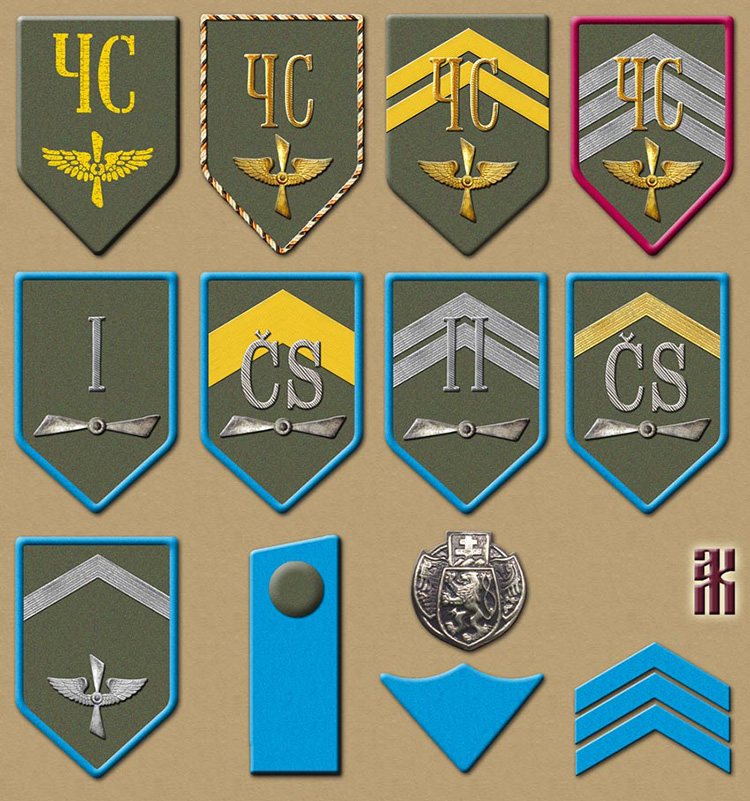
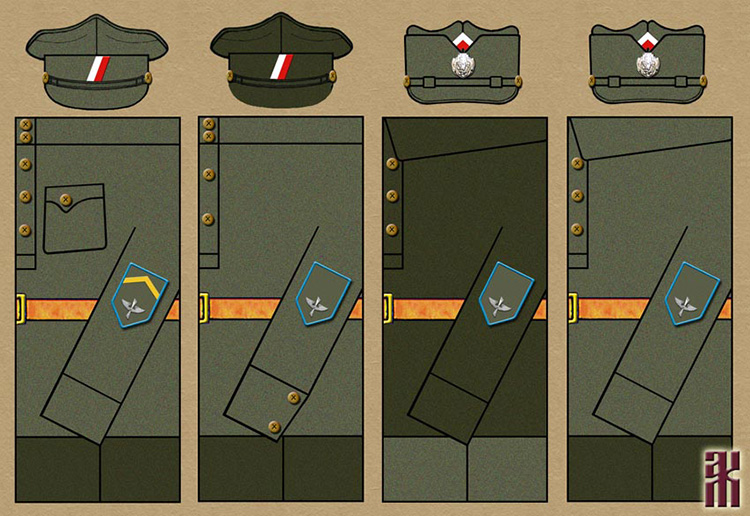
Insignia of the Czechoslovak Army's aviation units in Russia:
First row : sleeve badges up to October 1918, as per the 30 December 1917 order;
1 – private; 2 – gentleman volunteer private; 3 – corporal; 4 – lieutenant;
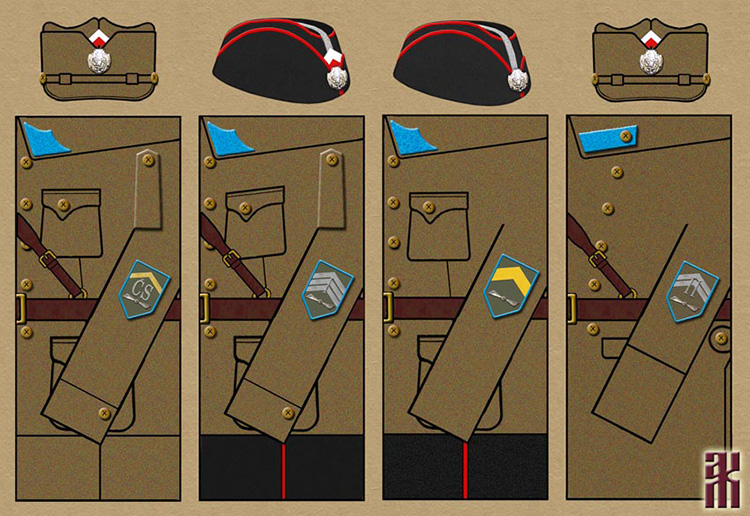
Second row: sleeve badges up to 1920, as per the 27 October 1918 order;
5 – private at 1st Rifle Division HQ; 6 – sergeant-major at corps HQ;
7 – second-lieutenant at 2nd Rifle Division HQ; 8 – major at corps HQ;
Third row: 9 – variant for an ensign; 10 – buttonhole tab; 11 – cockade of June 1919;
12 – tunic collar tab of "Vladivostok uniform"; 13 – service stripes
Order No. 15 of 30 December 1917 stated:
"§4. The number of the unit (regiment, artillery brigade, engineer company) is placed in Arabic numerals in the pointed corner of the shield..., with speciality insignia placed under the number for special-purpose units and komands.
Figure 1 shows the officially approved stencilled cipher and speciality insignia, but in practice metal was always used. The insignia was a "winged propeller", which in the Russian army had been worn by the men of the aviation units who were not pilots. For obvious reasons, the use of aviation emblems in the form of double-headed eagles was unacceptable to the Czechoslovaks.
Order No. 117 of 27 October 1918 stated:
§7. The types of troops and services are distinguished by the colour of the piping on the uniform shields and the tabs on the coat collars. It is established that ... for aviation units it is blue.
§8. The designation of the unit and speciality is placed in the lower half of the shield, with the unit number above the designation of the individual's speciality. It is established that: ... aviation units at corps headquarters shall have "ČS", aviation units at division headquarters shall have "I" and "II". Designation of specialist insignia: for pilots and technical aviation crews it is a propeller.
However, judging by photographs, the old emblem in the form of a "winged propeller" continued to be used alongside the new one, but was now made of white metal, as in Figure 9.
The cockade in Figure 11 was established for the Corps in June 1919 at the same time as the new headgear, the so-called "vydumka".
The chevrons for years of service were established by Order No. 11 of 27 October 1918:
§11. On the right sleeve (at the same height as the shield on the left sleeve) a designation of years of service is to be worn – a chevron of the same shape and size as the stripe on the shield, in the colour of the branch of service.
Each chevron corresponded to one year of service, with the count starting in 1914, i.e. from the moment the Czechoslovakian druzhina was formed.
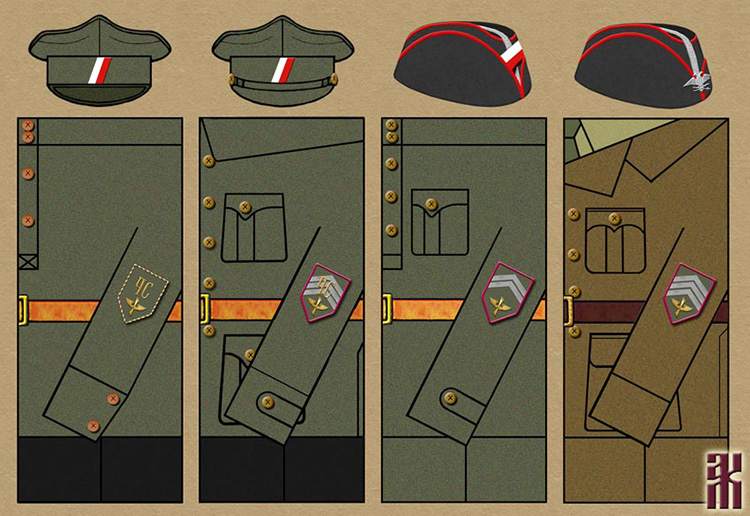
Uniforms of aviation units from December 1917 to October 1918
The uniforms have been reconstructed on the basis of numerous surviving photographs, and it can be concluded that officers most commonly wore various styles of tunics with patch pockets, while the lower ranks wore various styles of blouse. Until July 1919 the main headgear was a shaped Russian artillery cap with a leather visor and chin strap. The pilotka sidecaps (sometimes called "zaletki") that continued to be actively used in the corps initially had cockades of red and white ribbon or the old-style pilot emblems in the form of a double-headed eagle (having removed the emperor's monogram and the crowns on the eagle's heads).
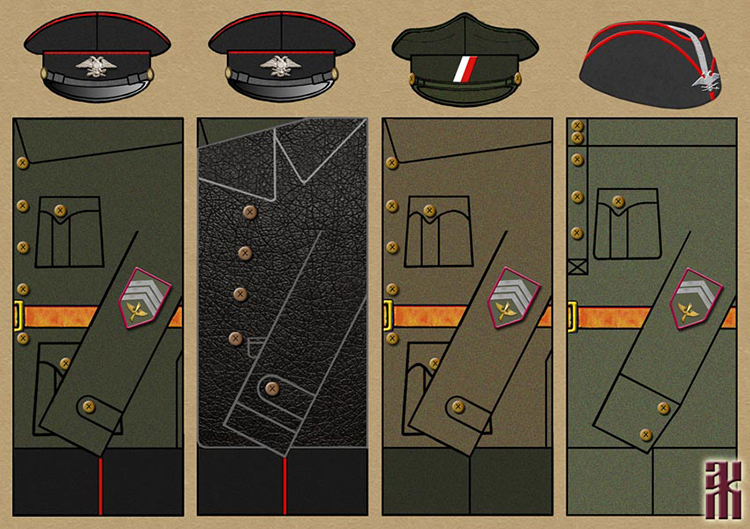
Uniforms of aviation units from December 1917 to October 1918
Pilots remained a closed corporation, proud of their traditions and, among other things, their external differences from the bulk of other soldiers. Figures 1 and 2 continue to wear coloured Russian caps, replacing the cockade with altered pilots' emblems, as well as coloured trousers (black with red piping). Leather jackets of various styles remained popular among the flying personnel. Figure 4 shows a pilotka with the altered eagle in place of the cockade. Later, pilots would abandon that emblem, as a symbol of another state, and switch to wearing the white and red ribbon common to all Czechoslovak units.
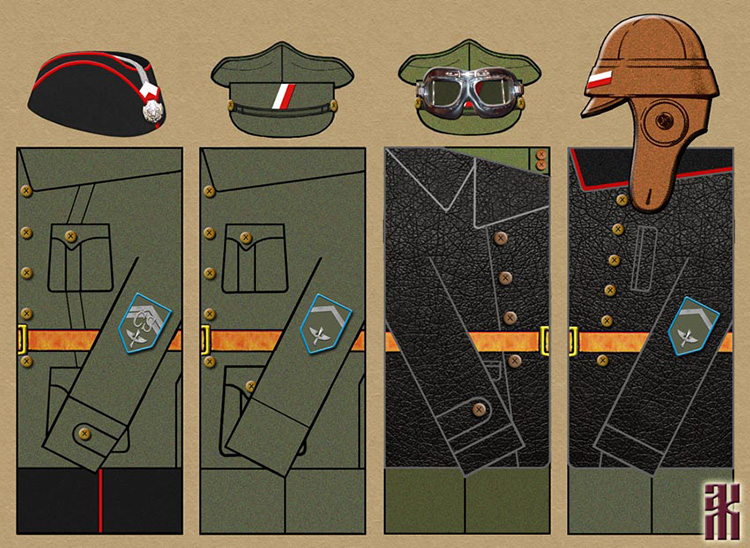
Uniforms of aviation units from October 1918 to 1920
Order No. 41 of 21 June 1919 introduced a new headgear to the Czechoslovak units, which was given the name vydumka (literally, "invention"), after which the wearing of other types of headgear was prohibited. Despite this, peaked caps continued to enjoy their former popularity as the most characteristic uniform distinction of aviation personnel. Insignia were transferred to them in the form of a white and red ribbon of the national colours of Czechoslovakia, sewn at an upward angle, and a new model metal cockade. Figures 3 and 4 show examples of the use of leather flight uniforms.
Uniforms of aviation units from October 1918 to 1920
As in all other units, there was a great variety of uniform styles in the aviation units, but from the summer of 1919 the main distinguishing feature of the Czechoslovak units was the vydumka.
Uniforms of aviation units from June 1919 to 1920
Army Order No. 41 of 21 June 1919 brought in a new model of uniform (the "Vladivostok uniform") for the corps, but it proved extremely difficult to provide it to all personnel. Initially, the new uniform was only distributed to officers (with permission to continue wearing the old uniform until the end of 1919, provided that the new uniform was worn during all official events). Later it was distributed to lower ranks. The introduction of a new model of overcoat, again common to all branches of the military, replacing the Russian model, followed in August 1919.
The aviation units, generally known for their high corporate spirit and desire to stand out from other units, continued to wear pilotka caps and the black trousers with red piping from the former Russian army, until their evacuation from Russia.
Home — State Symbols — Flags — Uniforms — Badges & Medals — Money — Other
Pygmy Wars Notes
The original for this page is at kolchakiya.ru/uniformology/czech/aviation.htm.
Discussion on the translation choices I have made can be found here.