
Uniforms of the Independent Motorised Company
at the Headquarters of the Czechoslovak Corps
All material and reconstructions are by A. Karevskiy.
The main sources for this material are:
Tatarov, B. "Czechoslovak Military Formations in Russia: Part 1, 1917-1918 // Staryi Tseykhgauz, No. 5-6", Moscow, 2015. pp. 54-76; and " ... Part 2, 1919-1920 // Staryi Tseykhgauz, No. 3", Moscow, 2016, pp.73-83.
Orian, E., Panus, B., Stechlik, E. and Steidler, F. "Ceskoslovenska Legie v Rusku, 1914-1920", Prague, 2014.
Bullock, D. "The Czech Legion // Men-at-Arms No. 447", Oxford, 2007.
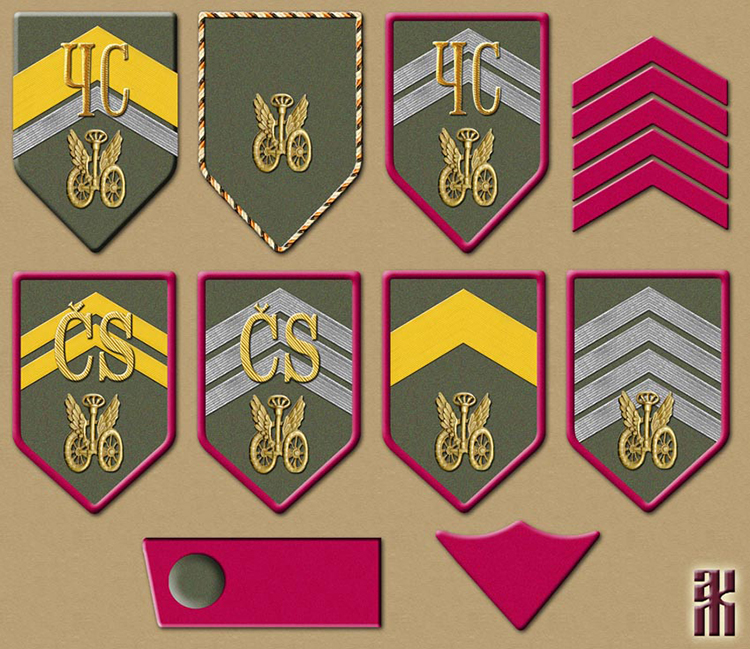
Insignia of the Independent Motorised Company of the Czechoslovak Corps HQ:
First row: sleeve badges as per the 30 December 1917 order and service stripes:
Second row: sleeve badges in accordance with the 27 October 1918 order;
Third row: buttonhole tab for the greatcoat and tunic collar tab of the "Vladivostok uniform"
Order No. 15 of 30 December 1917 detailed the initial sleeve badges. The specialist insignia for motorised units in the former Russian army continued to be used.
Order No. 117 of 27 October 1918 made amendments. For some unknown reason, that order did not specify the colour of the piping on the shields – in practice, it remained raspberry, although from October 1918 onwards, the standard colour for other technical units became first olive and then green. However, the emblem was regulated:
§8. The designation of the unit and speciality is placed in the lower half of the shield, with the unit number above the designation of the individual's speciality. It is established that ... for the army corps headquarters and seconded units, the letters "ČS" are used. Designation of specialities: ... for motor vehicle mechanics – a winged wheel with a steering wheel.
The "ČS" code was virtually never used in practice, but the vehicle emblem was always present on the shields.
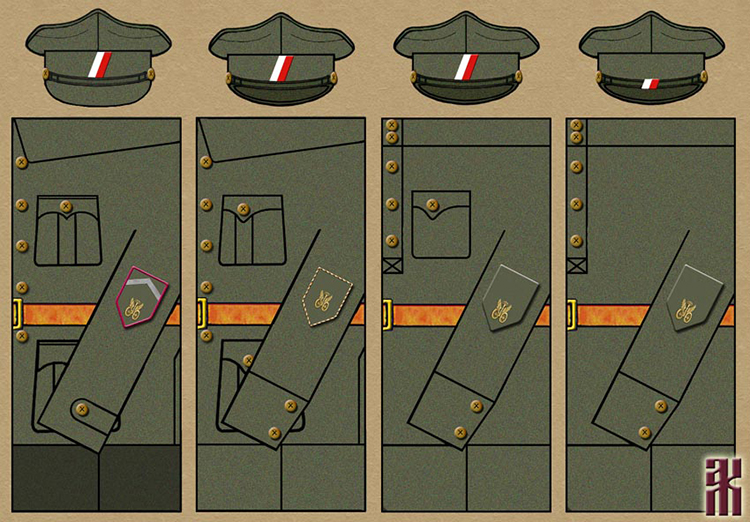
Uniforms of the Independent Motor Company at the HQ of the Czechoslovak Corps,
December 1917 to October 1918
The initial version of the motor company's uniform differed little from that of other units of the corps.
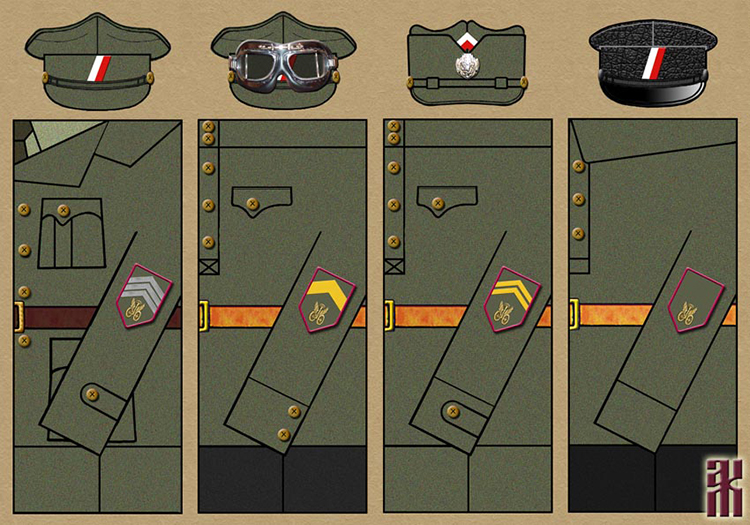
Uniforms of the Independent Motor Company at the HQ of the Czechoslovak Corps,
from October 1918
Judging by photographs, it was common among the company's officers to wear open British-style tunics with shirts and ties in various shades of green, as shown in Figure 1. A variety of shapes and cuts of outerwear was equally common among the soldiers of the motorised company, but they tried to follow the fashion of the motorised units of the former Russian army. They inherited leather jackets, caps and special "driver's" goggles. Figure 3 shows the most common uniform from the summer of 1919, after the introduction in June 1919 of the vydumka headgear, which became a characteristic feature of the Czechoslovak troops, even while retaining the blouses and tunics of the former Russian army.
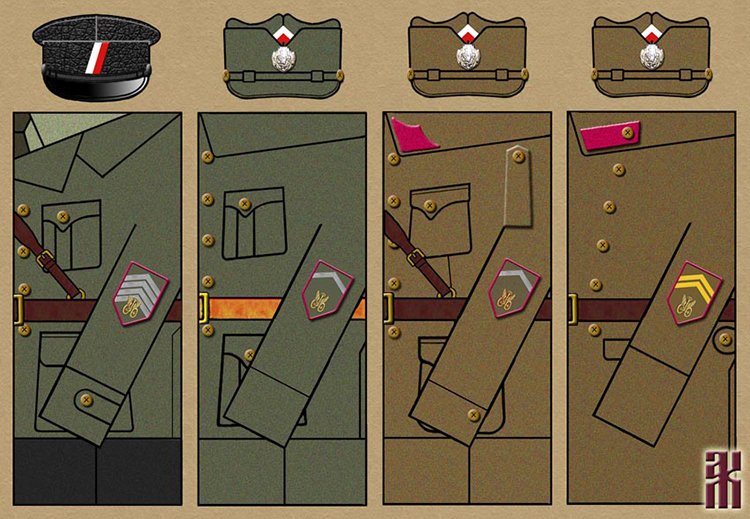
Uniforms of the Independent Motor Company at the HQ of the Czechoslovak Corps,
after June 1919
Despite the introduction of the vydumki, leather caps was popular even without the rest of the leather uniform (Figure 1). Photographs show that even the company commander himself followed this fashion. Figures 3 and 4 are the so-called "Vladivostok uniform". Introduced in June 1919, initially it was for officers, and then extended to lower ranks. The motorised company's distinctive colour (collar tabs and sleeve badge piping) were raspberry, the same as in the rifle units.
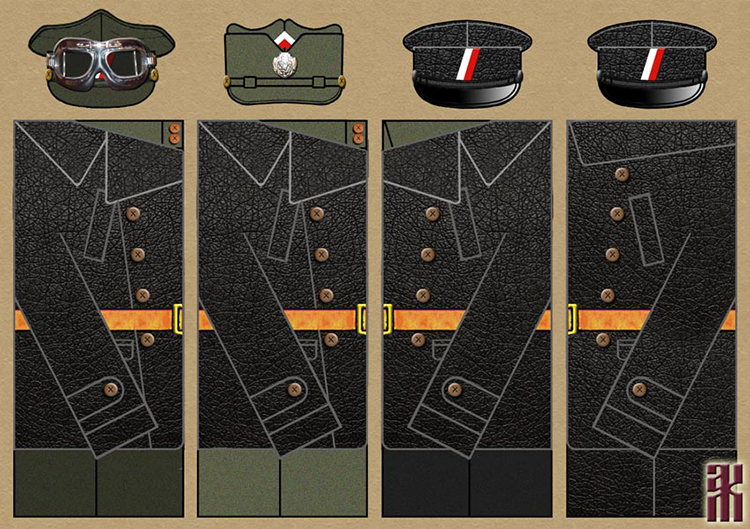
Uniforms of the Independent Motor Company at the HQ of the Czechoslovak Corps
Leather uniforms were common in the motorised company, in various combinations from a full set (jacket, trousers, cap) to individual items. Judging by photographs, no insignia were sewn onto them, with the exception of a white and red ribbon on the caps.
Home — State Symbols — Flags — Uniforms — Badges & Medals — Money — Other
Pygmy Wars Notes
The original for this page is at kolchakiya.ru/uniformology/czech/truckmen.htm.
Discussion on the translation choices I have made can be found here.