
Uniforms of the Czecko-Slovak Legion Artillery, 1917-1920
All material and reconstructions are by A. Karevskiy unless noted otherwise.
The main sources for this material are:
Tatarov, B. "Czechoslovak Military Formations in Russia: Part 1, 1917-1918 // Staryi Tseykhgauz, No. 5-6", Moscow, 2015. pp. 54-76; and " ... Part 2, 1919-1920 // Staryi Tseykhgauz, No. 3", Moscow, 2016, pp.73-83.
Orian, E., Panus, B., Stechlik, E. and Steidler, F. "Ceskoslovenska Legie v Rusku, 1914-1920", Prague, 2014.
Bullock, D. "The Czech Legion // Men-at-Arms No. 447", Oxford, 2007.
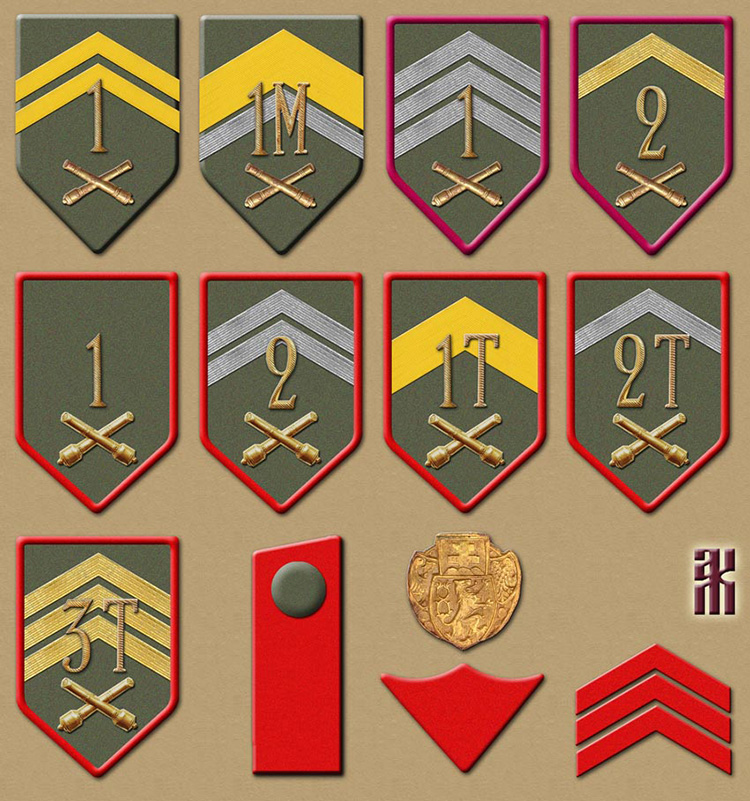
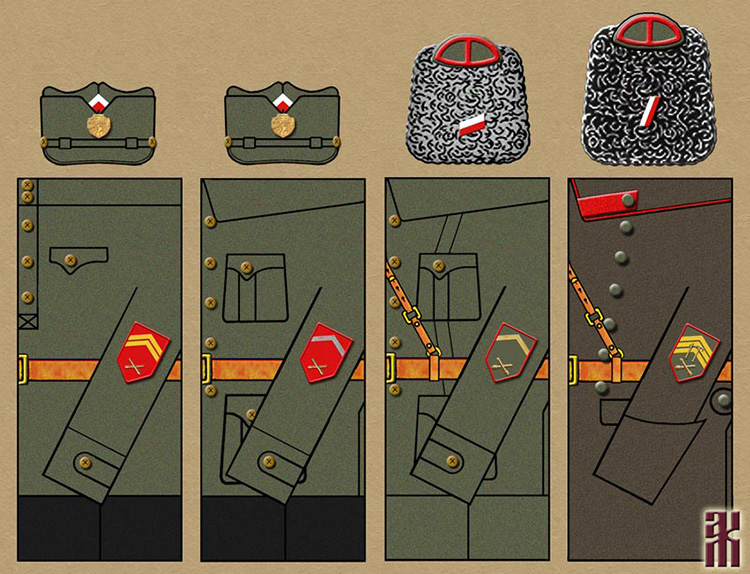
Insignia of artillery units from December 1917 to October 1918:
first row, as per the 30 December 1917 order: 1 – corporal of the 1st Artillery Brigade;
2 – sub-ensign of the 1st Howitzer Divizion ; 3 – lieutenant of the 1st Artillery Brigade;
4 – captain of the 2nd Artillery Brigade;
second row, as per the 27 October 1918 order: 5 – gunner of the 1st Artillery Brigade;
6 – second-lieutenant of the 2nd Artillery Brigade; 7 – sergeant-major of the 1st Heavy Artillery Divizion ; 8 – ensign of the 2nd Heavy Artillery Divizion ;
third row: 9 – colonel of the 3rd Heavy Artillery Divizion ; 10 – greatcoat collar tab;
11 – June 1919 cockade; 12 – tunic collar tab of the "Vladivostok uniform";
13 – service stripes
Order No. 15 of 30 December 1917 stated:
§4. The number of the unit (regiment, artillery brigade, engineer company), in Arabic numerals, is placed in the pointed corner of the shield ..., with specialist insignia placed under the number in specialist units and komands: for artillery units – cannons ... for howitzer divizions, the Arabic numeral of the divizion number and the letter "M" at the top and the artillery insignia at the bottom.
Order No. 117 of 27 October 1918 stated:
§7. The branches of the armed forces and services are distinguished by the colour of the piping on the uniform shields and the tabs on the collars of their coats. It is established that: ... artillery is red (scarlet).
§8. The designation of the unit and speciality is placed in the lower half of the shield, with the unit number above the designation of the individual's speciality. ... artillery field brigades shall have "1" and "2"; heavy artillery divizions shall have "1T" and "2T". The specialist insignia for artillerymen is crossed cannons ...
In Figure 10 the button on the greatcoat tab is covered in khaki cloth, which was required for buttons bearing the image of the Russian Empire's coat of arms. The cockade established in June 1919 was often made of yellow metal as the traditional metal for artillery. It went with the new headgear, the so-called "vydumka".
Chevrons for service were established by Order No. 11 of 27 October 1918:
§11. On the right sleeve (at the same height as the shield on the left sleeve) a distinction for years of service is to be worn – a chevron of the same shape and size as the stripes on the shield, in the colour of the branch of service.
Each chevron corresponded to one year of service, with the count starting in 1914, i.e. from the moment the Czechoslovakian druzhina was formed.
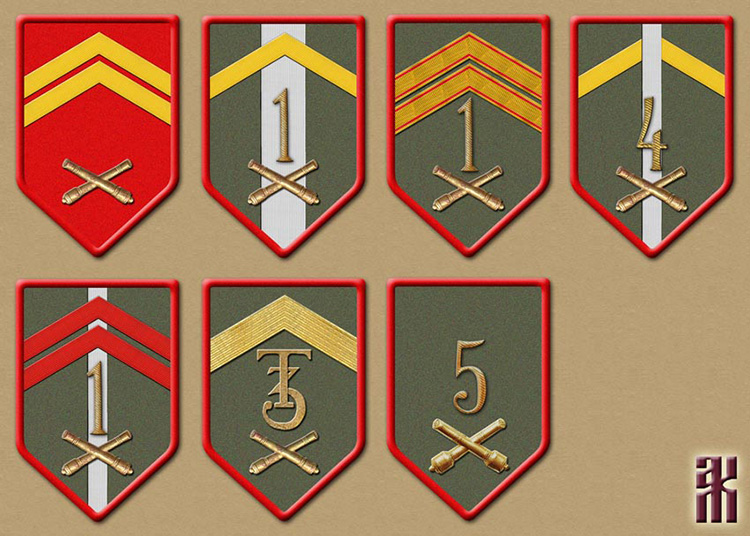
Variant insignia of artillery units:
1 – Captain Kulikovsky's battery, early period; 2 – Captain Kulikovsky's battery, late period;
3 – corporal of the 1st Artillery Brigade; 4 – bombardier of the 4th Regiment;
5 – corporal of the 1st Regiment; 6 – major of the 3rd Heavy Artillery Divizion;
7 – gunner of the 5th Regiment
Figure 1 is during the period when the battery was seconded to the Shock Artillery Brigade, and Figure 2 to afterwards. Figure 3 shows original yellow silk braid with red piping. Figure 4 is a bombardier of the artillery komand of the 4th "Prokop the Great" Rifle Regiment, with white gunner's braid, not official practice in the Czechoslovak army and preserved from the time of service in the Russian army. Figure 5 is an NCO-gunner of the artillery komand of the 1st "Jan Hus" Rifle Regiment, with red braid instead of the regulation yellow. Figure 6 shows the original interlaced cipher of the 3rd Heavy Artillery Divizion. Figure 7 is a gunner of the artillery komand of the 5th "Prague Thomas Masaryk" Rifle Regiment.
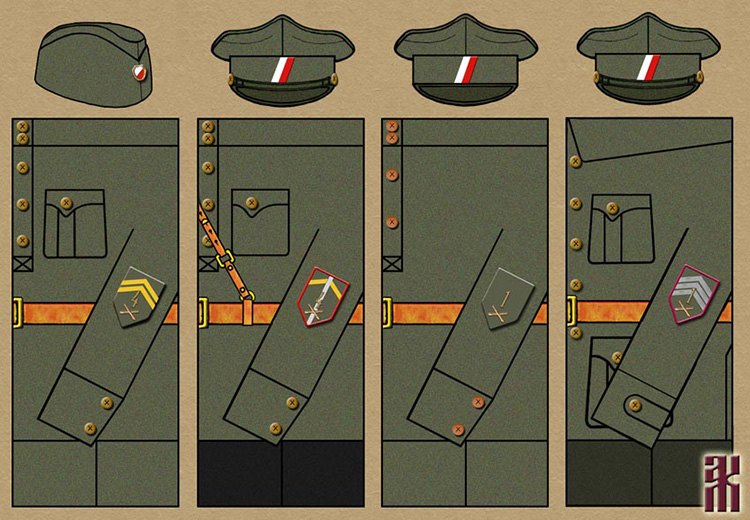
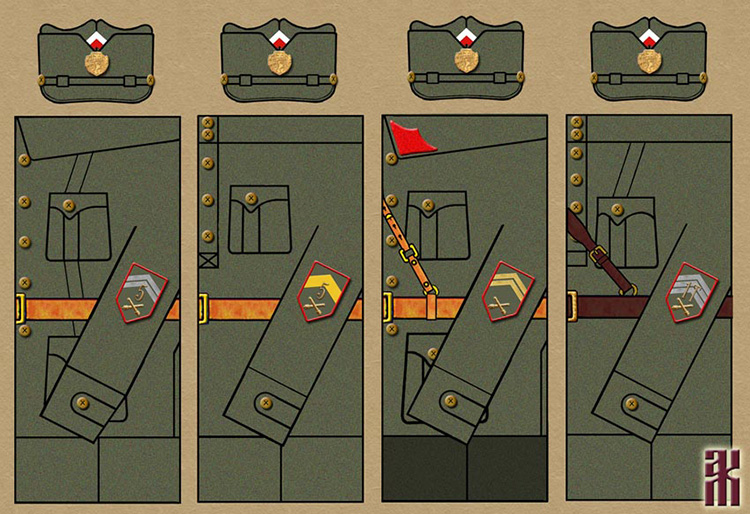
Uniforms of artillery units from December 1917 to October 1918, summer uniforms:
1 and 2 – men of the 4th Regiment; 3 and 4 – men of the 1st Artillery Brigade
Figures 1 and 2 are from of the artillery komand of the 4th "Prokop the Great" Rifle Regiment. The cap in Figure 1 is a "chechenka", named after its designer, regiment commander S. Chechek. It was introduced "due to the lack of Russian caps" and was worn with a small metal white and red shield instead of a cockade.
These uniforms have been reconstructed on the basis of numerous surviving photographs. It can be concluded that the most common type of uniform among officers was various types of tunics with patch pockets, while lower ranks wore blouses of various styles. Until July 1919 the main headgear was a shaped Russian cap with a leather visor and chin strap.
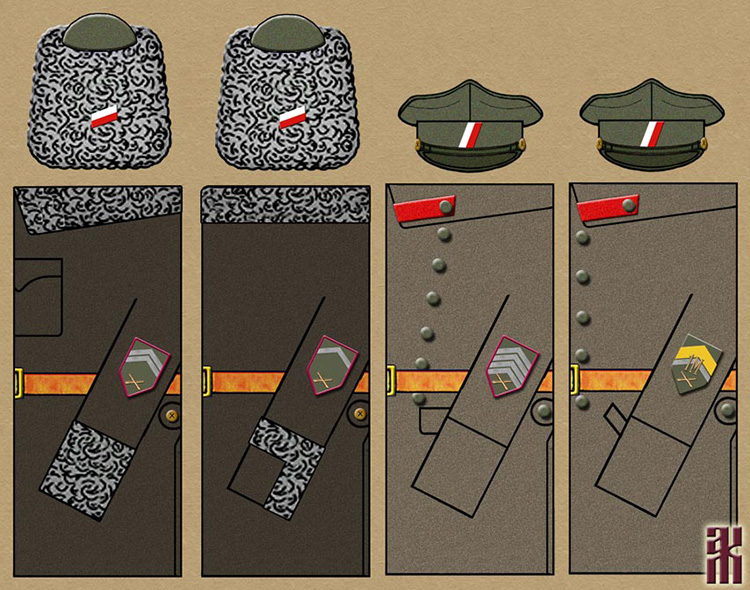
Uniforms of artillery units from December 1917 to October 1918, winter uniforms:
Until the summer of 1919, uniforms from the former Russian army dominated. Figures 1 and 2 show jackets of various styles. Figures 3 and 4 are in greatcoats with covered buttons. Regulations were that buttons with symbolism of states other than Czechoslovakia had to be covered with khaki fabric.
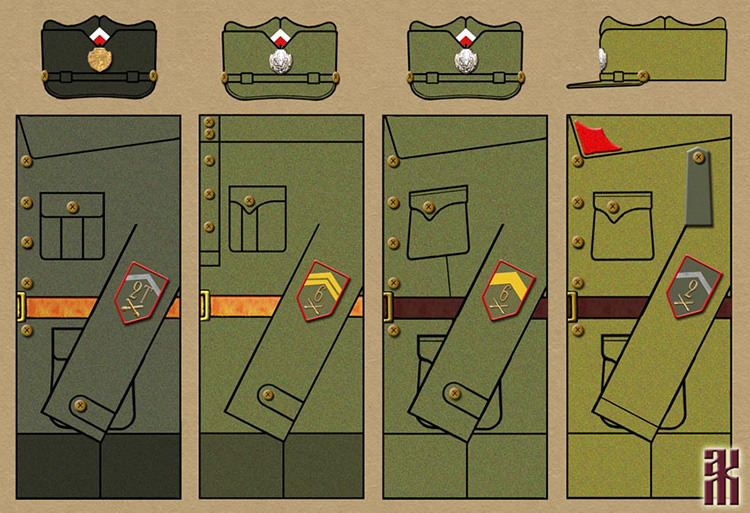
Uniforms of artillery units from June 1919
Order No. 41 of 21 June 1919 introduced a new headgear to the Czechoslovak units, which was called the "vydumka" (literally, invention), followed by a ban on wearing other types of headgear. The same order introduced a new uniform (the "Vladivostok uniform"), but it proved extremely difficult to provide it to all soldiers, and so the vydumka served for a long time as the main visual distinction of the Czechoslovak soldiers in Russia.
Figure 3 represents an example of wearing collar tabs intended for the so-called "Vladivostok uniform" on a completely different uniform, preserved from earlier times.
Uniforms of artillery units from June 1919
Examples of the variety in the colours used in the manufacture of uniforms. Figure 4 is a reconstruction of a so-called "Vladivostok uniform" from a surviving piece, made from an unusual light green material, with soft sewn-in shoulder-straps made from a different material.
Uniforms of artillery units from June 1919:
1 and 2 – men of Kulikovsky's battery during their secondment to the Shock Battalion;
3 – uniform of Major Kulikovsky; 4 – Sergeant of the 2nd Heavy Artillery Divizion
Figure 4 has preserved items of the old Russian uniform, which had become rare by this time: a black papakha and a greatcoat with red piping on the collar.
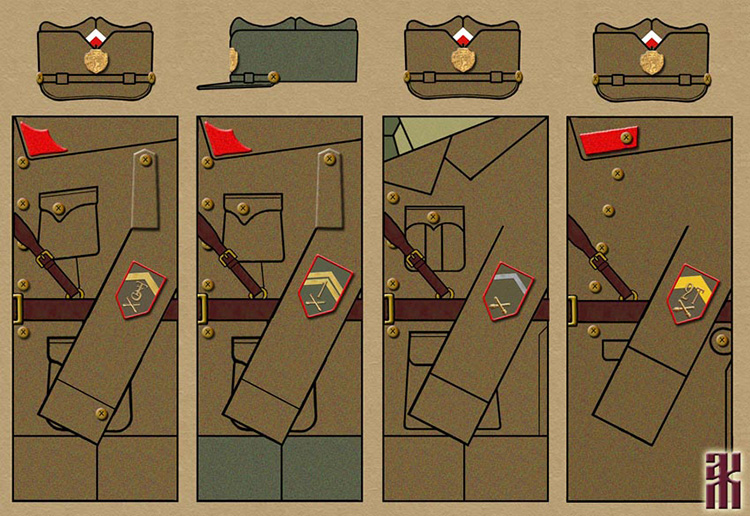
"Vladivostok uniforms" for artillery
The so-called "Vladivostok uniform" was introduced by Order No. 41 of 21 June 1919 at the same time as the vydumka cap. At first, the new uniform was only distributed to officers (with permission to continue wearing the old uniform until the end of 1919, provided that the new uniform was worn during all official events). Later that uniform was distributed to the lower ranks, although most received it only in Vladivostok shortly before being sent back to their homeland. The introduction of a new model of overcoat, common to all branches of the military, followed in August 1919.
Figure 2 represents an example of mixing sets of different colours. Figure 3 represents a lance-corporal of the 2nd Artillery Brigade with British uniform.
Home — State Symbols — Flags — Uniforms — Badges & Medals — Money — Other
Pygmy Wars Notes
The original for this page is at kolchakiya.ru/uniformology/czech/artillery.htm.
The Russian word mortira is used for all large-calibre high-angle firing pieces, including ones which in English would be pure howitzers, and hence they had a letter "M" for their cipher. However, I have translated the unit as a "howitzer divizion", as they would be in English terminology. Discussion on other translation choices I have made can be found here.