
Uniforms of the Chinese Expeditionary Forces in the Russian Far East,
August 1918-October 1920
All material and reconstructions are by A. Karevskiy unless noted otherwise.
The following were used in the reconstruction of the uniforms of the Chinese Expeditionary Forces in the east of Russia:
Minguo Jun Fu Tu Zhi. "Chinese Republic army uniforms", Shanghai, 2003.
Jowett, P. S. "Chinese Warlord Armies 1911-30 // Men-at-Arms No. 463", Oxford, 2010.
Jowett, P. S. "Chinese Civil War Armies 1911-49 // Men-at-Arms No. 306", Oxford, 1997.
Jowett, P. S. "Imperial Chinese Armies, 1840-1911 // Men-at-Arms 505", Oxford, Osprey, 2016.
Deryabin, A. I. "Civil war in Russia 1917-1922: Interventionist Forces", Moscow, 1999, p.45-46.
topwar.ru/115976-kitay-i-grazhdanskaya-voyna-v-rossii.html
During this period, various Chinese military formations, including local security and border guards, were deployed to the Russian Far East for short periods of time. The permanent forces of the Chinese intervention corps included various units of the 9th Infantry Division of the Chinese Republican Army, including the 33rd Infantry Regiment, a machine-gun company, a transport company, an engineer company, a cavalry squadron, a battery of the 1st Artillery Division, and a gendarmerie squad. The first echelon left Beijing by rail via Harbin on 26 October 1918 for Vladivostok. The second echelon travelled to Vladivostok from Beijing via Dagu by transport. The headquarters and most of the units were located in Nikolsk-Ussuriysk, the cavalry in Khabarovsk, and the infantry battalion and the office of the judicial department in Vladivostok.
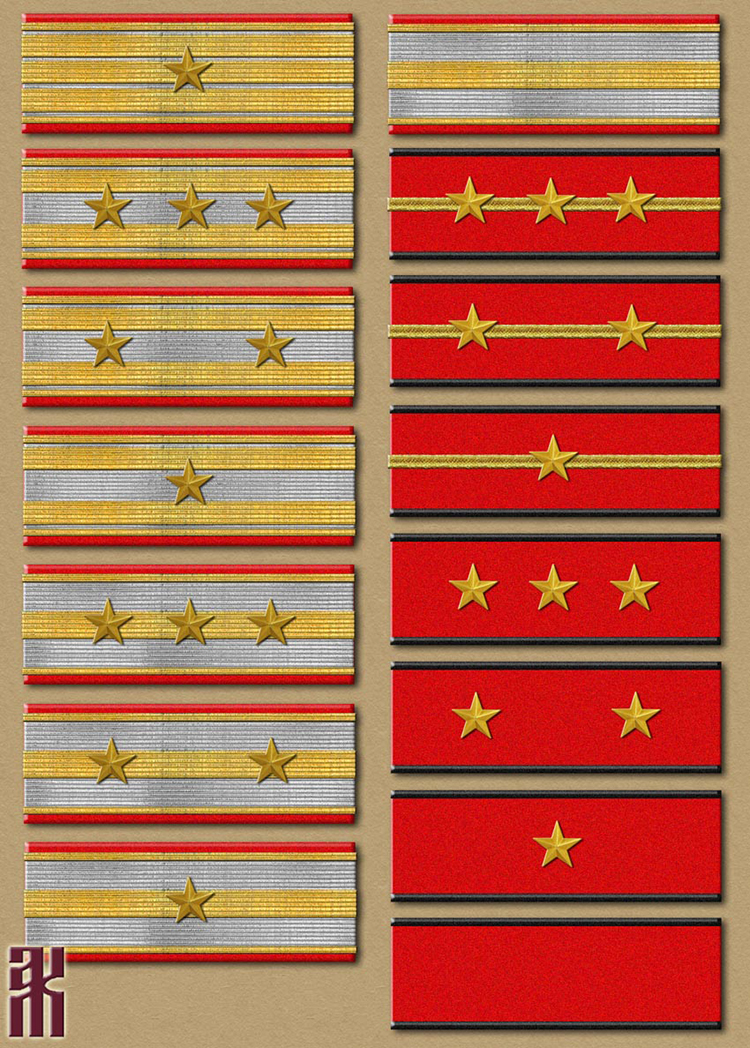
Rank markings of the Republican Army, adopted in 1912:
(going down) 1 – major-general; 2 – colonel; 3 – lieutenant-colonel; 4 – major;
5 – captain; 6 – lieutenant; 7 – second-lieutenant; 8 – ensign; 9 – staff sergeant;
10 – sergeant; 11 – corporal; 12 – senior private; 13 – private 1st class;
14 – private 2nd class; 15 – private recruit
These shoulder markings were the same for all branches of the military.
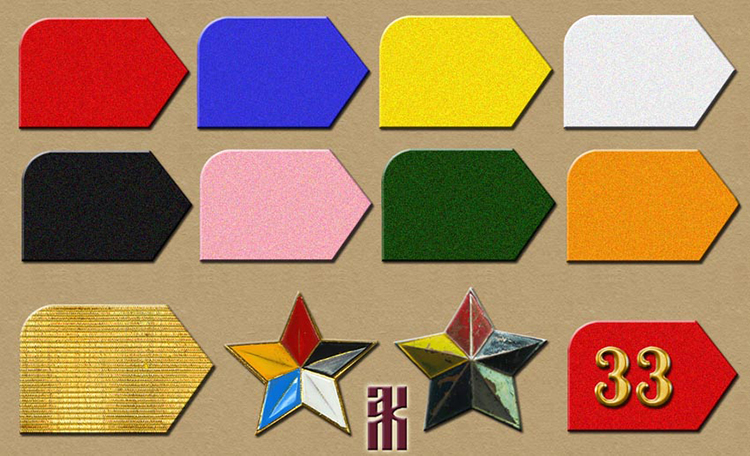
Collar tabs and cockades for everyday and parade uniforms of the Republican Army:
1 – infantry; 2 – artillery; 3 – cavalry; 4 – sappers; 5 – supply and transport;
6 – gendarmerie; 7 – military medics; 8 – military judiciary; 9 – generals;
10 and 11 – cockades; 12 – with unit number
The collar tab indicated the branch of service, and was the only feature that did that. The five-coloured stars of the Republican Army had the colours red, yellow, blue, white and black symbolising the main ethnic groups of China (Manchus, Chinese, Mongols, Muslims and Tibetans). In wartime and campaign unit numbers (regiment for infantry regiments, division number for others) was supposed to be on both collars, but this was not always done.
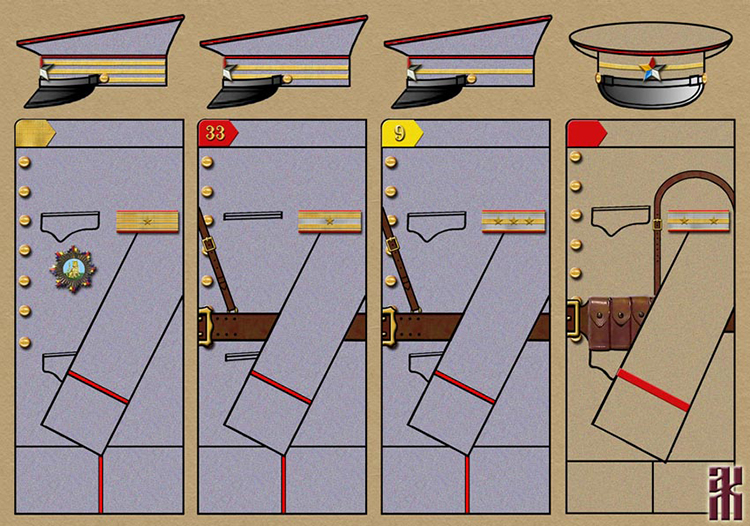
Officer uniforms:
Fig. 1 – general; 2 – staff officer; 3 – senior officer; 4 – officer in summer uniform
The cut of the uniform was basically the same for officers and other ranks, but the officer uniforms were made of better quality material, and had red piping on the tunic cuffs and trouser seams (in all branches). The caps of both officers and other ranks had red piping on the crown and upper edge of the hatband. The coloured visors on caps that existed in the Imperial (Qing) army were abolished in the Republican army, and the system of narrow braid sewn around the visor was changed: now one braid was assigned to officers, two braids to staff officers, and three braids to generals.
Figure 1 is taken from a photo of Major General Yu Yusi, commander of the Chinese expeditionary forces. His tunic is decorated with the Star of the Order of the Striped Tiger. Figure 2 shows the practice of tucking pocket flaps inside so that they looked like slit pockets, by both officers and soldiers – the same thing happened in the Imperial Japanese Army). Figure 4 is in the summer uniform, which was made of light khaki fabric. The loose-fitting sleeves were trimmed with wide red braid, but the trousers had no piping.
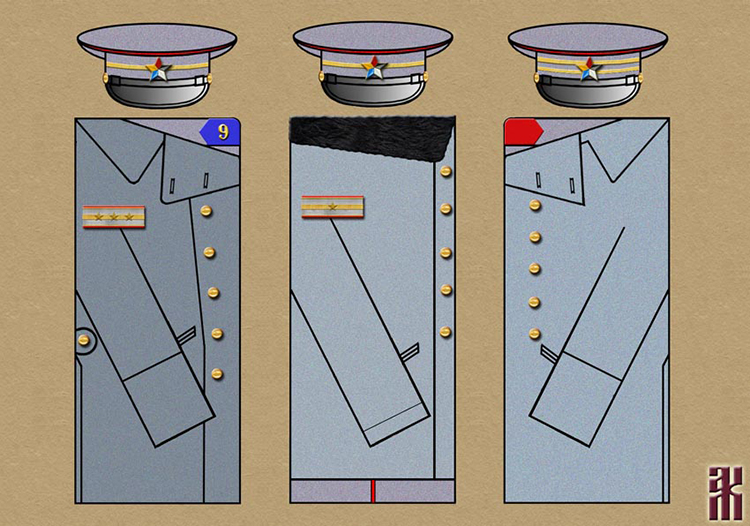
Officers' uniforms:
1 – greatcoat; 2 – quilted jacket with fur collar; 3 – raincoat.
Unlike those of other ranks, officers' greatcoats were made of grey cloth. Dark-coloured sheepskin collars were removable and were used on jackets and greatcoats. In all the photographs, the raincoats are worn unfastened and without a belt.
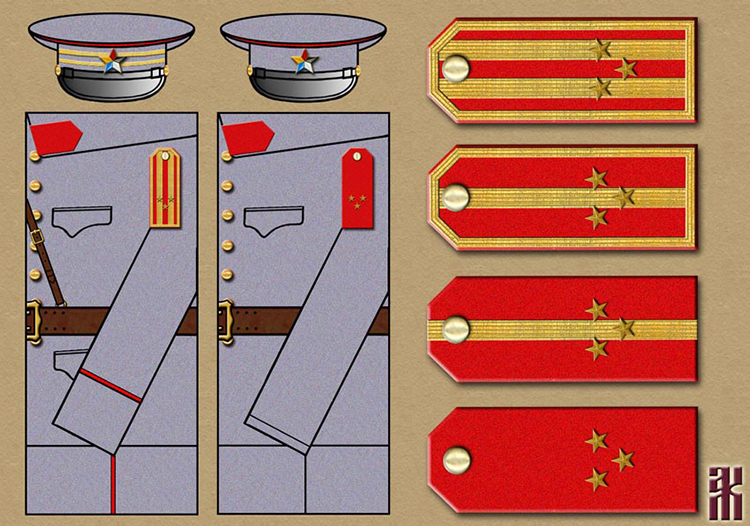
Full dress uniform: 1 – staff officer; 2 – private; 3 to 6 – shoulder-boards
Judging by photographs, the full dress uniform was the guard uniform of the Imperial Qing Army – a grey tunic with a turn-down collar and longitudinal shoulder-boards. Figure 1 is from a photograph of Colonel Sun Huanchang, commander of the 33rd Infantry Regiment.
The dress shoulder-boards of staff officers had 1 to 3 stars and two stripes; officers had 0 to 3 stars (ensigns had none) and a stripe; NCOs had 1 to 3 stars but no border; and soldiers had 1 to 3 stars on a plain background.
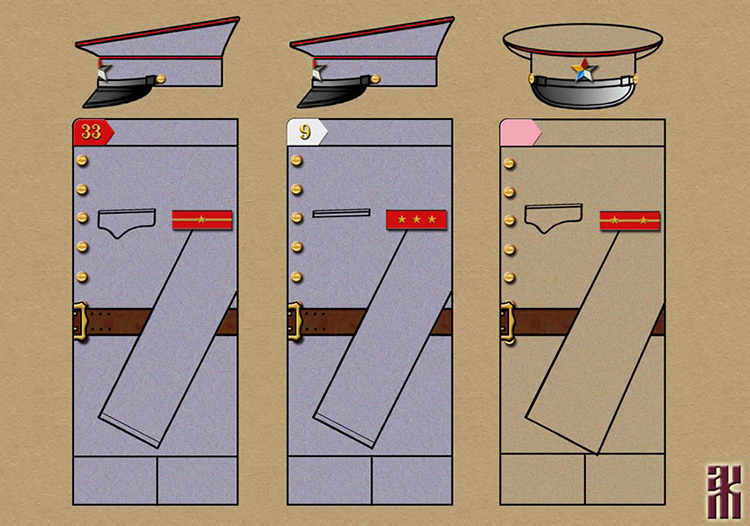
Uniforms of other ranks:
1 – "standard" version; 2 – with "tucked in" flaps; 3 – summer uniform
Soldiers' uniforms differed from officers' uniforms in the quality of the material and tailoring and the absence of coloured piping (except for the cap). The tunic had no sewn-on cuffs or side pockets. As among officers, it was common practice to tuck the pocket flaps inside, thus turning them into slit pockets.
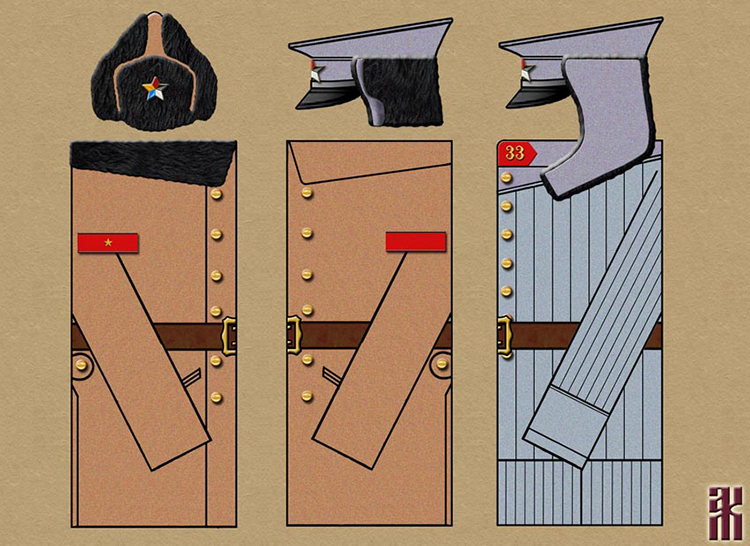
Uniforms of other ranks:
1 – greatcoat with a fur collar and fur hat; 2 – greatcoat, cap with fur ear flaps;
3 – quilted cotton jacket without insignia and matching trousers
Unlike the officers' greatcoat, the lower ranks version was made of light brown broadcloth. Figure 1 is a private with a fur collar fastened to the greatcoat. His fur hat is the same as worn by officers. Figure 2 has a cap insulated with attached fur ear flaps, which in this version are turned outwards with the fur, but judging by the photographs sometimes the fur faced inwards. Figure 3 shows the most common version of winter uniform. The cap has the attached fur ear flaps turned down.
Uniforms of Territorial Security Detachments
Territorial security detachments (local troops) were used mainly during border incidents and included infantry and cavalry units.
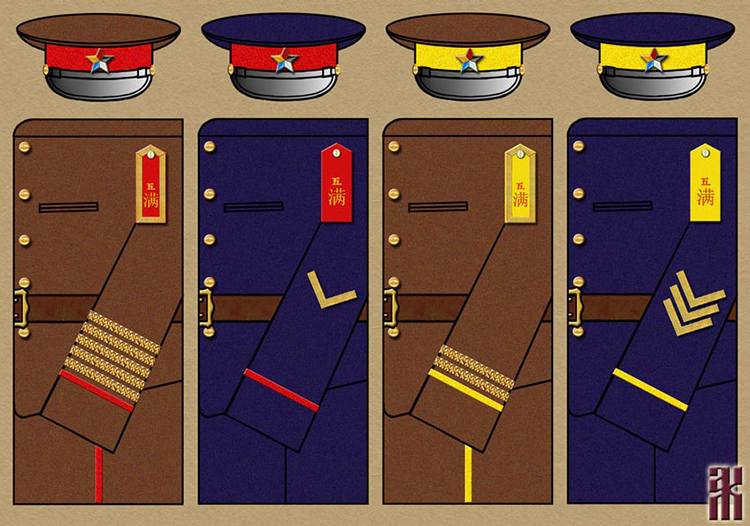
Uniforms for territorial security detachments:
1 and 2 – officer and other rank of infantry; 3 and 4 – officer and other rank of cavalry units
The uniform consisted of a jacket, trousers and a cap – dark brown for officers and dark blue for other ranks. The branches of service were distinguished by their insignia colours: the infantry had a red cap band, wide red braid on the cuffs, shoulder straps in red and a red trouser stripe for officers. The cavalry had the same, but in yellow.
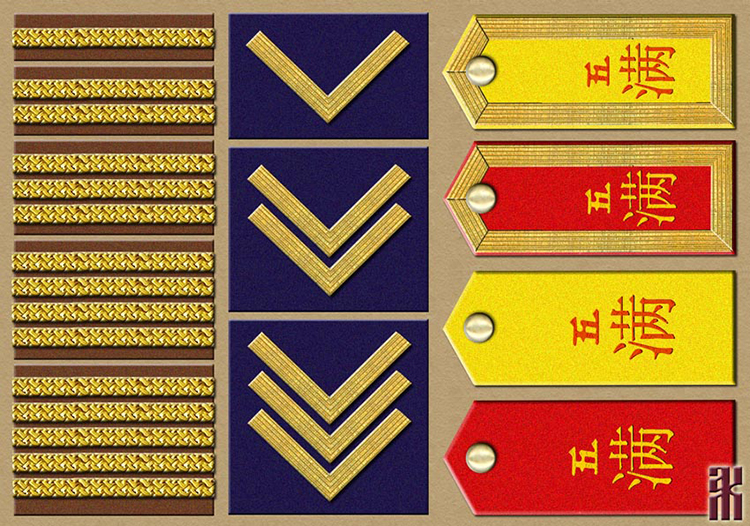
Rank markings of territorial security detachments:
officer cuff markings, other ranks arm chevrons, and shoulder-boards
The rank of officers was marked with gold cords on the cuffs above the braid denoting the branch of service. A junior officer had one cord, a platoon commander had two cords, a company commander had three cords, an assistant detachment commander had four cords, and the detachment commander had five cords. Other ranks had gold braid chevrons sewn below the shoulder seam: a private had one, a corporal had two, and a sergeant had three.
On the right are the shoulder-boards: red for the infantry and yellow for the cavalry. They were marked with a cipher reflecting the name of the province, the detachment number, the name of the troops, and the battalion and company numbers. Officers had gold braid around the edges.
Home — State Symbols — Flags — Uniforms — Badges & Medals — Money — Other
Pygmy Wars Notes
The original for this page is at kolchakiya.ru/uniformology/chinese.htm.
Discussion on the translation choices I have made can be found here.