
Uniforms of the Independent Mongol-Buryat Horse Brigade
named for Zorikhto-Bator
All material and reconstructions are by A. Karevskiy unless noted otherwise.
In addition to textual sources, the reconstruction is based on a photograph of Ataman Semenov with the staff of the Independent Mongol-Buryat Horse Brigade named after Zorikhto-Bator.
topwar.ru/66485-ataman-semenov-lyubov-pererosshaya-v-predatelstvo.html
Ataman Semenov (in white papakha) is dressed in the Buryat national robe known as a degel, as is the brigade commander, Major-General P. P. Levitskiy. The latter has a coloured cap, with shoulder-boards and two wound stripes on the left sleeve for wounds, which confirms that this is indeed a military uniform and not merely a change into national dress appropriate for the occasion.
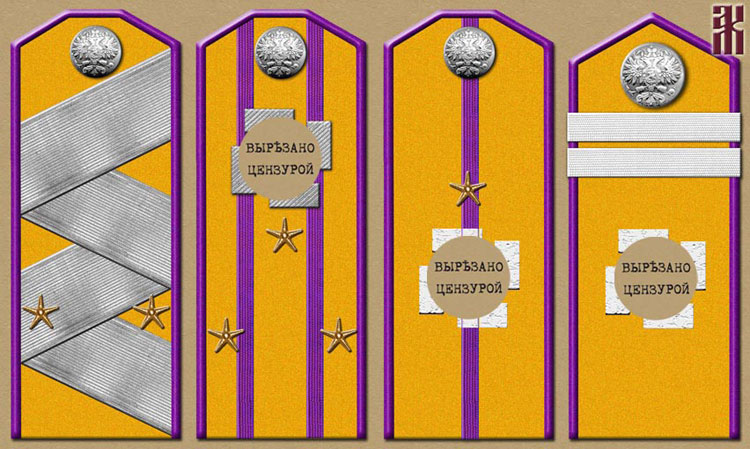
Shoulder-boards of the Independent Mongol-Buryat Horse Brigade
Figure 1 is a reconstruction of Levitskiy's general's shoulder-boards, based on the above photograph, while the others are based on extrapolations from the orders cited below. The swastika symbol was most likely in the form most commonly found in Buryat ornamentation and religious painting – straight, anti-clockwise, with ends shortened in relation to the central crossbar.
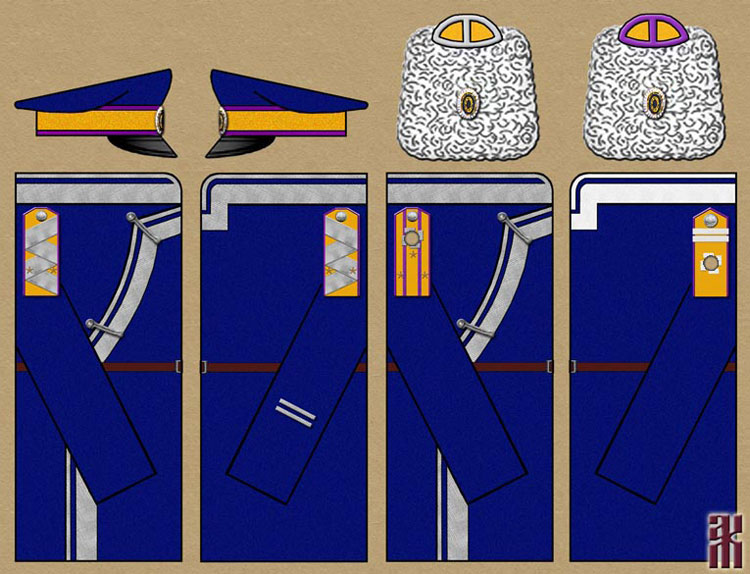
Uniforms of the Independent Mongol-Buryat Horse Brigade
1 and 2 – General Levitskiy; 3 – lieutenant-colonel; 4 – corporal
The colours of the cap were chosen based on the shoulder-boards and coat. The same scheme was later adopted in the units of the Asiatic Horse Division.
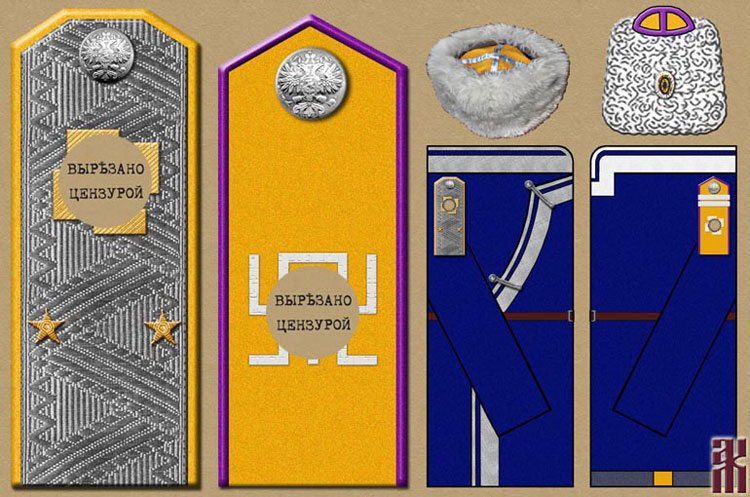
Shoulder-boards and uniforms of the Independent Mongol-Buryat Horse Brigade
1 and 3 – Ataman Semenov; 2 – alternative shoulder-board for a private; 4 – corporal
The reconstruction of Ataman Semenov shows him as a General of the Transbaikal Cossack Host , but with the insignia of the Mongol-Buryat Brigade, as General K. V. Sakharov mentions in his memoirs. Figure 2 shows a possible variant of the brigade emblem in the form of merged clockwise and anti-clockwise swastikas, a suggestion made by Moscow researcher A. S. Kruchinin. Figure 4 shows the same corporal as the previous illustration, but with a short robe for an ordinary horsemen.
The fascinating history of the Buryat White units in Semenov's army is widely known. The Combined Mongolian-Buryat Horse Division ("Wild Division") under the command of Petr Levitskiy (in Mongolian, Tsog Zhikholant) included three Buryat Cossack units: the 1st Buryat Regiment named for Dorzhi Banzarov, the 2nd Buryat Regiment named for Chinggis Khan, and the Independent Mongolian-Buryat Horse Brigade named for Zorikhto Bator, together with the horse artillery divizion of the Zorikhto Bator Brigade, and a regiment of Chakar Mongolians. Ataman Semenov himself liked to wear the military uniform of the Zorikhto Bator Brigade, which was similar to a Buryat robe (a degel) with shoulder-boards, as shown in surviving photographs from the Civil War.
Basayev, C. in "Who did the Buryats Fight for in the Civil War, or the Legend of the Red Partisan Baltakhinov // New Buryatia", at www.newbur.ru/articles/18982
Ataman Semenov, March 1920
Tall, with a large head and broad, powerful shoulders. Dressed in a Russian tunic with shoulder-boards bearing the Mongolian "suuvastika' symbol – the uniform of the Mongolian-Buryat Division – the ataman looked like a natural-born warrior.
Sakharov, K. V. in "White Siberia (The Civil War of 1918-1920)", Munich, 1923, p.301.
A little-known page in the history of the Asiatic Horse Division is the creation in August 1919 by Tsog Zhikholant (the name given to Major-General Levitskiy, when he became a Mongolian subject) of the detachment named for Zorikhto Bator (a Mongolian honorary title, roughly equivalent to the Russian rank of major-general). That detachment included the 2nd Dauriya and 3rd Khamar Regiments (originally without numbers).
On 31 August 1919, Order No. 15 of the detachment approved a sample of shoulder-boards for the horse regiments: "... the body of the shoulder-board is yellow, the stripes and piping are purple, and the buttons and Chinggis Khan insignia are white metal". Moreover, the detachment commander demanded strict compliance with the rules for wearing the insignia. In order No. 13, he wrote: "I have noticed that many of my detachment's officers are wearing non-standard shoulder-boards. I remind you that the shoulder-boards must be yellow with purple stripes. Order No. 243 to the Khamar Horse Regiment, of 5 September 1919, stated: "All officers are to take care to make shoulder-boards for themselves and their cavalrymen, in the form specified in Regiment Order No. 246."
The question arises, what exactly was meant in the order by "the Chinggis Khan insignia"? We venture to suggest that it was one of the oldest symbols of humanity, the swastika. It is known that a swastika was on the shoulder-boards of the Buryat cavalry regiment named after Dorzhi Banzarov in the Russian Far Eastern Army, subordinate to Ataman Semenov. Also, the tsiriki (soldiers) of Bogdo-Gegen's personal guard were dressed in red terliki short coats and wore yellow arm-bands with a black swastika
Kuznetsov, N. A. in " The White God of War: Baron R.F. von Ungern-Shternberg and the Asiatic Horse Division // Dobrovolets, No. 2", Moscow, 2003, p.25, citing RGVA F.39454 Op.1 D.6 L.192, 194.
Home — State Symbols — Flags — Uniforms — Badges & Medals — Money — Other
Pygmy Wars Notes
The original for this page is at kolchakiya.ru/uniformology/buryats_brigade.htm.
The images of the brigade's swastika emblem have been removed in accordance with Russian legislation.
It was usual Russian Imperial practice for the hat-band to be the same colour and piping as the shoulder-boards, which is how the field cap colours were reconstructed.
Tracking Mongolians of the period is a nightmare, because they used variant names over their lifetimes. On top of that, the different choices for transliterations lead to various alternative spellings. Zorikhto Bator is the Russian version of the title Zorigtbaatar (= brave noble) awarded by Bogdo Gegen VIII, khan of Mongolia, to the man born Enkhbilegtiin Togtokho, also known as Togtokho-taiji. He had been a rebel who fought against the Han Chinese economic and ethnic colonisation of Barga (Inner Mongolia) from 1907 to 1910. He was a leader in the Mongolian national revolution of 1911 and was active in revolutionary ranks until shot in 1921, during inter-revolutionary disputes. At no point did he lead the unit named after him.
Discussion on the translation choices I have made can be found here.