
Sleeve Insignia for the "Great Siberian Campaign"
Material and reconstructions by A. Karevskiy
Order to the Votkinsk Cavalry Division
Vladivostok, 22 June 1921
§1. I hereby announce for information, guidance and execution a copy of the order to the Votkinsk Detachment dated 20 June of this year, No. 010;
§2. I hereby announce for information and execution a copy of the order of the Commander of the Forces of the Provisional Amur Government dated 16 June of this year, No. 20:
I hereby establish a distinctive arm-band for members of the Kappel' Army who completed the Great Siberian Campaign.
All expenses incurred by this order shall be charged to the economic funds of the units.
APPENDIX: Description of the arm-band.
Signed: Commander of the Armed Forces of the Amur Government, Lieutenant General Verzhbitskiy,
Chief of Staff, Major-General of the General Staff, Puchkov.
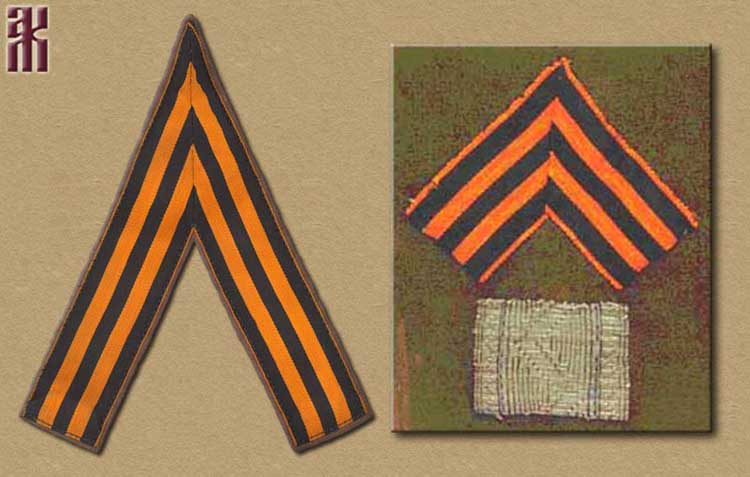
Sleeve chevrons for officers of the Far Eastern Army who took part in the Great Siberian Campaign: 1 – modern reconstruction in fabric; 2 – authentic chevron (the meaning of the silver braid at the bottom remains unclear)
Photo from the article: Selivanov, M. "Distinctions and differences of the Civil War era" at www.mirnagrad.ru/cgi-bin/exinform.cgi?page=29&ppage=3 [link dead]
Description of the sleeve insignia for members of the Army who took part in the Great Siberian Campaign:
The sleeve insignia is made from St. George ribbon, folded at a 45-degree angle.
The inner edges of the angle are one vershok long. The ends of the ribbon are cut in a straight line. The sleeve badge is worn with the angle pointing upwards above the elbow on the left sleeve.
Signed: Acting General of the Staff of the Provisional Amur Government
Peters, D. I. in "Material on the history of awards during the Civil War and the White Movement of 1918-1922", Philadelphia, 1996, p.30.
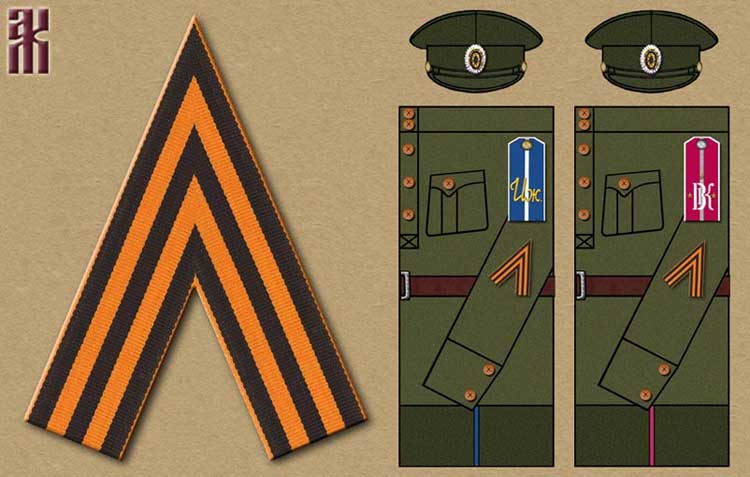
1 – reconstruction of the sleeve chevron for officers as per the order;
2 and 3 – examples on uniforms (here, the 1st Izhevsk Rifle and
1st Volga General Kappel' Regiments)
A photograph of Izhevtsy from 1921-1922 at http://voenforum.ru/index.php?showtopic=741&st=60 [link dead]
Order No. 12.
Khabarovsk, 11 January 1922
I have repeatedly stated in orders and conversations with officers and soldiers that we are the remnants of the great Russian army, that the army is united, that we serve our homeland, and not names. This is indeed the case, according to the inner convictions of every Russian soldier. But I must note that outwardly we are not yet united, due to differences in uniforms, and some officers of the Grodekov group wear clearly biased "А.С." monograms on their shoulder-boards. The people are watching us and fear atamanism even more than communism. Until the population sees us as their Russian army without any hint of the atamanism they have experienced, we will be alone, and the people will not support us. Believe me, all my endeavours are motivated solely by love for my homeland and fear for the sacred cause of liberating our Fatherland, as well as the experience I have gained over four years of civil war, experience gained with the blood of many of Russia's finest sons. Until the army is finally brought to a single type of appearance, I order:
... 3) Remove all sleeve insignia, except for the St. George ribbon chevron for those who have completed the Great Ice Campaign ...
Major-General Molchanov
Filimonov, B. B. in "White Rebels: The Khabarovsk campaign, Winter 1921-22", Moscow, 2005. pp.460-461.
It should be noted that none of the four points of the order were fully implemented: ... The St. George chevron for those who completed the campaign was again, both before and after the order, worn not by all those who were entitled to it, but also by those who either greatly respected the distinction or who loved beauty.
Filimonov, B. B. in "White Rebels: The Khabarovsk campaign, Winter 1921-22", Moscow, 2005. p.462.
Home — State Symbols — Flags — Uniforms — Badges & Medals — Money — Other
Pygmy Wars Notes
The original for this page is at kolchakiya.ru/uniformology/banner_Sib_ice.htm.
The "Great Siberian Campaign" was also known as the "Siberian Ice March". It was the retreat across middle Siberia in the winter of 1919/1920 when Kolchak's army fell apart completely. It ended with the remnants of Kolchak's Russian Army taking shelter with Semenov in Transbaikalia, where they became known as the Kappel'evtsy. The insignia discussed on this page is from the period after that in the Far East (Primor'e, Priamur and Vladivostok period).
In the Far East the Semenovtsy (remnants of Semenov's army), based in Grodekov, formed a separate group from the Kappel'evtsy. The reference to the "A.C" insignia is men wearing the "A.S." of Ataman Semenov. The two groups were very much antagonistic to each other.
Discussion on the translation choices I have made can be found here.