
Draft Uniforms of the Akmolinsk District Police, January 1919
All reconstructions are by A. Karevskiy.
On 18 January 1919 the governor of the Akmolinsk region, S. S. Rezanov, sent the following report to the Department of Police:
According to the report of the Chief of the Omsk City Police, the Chief of the local garrison suggested that, in order to distinguish the police from the general grey mass dressed in military uniforms ... they should wear soldier-style shoulder insignia (shoulder-boards) made of khaki broadcloth, with a green stripe ? inch wide sewn along the middle of the shoulder-board, and he is providing the full assistance of the Quartermaster's Department in the procurement of the necessary materials. Bearing in mind that the tricolour cord (national colours), from which we are meant to make shoulder cords for police officers, is not available on the local market, I request permission to temporarily give the police officers in my area of responsibility the shoulder-boards designed by the Chief of the Omsk Garrison.
The Ministry of Internal Affairs reacted rather coolly to the initiative, stating that it would be better to wait for the approval of a general police uniform.
Glazkov, V. in "Accidentally and, of course, extremely diverse in their uniforms: Uniforms and insignia of the Siberian police, 1918-1919 // Staryi Tseykhgauz No. 83", Moscow, 2019, p.44.
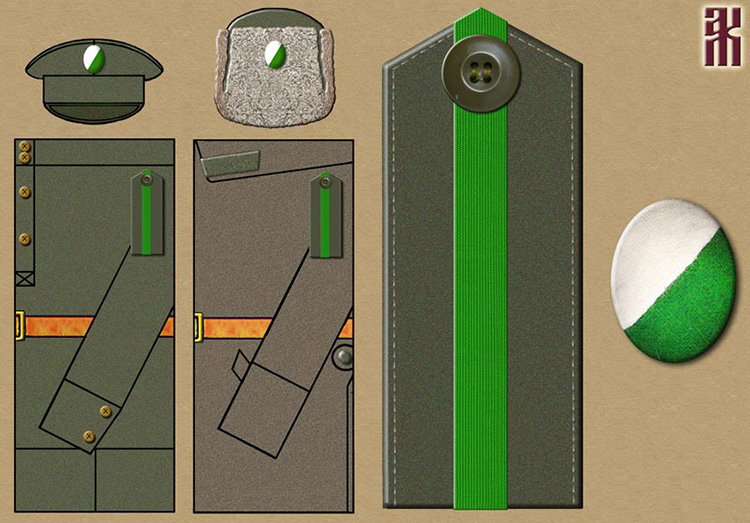
Draft uniform for senior and junior policemen of the Akmolinsk region, according to the order of the governor of the Akmolinsk region dated 18 January 1919
Home — State Symbols — Flags — Uniforms — Badges & Medals — Money — Other
Pygmy Wars Notes
The original for this page is at kolchakiya.ru/uniformology/Akmolinsk_militia.htm.
Akmolinsk is now Astana, Kazakhstan.
Discussion on the translation choices I have made can be found here.