
Shoulder-boards of the artillery units of the 4th East Siberian Army Corps
When looking in the Russian State Military Archive (RGVA) for material on the 4th East Siberian Army Corps, we could only find an order that established the ciphers on the shoulder-boards of the artillery units for that corps. There was no description of the shoulder-boards of the rifle units or the technical units.
Order No. 285, 4th East Siberian Army Corps, 27 November 1918, Irkutsk
At the same time, stencil drawings are announced for the shoulder-boards of the ranks of the 1st East Siberian Light Artillery Divizion, the 1st East Siberian Heavy Artillery Divizion and the East Siberian Reserve Artillery Divizion.
Appendix: 3 drawings.
Commander-in-Chief Major General Ellerts-Usov.
RGVA F.39513 Op.1 D.17 L.162.
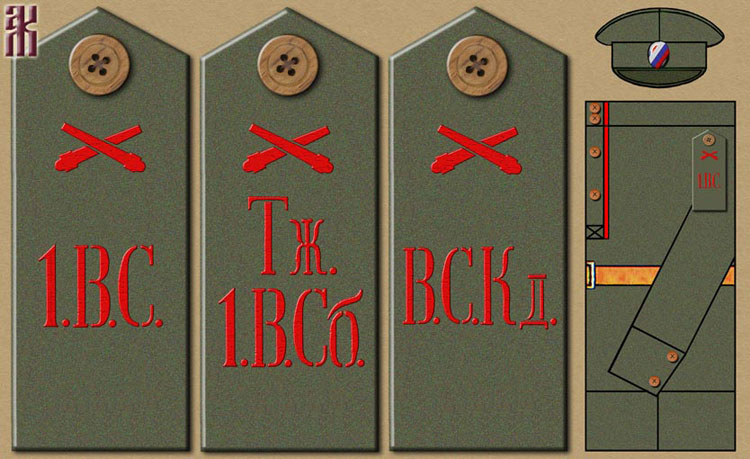
Shoulder-boards and uniform of the artillery units of the 4th East Siberian Army Corps:
1 – light artillery gunner; 2 – heavy artillery gunner; 3 – reserve artillery gunner
The red lace of the blouse opening is shown in accordance with Military Department Order No. 12 of July 27, 1918, which established the distinctions for the soldiers of the Siberian Army (riflemen were in raspberry). It is quite possible that with the introduction of shoulder-boards that the distinction was preserved.
Home — State Symbols — Flags — Uniforms — Badges & Medals — Money — Other
Pygmy Wars Notes
The original for this page is at kolchakiya.ru/uniformology/4_East_Siberian_Corp.htm.
Discussion on the translation choices I have made can be found here.
History of the 4th East Siberian Army Corps
Formed in September 1918 in the Irkutsk and Transbaikalia regions as part of the Siberian Army. In early October 1918 it was made up of the 8th Chita Siberian Rifle Division, the 3rd Irkutsk Reserve Artillery Brigade, the 4th Irkutsk Heavy and Mountain Artillery Divizions, the 4th Irkutsk Cavalry Brigade (Irkutsk Hussar and Cossack Regiments), the Irkutsk Engineer Regiment, and the Irkutsk and Chita Engineer Companies.
At the beginning of December the corps had 19,150 men: the 9th (former 8th) Siberian Division (in the Trans-Baikal Region) with three artillery divizions had 8,150 men, the 3rd Siberian Division (Irkutsk Region) with four artillery divizions had 8,350 men, the new 8th Siberian Division (Enisei Region) had 1,500 men and the 4th Irkutsk Cavalry Brigade (Irkutsk and Krasnoyarsk) had 800 men.
However the regional corps were abolished by Kolchak and the corps was disbanded in early January 1919. The bulk of the units went to 3rd Irkutsk Siberian Rifle Division. The 7th Siberian Reserve Regiment was formed from the remnants.